Lessons and mistakes on a B-52 bomber training flight

0

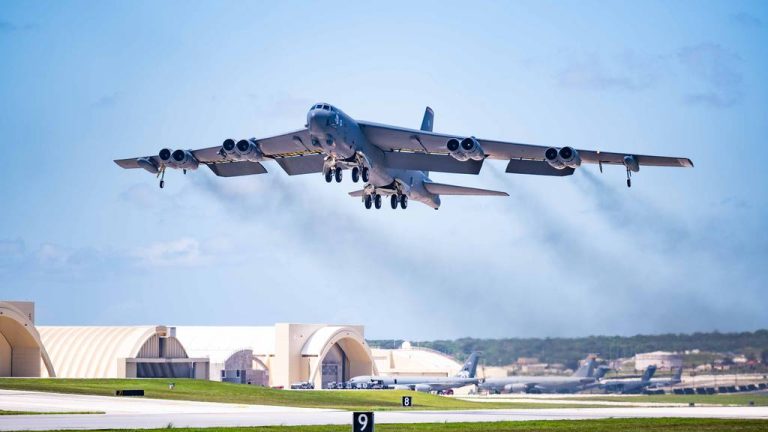
ABOARD A B-52H STRATOFORTRESS — A B-52H Stratofortress’ hulking gray frame rumbles through the cloudless blue sky, closing in on targets 19,000 feet below.

The plane’s weapon systems officer, Capt. Jonathan “Loaner” Newark of the 11th Bomb Squadron at Barksdale Air Force Base, Louisiana, furiously taps targeting coordinates into a computer, his face bathed in green light.

Numbers on the screen tick down to zero as the bomber looms over its destination. The bomb bay doors open with a whir and a thump.

”Weapons hot,” Newark says over a crackling intercom. He reaches to his right and flips open a small panel covering a button designed to let loose a 2,000-pound bomb. “Bay three, releasing.”

In one of several passes, and without warning, the bomber jerks sharply upward as its student pilot, 1st Lt. Clay Hultgren, disengages the autopilot at the wrong time. Within seconds, the plane climbs past its assigned altitude limit of 20,000 feet — where it could run afoul of other aircraft.

Instructor pilot Lt. Col. Michael “Fredo” DeVita quickly grabs the yoke and wrestles the 185,000-pound bomber back down to a proper altitude, banking hard to the left. The plane steadies and resumes course as quickly as it veered off track.

No bombs — real or fake — were aboard the B-52 during its Jan. 4 training run. But the five-person aircrew on the flight dubbed “Scout 93″ practiced each step in the process as if they were headed for a airstrike at war.

Stratofortress pilots control six-decade-old hardware with a 185-foot wingspan — and the lives of the four or five airmen onboard. But the moment the Vietnam War-era bomber’s wheels leave the ground, anything can happen — and some of the most important lessons cover more than routine flight procedures.

During training flights, instructors impress upon younger lieutenants the seriousness of life and death when controlling one of the most formidable weapons of war ever built. Its crew must make calculations, down to the smallest decimal point, that ultimately determine whether the bomber strikes its intended target or innocent civilians.

“It’s tough to really glue everybody together,” Newark said. “At the end of the day, we’re all crew and we’re all in charge of those weapons. We all own them.”

Cold War plane, 21st-century training

Hultgren aims to join a long line of pilots that stretches back to the B-52′s debut in 1954. If his training goes as planned, he’ll be among those in the cockpit as the fleet remains in service for decades to come. The Air Force is now working on a series of upgrades, such as new engines, that aim to keep the B-52 flying until about 2060.

As the Stratofortress barrels toward a century in operation, its missions and training for the aircrew aboard must adapt to the digital age, too.

Five crew members were aboard the bomber that day, including three instructors: DeVita, 40, a pilot who commands the 11th Bomb Squadron; electronic warfare officer Capt. David “Rumble” Bumgarner, 35; and Newark, 34, the weapon systems officer. Rounding out the crew were pilot trainee Hultgren, 27, and WSO student 1st Lt. Jeremiah Tackett, 27, both too early in their careers to have earned their own call signs.

The mission marked Hultgren’s sixth training flight on the B-52, and Tackett’s 10th.

What is it like to be airborne in a bomber old enough to have flown in Vietnam? Go aloft in America’s oldest, active long-range bomber, the B-52.

Their unit, the 11th Bomb Squadron, is the active duty component of the Air Force’s B-52 formal training unit. It takes airmen about nine months to finish the academics and flight training syllabi to learn to operate B-52s and their weaponry. About three dozen students graduated last year, the service said.

For Hultgren occupying the co-pilot’s seat is an exciting opportunity. He dreamed of flying when he joined the Air Force and would have been happy in any aircraft, he said. But being chosen to operate the B-52 — with its deep history and strong community with others who fly the Stratofortress — was thrilling.

“I like that I’m doing something that people have been doing for a while,” Hultgren said.

‘You scared him’

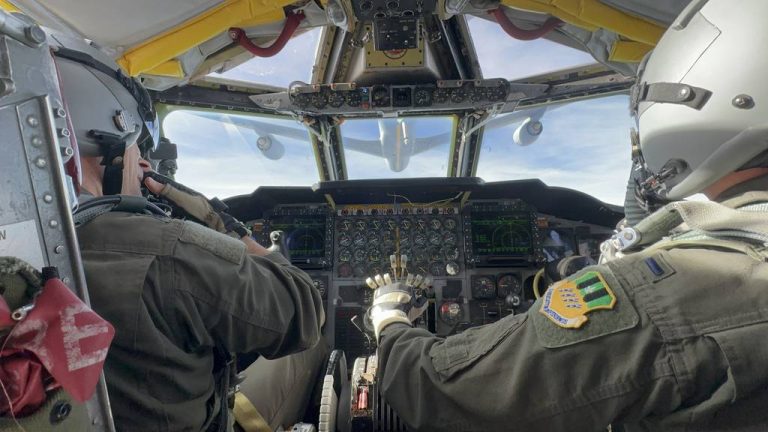
On the morning of the training flight, the crew strapped into their parachutes, donned their oxygen masks and buckled up for takeoff.

Their aircraft — completed in 1960 and dubbed the “Red Gremlin II” — eased onto the runway, following another outbound B-52 that spewed a plume of jet fuel exhaust as it departed.

Hultgren’s left hand rested on the bomber’s eight throttle levers, which allow the pilots to individually adjust the power to any engine that shows signs of trouble. DeVita reached over and guided him as they pushed forward in tandem.

A whine rose from the plane’s engines as it accelerated through the acrid cloud of exhaust. DeVita stuck his hand into Hultgren’s peripheral vision, flashing a thumbs-up. The student let go of the throttle and gently pulled back on the yoke with both hands. The Red Gremlin II was airborne.

A typical B-52 training mission almost always follows the same script: takeoff, a few passes with an aerial refueling tanker, simulated bomb runs, and a few touch-and-go landings. Each sortie lasts five or six hours.

During the nearly 6-hour, counterclockwise loop over Arkansas, Oklahoma and back to Louisiana, the B-52 flew alongside the first bomber, met up with a KC-135 Stratotanker for aerial refueling practice and logged bombing runs at Fort Johnson, Louisiana.

Aerial refueling is one of the hardest things for a pilot to master — especially when flying something as massive as the 159-foot-long B-52, mere feet away from a tanker that is almost as large, tens of thousands of feet in the air at hundreds of miles per hour. It requires a steady hand, Newark said, and is “where pilots make their money.”

“Two big airplanes, with a lot of aerodynamic forces, and you’re trying to make really small corrections,” DeVita said. “We’re talking corrections of … a couple feet left or right, on airplanes that are really close together. That’s the hardest part.”

There’s a lot of aerodynamics to consider. As Hultgren pulled the B-52 closer to the KC-135 for yet another round of refueling, the bomber entered the tanker’s downwash. The B-52 began drafting off the KC-135, causing the bomber to speed up as its air resistance waned.

A buzzer blared and red light flashed. The KC-135 pulled away. DeVita pushed Hultgren’s hand off the throttle and eased the plane back.

“You scared him a bit,” DeVita said. “That’s why I took over.”

But after spooking the tanker, Hultgren showed he could learn from his mistakes. DeVita gave him back the throttle and offered pointers on making incremental changes to the bomber’s power to find the “sweet spot” behind the KC-135.

“Whenever you’re ready,” DeVita said. “If you need a little bit more of a break, that’s fine.”

“Think we can do one more?” Hultgren asked. He slowly maneuvered the B-52 forward for its sixth refueling connection.

“Crank the power just a hair,” DeVita said. “Good.”

“F—ing awesome,” Hultgren murmured, as the refueling boom loomed larger and larger above the cockpit.

“That’s really good, dude,” DeVita said as the boom settled into place with a thunk. “Contact. Perfect.”

Hultgren kept practicing to get aerial refueling right, over and over, before the bomber parted ways with the KC-135 and flew back to Louisiana for bombing practice.

Like most training missions, this run was designed to pit the B-52 against a generic, unnamed adversary, Newark said. The crew of the Red Gremlin II practiced entering a simulated battlespace with enemy fighters and friendly forces — in this scenario, F-22 Raptor and F-16 Fighting Falcon fighters and an E-3 Sentry airborne target-tracking jet — before striking imaginary ground targets.

But instructors can throw students some curveballs. The bombing simulation began by striking soft targets such as aluminum aircraft hangars, before the instructors directed the crew to hit hardened two-story buildings in other locations. The deviation pushed Tackett, the student WSO, to decide what combination of munitions could best destroy the sturdier buildings, and to work with Newark to update the targets.

How do you eject from a B-52 Stratofortress if something goes wrong? Go inside the training aircrew receive to fly in America’s largest and oldest bomber.

“It gives them [experience with] live problem-solving,” Newark said. “That’s what drove all those good discussions about, how would we destroy a troop staging area? How would we destroy a hardened building? Because we didn’t tell them ahead of time what it would be.”

For years, Stratofortress flights required five airmen — two pilots, two WSOs and an electronic warfare officer. But advancements in technology are allowing the Air Force to fold the EW officer’s duties into the WSO job, blending the bomber’s offensive and defensive roles and shrinking the crew to four.

Now WSOs can handle electronic warfare and airstrikes from computers that show data for both jobs, rather than making airmen sit at a designated station that can perform only one role.

Combining those tasks isn’t daunting for Tackett, the WSO-in-training. When asked how he juggles the sometimes-conflicting duties of a WSO, whose job is to take a plane close enough to a combat zone to strike targets, and an EW officer, who is responsible for keeping a plane out of danger, Tackett said: “A lot of it comes down to commander’s intent, and our mission for the day, making judgment calls, and assessing the situation from there.”

“Knowing both sides of it, I’m able to provide better recommendations to pilots” about where to go and what to hit, Tackett said.

A cramped ride

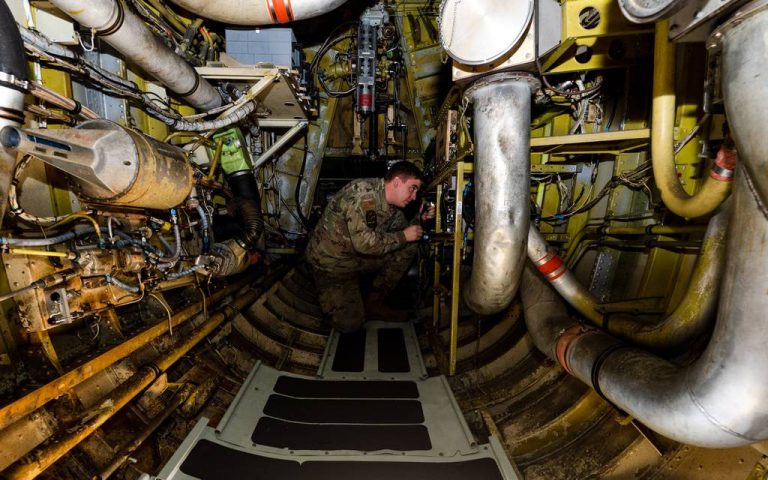
Flying on the B-52 can be exhausting, and even more so on operational missions that can last up to 36 hours. Despite being one of the biggest bombers ever built, the Stratofortress doesn’t leave much space or comfort for the crew.

It’s cramped and noisy. The constant roar of its six-decade-old engines creates such a din that airmen wear earplugs under their noise-canceling headsets and flight helmets. Without the communications system, it’s impossible to hear what someone else is saying, even when shouted from inches away.

Airmen must stoop when making their way from the cockpit to the electronic warfare station at the back of the jet’s upper level, and then down a ladder to the WSO station. Their posture in the seats isn’t much better.

“This is why our backs are all so screwed up,” DeVita said. “We’re sitting hunched over like this, with this heavy parachute on.”

Amenities are few. A single bunk behind the pilot’s seat allows airmen to grab some shut-eye on long-haul flights; a small, well-used oven that can heat meals up to 400 degrees sits in the back. Typically, the crew brings light sandwiches or other snacks to ward off hunger, and — since it’s easy to get dehydrated while spending hours at high altitude — large bottles of water.

The B-52 crews find ways to entertain themselves in transit on ultra-long flights. Sometimes that means bringing a book; other times, 11th Bomb Squadron members plug a music player into the intercom, courtesy of a jury-rigged cable one airman soldered together.

In 2022, Air Force Global Strike Command launched a program at Barksdale called “Comprehensive Readiness for Aircrew Flying Training,” or CRAFT, to give airmen the physical, nutritional and mental tools to better weather the grueling missions.

But there’s one thing the Air Force can’t give crews: a real bathroom.

Behind this bomber’s WSO station, next to the bomb bay hatch, sits a single urinal without a curtain for privacy. Passengers are often reminded of the “Big Ugly Fat Fellow’s” cardinal rule: Do not go No. 2 on the B-52. An emergency garbage bag is on hand for those who really must go, but the crew is clear: Using it won’t win you any friends.

Debriefing the mission

After a series of repeated touch-and-go landings, the bomber came to a safe halt at Barksdale. The crew made their way back to Thirsty’s, a heritage room decorated with the insignia of the 93rd Bomb Squadron and other aviation memorabilia, a pair of arcade machines and a bar.

The crew popped jalapeño popcorn and cracked open small beers — only one per person — before the instructors started the debrief to run through the results of the day’s training.

They successfully refueled the bomber, and they hit their targets, which was good, DeVita said.

But then, DeVita said, the mission “started to go downhill.” The crew missed check-ins and roll calls they were supposed to make with other aircraft, and started to fall behind schedule.

“In real life … they might cancel the whole ball, because we didn’t speak up or show up,” DeVita told Hultgren and Tackett. The students listened with neutral expressions.

Then there was the matter of the lurch. After a simulated bomb drop at about 19,000 feet, DeVita said, Hultgren had turned off the autopilot while attempting a ‘break turn,’ in which an aircraft turns away hard from a potential threat. Hultgren didn’t account for the bomber’s nose pitching up, causing the sudden and unexpected climb, DeVita said.

“I’ll take the slap on the wrist for that,” Hultgren said. Some of the crew chuckled — but not DeVita.

“Did anybody tell you to kick off the autopilot and make that aggressive of a turn?” DeVita asked him. “Someone taught you that? Or did you teach yourself that?”

“My first-ever break turn, they said don’t use autopilot,” Hultgren said.

“Who?” DeVita said.

Hultgren demurred: “I don’t want to out him.”

DeVita told Hultgren that, at his current skill level, he should stick with the autopilot in those scenarios. And he warned Hultgren that kind of flying endangers the bomber and its crew.

“[At] the roll rate that you did today, I wasn’t comfortable that you were not going to break the airplane — not to mention the fact that we didn’t have control of the airplane, because we climbed 300 feet out of the airspace,” DeVita said.

But DeVita owned up to making his own mistake, when he relayed the wrong data to the crew during bombing practice.

“It can happen so easily, even to experienced people,” Newark said. “It has to be exact.”

The instructors stressed to the students that — even when they’re the new airman in their squadron, and even if it’s a more experienced commander who made a mistake — they need to speak up if they see even a single decimal point out of place on a bomb’s coordinates. Newark said he’ll sometimes give students the wrong coordinates during training to ensure they double-check the numbers.

“I wasn’t paying attention” won’t hold up as an alibi in court, Newark said.

“Don’t just be a passenger in that situation,” Newark said. “If we drop the bomb on the wrong target …”

“We all go to jail,” DeVita answered.

Though the training on “Scout 93″ didn’t go perfectly, that’s why the Air Force spends so much time training B-52 students, DeVita said. Instructors give their unvarnished feedback; students learn and grow from their mistakes.

Hultgren acknowledged his mistakes and said his aerial refueling skills have greatly improved, thanks to DeVita’s frank feedback. He and Tackett are on track to graduate in March.

“If we fly a sortie, and we don’t debrief anything [that went wrong], then we shouldn’t have wasted the taxpayer’s money by taking the airplane airborne,” DeVita said. “It’s not personal.”

Stephen Losey is the air warfare reporter for Defense News. He previously covered leadership and personnel issues at Air Force Times, and the Pentagon, special operations and air warfare at Military.com. He has traveled to the Middle East to cover U.S. Air Force operations.


Finally made a decent drone video and messed with the cattle.

0

Yep we finally got 2-3 good rains that made runoff. Replaced that evaporates off 4′ water loss in the big pond fill up fast on the second big rain. The lake and little pond didn’t lose nearly as much water during (2023 the driest year I have ever seen) but the little pond has a single pretty good spring in the bottom of it.

The lake has more springs that started flowing than I thought. This was at the tail end of the -5 to +10 couple of weeks we had. Nothing better than cold and ice to tell you where the springs are.

Also will tell you where the springs create water flow and some light current. LOL couldn’t pay me enough to walk more than a few feet out on that ice!
DSC03938.JPG

The big pond on the other hand does not have a single spring in it, just the fountain pump. So that is why it lost so much depth from April through October with pretty much no rain.
DSC03911.JPG


Lacking parts, airmen scramble to keep B-52s flying

0

The B-52 Stratofortress long-range bomber has been in service since the 1960s. Here’s what it will take to keep it flying.

BARKSDALE AIR FORCE BASE, La. — As the B-52H Stratofortress tops more than six decades in service, it’s grown increasingly temperamental — and for the U.S. Air Force, a challenge to keep in the air.

Its original 1960s-era engines keep finding “new and creative” ways to break, as an Air Force Global Strike Command leader put it. Stocks of spare parts are limited, and the industrial base needed to repair broken components or make new ones is drying up.

The Air Force is scrambling to keep the B-52 bomber operational and is resorting to an array of options to do so — up to and including a process called cannibalization. To date, three out of every five B-52s are able to carry out their missions at any given time.

Airmen across the spectrum at Barksdale Air Force Base — from the flight line and supply shop to leadership — describe a situation where maintainers must regularly “cannibalize” parts, meaning take them off one B-52 to be installed on another so the second aircraft can fly.

It’s a lengthy process that can create further problems, and it’s meant to be a last resort. But the B-52 community is increasingly turning to that method. Tech. Sgt. Bonny Carter, the noncommissioned officer in charge of the B-52′s decentralized maintenance support section at Barksdale, said the rate of cannibalization has gone up 200% since 2019, before the coronavirus pandemic snarled supply chains worldwide.

Global Strike Command disputed that figure, though it acknowledged cannibalization rose over the last five years mainly due to obsolete parts. The command did not provide statistics on cannibalization rates, as requested by Defense News.

The Air Force is using other fallback options first, such as pulling parts out of the “Boneyard,” the Air Force’s airplane cemetery in Arizona where many retired B-52s rest. The service also combs the industrial base for new sources of fresh parts, and taps its own back shops and sustainment center to repair parts or make new ones. Back shops are rooms where specialized repair and maintenance is done on smaller components.

A wide-ranging series of modernizations for the B-52 — everything from new Rolls-Royce engines to new wheels and brakes — is on the way, and the Air Force hopes these upgrades will result in a more reliable airplane, with a fresh supply of spare parts that relieves some pressure on maintainers.

But until that happens, Global Strike Command will need to keep the B-52H flying, even if it’s increasingly daunting, said Col. David Miller, the organization’s director of logistics and engineering.

Vendors, pool of parts dwindling

The biggest maintenance challenge facing the B-52 is the “slow atrophy” of the defense-industrial base that supplies it, according to Miller.

“The vendor base is just drying up,” he said. “Trying to entice vendors to continue to make very old, very difficult parts in small numbers is a challenge,” particularly when it comes to specialized parts with little, if any, value to commercial aviation.

The reduction of the B-52 fleet over the years — from a high of 744 to 76 today — also shrunk the market for spare parts, further limiting companies’ opportunities to make money in this business. Some companies, particularly small mom-and-pop shops, have either decided to stop making parts the B-52 relies upon, or gone out of business entirely.

It can take months or even years to get some crucial parts for a B-52. One part, a valve, has a 900-day lead time, Miller’s office said, and his directorate is working to replace that rare piece with a more readily available valve.

Global Strike Command said it sometimes takes those valves off B-52s entering depot maintenance in order to install them on bombers preparing to fly.

The parts supply problem is particularly acute for the B-52′s TF33 engines, which Pratt & Whitney made in the 1960s, Miller said. Parts from those engines — or whole engines entirely — are the component most often cannibalized for B-52s, he said.

Miller noted the bomber depot at the Oklahoma City Air Logistics Complex used to regularly remove engines from B-52s as they entered their lengthy heavy maintenance process, then reinstall those components on other B-52s that were nearly finished with their overhauls. But with more spare parts on the depot shelves, the service no longer does that.

The Rolls-Royce F130 engines are to come with new parts that last longer before they break or require maintenance, as well as a fresh supply chain making readily available replacements when parts do break, he explained.

“What we’re buying into is an aircraft that’s not going to have to go through core maintenance very often, if at all,” Miller said. “As opposed to the TF33 — that goes through a lot of maintenance right now.”

The Pentagon in November moved to shore up the B-52′s engines, awarding Pratt & Whitney a contract worth up to $870 million to sustain nearly 1,000 TF33s. Those engines also power the E-3 Sentry airborne warning and control aircraft, and the sustainment contract could run through spring 2034.

In an interview with Defense News at the time of the contract’s award, Pratt & Whitney executive Caroline Cooper said the sustainment contract would help address the spare parts shortages exacerbated by the decline of companies making niche, low-volume parts for the B-52. Cooper said this deal provides funding for the firm to either make those parts itself or find other companies to take on the work.

“We’re looking at … the operational tempo of the aircraft, and then looking at the inherent risks in the supply chain, and wanted to build that upper limit so that we can move quickly and expeditiously to get the men and women in the Air Force what they need,” Cooper said in November.

Master Sgt. Dylan Drake, a production superintendent at Barksdale’s 2nd Maintenance Squadron, said maintainers are “excited” for the new engines to come online. If they’re as reliable as promised, he said, maintainers will be able to turn their attention to other parts of the B-52.

“If we don’t have to worry about the engines, that’ll let us focus on other systems,” Drake said.

When maintainers remove faulty parts from the B-52, Miller said, sometimes they can be overhauled or repaired — but they sometimes must be replaced entirely. And that is growing harder and harder.

Carter, of the 2nd Logistics Readiness Squadron, said when a maintainer needs a spare part, the first step is to look in her supply shop’s own stocks, then reach out to other supply shops elsewhere if it’s not on the shelf. The decentralized maintenance support section Carter oversees stores and organizes spare parts for maintainers to fix Barksdale’s B-52s.

If they’re still striking out, the Air Force has workarounds, Miller and Carter said in separate interviews. That could include turning to an Air Force back shop to make a new part or the Air Force Sustainment Center at Tinker Air Force Base in Oklahoma.

Miller said the components undergoing production or overhaul at the sustainment center range from wire harnesses to larger, modular components known as line replaceable units.

The advantage of keeping the Air Force’s own industrial base for B-52 parts humming, Miller noted, is that the service knows it will be available if a war breaks out.

“You never know when we’re going to be called upon, perhaps in a wartime environment, to be able to provide that [maintenance in] real time,” he said. “That’s not the time to go out and find we’ve got to cold start [the production line], and [with] an 18-month delay, having a new vendor produce something for us.”

But the work is also stretching the service further. Carter said back shop airmen are working longer hours to fix broken parts — even those that previously weren’t their responsibility to repair.

It could mean pulling a part out of a retired B-52 in the Boneyard, officially known as the 309th Aerospace Maintenance and Regeneration Group. But there are a finite number of B-52s there the service can scavenge, Carter said, so that solution will only work for so long.

It could mean hunting down a commercial company that does similar kinds of work and hiring them to make a part.

And if all else fails, airmen pull parts from one aircraft for installation on another. But that solution can make more problems.

“When we do the cannibalization, it downs another aircraft so we can make this aircraft flyable to conduct its mission, to get training hours,” Carter said. “And then we have to swap again. We are constantly swapping parts.”

“But we’re learning to work with what we got,” she added. “You know, more with less.”

Stephen Losey is the air warfare reporter for Defense News. He previously covered leadership and personnel issues at Air Force Times, and the Pentagon, special operations and air warfare at Military.com. He has traveled to the Middle East to cover U.S. Air Force operations.

Today, 2/19/2024 Only Great Deals On AAC Ammunition At PSA

0

I picked some very nice 300 BO AAC Sabre Tip 125 gr supersonic defensive ammunition at 65 cents per round. This is not FMJ, but a very well designed bullet that did great in the ballistic jell test I've seen at remanufactured FMJ prices. Purchased for my pending 300 BO backpack gun build, Lots of other cartridges/bullet combinations as well.

President's Day daily deals on more than ammo
https://palmettostatearmory.com/daily-deals-new.html

How the Air Force is prepping to fly century-old bombers

0

BARKSDALE AIR FORCE BASE, La. — As it idled on the flight line here, a B-52H Stratofortress known as the Red Gremlin II looked much the same as it did in the 1960s.

But the U.S. Air Force’s B-52 bomber fleet is showing its age, and the Red Gremlin II is no exception.

On a crisp, clear morning in January, its five-person aircrew from the 11th Bomb Squadron ran through preflight checks for a training mission, tallying up what was broken and how serious the problems were.

Instructor pilot Lt. Col. Michael DeVita’s digital display — a relatively recent system known as the Combat Network Communications Technology, or CONECT — wasn’t working. The radar altimeter was down. And the targeting pod display, needed for a key element of the planned simulated bombing, was on the fritz. At one point, DeVita, the squadron commander, leaned over and gave a stubborn dial three solid taps to unstick it.

For the last six decades, the Red Gremlin II and the other 75 B-52s still in use have been the backbone of the Air Force’s bomber fleet.

They have conducted around-the-clock nuclear alert missions at the edge of Soviet airspace as well as massive bombing campaigns during the Vietnam War. They helped carry out strikes on Iraq that paved the way for the rapid ground assault of Operation Desert Storm. And in recent years, these aircraft conducted precision-guided strikes against the Taliban and the Islamic State group.

Now the Stratofortress needs to last another 36 years.

The Air Force is preparing to bring on its newest stealth bomber, the B-21 Raider, and retire the aging B-1 Lancer and B-2 Spirit. Sometime in the 2030s, the service plans to have a fleet of two bombers — at least 100 B-21s and the current fleet of 76 B-52s, modernized top to bottom with a slate of upgrades.

It is the most sweeping revamp of the U.S. bomber fleet in more than a generation.

This $48.6 billion overhaul is intended to keep the (eventually redubbed) B-52J operational until about 2060 — meaning the Air Force could be flying nearly century-old bombers. When the last B-52 was delivered in 1962, it was expected to last 20 years, the Defense Department’s inspector general said in a November 2023 report.

The service is preparing for the overhaul, rethinking day-to-day maintenance and reevaluating its strategy for how a fleet made up of two bomber types would operate against an advanced enemy.

“The B-21 with the B-52J [will be] a very powerful, integrated force,” Maj. Gen. Jason Armagost, commander of 8th Air Force, said in a January interview here, sporting a B-21 patch on his uniform sleeve. The combined fleet would be capable of conducting a wide range of operations and striking an array of enemy targets, possibly armed with the latest hypersonic weapons.

The centerpiece of the B-52J modernization will be the replacement of the bomber’s original ’60s-era Pratt & Whitney TF33 engines with new Rolls-Royce-made F130 engines; that $2.6 billion effort is known as the Commercial Engine Replacement Program. The Air Force expects the first test B-52J will start ground and flight tests in late 2028, and for more B-52s to receive new engines throughout the 2030s.

But that’s not all: The B-52J will also receive a new modern radar, improved avionics, the Long Range Standoff weapon to carry out nuclear strikes from a distance, communication upgrades, new digital displays replacing dozens of old analog dials, new wheels and brakes, and other improvements.

The Air Force is counting on all these advances to work. If they don’t, the service could find itself with perhaps as much as 40% of its planned bomber fleet unable to keep up with wartime requirements.

The Air Force must make the B-52 modernization succeed, said Heather Penney, a retired F-16 pilot and senior resident fellow at the Mitchell Institute for Aerospace Studies. “Long-range strike is absolutely nonnegotiable. Bombers are it.”

Air Force historian Brian Laslie said the fact the B-52 is still in the air, and could continue flying until around its centenary, is remarkable.

“If there was an airplane that was flying today that was 100 years old, we have to go back to 1924,” Laslie said. “We’re talking about the [Boeing P-26] Peashooters, the [Curtiss] JN-3 and JN-4 Jennys [a series of World War I-era biplanes]. We’re talking about canvas and wire and wooden airplanes. A hundred years ago, we don’t even have enclosed cockpits [or] retractable landing gear.”

Experts like Penney argue the United States has underinvested in its bomber fleet since the 1990s, including truncating its B-2 purchase by more than 100 planes, letting the B-1 fleet decay, and waiting too long to start working on the B-21. As a result, she said, the Air Force is asking the B-52 to shoulder a burden no bomber has before.

“We’re asking geriatric B-52s to be that backbone while we’re waiting for B-21 to be able to come on board,” Penney said.

The B-52 Stratofortress bomber has been in service since the 1960s. Here’s what it will take to keep it flying.

Looking for ‘showstoppers’

Before a B-52 takes off, DeVita said, it’s common for its crew to find at least one thing is broken during the preflight check process. Usually maintainers can fix the problem on the flight line and the crew takes off with a fully operational jet. But sometimes, he added, a broken system can’t be fixed in time, and the crew must decide whether its loss would be bad enough to scrub the mission.

Of the 744 Stratofortresses the Air Force built between 1954 and 1962, 10% remain — and the years have taken a toll. The aircraft’s mission-capable rate has steadily declined over the last decade, from a modern high of 78% in 2012 to 59% in 2022 — the most recent year for which statistics are available.

The bomber’s 185-foot wingspan means it must often remain outdoors, exposed to the elements, including frigid winters at Minot Air Force Base in North Dakota, searing Middle Eastern heat and sand, and corrosive salt air from the Pacific Ocean. Key parts have become increasingly unavailable, as the companies that made them have moved onto other business or simply closed.

The B-52 may be old, but it’s a hardy plane, said Capt. Jonathan Newark, the instructor weapon systems officer for the training flight. And even though some of its systems may look “antiquated,” he said, they get the job done. He gestured to a panel with thick, black keys he uses to punch in targeting data.

“You look at this keyboard, it looks like something out of the Cold War. Dr. Strangelove, right?” Newark said, referring to the 1964 film about nuclear war that prominently features the B-52. “But we could do every single mission set using this keyboard … all the way up to our most advanced weapons.”

Back on the runway, the Red Gremlin II idled more than a half hour longer than expected, with the engines emitting a low and steady whine, while maintainers tried to get the targeting pod screen to function. But a fix would have taken too long, so the crew decided to get the flight going.

“We’re balancing what training we can get done,” Newark said. “I don’t have any showstoppers [on this flight]. The students that are here can still get all the training they need. [The targeting pod practice would be] nice to have, not necessarily something we needed today. There’s a lot of things like that — the radar altimeter doesn’t work.”

“We’re able to make an aircrew decision to fly without it,” he added. “We do that a lot with airplanes that are a little bit older.”

Issues with the engines, hydraulics or flight surfaces would be deal-breakers in any situation, Newark said. But in combat, a B-52 crew will be more willing to fly with minor problems on their plane because the mission must get done.

So the crew of the bomber, call sign Scout 93, strapped on their parachutes, buckled into their seats and roared into the sky to meet up with a KC-135 Stratotanker aerial refueling tanker near Fayetteville, Arkansas.

Top-to-bottom upgrades

The scope of this modernization project is unprecedented in the B-52′s history, said Col. David Miller, director of logistics and engineering at Air Force Global Strike Command.

And Armagost noted the service expects the B-52′s engine upgrades will provide improved efficiency and range. But the new Rolls-Royce engines are also expected to be quieter and more reliable than the current engines, plus they wouldn’t have to depend on an outdated supply chain for spare parts.

“If we’re on a [bomber task force] mission in Indonesia, we’ll probably have parts available for those [new] engines that are pretty close, rather than having to schedule a C-17 [cargo aircraft] to fly an engine from” the United States, Armagost said.

The B-52J will receive a modern active electronically scanned array radar to improve its navigation, self-defense and targeting capabilities. The B-52′s current, outdated mechanically scanned radar is at the end of its life and is increasingly difficult to support, Armagost said.

But making the B-52 new again is only one step in the process. The Air Force is also trying to map out how best to use it in a war against advanced forces that could deny airspace to the U.S. and allies.

Such a conflict would represent a dramatic shift away from the relatively open airspaces in which B-52s have operated for the last two decades. And the modernization on the way is vital to keeping the B-52 able to engage the enemy, Armagost said. That will mean figuring out the best way for the B-52J to work alongside the B-21 now in development.

The B-21 Raider, with its next-generation stealth capabilities, was designed to conduct penetrating strike missions against an adversary with advanced air defenses, such as China, while the B-52J — about as stealth-less as can be — would carry out standoff strikes, launching missiles at enemy targets from outside contested airspace.

But Armagost doesn’t expect a “siloed” approach to how the service will use its fleet of two bomber types, with one or the other individually designated to carry out certain types of missions. What’s more likely, he said, is the B-52J and B-21 working in concert, along with other U.S. forces or partners, in integrated multidomain operations that could include working with cyber and maritime assets.

“Their capabilities are inherently different,” Armagost explained. “But a penetrating strike force, [including the B-21], might open up opportunities for a standoff strike force, [like the B-52], that then has follow-on opportunities for reacquiring denied or contested airspace.”

He envisions the B-52J conducting the kind of integrated operations that paved the way for Desert Storm or the opening salvoes of Operation Iraqi Freedom.

During the Gulf War, for example, B-52s flew 1,741 missions and dropped 27,000 tons of munitions, including Conventional Air Launched Cruise Missiles and conventional bombs. They targeted airfields, aircraft, command-and-control sites, power facilities, and Republican Guard positions, while allowing allied ground forces to sweep through and swiftly win the war.

And in a single night mission in the opening phase of the Iraq War, B-52s launched 100 cruise missiles at targets before going on to fly at least 100 additional missions in the conflict’s first few weeks.

Such a campaign would allow “a 100-hour ground war because of what’s been conducted through an air operation,” Armagost said. “Then the resulting joint environment becomes completely different than what it was prior to that.”

The Air Force is drawing up “robust” concepts of operations for how the B-21 will carry out missions, he added, including alongside the B-52, which is also helping Air Force Global Strike Command identify potential future capability gaps and how to address them.

The weapons arming the B-52J will likely run the gamut, Armagost said — everything from gravity bombs that provide “affordable mass,” to cruise missiles for carrying out strikes beyond the range of enemy air defenses, to precision-guided munitions and highly specialized, “exquisite” weapons like hypersonics.

“If it can fly or be dropped off an aircraft, the B-52 has probably done it,” he said.

The Air Force has used B-52s to test prototype hypersonic weapons in recent years, and Armagost “absolutely” sees them as a regular part of the Stratofortress’ future arsenal.

Although hypersonic weapons have the potential to provide tremendous capabilities — including flying faster than Mach 5 and maneuvering in such a way as to avoid countermeasures — they carry price tags so steep that the B-52J would need cheaper and more traditional bombs, too, he added.

“Everything is a choice, particularly when it comes to aviation,” Armagost said. “If it flies fast or is maneuverable, everything’s a trade-off. That’s why gravity weapons probably will always be a thing.”

Broken tech ‘makes combat a lot more difficult’

After a nearly six-hour flight that included flying alongside another B-52, aerial refueling with a KC-135 Stratotanker out of Illinois’ Scott Air Force Base, and simulated bombing practice, the crew of the Red Gremlin II turned back to Barksdale. Its student pilot, 1st Lt. Clay Hultgren, practiced touch-and-go landings over and over, and then brought the bomber to a safe stop.

During the post-flight debrief, instructors took stock of how the flight went — and considered the toll the broken equipment took on their lessons. The radar altimeter started working after the bomber took off, but even if it stayed broken it wouldn’t have been a big deal.

The crew was able to successfully complete most of the planned bombing simulations, except an assignment to find and target mobile equipment.

“We weren’t able to do that because we didn’t have a targeting pod,” DeVita said. “So [we have an] alibi for that.”

And losing the bomber’s CONECT screen — a system rolled out in the mid-2010s that provides detailed, moving color maps and helps with digital targeting — was a major “limiting factor,” DeVita added. The crew of the Red Gremlin II instead had to use the legacy navigation system DeVita learned to fly on years ago.

Losing the CONECT screen also meant the weapon systems officer and electronic warfare stations didn’t have the maps that would have made their jobs easier, DeVita said.

“That’s an issue,” he explained. “It makes combat a lot more difficult to be precise and to do a lot of the things that we walked out the door to do today. So that was unfortunate.”

While the B-52′s massive modernization is vital, Penney fears what the Air Force might find when it takes a closer look under its hood. Six decades of flying may have left it with metal fatigue, corrosion, stress fractures and other hidden structural issues, the retired F-16 pilot said.

She compared the potential dangers facing the B-52 to the unwelcome surprises the service found when it re-engined massive C-5 Galaxy transport aircraft in the 2010s.

“They ended up having to cut the planned number of [C-5] upgrades nearly in half because when they opened up the aircraft, they found a lot of stuff that they didn’t expect,” she said. “They ended up having to do a lot of unplanned [service life extension work], essentially, and that ended up eating into the available money they had for the program.”

Air Force Global Strike Command said in a response to Defense News’ inquiry that the service assessed the B-52s before deciding to modernize them, and found their underlying structures were strong enough to last through the plane’s extended life span.

Penney said she also worries about the risks that come from concurrency as the Air Force attempts multiple major upgrades on a plane in short succession, if not simultaneously. Any one of those upgrades — re-engining, installing a new radar, updating avionics and so on — would be a major effort on its own, she added.

“These are programs that are long overdue and are utterly necessary if the B-52 is going to be able to execute what we need it to do in today’s — and last into the future’s — strategic environment,” she said.

If the B-52 modernization ends up significantly more complicated than expected, and thus delayed, Penney explained, the Air Force may be forced to extend the life of some B-1s or B-2s beyond their planned early retirements in the 2030s just to keep enough operational bombers.

And if the Air Force opens up the B-52 and finds structural problems severe enough to jeopardize the re-engining?

“We can’t even go there,” Penney said. “It is such a must-do. We cannot fail.”

Stephen Losey is the air warfare reporter for Defense News. He previously covered leadership and personnel issues at Air Force Times, and the Pentagon, special operations and air warfare at Military.com. He has traveled to the Middle East to cover U.S. Air Force operations.
No wonder folks are fleeing Calif

0

A bill introduced Friday by California Assembly Member Mike Gipson (D) would force insurance companies to provide lawmakers with an annual report highlighting homeowners with guns in their residence.
(A bill introduced Friday by California Assembly Member Mike Gipson (D) would force insurance companies to provide lawmakers with an annual report highlighting homeowners with guns in their residence.)

Coming soon to a city near you….?

Air Force unveils command changes, wing plans in bid to outpace China

0

AURORA, Colo. — The Air Force said Monday it will create a new forward-looking capabilities planning command, refocus its training enterprise, and rethink how airmen deploy as part of a set of 24 initiatives designed to reorient the service to outpace China’s military ambitions and prevail in future conflicts.

The Air Force and Space Force’s top civilian and uniformed leaders unveiled the sweeping slate of plans at the Air and Space Forces Association’s Air Warfare Symposium here following a monthslong, department-wide review that began in the fall. Its results comprise one of the most significant reorganizations since the end of the Cold War.

Air Force Secretary Frank Kendall said the goal is to prove the Department of the Air Force’s competitive resolve to U.S. adversaries — particularly Russia and China — and to execute those plans with urgency.

“We can no longer regard conflict as a distant possibility or a future problem that we might have to confront,” Kendall said. “The risk of conflict is here now, and that risk will increase with time.”

Among the biggest shakeups is the launch of a new Integrated Capabilities Command. The organization will become a central planning hub as the service crafts its requirements for the decades ahead — removing that responsibility from the service’s other commands and allowing the Air Force to think more holistically about its needs.

The new command, to be led by a three-star general, is “just what the name infers,” Air Force Chief of Staff Gen. Dave Allvin said.

“This is where the operators will test operational concepts against our force design,” he said. “They will also ensure that when we have modernization initiatives, those are rationalized to ensure … we do not unintentionally put modernization on platforms that really don’t have a long-term play in the future force design. It wastes money.”

The move also frees up the Air Force’s major commands, which organize, train and equip troops for missions around the globe, to focus on daily operations rather than future force planning.

The Space Force will create a similar organization, Space Futures Command, to lay the groundwork for expanding the service’s missions through experiments and wargames.

While much of the proposed updates aim to revamp the Air Force and Space Force’s acquisition enterprise — including several more offices that will lend greater focus to the department’s highest-priority projects, like nuclear modernization and information warfare — the services also hope to improve how airmen and guardians are trained throughout their careers.

To that end, Allvin said, the service will replace its Air Education and Training Command with a new Airman Development Command. While few details accompanied the announcement, Allvin said the renamed command aims to streamline the educational pipeline, so that when troops move “from one part of our Air Force to another part of our Air Force, they don’t need to relearn the systems and tools and they can develop faster.”

“We believe we’re going to have a more coherent force … that can move rapidly through the future,” Allvin said. “We’re all also reinforcing mission-ready training.”

Many details of this week’s announcements, on which the service had raced to build consensus by Monday’s keynote, are still being finalized. It’s unclear where the headquarters of new organizations will be located, or how quickly the department can launch them.

Senior leaders had discussed the possibility of consolidating the Air Force’s nine major commands into a more streamlined system, according to two sources outside the military who are familiar with the internal discussions.

But rather than combine or eliminate commands, Allvin said, the service can do more to highlight the various roles within them — particularly, how they provide forces to the larger joint combatant commands like U.S. Cyber Command and U.S. Transportation Command.

That includes a plan to move Air Forces Cyber from under Air Combat Command and elevate it to a service component command. AFCYBER would report to U.S. Cyber Command for daily offensive and defensive operations on military networks and systems. Doing so may allow CYBERCOM to more seamlessly direct Air Force cyber units and give the organization a larger role in managing its own training and resources.

The shift marks Air Forces Cyber’s third major move since 2018, when the organization moved from Air Force Space Command to Air Combat Command. It later combined with Air Force intelligence units to create 16th Air Force at Joint Base San Antonio, Texas.

As it seeks to become more nimble and responsive to the joint combatant commands that direct daily operations around the world, the service will also turn its operational wings into “units of action,” categorized as deployable combat wings, in-place combat wings and combat generation wings, the Air Force said.

The idea is to create standardized packages of combat assets, like aircraft, maintainers and other support staff, that can deploy alongside the same squadrons with which they train, without shortchanging bases of the airmen needed to run daily operations and protect their perimeters.

The plan is expected to contribute to more predictable deployment schedules, a top focus for the service after leaving Afghanistan in 2021.

Allvin also said the Air Force will aim to mount a new service-wide training exercise in the Indo-Pacific in fiscal year 2025 that tests how pieces of the force work together, rather than limiting those lessons to individual commands.

Hints of other planned personnel changes have already trickled out, including news that the service will bring back warrant officers to bolster the Air Force’s technical expertise in cyber operations and information technology. The Air Force’s last active duty warrant officer retired nearly 50 years ago after the service deemed them too inflexible to meet its personnel needs, according to the Warrant Officer Historical Association.

The Department of the Air Force isn’t requesting specific funding for the changes in the fiscal year 2024 or 2025 budgets, but will ask Congress to move money around mid-year if necessary, Kendall said. New funding will be built into the fiscal 2026 budget request that is starting to take shape, he added, but officials will largely try to use existing appropriations in new ways.

One challenge the Air Force faces will be defining the separate responsibilities of each organization, one retired general officer told Air Force Times. Defense organizations tend to multiply over time because it’s typically easier to stand up a new unit to address a problem than to repurpose existing ones, he said, so leaders must have a clear implementation plan and ensure airmen understand the long game.

Another retired general officer questioned whether the Air Force and Space Force have enough time to put the plans into action before Kendall, a political appointee, may leave his post at the end of President Joe Biden’s current term.

The department must see its vision through to the end to ensure piecemeal changes don’t cause more confusion than good, he said.

“The question is, will it be done right?” he said.

Courtney Mabeus-Brown is the senior reporter at Air Force Times. She is an award-winning journalist who previously covered the military for Navy Times and The Virginian-Pilot in Norfolk, Va., where she first set foot on an aircraft carrier. Her work has also appeared in The New York Times, The Washington Post, Foreign Policy and more.

Rachel Cohen is the editor of Air Force Times. She joined the publication as its senior reporter in March 2021. Her work has appeared in the Washington Post, the Frederick News-Post (Md.), Air and Space Forces Magazine, Inside Defense, Inside Health Policy and elsewhere.

Tucker goes off on free speech

0

I think Tucker has some valid points and yes, the elites of America don’t give a damn about Ukraine and its people. It is simply a means to keep the money flowing so they can scrape the cream off the top without anyone noticing, while keeping the Defense industry fed and profitable, making them money and providing donations to for their elections.

I watched the entire interview with Putin. Frankly, the first half couldn’t even be called an interview as Putin controlled it while the second half wasn’t much better. It certainly wasn’t a normal interview and Putin was wonderful. Yes, I was a big fan of Putin’s at one time, I freely admit it, but power has changed this man. You can definitely see this in the interview. He does not like to be interrupted and definitely doesn’t like his opinion contradicted.

Putin history lesson basically was chronologically accurate but skewed and, in many cases, flawed. Many things he said were flat out lies, such as Ukraine using mercenaries in which he is referring to the international legion, which is a brigade of foreign troops including Americans. These troops are part of the Ukrainian army, wear the Ukraine uniform and follow Ukrainian military leadership command – so – they are not mercenaries. They are no different from the Nepalese and/or the Muslim Syrians’ the Russians have enticed with adverts of citizenship and/or monetary contracts, not to mention the Wagnar group (Russian state-funded private military company) that until recently was employed in the Ukraine.

I believe now Putin point of allowing this interview was to be seen as a nationalist, a man who loves his country and willing to endure this war, doing whatever it takes to reunite his country, to put himself into a better light – period. It definitely worked but it’s also definitely bullshit. The Ukrainian people do not want to be part of Russia, that part must be clear even to the blind after ~2-years of war and many times throughout history they have tried to break away and for damn good reasons. Poland also was part of Russia. Are they next? Moldova? The Baltic States? Bullshit. History is full of countries that were own by others, have common culture to include America.

There were lots of things missing from the interview but what annoyed me was Tucker not digging into some of the hard reasons Russia wants, at a minimum, the Crimean and Eastern Ukraine. Namely, the recently discovered huge natural gas fields and the massive naval base in Sevastopol. The naval base is critical to the defense of Russia. Frankly, this is a valid reason and I wondered about it long ago, thought Russia might even lease the base. Silly me. The natural gas fields in the Crimean area would enrich Ukraine making them a prosperous and independent nation but would also make them a direct competitor to Russia. Who do you think energy thirsty Western Europe will purchase natural gas from, Ukraine or Russia? Remember, the Russia economy almost totally is based on its natural resource’s exports. Think about that that… Anyway, these two reasons alone are enough for Russia to want and keep the Crimean and they will – period.

The West intelligence services won the war for the hearts and minds of Ukrainian people as they decided to join the West with hopes of joining the EU and a better life. Putin couldn’t tolerate that for numerous reasons, not just his sob story of long-lost history, so played his last card in the region. The card Russia historically (look it up!) has always played when they can’t achieve their goals in any other manner: ‘might makes right.’ However, the Ukrainians get a vote too and they are giving their vote on the battlefield.

I like Tucker and he definitely is entitled to his opinion. He doesn’t like the war and doesn’t want US involved. I agree but we are involved, up to our necks. Yes, we must stop the funding basically because we are broke and, sadly, in my opinion, due to Biden’s interference and true intent never to win just prolong the war, I do not believe the war can now be won or even force the Russians out of Ukraine. There is nothing left but diplomacy…if Putin will even accept it. However, do not be surprised that if in 5 years, after Russian logistical stores are increased, manpower training is improved, roads and bases are built, that the Russians don’t come knocking again with stories of how history supports their cause.

Ukraine has proven without a doubt the reason these nations want and need to be part of NATO for standing alone means nothing but being the puppet of their larger neighbor, basically living on their knees. How many on this forum would be willing to live in this manner? So, you understand the predicament the people of Ukraine find themselves, they can’t win but they will fight.


US Air Force readies to award collaborative combat aircraft deals

0

DENVER, Colo. — The Air Force plans to whittle down the number of companies working to build the first batch of collaborative combat aircraft to two or three over the next few months, the service’s secretary said Tuesday.

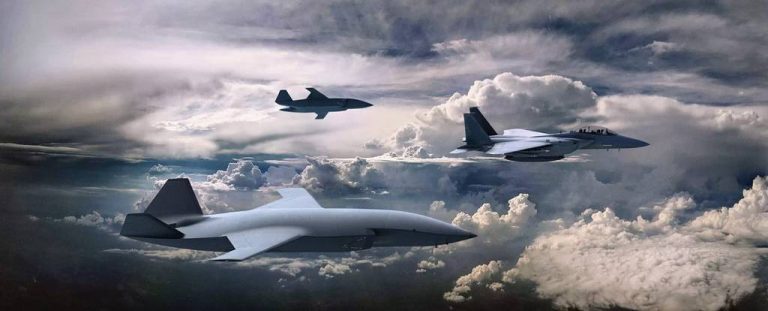
And the Air Force plans to award contracts for the next round of CCAs — drones loaded with autonomous software that would fly themselves into battle alongside crewed fighters — in fiscal 2025, Frank Kendall said during a roundtable at the Air and Space Force Association’s Air Warfare Symposium here.

This next round of CCA development could also involve participation by the United States’ closest and “most strategic” international partners, he said.

On the first increment of CCAs, the Air Force has contracts with five companies: Lockheed Martin, Boeing, Northrop Grumman, General Atomics and Anduril. Kendall said the Air Force would like to cut that to three, but acknowledged budgetary limitations will make choosing just two companies more likely.

The Air Force plans to field several different types of CCAs, with different capabilities and levels of survivability, to carry out a wide range of missions including strikes, surveillance, jamming, and serving as decoys to draw enemy fire.

Kendall said the Air Force is working on its first two “increments” of CCAs as part of its five-year plan, and moving with a “sense of urgency” on the program. As with the first increment of CCAs, he said, the contracts for the second increment will cover concept definition and preliminary design work.

The Air Force will next focus on moving CCAs into production, Kendall said, and in the next few years will further downselect the companies working on the first increment of CCAs. Kendall said it remains uncertain how many companies will move into production, adding that there could be at least two firms working on the initial batch of CCAs.

Andrew Hunter, the service’s assistant secretary for acquisition, technology and logistics, said the Air Force’s CCA program has been closely consulting with Air Combat Command to see what kind of capabilities these aircraft would need in combat.

And the Air Force received a great deal of feedback from industry about how they could meet the service’s loose goal of fielding about 1,000 CCAs, Hunter said.

Companies who didn’t make the cut for the first increment will get a second shot in the next increment, Hunter said.

At least one defense contractor is hoping to do just that. In an interview with Defense News Tuesday, Steve Fendley, president of the unmanned systems division at Kratos Defense and Security Solutions, said that while the company didn’t make the cut for the first round of CCAs, it remains very interested in the program and plans to compete for the next version.

“We’re in the mix,” Fendley said. “Part of what’s important to the Air Force, and to us, is being able to see the range of capability systems and the range of cost systems to satisfy all of the different scenarios and mission challenges” for which the Air Force wants CCAs.

Most of the attention paid to CCAs has so far focused on the companies building the physical drone portion, Hunter said, but “another slew of contractors” is working alongside them on software and other elements of the program.

That work will continue apart from the individual increments to develop the CCA air vehicles, he said. And developing that kind of “foundational architecture” for CCAs is one potential area on which the Air Force can work with international partners, Hunter added.

He said creating a software core that allows a CCA to operate autonomously is the hardest part of this program. The Air Force can get it done in the first batch of CCAs, he noted — but there will be room to improve.

“We have a high degree of confidence that we can deliver useful autonomy in increment one,” Hunter said. “But it will be more limited than I think what you’ll see down the road.”

Stephen Losey is the air warfare reporter for Defense News. He previously covered leadership and personnel issues at Air Force Times, and the Pentagon, special operations and air warfare at Military.com. He has traveled to the Middle East to cover U.S. Air Force operations.

Original Work – The Alchemist’s Secret (The Zero Enigma Series)

0

Chapter Three: Akin

Louise and I had never really been friends, not in any real sense of the word, but I had respected her.

It hadn’t been easy, and if we hadn’t been forced to work together it was possible we would never have shared more than a nodding acquaintance. She was a merchant’s daughter with a genuine talent for magic, a remarkable skill for learning and combining what she’d learnt into newer and better spells, and a burning passion for social justice. She chafed under the aristocratic system, the need for a commoner to have a patron if they wanted to advance, and I suppose I couldn’t really blame her. She had once likened it to prostitution and, while I had been horrified at the time, she had a point. I’d learnt too much about too many aristocrats abusing their power to feel otherwise, even though I still believed in the system. It let the talented rise, without threatening the system itself.

But that rise comes at a price, I reminded myself. My father’s clients had fawned on him – and now me – in a manner I found rather embarrassing. It was the price of their posts. They had to laugh at my jokes, back me even when they thought I was being an ass … they weren’t allowed, even, to tell me when I was being an ass. And if they decide they want to stop paying, they don’t get to keep what they had …

I sighed inwardly. I had tried to help her, trading lessons in etiquette for her assistance in winning the contest to become Wizard Regnant, but I feared I might only have made matters worse. Louise burned with resentment, all the more so after she’d been denied the valediction post she’d deserved, and I was sure she had turned her formidable intellect to the task of challenging the system, of tearing it down and rebuilding it. She had …

Alana leaned forward. “She was elected to Magus Court, wasn’t she?”

“Yes,” Lucy said. “She won the special election.”

I kicked myself mentally, even as I pretended I knew what they were talking about. I’d heard about the election, and how the dark horse candidate had won, but it had come when I’d been trying to rebuild the family after the coup. Louise might have been an acquaintance, and I wished her well, yet her exploits had been unimportant compared to the task of pulling the family back together before our enemies could take advantage of our disunity to put a knife between our ribs. Or worse …

“Charming,” Alana said. She knew Louise too, although I doubted their relationship was on a first-name basis, and she knew how clever Louise could be. “What happened?”

“The guild got overconfident,” Lucy said. “More accurately, their representative got overconfident. He didn’t make a show of doing his best for his voters, so when Louise threw her cap into the ring – perhaps literally – they turned on him. And by the time he realised he was fighting for his political life, it was already too late.”

“Idiot,” Alana said, dismissively.

I supposed she was right. The patron-client system might be the foundation of the entire city – you simply couldn’t go very far, unless you had a patron – but there were limits. A guild representative who failed to deliver what his voters wanted, who didn’t even manage to make a show of trying to deliver, would be hopelessly vulnerable once opposition got organised, no matter how much money and patronage was splashed out … hell, his patrons had probably cut the expenditure when they realised he was doomed. No point in throwing good money after bad … I wondered, suddenly, if he was one of my clients. It wasn’t impossible. There were so many, and I was so overworked, that quite a few names and faces had gone through one ear and out the other, without my taking any real notice of them. No … if he were, Alana would have said something. She had a mind like a steel trap, and a certain willingness to embarrass anyone who might prove to be a rival. If we hadn’t been forced to work together, we would be enemies.

“Yes,” Lucy agreed, flatly. “But he lost, and now Louise has his seat.”

“One seat,” I pointed out. “That leaves ninety-nine to go.”

Lucy met my eyes. “You really should listen to her,” she said, cocking her head in a manner that suggested she was communing with the wards. “This is important.”

“Very well,” Alana said. “We’ll hear her out, and then we’ll throw her out.”

I tried not to wince at the look that flitted across Lucy’s face, coming and going so quickly I would have missed it if I hadn’t been looking at her. Alana was a guest in Lamplighter Hall, and she was her father’s heir rather than her family’s matriarch, but she was still incredibly powerful, powerful enough to speak to Lucy as if she were sitting in Aguirre Hall, rather than Lucy’s mansion. It was Lucy who decided who was allowed to visit, and what sort of conduct was tolerated, and who would be kicked out if they failed to comport themselves as guests. Alana had no right to suggest otherwise. If she found Louise’s presence intolerable, she was free to leave.

“Be polite,” I said. “She is a representative.”

Alana shot me a sharp look, then shrugged and settled back into her chair.

The door opened. I stood and bowed politely as Louise stepped into the room. She had always been striking, rather than attractive, with long blonde hair that was so pale it was almost white and a severe face that was only mildly softened by blue eyes and a pair of oversized glasses that seemed designed to divert attention from her face. She looked … it struck me, suddenly, that she looked older than us, even though we were the same age. She had practically been born old.

“My Lady,” I said. She was technically entitled to the honorific, as a representative, although I suspected I was the first one to give it to her. “It is good to see you again.”

Louise nodded, then surprised me by dropping a simple yet elegant curtsey. I wondered, idly, who’d taught her, and why. She wore a simple merchant’s dress, her chain of office hanging around her neck, rather than Magus Court robes … I had no idea if she had come incognito, or if she simply detested the robes. I could hardly blame her, if so. The standard design made their wearers look like walking blancmanges, although they did encourage a certain sense of equality. The dress suited her better, I thought. It was carefully tailored to draw attention to her face and away from her chest, without making it obvious.

“You are welcome here,” Lucy said, indicating a chair. “Please. Be seated. Would you care for some refreshment?”

“No, thank you,” Louise said. Her voice was softer than I remembered, but had a hint of underlying steel that reminded me – again – that she had a backbone. “I won’t take up much of your time.”

“That’s good to hear,” Alana said, in a tone that would probably have earned her a slap from her mother. It was precisely one degree warmer than the level Louse – or anyone – could reasonably take offence, conveying a disdain Louise would have to be deaf or dumb to miss. “We have some important work to do elsewhere.”

Louise showed no visible offense, although I knew her well enough to be sure she was boiling inside. “I’ll keep this quick, then,” she said. “I wouldn’t want to keep you from the ballroom floor for any longer than strictly necessary.”

“Your consideration warms my heart,” Alana said, not quite sneering. I could tell she’d taken offense. She was the Heir Primus. She couldn’t afford to waste her years gallivanting around the dance floor, not when she needed to learn the ropes before her father passed away. Her father was already entrusting her with more responsibility, rather than letting her waste her life until she found herself thrown into the deep end, swimming with the sharks. I envied her. “It is good that you …”

I cleared my throat. “If time is pressing, can I suggest we abandon the formalities? We don’t have to waste hours on pointless repartee, if we do not wish to.”

Louise nodded, curtly. “I’ll get right to the point,” she said. “I intend to introduce a bill mandating secret ballots for guild elections, all elections. And I would like you three to support it,”

Alana hissed. “Out of the question.”

I kept my face blank, somehow. The voting was public, almost always. How else could you be sure your clients voted the way you wanted them to, putting your preferred candidates into office, rather than voting for the wrong person? It was unthinkable that the Great Houses would allow their clients so much freedom, certainly not as the default. Sure, there were times when clients were released to vote their own consciences, but those were incredibly rare and most clients preferred to abstain, rather than risk alienating their patrons. Louise was insane, if she thought her bill would even make it out of committee. The remainder of Magus Court would unite against her. Every man jack of them would oppose the bill …

… Or would they?

I forced myself to think, fast. The bill would be incredibly unpopular with the Great Houses and their clients, but it would be very popular with everyone else. Guild elections were often little more than a formality, where the results were predetermined in advance … because anyone who voted against the winner would be known, and would be punished, when the election was completed. There were very few who’d dare to break ranks, certainly not enough to change the outcome. But if the ballot was secret, if no one knew who’d voted for who … my heart sank. The representatives would have very real trouble keeping their voters from tossing them out, if they refused to allow the bill to pass. And there was very little we could do to prevent it.

Alana’s face, so similar to Cat’s and yet so different, tightened. “Do you really think the bill will pass?”

“It will, with your support,” Louise said. “And you really should support it.”

I leaned forward, feeling my blood run cold. Louise burned with passion, but she wasn’t given to impractical dreaming. She had concocted a scheme to get herself and elected and won … I refused to believe she didn’t have something in mind to make sure her bill became public, and was debated in open chamber. My eyes narrowed … was that the plan? Magus Court’s debates were normally ill-attended, and the only watchers were people who wanted to be lulled to sleep, but a bill as important as this one would draw interest from all walks of life. Was Louise counting on us having problems justifying our opposition, if we spoke openly against it? It would be hard to pretend our motives were good, by any reasonable standards, if we had to say the quiet part out loud. Was she counting on it?

My lips were suddenly dry. I forced myself to speak. “Why?”

Louise met my eyes. She wasn’t the most attractive girl in the world, certainly not when compared to Cat or Alana or Lucy, but there was a fire in her gaze that burned brightly, calling to me even though I knew it would burn me if we touched. Perhaps literally. I hadn’t heard her name connected with anyone, and she’d never struck me as being particularly interested in romantic relationships, but … I shook my head. That thought was going nowhere good.

“The city is starting to boil over,” Louise said, quietly. “Resentment at the Great Houses – at the aristocracy – is at a fever pitch. There is no denying, now, that the infernal devices were laid by aristos trying to discredit the various protest movements, killing or maiming hundreds to silence us … this time, we will not be silenced. Change is coming, whether you like it or not. The only question, My Lord, is if you will work with us to manage the change, or be destroyed when the resentment finally explodes.”

Alana bristled. “And what does resentment matter, when our spells could freeze your protestors in their tracks and our armsmen simply lop off their heads before they can recover? I could snap my fingers, right now, and turn you into a toad. What would you say to that?”

I winced. It was unclear which of the two girls was really better at magic. Alana was talented, and she’d had training from birth, but Louise was smart and she’d spent hours in the library, fighting desperately to catch up with her peers. It had worked too, by and large. No one would take her lightly, even Alana. She might even have been the real valedictorian. It was hard to say for sure. Everyone knew the system was rigged. Alana and I wouldn’t have become Head Boy and Girl if it hadn’t been.

Probably, I reflected. But who knows for sure?

Louise smiled. “Remind me,” she said. “What happened at your coming-out?”

Alana’s fists clenched. “And how do you know about that?”

Lucy made a sound that suggested she was trying not to laugh. Alana glowered at her, then back at Louise. The disaster at Aguirre Hall hadn’t been hushed up … no one, not even Lord Aguirre himself, could have hoped to keep word from getting out. Too many people who’d been there had an interest in telling the entire world, from high-ranking aristos who were technically his enemies to low-ranking aristos and commoners who needed to make money and didn’t care what they had to do to get it. Blabbing to the newspapers was one step below prostitution, if you asked me, but it did have the great advantage of not requiring bodily contact. There were too many aristos who had nothing but their names, these days, pushing their children to marry merchants …

“It was the first noticeable incident, but there have been others,” Louise said. “The magic is nowhere near as reliable as it was.”

Her lips twisted into an expression no one would mistake for a friendly smile. “So my answer to your question is” – she put on the lowest of lower-class accents – “come and have a go if you think you’re hard enough.”

“Not here,” Lucy said, quickly.

Alana gathered herself. “No one is disputing that you are a great magician,” she said, in a tone that conveyed the exact opposite. “But there is only one of you. Most magicians are aristocrats, or aristocratic patrons. What do you say to that?”

Louise made a show of checking her watch, then stood and walked to the window. “Come and look at this?”

I frowned, exchanging glances with Alana as we followed her. Lucy’s office overlooked the main road running from the North Bridge through North Shallot and all the way down to the South Bridge. It had puzzled me, the first time I’d visited her office, although I suspected she’d chosen the chamber because it let her see the mansions, rather than South or Water Shallot. It was the closest she could get to a sea view. And …

My heart twisted as I saw the marchers, making their way over the bridge and into North Shallot. There were hundreds – no, thousands; perhaps even hundreds of thousands – of people, clad in their best outfits as they marched past, waving banners with Louise’s face and signs demanding SECRET BALLOT NOW! I sucked in my breath as I spotted a number of young children, girls and boys, on the edge of the crowd. They looked as if they were heading for a day on the beach.

Alana turned to look at Louise. “That’s an illegal gathering!”

Louise looked back at her, evenly. “Are you going to arrest the whole city?”

I said nothing. The guards on the bridge, who should have turned the marchers back, were nowhere to be seen. I suspected – I hoped – they’d taken one look at the crowd and decided that discretion was the better part of valour. They’d be in deep shit afterwards, when the aristocracy started demanding answers, and they’d probably be fired … but better fired than torn apart by an angry crowd. The armsmen on various gates stared at the crowd, seemingly unwilling to do anything they didn’t have to. I didn’t blame them either. The marchers weren’t trying to break into the mansions. They were just making a show of strength.

Louise spoke, from behind me. “There will be change, like it or not,” she said. I didn’t look at her. I was too busy watching the crowd. The people looked friendly enough, I supposed, but that could change in a heartbeat. I wondered why our agents hadn’t warned us in advance. There were supposed to be spies in the reform movement. “The only question, My Lord and Ladies, is if you will midwife its birth, and in doing so survive, or if you will stand in its way and get crushed.”

I turned to face her. “Do you think they” – I nodded towards the distant mansions – “take well to being pushed around?”

“I don’t know,” Louise said, artfully. “How do you think we felt about it?”

Her gaze sharpened. “Stings, doesn’t it?”

She nodded to Lucy. “I’ll be in touch,” she added. “Thank you for arranging this meeting. I’ll show myself out.”

I watched her go, feeling cold. The last protest movement had come apart at the seams. This one … I suspected it would last longer than its predecessor, perhaps long enough to force real and lasting change. And yet, the Great Houses would not concede anything under pressure. I knew that for a fact.

“This will not stand,” Alana said. I knew she spoke for the entire aristocracy. “It will not.”