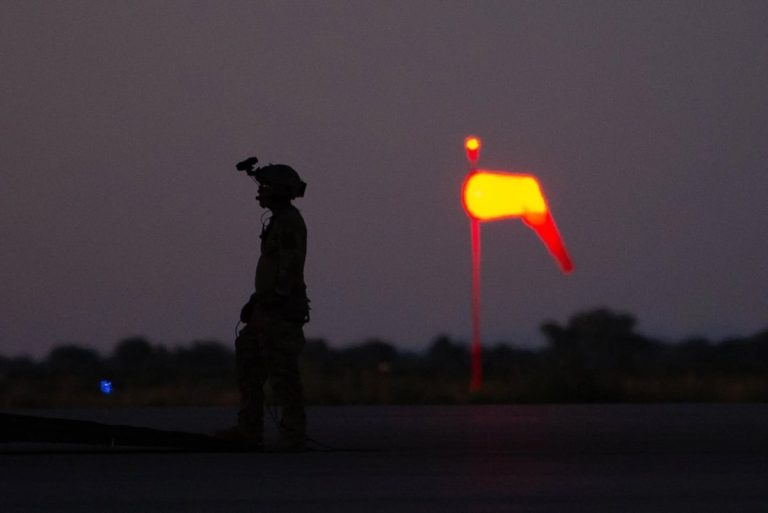
The Air Force’s Special Operations Command began a new inspection process last month that assesses a wing’s combat readiness for operations while providing airmen “the freedom to fail.”
The 27th Special Operations Wing was the first to conduct a Combat Readiness Inspection, a new assessment that gives airmen the opportunity to fail in a “controlled exercise environment,” according to the Air Force.
Any mistakes or shortcomings that pop up during such inspections will be treated as learning opportunities, and not lead to punishments, the service said.
“The goal for this event was never perfection,” Lt. Gen. Mike Conley, Air Force Special Operations Command commander, said in a release. “We wanted the Wing to be all in, face tough challenges, discover areas for improvement, and work together to problem solve for the future…and they did just that.”
The 27th Special Operations Wing underwent the new inspection as part of the Emerald Warrior exercise.
Air Force Inspector General Lt. Gen. Stephen Davis watched the 27th at Cannon Air Force Base, New Mexico, and made sure that the tests were realistic, the Air Force said.
Inspectors for the test judged the readiness of a 27th Special Operations Wing Special Operations Task Group that included aviation, special tactics and logistics units.
During the inspection, elements of the wing established multiple bases across Idaho and Nevada, and used 200 personnel to conduct a variety of operations.
Riley Ceder is an editorial fellow at Military Times, where he covers breaking news, criminal justice and human interest stories. He previously worked as an investigative practicum student at The Washington Post, where he contributed to the ongoing Abused by the Badge investigation.
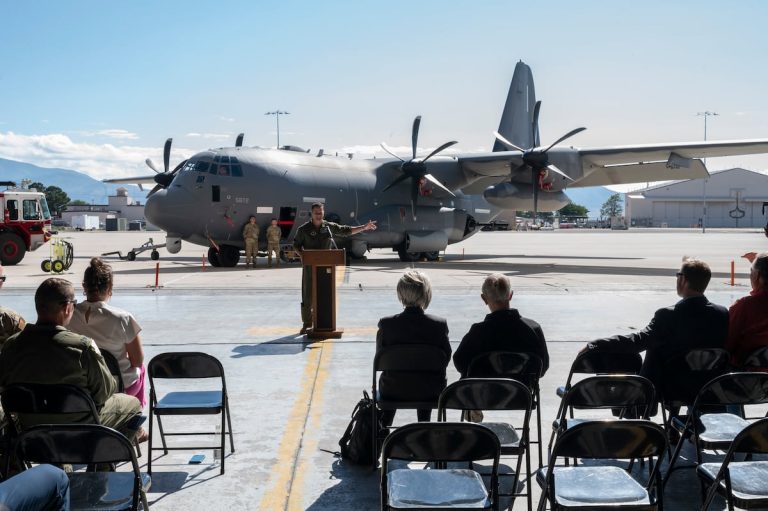
A storied gunship touched down at Kirtland Air Force Base, New Mexico, several weeks ago, as part of the U.S. Air Force’s effort to consolidate gunship training and reduce training time, the service confirmed.
The 58th Special Operations Wing at Kirtland held a ribbon-cutting ceremony Sept. 5 to commemorate the arrival of the first AC-130J Ghostrider, which was delivered at the end of August.
Training for the gunship is currently split between Kirtland and Hurlburt Field, Florida. However, with the aircraft’s arrival at Kirtland, all future training will take place there under Air Education and Training Command, or AETC.
“Creating a consolidated training location will reduce travel costs and allow for training timelines to be accelerated,” a spokesperson for the 58th Special Operations Wing said.
The AC-130J, armed with a howitzer cannon and advanced navigation features, provides defense support to ground troops, among other capabilities.
Currently, AC-130J training falls under the jurisdiction of AETC and Air Force Special Operations Command, or AFSOC, at Hurlburt Field.
Students complete their first round of training under AETC at Kirtland before traveling to Hurlburt Field for mission qualification training under AFSOC, where they learn to operate the AC-130J.
“The training focuses on getting aircrew trained on the AC-130J specifically and preparing them to operate in a combat environment and defend our national interests,” a spokesperson for the 58th Special Operations Wing said.
Consolidating training into one location will reduce gunship training by 30 days, the Air Force said.
The Air Force praised New Mexico’s terrain as a perfect match for training that will include academic and simulator instruction.
Five more Ghostriders are on their way to Kirtland, with their arrival expected to bring 299 active duty airmen and their families to the New Mexico base.
Riley Ceder is an editorial fellow at Military Times, where he covers breaking news, criminal justice and human interest stories. He previously worked as an investigative practicum student at The Washington Post, where he contributed to the ongoing Abused by the Badge investigation.
Since the Air Force and Space Force launched their first generative AI tool in June, more than 80,000 airmen and guardians have experimented with the system, according to the Air Force Research Laboratory.
The lab told Defense News this week that the early adopters come from a range of career fields and have used the tool for variety of tasks — from content creation to coding.
“The information we gain from this research initiative will help us to understand demand, and to identify areas in which AI can give airmen and guardians time back on mission,” the lab, known as AFRL for short, said in an email. “This will in turn enable us to better prioritize feature updates and security considerations as we scale enterprise capabilities related to generative AI in the future.”
The military services have been exploring how they might use generative AI tools like ChatGPT to make daily tasks like finding files and answering questions more efficient. The Navy in 2023 rolled out a conversational AI program called “Amelia” that sailors could use to troubleshoot problems or provide tech support. The Army started experimenting with the Ask Sage generative AI platform earlier this year and announced this week that it’s integrated the system into operations.
Alexis Bonnell, AFRL’s chief information officer and director of digital capabilities, told reporters in July that that the high usage rates for NIPRGPT confirm that there’s demand for generative AI tools within the Air Force and Space Force workforce.
However, the way service members are using the platform is even more telling, she said. Rather than simply using NIPRGPT to ask a question for find a document, most users have used a framework called RAG, or retrieval-augmented generation, to individualize the tool for their specific roles.
“What it signals to me is that people can now be more positively entrepreneurial and they don’t have to wait for a dashboard to be developed or a major system upgrade,” Bonnell said. “In some cases, they’re able to just bring in the knowledge they have a relationship with.”
The pilot has also helped the services start to shape an acquisition strategy for the capability. AFRL developed NIPRGPT using publicly available AI models and hasn’t committed to a particular approach or vendor as it builds on that baseline. As the pilot moves forward, the lab will work with commercial vendors to test and integrate their tools and determine whether they have utility.
Bonnell said that as AFRL continues to assess usage trends, it will get a sense of what features airmen and guardians want and what those tools might be worth to them.
“The ability to actually look at our actual use and inform our actual acquisition and be in a different position of evidence-based insight at the negotiating table with commercial, I think, is going to be really important,” she said. “So when we look at this rich horizon of commercial tools, we can be much more evidence-based, informed purchases versus throwing some AI at it.”
Courtney Albon is C4ISRNET’s space and emerging technology reporter. She has covered the U.S. military since 2012, with a focus on the Air Force and Space Force. She has reported on some of the Defense Department’s most significant acquisition, budget and policy challenges.
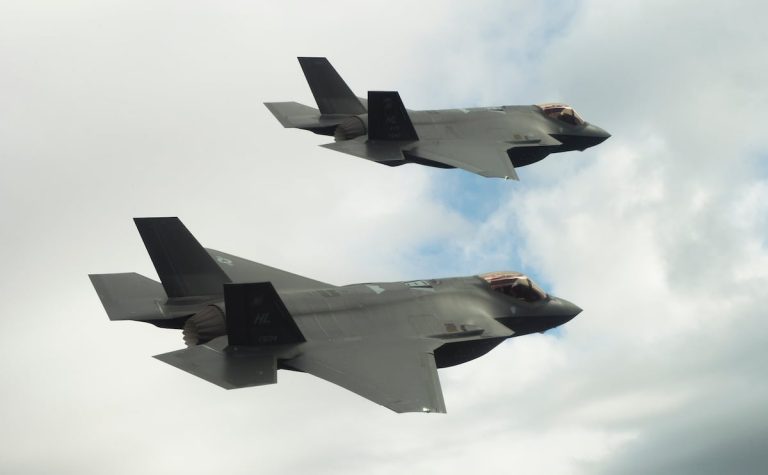
The U.S. Air Force plans to bed down 25 F-35As in fiscal 2026, according to a recent Defense Department report outlining how the service plans to field an inventory of nearly 700 of the aircraft by the end of the decade.
The Selected Acquisition Report, effective as of Dec. 31, 2023, was cleared for public release in August. It outlines the number of fighters the service intends to field each year through fiscal 2029, with expected losses of between two to four F-35As per year, for a total inventory of 664 aircraft.
An Air Force official told Air & Space Forces Magazine, which first reported on the report, that the figures should not be considered as an exact reflection of planned Air Force budget requests, but they relate to “a number of factors” impacting how fast aircraft can be purchased, delivered and absorbed into existing units and fielded to new locations. The official also said there have been adjustments to the program since late 2023 when the report became effective, which were not captured in the report.
The Pentagon’s plan is for the fleet of F-35s, including the F-35B variant for the U.S. Marine Corps and the F-35C variant for the U.S. Navy, to replace the various services’ legacy fleets and complement their other aircraft.
RELATED
For fiscal 2026, the report outlines a plan to bed down 16 F-35Bs and 20 F-35Cs, with the services reaching an inventory of 245 and 219 of those respective aircraft by fiscal 2029. Expected losses for the Marine Corps and Navy fleets range from zero to two per year, about half of what the Air Force anticipates.
Additionally, the report describes a procurement plan for the F-35As, with an intention to buy 42 in both fiscal 2025 and 2026, 47 in fiscal 2027 and 2028 and then 48 per year through fiscal 2048. Then, in fiscal 2049, it plans to buy 34, bringing the total number of aircraft acquired since 2007 to 1,763.
The Air Force’s 2025 budget request also outlines the service’s ask for 42 F-35As, a procurement document shows.
The Pentagon cleared the F-35 Joint Strike Fighter for full-rate production earlier this year, Defense News previously reported.
Jonathan is a staff writer and editor of the Early Bird Brief newsletter for Military Times. Follow him on Twitter @lehrfeld_media
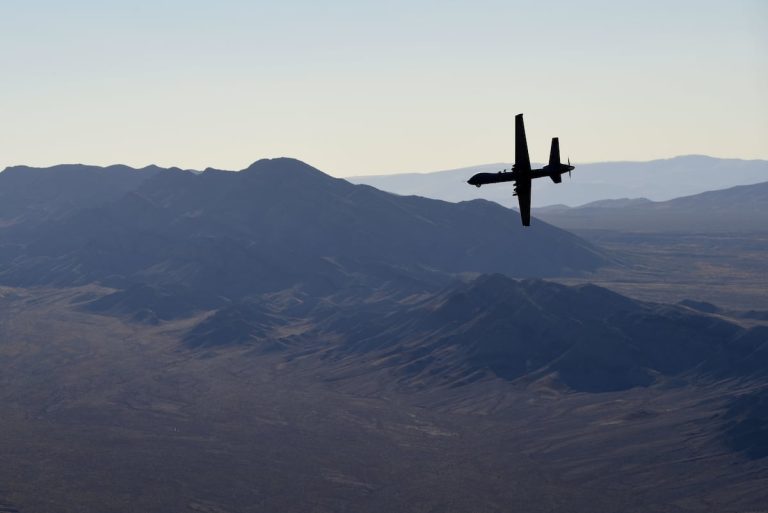
DUBAI, United Arab Emirates — Yemen’s Houthi rebels claimed Monday that they shot down another American-made MQ-9 Reaper drone, with video circulating online showing what appeared to be a surface-to-air missile strike and flaming wreckage strewn across the ground.
The U.S. military said it was aware of the Houthis’ claimed downing of a drone over the country’s southwestern Dhamar province, without elaborating.
The Houthis have exaggerated claims in the past in their ongoing campaign targeting shipping in the Red Sea over the Israel-Hamas war in the Gaza Strip. However, the online video bolstered the claim, particularly after two recent claims by the Houthis included no evidence.
Other videos showed armed rebels gathered around the flaming wreckage, a propeller similar to those used by the armed drone visible in the flames. One attempted to pick up a piece of the metal before dropping it due to the heat.
Brig. Gen. Yahya Saree, a Houthi military spokesperson, identified the drone as an MQ-9, without elaborating on how he came to the determination. He said it was the third downed by the group in a week, though the other two claims did not include similar video or other evidence. The U.S. military similarly has not acknowledged losing any aircraft.
Saree said the Houthis used a locally produced missile. However, Iran has armed the rebels with a surface-to-air missile known as the 358 for years. Iran denies arming the rebels, though Tehran-manufactured weaponry has been found on the battlefield and in seaborne shipments heading to Yemen despite a United Nations arms embargo.
Reapers, which cost around $30 million apiece, can fly at altitudes up to 50,000 feet and have an endurance of up to 24 hours before needing to land. The aircraft have been flown by both the U.S. military and the CIA over Yemen for years.
The Houthis have targeted more than 80 merchant vessels with missiles and drones since the war in Gaza started in October. They seized one vessel and sank two in the campaign that has also killed four sailors. Other missiles and drones have either been intercepted by a U.S.-led coalition in the Red Sea or failed to reach their targets, which have included Western military vessels as well.
The rebels maintain that they target ships linked to Israel, the U.S. or the U.K. to force an end to Israel’s campaign against Hamas in Gaza. However, many of the ships attacked have little or no connection to the conflict, including some bound for Iran.
Those attacks include a barrage that struck the Greek-flagged oil tanker Sounion in the Red Sea. Salvagers have begun towing away the burning oil tanker, hoping to avoid a catastrophic leak of its 1 million barrels of oil on board.
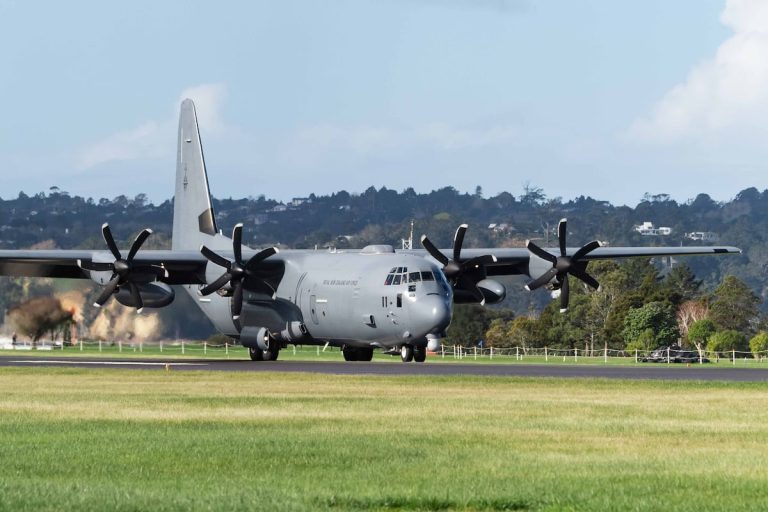
CHRISTCHURCH, New Zealand — The first of five C-130J-30 Super Hercules aircraft touched down in New Zealand earlier this month, part of a plan by the Royal New Zealand Air Force (RNZAF) to retire its 1960s-era C-130H Hercules fleet.
The initial plane, made by Lockheed Martin, was welcomed to RNZAF Base Auckland in a ceremony on Sept. 10. Chief of Defence Force Air Marshal Tony Davies stated: “We’ve taken a huge step forward in our tactical air transport capability. The additional capabilities the new C-130J fleet brings will open up expanded roles for the aircraft to meet the needs of New Zealand and our partners.”
Wing Commander Bradley Scott, who spearheads the air service’s No. 40 Squadron that will operate the new fleet, told Defense News that all five C-130Js would arrive by the end of October.
The Hercules is a workhorse in an air force fleet that possesses no combat aircraft. Indeed, the first C-130J’s workload commenced the following day, as it moved cargo and provided familiarization for air movements staff at several airbases around New Zealand.
Kiwi aircraft have an L3Harris Wescam MX-20HD electro-optic camera mounted under the nose to assist search-and-rescue or disaster-relief missions, something they regularly perform around New Zealand and the South Pacific. The C-130Js also have a SATCOM-based wide-bandwidth broadband system.
Scott noted: “It’s not necessarily a step change in capability with the C-130J, but it’s certainly a modernization and capability enhancement that we’ll receive.” He said the new aircraft “can carry more things a farther distance and burn less fuel doing so.”
Flights to Antarctica are part of the C-130J’s remit, and these will occur within a few months. Final operational release for the aircraft in all roles is scheduled for late 2025.
Dispensing with a competitive tender, Wellington budgeted NZ$1.521 billion (US$990 million) for the aircraft and related infrastructure in 2020. Interoperability with partners like Australia and the U.S. was an important consideration, and the package includes a full-motion flight simulator stationed at Whenuapai.
Crew and maintainer training started in the United States last year; four aircrews have already been trained by the U.S. Air Force, with two more to go. The simulator has not arrived yet, but the first New Zealand-based training program will start in early 2026. “Under the J-model contract, we’d be aiming to achieve as much training as possible in the simulator,” Scott explained.
The air service here already retired two C-130Hs this year. All will be gone by Jan. 31, 2025, after the fleet will have collectively flown nearly 155,000 hours over 97,000+ sorties.
Gordon Arthur is an Asia correspondent for Defense News. After a 20-year stint working in Hong Kong, he now resides in New Zealand. He has attended military exercises and defense exhibitions in about 20 countries around the Asia-Pacific region.
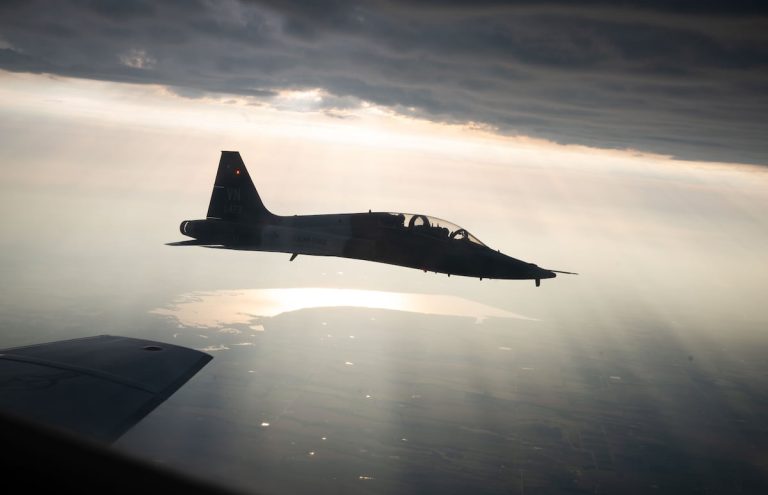
U.S. Air Force pilots graduating from training courses with the T-38 Talon may be required to fly non-fighter or bomber aircraft as a result of pilot shortages, according to a new Air Force policy.
The challenges in pilot inventory were outlined in an August service memo reviewed by Defense News and confirmed by an Air Force official.
Described in the document as a “significant but necessary policy change,” the move shifts the traditional assignment flow for T-38 pilots, who now may be matched to fly non-fighters or bombers.
“We are 1,848 pilots short, with 1,142 of those being fighter pilots,” the memo states. “While we would prefer to send every qualified T-38 graduate to a fighter [Formal Training Unit], circumstances dictate that we utilize available capacity to maximize pilot production. In the near term, in addition to traditional fighter/bomber assignments, T-38 graduates will be matched to additional T-6 [First Assignment Instructor Pilot] assignments and opted for non-fighter/bomber aircraft.”
Due to personnel challenges, some breaks between pilot training and assignment to a formal training unit have exceeded one year, the memo adds.
Brig. Gen. Travolis Simmons, the director of training and readiness and deputy chief of staff for operations with Headquarters Air Force, told Military Times that the delayed starts at the fighter FTUs are “due to a combination of sustainment and manpower challenges.”
For now, the document describes how T-38 students will prioritize all aircraft, not just fighters and bombers, on their “dream sheets” to ensure an accommodation of preferences. It also outlines that the students may volunteer for non-fighter and bomber opportunities.
“The Air Force has always assigned aircraft based on Air Force needs, platform availability, student preference and student class ranking,” Simmons said. “Even with the recent policy shift, those core tenets remain the same.”
He added that while the policy change is meant to optimize available resources, as capacity and needs evolve, pilots affected by the policy change may have the option to “voluntarily crossflow to fighter/bomber aircraft.”
RELATED
The Air Force memo also notes the service intends to return to a regular assignment flow as quickly as possible.
The final pilot production numbers for fiscal year 2024 will not be available for release until later in the calendar year, Simmons said.
Jonathan is a staff writer and editor of the Early Bird Brief newsletter for Military Times. Follow him on Twitter @lehrfeld_media
The three versions of the subsonic Barracuda cruise missile — dubbed the Barracuda-100, -250 and -500 — are built using common subsystems that can be easily swapped in and out as new technologies are developed or threats emerge, Anduril said, which makes them highly adaptable. They will be able to conduct direct, stand-off or stand-in strikes, the company said.
Barracuda’s modularity will also make it attractive to international customers, said Chris Brose, Anduril’s chief strategy officer.
“You can take it apart like Lego blocks,” Brose told reporters in a Wednesday call. “It makes it a lot easier to work through and navigate defense export issues and collaboration with allies.”
Diem Salmon, vice president for air dominance and strike at Anduril, told reporters Barracuda’s open-architecture subsystem structure will allow them to cost about 30% less than other similar missiles.
“Rather than designing bespoke capabilities for each single weapon system that you’re trying to put out there, how do we actually make this simpler, and how to we actually design out the hard parts?” Salmon said.
Anduril also created a “hyperscale production” strategy for Barracuda based on a simple design with fewer parts that uses commercial components and requires no more than 10 tools to assemble, the company said. Besides bringing down costs, Salmon said, Anduril’s approach to Barracuda will allow the company to scale production up or down as needed.
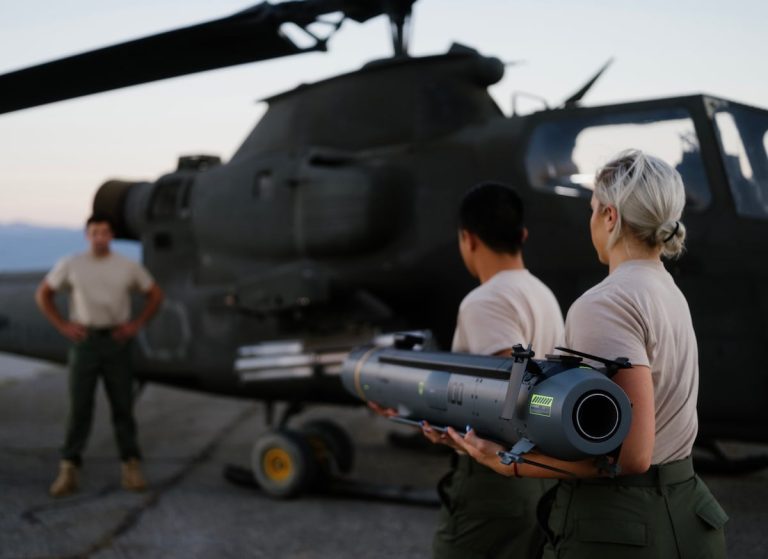
All versions of the Barracuda would be able to fly at speeds of up to 500 knots, Anduril said. The smallest version, the Barracuda-100, would have a range of up to 85 miles when launched in the air and carry a payload of up to 35 pounds. It could be launched from the ground, from the tail of a C-130 mobility aircraft or from the rails of AH-64 Apache or AH-1Z Viper helicopters.
The Barracuda-250 would be able to fly about 200 nautical miles when air-launched, though its payload capacity would be the same as the 100. It could be launched from the internal weapons bay of F-35 fighters or bombers, and externally from F-15E Strike Eagles, F-16 Fighting Falcons and F-18E/F Super Hornets.
The Barracuda-500 could have a range of more than 500 nautical miles, carry more than 100 pounds of payload and loiter for more than two hours, the company said. Besides being launched externally from the F-15E, F-16, and F-18E/F, Anduril said, it could be launched as a palletized munition from the C-17 and C-130.
Anduril also said Barracuda missiles are highly maneuverable and able to withstand up to 5 G-forces.
Barracuda’s autonomous capabilities will allow it to fly alongside other Barracudas or aircraft and collaborate with them, according to Brose. That could include multiple Barracudas providing different capabilities in a single mission, with some detecting targets, others acting as decoys or providing countermeasures, and still others carrying out strikes.
“That package can go deliver the mission effect that you want, without having to bundle all of that into one air vehicle, and then radically drive up the cost per round of every single vehicle,” Brose said.
Anduril is testing Barracuda as part of the Air Force Armament Directorate and Defense Innovation Unit’s Enterprise Test Vehicle project, according to Brose, among other testing programs he declined to specify.ETV seeks to test prototypes of a modular drone to test payloads, sensors and other technology and be produced affordably at high rates.
All three versions have conducted flight tests, Salmon said. Anduril is also focusing on testing its subsystems, particularly its flight software, she said, to “mak(e) sure we’re wringing out all the kinks there.”
Stephen Losey is the air warfare reporter for Defense News. He previously covered leadership and personnel issues at Air Force Times, and the Pentagon, special operations and air warfare at Military.com. He has traveled to the Middle East to cover U.S. Air Force operations.
But as Air Force leaders translated their vision into an acquisition strategy, a novel meeting of the minds — at least by Defense Department standards — may have saved the service from a major miscalculation: A new cohort of so-called collaborative combat aircraft, as originally envisioned, wouldn’t be able to fly far enough to be effective in combat, which would have been a serious problem in the Pacific theater.
That’s according to acquisition chief Andrew Hunter, who spoke about the episode anecdotally to stress how the Air Force had changed its acquisition practices by soliciting early input from stakeholders who were previously consulted only later in the process.
Key to catching the range shortcoming, he said in a July interview, was the unique approach the Air Force took to buying the autonomous drone wingmen known as CCAs. The service brought operators from Air Combat Command into the room alongside acquisition experts, who would normally have taken the lead on a major procurement like this.
“We had … a lot of discussion about range to understand operationally, what was meaningful and what was going to be effective,” said Hunter, the service’s assistant secretary for acquisition, technology and logistics.
With ACC operators’ insights, he said, the Air Force was able to push contractors to find the “sweet spot” of enough range, at a reasonable price and on the right timeline.
That approach to acquisition is a hallmark of the Air Force’s operational imperative effort, Hunter said, and could change how the service procures systems in the future.
Air Force Secretary Frank Kendall rolled out his wide-ranging, seven-pronged operational imperative plan in March 2022, seeking to transform everything from how the Air Force deploys and sets up bases in war zones to procuring advanced aircraft — including CCAs, the Next Generation Air Dominance future fighter and the B-21 Raider stealth bomber — and finding better ways to track and target enemy forces.
With the Biden administration’s term nearing the finish line, Kendall’s operational imperative transformations could prove to be his lasting legacy on the Air Force.
And such modifications are already guiding other changes to the force. In a Sept. 4 panel at the Defense News conference, Hunter said the operational imperatives were the “genesis” of a broader restructuring of the Air Force, called the reoptimization for great power competition, that was unveiled earlier this year.
Along the way, the operational imperative effort also prompted the Air Force to rethink how it does business and procures new aircraft and other systems, in particular by bringing the operational and acquisition communities together.
From the start, Hunter said, each team working on an operational imperative effort was co-led by an acquisition expert and an operational expert, so each perspective was equally balanced. The systems eventually developed will be used by the Air Force’s operators, so involving them each step of the way was logical, he added.
The rapidly moving acquisition process involves so many decisions — everything from choices on designs, contracts, schedules and how systems will be used — that there’s no time to waste on creating systems that aren’t immensely useful.
“It’s not one of those cases where we get a requirement, and then we in the acquisition community run off and do our thing, and then we come back at the end and say [to operators], ‘Here it is, hope you like it,’” Hunter said. “If they don’t scratch the operational itch, then we’ve not succeeded.”
The time has come, Hunter added, to move away from the lengthy, traditional model in recent decades of sending requests for proposal to a limited number of major firms and only picking one. Instead, the Air Force wants to move to a “next-generation” acquisition model that continually works with a range of industry partners and iterates multiple designs over time.
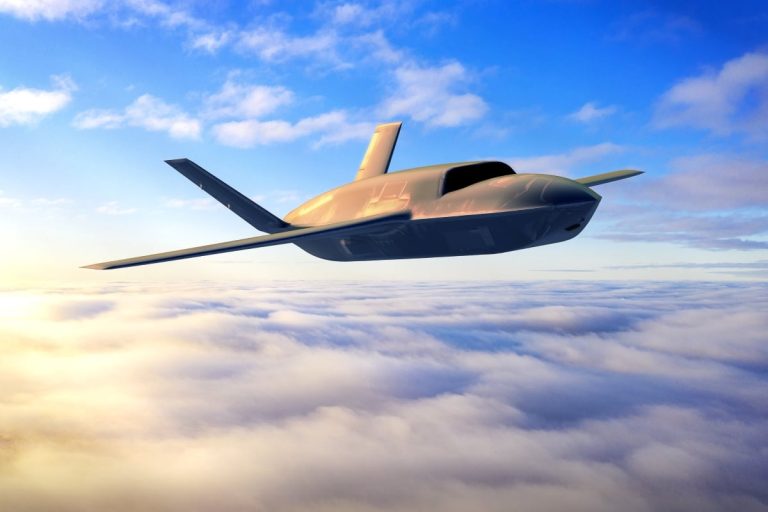
Anduril and General Atomics have been selected by the Air Force to develop autonomous collaborative drones. Anduril has proposed its Fury aircraft, shown here, as the service’s first. (Anduril)
The Air Force’s CCA program is the most prominent example of this approach. The service in April announced it had selected Anduril and General Atomics for the first “increment” of the drones. And a second increment is on its way in fiscal 2025 — one that could produce autonomous drones dramatically different from the first batch.
“Do not assume, and it may not be, just an evolution of increment one,” Hunter said Sept. 4. “It could be an entirely different set of missions; it could be an entirely different kind of an aircraft.”
Chasing threats
As the service works on operational improvements, threats faced by the United States continue to evolve. China, in particular, is focused on strengthening its own military for a possible invasion of Taiwan — and is doing so “incredibly quickly,” Hunter said.
“The threat’s not sitting still,” Kendall said in a June interview with Defense News at the Pentagon. “It’s getting worse, and it’s … very creative.”
So, the Air Force adjusted its plans, supplementing its modernizing effort with other “operational enablers” that cut across multiple areas. The service also needed to improve capabilities, especially through greater munitions, better electronic warfare and mobility — like an envisioned future stealthy tanker, dubbed NGAS, for its next-generation aerial refueling system.
And the Air Force changed course on Next-Generation Air Dominance, a future fighter family of systems expected to replace the F-22. The price tag for each NGAD, as originally conceived, would likely have been about three times the cost of an F-35, Kendall said. The NGAD program is now on hold while the Air Force reconsiders its design, and it is unclear when the service will award a contract.
The imperatives were built around a “focus on operational problems we need to solve,” Kendall said. “What are the things we need to figure out to make sure we’re competitive and stay ahead of other threats?”
Kendall said the Air Force is making progress on these imperatives, though he tempered his comments by noting that funding limitations and shortfalls in cybersecurity and other technology have kept the effort from moving as quickly as he hoped.
“I’m always impatient,” Kendall said. “I want to go faster to get militarily meaningful quantities out into the force that make a difference operationally.”
When Kendall announced his operational imperative plan, work was already well under way on the 2023 budget proposal. This meant the first time the Air Force could request funding for new operational imperative efforts was in the 2024 budget cycle.
But Congress threw the Pentagon a curveball. Disputes on Capitol Hill held up the military’s 2024 spending bill for months, and the fiscal year was already half over when lawmakers finally passed it.
While the 2024 budget delay hindered much of the operational imperative effort, Hunter said, some elements — such as the command, control, communications and battle management, or C3BM, effort — were already under way or had existing funding to get going.
The Air Force was able to move quickly to field C3BM capabilities, such as the cloud-based command and control effort that knit together several different air defense data sources to better defend the homeland. Hunter said that was able to be fielded rapidly over the last two-plus years or so, and has been successful.
And because the program to develop CCAs was already under way as part of NGAD and had “significant” funding, the Air Force was also able to keep it rolling despite the 2024 budget delay, Hunter said.
But as budgets get tighter, it remains to be seen whether the OI project will receive the funding it needs.
A lasting impact?
The Air Force’s desired funding for operational imperative efforts grew from about $5 billion in 2024 — once the budget was passed — to $6 billion in the 2025 budget request.
Kendall said he’s hoping to maintain full funding in 2026, but expects tight budgets to force the service to make “difficult choices,” including whether the OIs will get the funding he wants.
The growth of additive manufacturing, and technology advancements making it possible to conduct distributed manufacturing for high-end military capabilities, are also helping the Air Force create its new procurement model, Hunter said.
“You can scale more rapidly,” he said. “You can maybe work more intimately with partners and allies … which is definitely important to our strategy of integrated deterrence. You can do complex designs more affordably. These approaches are very consistent with rapidly adopting those technologies into our production and design processes.”
Hunter feels strongly that this approach to procurement — with tighter cooperation between acquisition experts, industry and operators and more frequent iterations to evolve designs — will one day become standard for the Air Force, and perhaps other services.
“This is the way to do it, now and in the immediate future,” Hunter said. “I don’t see a date where it will become less relevant.”
And it’s not an entirely new approach, he said, but it is a habit the Air Force had gotten out. He compared this strategy to that of the World War II and post-war eras — when aviation technology transformed by leaps and bounds — as opposed to the late-Cold War era of the 1980s and 1990s, during which the pace of advancements slowed.
“Change was happening so fast” during WWII, Hunter said. “And you see … how quickly we were able to develop rockets and missiles in the ‘50s and ‘60s. The pace of change and progress was so fast that it drove us towards these more tight-knit relationships among experts.
“It’s not unprecedented, but I definitely think it’s a little bit of a ‘back to the future’ scenario of behaving a little more like we did in those earlier periods.”
Stephen Losey is the air warfare reporter for Defense News. He previously covered leadership and personnel issues at Air Force Times, and the Pentagon, special operations and air warfare at Military.com. He has traveled to the Middle East to cover U.S. Air Force operations.
The massive strike by tens of thousands of Boeing machinists in Washington state will affect the company’s work on the KC-46 Pegasus refueling tanker, the company’s chief financial officer Brian West said Friday.
West’s comments to the Morgan Stanley Laguna Conference came hours after more than 30,000 union members voted overwhelmingly to reject a contract and go on strike.
“The tanker program is going to be impacted by the (Boeing Commercial Airplanes) factory disruption, and now work stoppage,” West said. “That is going to flow through the tanker rates, which is going to be more cost pressure.”
The extent to which KC-46 production might be impacted was not immediately clear, nor was how the strike could impact other Boeing defense programs, such as the U.S. Navy’s P-8 Poseidon. Boeing builds the KC-46 on its 767 line in Everett, Washington, and the 737-derived P-8 in Renton, Washington.
Further statements from Boeing and the Defense Department on the strike’s defense program ramifications were not immediately available.
Boeing management and leaders of the International Association of Machinists districts 751 and W24 reached a tentative agreement on a deal for 33,000 union members that would include a 25% wage increase over the four-year life of the contract.
Union leaders this week told members that while the contract did not deliver everything they sought, it would be “the best contract negotiated in our history” and recommended accepting the deal.
“We have achieved everything we could in bargaining, short of a strike,” District 751 president Jon Holden said in a Monday message to union members.
But that deal fell short of the 40% increase the union originally sought, angering rank-and-file members. On Thursday — the final day of the old contract — more than 94% of union members voted to reject the contract and 96% voted to go on strike. Union members are now picketing Boeing facilities in Washington.
Boeing machinists voted overwhelmingly Thursday to reject a tentative contract and go on strike. This will affect operations at facilities like the company’s Everett, Washington, plant where 767 aircraft are turned into KC-46 Pegasus tankers. (Jeff Martin/Staff)
West said the company was “disappointed” by union members’ decision to reject a contract and go on strike.
“Initially, we were pretty pleased,” West said. “We had an unprecedented temporary agreement that was unanimously endorsed by union leadership. Over the last few days, it became loud and clear with our union members that that offer didn’t meet the mark. So there was a disconnect.”
Kelly Ortberg, Boeing’s new chief executive, is now speaking directly with workers to hear their concerns and figure out how to find an acceptable agreement, according to West.
A lengthy strike will hurt Boeing’s production, deliveries and operations and jeopardize its ability to recover from its many woes, West said. Those troubles most notably include quality and safety problems with its Max series of airliners.
In July, Boeing pleaded guilty to conspiracy to defraud the United States in connection with the crashes of two 737 Max aircraft. That followed a January incident in which the door plug of another 737 Max blew out in flight.
If the machinists’ strike is not resolved quickly, it could present further dangers for Boeing and its defense sector, which have already weathered one blow after another.
Fitch Ratings, one of the top international credit rating agencies, said Friday that Boeing “has limited headroom for a strike.” If the strike lasts a week or two, Fitch said, the company’s investment-grade credit rating is not likely to change.
But a longer strike, Fitch said, could seriously affect Boeing’s operations and financial outlook and increase the risk of a downgrade.
West said he is confident Boeing can balance its finances and debt and keep its credit rating investment-grade.
However, Boeing Defense, Space and Security is “still in recovery mode” and is likely to lose money in the third quarter, West said. These losses will in part be caused by cost pressures in Boeing’s fighter sector, as it ramps up production of the F-15EX Eagle II fighter and winds down work on the F-18 Hornet, according to West.
“Development hurdles” on the T-7 Red Hawk and MQ-25 Stingray programs, which are fixed-price contracts leaving Boeing on the hook for cost overruns, have also driven up costs, West said.
The U.S. Air Force awarded Boeing a $2.3 billion contract in November 2023 to build 15 more KC-46s, bringing the total number of Pegasus tankers on contract to 153. But the company has also taken significant losses on the program’s fixed-price contract, with the cost overruns topping $7 billion.
Stephen Losey is the air warfare reporter for Defense News. He previously covered leadership and personnel issues at Air Force Times, and the Pentagon, special operations and air warfare at Military.com. He has traveled to the Middle East to cover U.S. Air Force operations.