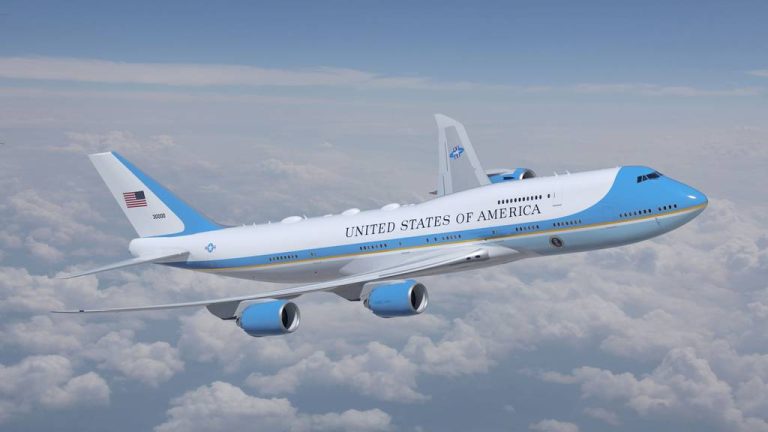
WASHINGTON — The paint scheme for the next Air Force One will remain largely the same as the current version of the presidential aircraft, but with a slightly deeper shade of light blue instead of the current robin’s egg blue.
The Air Force said Friday President Joe Biden has selected the Boeing-made VC-25B’s new livery design, bringing to a close years of debate across two administrations.
The VC-25B’s engines will also use the darker blue from the aircraft’s cockpit area, instead of the robin’s egg blue on the engines of the VC-25A, the Air Force said. And the VC-25B will not have a polished metal section, because the alloys used for the exterior of the Boeing 747-8 airliners that are being adapted into the presidential aircraft do not allow it.
Former President Donald Trump wanted the new presidential aircraft to ditch the robin’s egg blue and white color scheme in place since the Kennedy era, and instead adopt a darker red, white and blue design.
But Trump’s ideaproved controversial — and not only for aesthetic reasons. The Air Force said in Friday’s release a thermal study found the dark blue in the Trump administration design would add heat in some environments, and would require more Federal Aviation Administration qualification testing for several of the airplane’s commercial components.
When Biden assumed office in January 2021, his administration downplayed his interest in redesigning the Air Force One paint scheme.
But by June 2022, the administration had decided to drop the red, white and blue paint plan, citing the additional engineering, time and cost it would require. Part of that decision was based on the temperature issue.
In its release on Friday, the Air Force said a decision on the Air Force One livery had to be made by this year to give Boeing enough time to carry out engineering, certification preparation, and supplier selection activities.
The two airplanes were originally expected to be delivered in late 2024, but the program has fallen years behind schedule.
The Air Force said Boeing is expected to deliver the first VC-25B in 2027, and the second the following year — well into the next presidential term.
Andrew Hunter, the Air Force’s assistant secretary for acquisition, technology and logistics, told Congress in May 2022 the aircraft would be two to three years late.
Hunter told lawmakers a Boeing subcontractor had been unable to finish the job of making vital modifications to the plane’s interior, which largely led to the “significant delay.” Boeing had brought on other subcontractors to make those modifications, and had taken on some of the tasks itself, he said.
This means the Air Force will have to keep flying the current Air Force Ones for several more years. The service said in its release it is able to operate the VC-25A until the new planes are delivered.
The Trump administration and Boeing negotiated, and in July 2018, the Air Force awarded Boeing a contract for the presidential aircraft the White House said was far lower than the original proposal.
As Boeing modifies the 747-8s into the new Air Force Ones, it is adding into each plane a medical facility, a self-defense system, a mission communication system, an executive interior, autonomous ground operations capabilities and electrical power upgrades.
Stephen Losey is the air warfare reporter for Defense News. He previously covered leadership and personnel issues at Air Force Times, and the Pentagon, special operations and air warfare at Military.com. He has traveled to the Middle East to cover U.S. Air Force operations.
WASHINGTON — The Air Force wants to retire 310 aircraft, including 42 A-10 Warthogs, as part of its fiscal 2024 budget to free up money for its modernization programs.
The Department of the Air Force is requesting $215.1 billion in 2024, $9.3 billion, or 4.5%, over the amount enacted for fiscal 2023. That includes a proposed budget of $185.1 billion for the Air Force itself, up $5.4 billion from 2023, and $30 billion for the Space Force, up $3.9 billion increase from 2023.
Nearly $5 billion of that totalbudget growth would go to research, development test and evaluation spending, bringing that section’s funding up to $55.4 billion in 2024.
Massive retirement wave
The Air Force’s plan to retire 310 aircraft in 2024 would be far greater than the 150 retirements it recommended in the 2023 budget, though Congress ultimately approved just 115 of those. If lawmakers approve all, or even most, of these retirements, it would represent a significant step forward in the service’s effort to weed out older, outdated airframes from its fleet.
If approved, the proposed retirement of 42 A-10s in 2024 would follow this year’s retirement of 21 Warthogs, and would leave the service with 218 of the attack aircraft. The Air Force has tried for years to retire the Warthog, arguing it would be too vulnerable against an enemy with advanced air defenses, and instead use the money to pay for newer fighters.
Air Force Chief of Staff Gen. CQ Brown told reporters at the Air and Space Forces Association’s symposium in Colorado March 7 the service wants to have all A-10s retired by 2029. Until recently, Congress has blocked the Air Force’s attempts to retire the A-10.
The Air Force wants to retire 42 A-10 Warthogs as part of the proposed 2024 budget, which would leave the service with 218 of the attack aircraft. (Air Force)
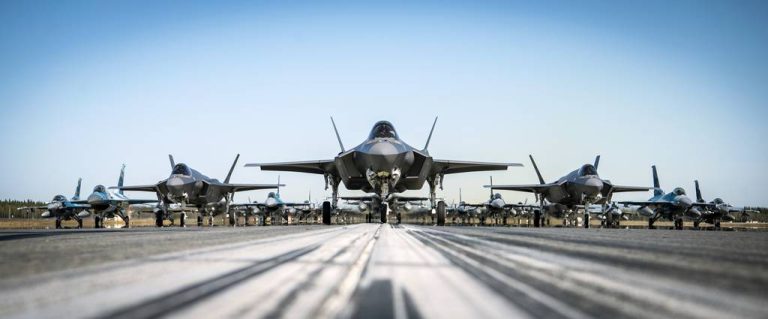
The Air Force also wants to retire 57 F-15 C and D fighters. Some those Eagle jets are around four decades old, and are reaching the end of their lives. The Air Force plans to bring on new F-35s, as well as newly-made F-15EX Eagle II fighters from Boeing, to replace those retiring fighters.
And the service is already withdrawing dozens of older F-15s from Kadena Air Base in Japan for retirement, replacing them with rotational fighters such as F-22s.
The Air Force is taking another shot at retiring 32 Block 20 F-22A Raptor fighters, which are not combat-capable and are now primarily being used for training purposes. Congress last year blocked the Air Force’s first attempt at retiring 33 of those F-22s.
The Air Force also wants to take more steps toward retiring the E-3 Sentry airborne warning and control system, or AWACS, aircraft in 2024.
The Air Force suggested retiring 15 of its 31 AWACS in its 2023 budget proposal, but lawmakers granted only 13 of those retirements. And Congress placed conditions on those retirements, requiring the service to produce a report on the E-3 retirement as well as its acquisition strategy for replacing it with the E-7.
Maj. Gen. Michael Greiner, the Air Force’s deputy assistant secretary for budget, told reporters in a March 10 briefing at the Pentagon that the Air Force believes it has met the requirements for the 13 AWACS retirements this year, which would bring its total fleet down to 18.
And in the 2024 budget proposal, the service said it wants to retire two more E-3s, leaving it with 16.
The Air Force has flown AWACS, with the unmistakable massive rotating radome mounted on its fuselage, since the 1970s. But the Air Force says the E-3′s air frame is increasingly difficult to keep flying and its sensor technology is outdated.
The Air Force plans to replace the AWACS with a new fleet of 26 E-7s by 2032. The service awarded Boeing a contract Feb. 28 to begin working on the U.S.’s first rapid prototype E-7, which is expected to begin production in fiscal 2025 and be fielded two years later.
In the briefing last week, Air Force Secretary Frank Kendall downplayed the likelihood of a capability gap emerging by retiring some AWACS before E-7s arrive to replace them.
“The E-3 is essentially not effective in the environments we’re most worried about,” he said. “The sensor is pretty ancient at this point, and the aircraft are very expensive to maintain.”
An E-3 Sentry airborne early warning and control system aircraft prepares to participate in Operation Noble Defender at Joint Base Elmendorf-Richardson, Alaska, Jan. 26, 2023. The Air Force proposed retiring two more AWACS as part of its fiscal 2024 budget, as it prepares to bring on a fleet of Boeing E-7A aircraft to replace them. (Tech. Sgt. Curt Beach/Air Force)
Retiring about half the current E-3 fleet will make available spare parts and other resources the Air Force can use to keep the remaining AWACS fleet in the air, Kendall added, so it can meet critical requirements such as NORAD’s air defense mission.
“It’s a question of making the transition as smooth as possible, freeing up the resources, starting to retrain the people, and then move them over [to E-7s] with a minimal operational impact from taking [AWACS] down,” he said.
The budget also proposes adding $254 million to continue rapid prototyping work on the Boeing E-7A, set to replace the aging E-3 Sentry airborne warning and control system aircraft, which would bring its FY24 funding to $681 million.
Greiner said the increased spending on E-7 would allow the Air Force to procure a second rapid prototype aircraft.
The budget calls for retiring the final 24 KC-10 Extender refueling tankers and the remaining 48 Block 1 MQ-9 Reapers. It would also retire the last three E-8 Joint Surveillance Target Attack Radar System, or JSTARS.
The Air Force also wants to retire 37 HH-60G Pave Hawk combat rescue helicopters, which are being replaced by HH-60W Jolly Green II helicopters made by Sikorsky and Lockheed Martin; 52 T-1 Jayhawk twin-engine jet trainers.
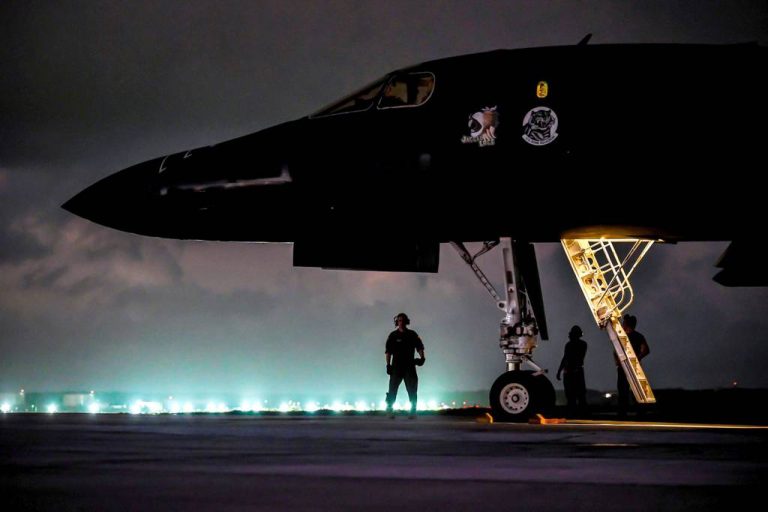
The Air Force has also decided to retire one B-1B Lancer bomber that suffered an engine fire in April 2022, rather than try to repair it. That would leave the service with 44 B-1s. The force aims to have the entire fleet retired by the early 2030s.
R&D bonanza
The proposal includes $4.8 billion in budget growth for 20 new or significantly boosted programs to transform the Air Force, including CCAs.
Funding for the CCA program woulddramatically increase by $470 million to $522 million, to speed up development and testing of the autonomous drones. CCAs would fly as part of the Next Generation Air Dominance family of systems that will make up the Air Force’s sixth-generation fighter, as well as the F-35 and possibly other crewed aircraft.
That funding boost would cover the cost of developing the platform itself, developing the autonomous programming that will fly the drones, and standing up an experimental operations unit to plan how the service will use CCAs, Greiner said.
Greiner said the budget proposal is where the “acceleration” of work on CCAs can be seen. “We start to work on CONOPS, concept of operations, and how we would actually employ these,” he said.
Kendall said at AFA March 7 the service is planning for 1,000 CCAs as it starts to flesh out the basing needs, organizational structures, sustainment, and other requirements for such a fleet.
Kendall said in the March 10 briefing the Air Force wants to start production on CCAs by the end of the decade. He also said that, as the Air Force has increasingly discussed its plans to team crewed fighters with autonomous CCAs, the defense industry has ramped up its own research and development on this technology.
“I’m encouraged by what industry’s been doing on their own,” Kendall said. “This is a serious program. It’s a multibillion-dollar program.”
Even so, Kendall stressed each CCA must cost “a fraction” of an F-35, and said he has seen enough work to indicate that’s a “very reasonable goal.”
Kendall in September said the Air Force might hold a competition for CCAs in 2024, but the service has not settled on when that will happen.
“We’re going to start with competition and we’ll downselect at some point,” Kendall said. “We haven’t figured out exactly when that will be.”
A conceptual design of low-cost, attritable drones serving as wingmen for a crewed fighter jet. (U.S. Air Force)
The Air Force also wants to boost the budget for NGAD by $276 million in 2024 for technology maturation and risk reduction. That growth would bring its total research and development funding to more than $1.9 billion.
Kristyn Jones, the Air Force’s assistant secretary for financial management and comptroller, who is performing the duties of undersecretary of the Air Force, said the service needs to change to maintain its air dominance, which is being challenged by China. The service needs to look for cost-effective ways to carry out its missions, including teaming crewed fighters with the autonomous drones it refers to as CCAs.
“We cannot afford complacency, nor can we afford an Air Force composed largely of fighters that cost as much as our fifth-gen aircraft,” such as the F-35, Jones said.
More fighters, tankers and B-21 Raiders
The Air Force hopes to buy 48 F-35As in 2024, more than the 43 Congress approved in 2023.
The proposed budget would also pay for 24 F-15EX fighters and 15 Boeing KC-46A Pegasus refueling tankers in 2024, which would be the same number of each bought in 2023.
The Air Force originally planned to buy 144 F-15EXs, but in documents accompanying last year’s budget request, the service dropped that expected procurement to 80. In the March 10 briefing, Kendall told reporters the Air Force has partially reversed that cut, and now plans to buy 104 F-15EXs, though he did not explain why the Air Force’s stance had changed.
The Air Force also wants a $673 million spending boost for the B-21 in 2024, which would bring its procurement funding to more than $2.3 billion to continue low-rate initial production. An Air Force official told reporters the Raider’s procurement funding would buy more than one aircraft, but would not say how many, and also includes money for spares, training and advance procurement for long lead parts for future production lots.
The Air Force said it is still anticipating the B-21′s first flight sometime in 2023.
Northrop Grumman executives said in a January earnings call the company expected the Air Force to award the first B-21 production contract later this year. In a March 7 roundtable with reporters at the AFA conference, Kendall and Air Force acquisition chief Andrew Hunter declined to say if they were planning on a B-21 contract this year, and said they were focused on the first flight milestone.
The first B-21 Raider rolls out of a hangar at Air Force Plant 42 in Palmdale, California, on Dec. 2, 2022. (Stephen Losey/Defense News)
Kendall told reporters in Colorado he wants the B-21 to avoid the problems associated with concurrency that plagued the F-35 in its development period. Concurrency refers to when an aircraft moves through development and into procurement at the same time.
“The excessive concurrency [of] the F-35 program, I was famous at one time for calling that acquisition malpractice,” Kendall said March 7. “We’re not going to do acquisition malpractice [with the B-21]. We want to have some confidence.”
The Air Force also plans to buy seven MH-139 Grey Wolf helicopters, two more than in 2023, and one E-11 aircraft that can carry out the Battlefield Airborne Communications Node, or BACN, mission. It also bought one E-11 in 2023.
The proposed budget includes about $8 million for the Air Force’s Next Generation Air Refueling System, or NGAS, so the service can finish its analysis of alternatives research. The Air Force announced at AFA it is revamping its plans for future aerial refueling tankers and will cut in half the number of tankers it planned to buy as an interim step.
The budget also would for the first time add procurement money for the LGM-35A Sentinel program, meant to succeed the Cold War-era Minuteman III intercontinental ballistic missile later this decade. Greiner said the proposed $539 million would pay for long lead item parts to help prepare for the first lot of the Sentinel, expected in fiscal 2026.
Stephen Losey is the air warfare reporter for Defense News. He previously covered leadership and personnel issues at Air Force Times, and the Pentagon, special operations and air warfare at Military.com. He has traveled to the Middle East to cover U.S. Air Force operations.
WASHINGTON — The Pentagon is abandoning its efforts to develop a next-generation adaptive engine for the F-35 Joint Strike Fighter, according to Air Force Secretary Frank Kendall.
Instead, Kendall said during a March 10 briefing on the fiscal 2024 budget, the military will stick with and upgrade the F-35’s current engine — a major win for F135 maker Pratt & Whitney.
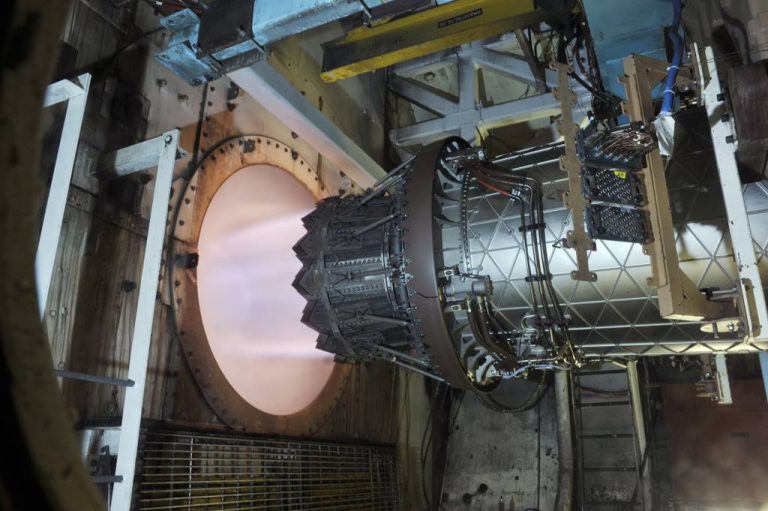
The decision means the military will not move forward with its Adaptive Engine Transition Program, an effort to fund research, development, prototyping and testing of a new kind of engine with enhanced thrust, power and cooling ability, The adaptive engine uses three streams of air to cool the engine and the jet, and has an adaptive cycle that allows it to adjust to the configuration that provides the most thrust and efficiency for a given situation.
Both General Electric Aviation and Pratt & Whitney had designed new engines as part of AETP, but only GE had pitched its engine — the XA100 — as a replacement for the F-35.
Military officials said Friday they determined Pratt & Whitney’s proposal to modernize the already existing F135s in a program called the Engine Core Upgrade was the most cost-efficient option that would work for all F-35s.
“We were not able to fund the AETP program,” Kendall said. He told reporters the cost of GE’s XA100 adaptive engine and doubts it would work in all versions of the F-35 led the military to stick with the F135.
“We needed something that was affordable, and would support all the variants” of the F-35, he added.
An Air Force spokesperson said Tuesday the service plans to spend $245 million on the Engine Core Upgrade in 2024.
The Air Force also said Tuesday it has obligated nearly $2.7 billion for AETP since the program launched in 2016.
In a statement provided to Defense News, a GE spokesperson expressed the company’s displeasure with the Pentagon’s decision.
“This budget fails to consider rising geopolitical tensions and the need for revolutionary capabilities that only the XA100 engine can provide by 2028,” the GE spokesperson said. “Nearly 50 bipartisan members of Congress wrote in support of advanced engine programs like ours because they recognize these needs, in addition to the role competition can play in reducing past cost overruns. The XA100 engine is ready to power U.S. warfighters today and in the future.”
The GE spokesman said in a follow-up email that the company plans to keep working on the XA100 this year as it moves into the design and manufacturing advancement phase. The Air Force awarded GE a contract Dec. 27 worth up to $203 million to keep maturing its AETP design.
Pratt & Whitney applauded the military’s decision to fund its Engine Core Upgrade in its own statement.
“All F-35 variants need fully-enabled Block 4 capabilities as soon as possible, and with this funding, we can deliver upgraded engines starting in 2028,” Jill Albertelli, president of military engines at Pratt & Whitney, said in the statement. “The F135 ECU saves billions, which ensures a record quantity of F-35s can be procured. It also ensures funding will be available to develop 6th generation propulsion for the Air Force’s Next Generation Air Dominance Platform.”
Pentagon officials have repeatedly said that as the F-35 receives more upgrades and additional capabilities — particularly with its upcoming Block 4 modernization — it will need more power and cooling than the current F135 engine can provide.
GE officials said the company’s XA100 engine would use advanced composites and new technologies such as a third stream of air to produce better fuel efficiency, thrust, speed, range and heat management.
But the XA100 would have proven costly. Kendall last year warned outfitting the F-35 with an adaptive engine could cost more than $6 billion, which he said would force the military to buy roughly 70 fewer fighters.
An F-35A Lightning II assigned to Luke Air Force Base, Ariz., prepares to be refueled by a KC-135 Stratotanker assigned to the 161st Air Refueling Wing during a local sortie, Sept. 16, 2022. (Staff Sgt. James A. Richardson Jr./Air Force)
Kendall also noted the military had serious doubts about GE’s ability to make its adaptive engine work in the F-35B, the Marine Corps variant.
“The Air Force, with the A variant, was the only service that was really seriously interested in AETP, for which it was a really good fit,” Kendall said. “There was some discussion about whether it could be made to go in the [Navy and Marine Corps’ carrier-based] C variant. But the Marine Corps variant was going to be very, very difficult, if not impossible.”
Dave Tweedie, vice president and general manager for advanced products at GE Edison Works, said in a Feb. 16 call with reporters the company had found a way to adapt its XA100 into the F-35B.
Pratt & Whitney, owned by Raytheon Technologies, has developed its own adaptive engine, the XA101. But the company’s executives have said the adaptive engine is better suited to future aircraft such as the Next Generation Air Dominance platform, and upgrading the F135 is a cheaper, more reliable way to improve the F-35′s power, thrust and cooling ability.
In a Feb. 28 call with reporters, Jen Latka, vice president of F135 programs at Pratt & Whitney, said the company has already been working on preliminary design for the Engine Core Upgrade, using $200 million in funds appropriated in 2022 and 2023. That includes $75 million in the omnibus appropriations bill Congress passed in December.
Latka told reporters in that call an upgrade of the existing engines will cost about one-third as much as developing a new engine and will work in all three F-35 variants.
This would be a “drop-in” upgrade to existing F135 engines, she said, and retrofitting could occur in existing depots.
Latka said it could be easily adopted by international partners under already-existing frameworks and would be supported by the current framework for F135 export authorizations.
“Establishing an integrated global sustainment network does not happen overnight,” she said. “The existing structure of the [maintenance, repair and overhaul] facilities and depots is more than a decade in the making. The Engine Core Upgrade is not going to change the work share with current partners domestically or globally.”
In the Feb. 16 call, Tweedie told reporters that if the Pentagon chose not to move forward with AETP for the F-35, GE could roll some of the technology it developed for the XA100 into its work on the Next Generation Adaptive Propulsion program to power NGAD.
“While the engines are different, there’s quite a bit of leverage in technology from AETP to NGAP,” Tweedie said. “We certainly in all scenarios will take the data and the lessons and the technology matured under AETP for beyond the F-35 as well.”
Kristyn Jones, the Air Force’s assistant secretary for financial management and comptroller, who is performing the duties of undersecretary of the Air Force, said in a briefing at the Pentagon Monday that although military is not planning to transition AETP to a program of record, the Pentagon will leverage several of its technologies on future engine programs.
Jones highlighted the Next Generation Adaptive Propulsion program as an example of a program that can take advantage of the work on AETP. The Air Force is requesting $595 million for NGAP in 2024, which would be an increase of $375 million over 2023.
“It was not necessarily a sunk cost,” Jones said. “We’ll be building on the lessons learned from that program.”
Stephen Losey is the air warfare reporter for Defense News. He previously covered leadership and personnel issues at Air Force Times, and the Pentagon, special operations and air warfare at Military.com. He has traveled to the Middle East to cover U.S. Air Force operations.
The Department of the Air Force’s request for $215.1 billion in fiscal 2024, unveiled Monday, would maintain the status quo through a marginal decrease in jobs and just enough time in the cockpit to keep airmen’s skills fresh.
Most of that funding — $185.1 billion — would go toward the Air Force, which is working with an enacted budget of $179.7 billion this fiscal year. Another $30 billion would head to the Space Force.
If approved by Congress, the 4.5% boost over 2023 would largely pay for more investments in developing and buying new technology, plus cover its expensive operations-and-maintenance bill. It would also fuel the Space Force’s 30% growth in its fourth year.
“We’re in a situation, strategically, where we have to make a transformation to next-generation capabilities,” Air Force Secretary Frank Kendall told reporters at an embargoed briefing on March 10. “If we stay where we are, and emphasize keeping the current force strong … we’re going to be falling behind pretty rapidly.”
The Air Force is the third-largest branch of the armed forces, with an estimated 647,000 uniformed and civilian jobs in 2024.
Next year, the Department of the Air Force plans to have 512,100 enlisted and officer jobs across the active duty Air Force and Space Force, Air National Guard and Air Force Reserve. An estimated 504,000 troops currently fill those jobs, according to Pentagon data.
The active-duty Air Force would account for 324,700 of those slots, down from the 325,344 that were granted by Congress this year. It also seeks approval for 108,400 billets in the Air Guard — no change — and 69,600 billets in the Reserve, slightly fewer than the prior year.
Several hundred jobs are no longer needed as the service changes over time, spokesperson Ann Stefanek said.
It is in the process of retiring hundreds of outdated aircraft like the E-3 Sentry and E-8 Joint STARS jets, which track targets on land and in the air, and bringing in platforms like the F-15EX Eagle II fighter, B-21 Raider bomber and the E-11 communications relay plane. The service expects to downsize from 5,154 to 4,964 aircraft next year.
RELATED
Seven hundred jobs are moving from the Air Force to the Space Force as well, Air Force budget chief Maj. Gen. Michael Greiner told reporters March 10.
The Space Force is projected to grow to 9,400 billets, but would remain the Pentagon’s smallest branch at 14,300 jobs overall.
If the request is enacted, troops would see a 5.2% pay raise — the largest in 22 years — plus an estimated 4.2% increase in their housing allowance and a 3.4% bump in meal allowances.
The department also hopes to grow from 148,633 to 149,571 civilian jobs. Those employees could receive a 5.2% raise as well.
RELATED
The Air Force’s active-duty end strength — or the number of people that fill those jobs — has declined more often than not in the past 25 years. That figure has hovered between 300,000 and 400,000 airmen since 1996.
Its high point came in 1952 with more than 983,000 active-duty airmen, according to the 2022 Air and Space Forces Association almanac. It fell to around 311,000 by 2015 before gradually rising again.
Without a steady stream of recruits to consistently grow the force, the Air Force is figuring out how to make the most of the people it already has.
“We’re doing a lot of training to try to reorient the force away from the missions we’ve been doing for 20 or 30 years … towards what we’re going to have to face in the future. It’s a pretty significant shift,” Kendall said.
Teaching squadrons how to be “multicapable airmen,” or perform tasks outside of their usual job description, is one way they are trying to bridge that gap. Service officials believe their bases overseas will be greater targets in future conflicts, and that airmen have to be prepared to handle those consequences on their own.
If airmen are separated or killed in an attack, the remaining troops should be able to fulfill their mission without the help of a larger unit, Kendall said.
“They’re going to be operating under fire, essentially,” he said.
Kendall said he’s “very comfortable” with the quality of today’s airmen, despite recent recruiting struggles. The Air Force expects it will fall 10% short of its goal this year amid a strong civilian job market, dwindling interest in military service and a dearth of qualified candidates.
The fiscal 2024 budget request would increase spending on recruitment to seed more interest in serving, including an initiative to pay off up to $65,000 in student loan debt for new recruits.
RELATED
But the secretary is also pleased with retention: Once people join, they want to stay, he said.
There’s no substantial boost in flying time coming for military aviators. But ensuring that time in the cockpit doesn’t decline further is among Kendall’s top priorities for daily ops.
He indicated that the Air Force pulled money from other areas to again fund its flying program at 1.1 million hours. That allows airmen to practice flying often enough that their technical skills and judgment stay sharp enough to be safe in the air. Dwindling airtime is also one of several reasons why pilots leave the military for commercial airlines.
“I’ve made a strong commitment to our people to hold the line on that,” he said.
Rachel Cohen joined Air Force Times as senior reporter in March 2021. Her work has appeared in Air Force Magazine, Inside Defense, Inside Health Policy, the Frederick News-Post (Md.), the Washington Post, and others.
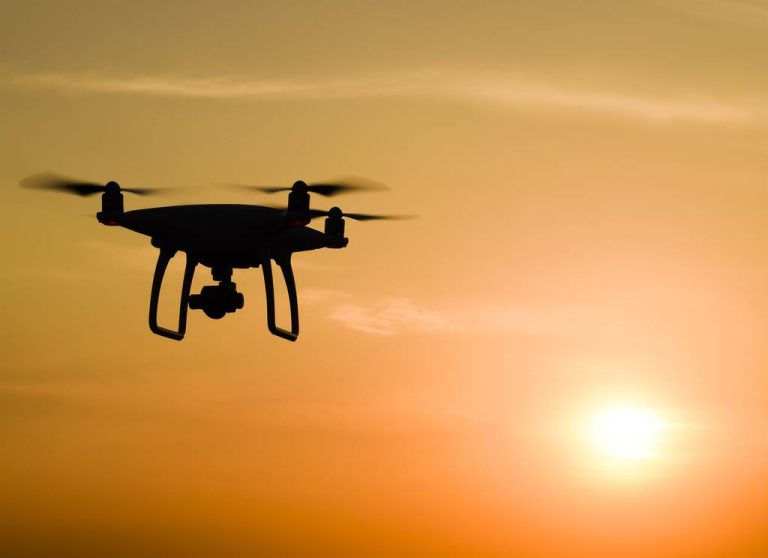
MILAN, Italy — The Danish Defence Ministry has issued a multimillion-dollar tender for several small drones intended for intelligence, surveillance, reconnaissance and fire support operations.
The Tenders Electronic Daily, an online version of the Supplement to the Official Journal of the European Union that details public procurement efforts on the continent, published last month a detailed contract notice for the purchase of NATO Class 1 small unmanned aerial systems as well as sustainment, support and training. This category of drones generally refers to tactical unit systems weighing more than 15 kilograms (33 pounds).
The main components of the order will consist of a minimum of three drones capable of vertically taking off and landing without the need for a separate system, such as launchers or parachutes. Each drone should feature a synthetic aperture radar and a primary sensor package. The order would also include two ground control stations and all necessary ground equipment.
During the assessment phase, the Defence Ministry will consider as the most important factors the specific drone category and the lowest temperature at which the system can operate and land. The value of the initial purchases are expected to be about $107 million, and the tender will close March 23.
Other outlined technical capabilities include:
An on-station time — the ability to maintain an observation position — of at least 8 hours at a range of 90 kilometers (56 miles).
The ability to take off at a temperature of minus 10 degrees Celsius (14 degrees Fahrenheit).
The ability to continue an in-flight mission, including landing, in conditions of minus 40 degrees Celsius.
The ability to launch and land on ships.
The ability to fit in two 10-foot International Organization for Standardization containers for storage.
The drones are intended primarily for national and international ISR missions. Additionally, the online documents stated that each drone is “to be operated from a total of two trucks with ISO containers, making it possible for operators to continually operate one UAV while moving the ground control station from which the drone is operated.”
The Danish military has wanted to increase its unmanned capabilities for several years, specifically to monitor Arctic regions. In 2020, Denmark announced its intention to procure drones, but that notice was terminated. A report from Tenders Electronic Daily shows the decision was made after the Defence Ministry noticed the planned acquisition did not take into account operational needs for the country’s defense.
Denmark previously experimented with several types of smaller drones, but has never possessed larger systems such as the MQ-9 Reaper. Platforms of that size tend to be more costly than smaller variants and require greater infrastructure to operate. As the country has territorial claims in areas around the Faroe Islands and the north of Greenland covering parts of the North Pole, there are few land-based structures from which large drones can land and launch; this could be why the country prefers vertical-takeoff-and-landing platforms.
In 2007, it acquired 12 Raven B small drones from AeroVironment, on which the country relied during operations in Afghanistan. In 2012, Denmark replaced them with Puma AE drones, also produced by the American company, but they were larger and can loiter for longer durations. The country currently does not possess armed variants.
Elisabeth Gosselin-Malo is a Europe correspondent for Defense News. She covers a wide range of topics related to military procurement and international security, and specializes in reporting on the aviation sector. She is based in Milan, Italy.