Paramount to make blades for Africa’s Soviet-era helicopters in UAE

0

Milan, Italy – South Africa’s Paramount Group is gearing up production of composite blades for Soviet-designed helicopters with the establishment of a production facility in the UAE, looking to collect orders from African operators of the aircraft in need of maintenance and configuration upgrades.

Last month, Paramount said it signed a strategic partnership agreement with UAE-based AAL Group to locally manufacture main and tail rotor composite blades for Mi-type helicopters. The Emirati entity has provided a full-range of maintenance and repair services for the Mi-family of rotary-wing aircraft for more than two decades

“Our activities with AAL Group in the UAE will include but not be limited to the management of an advanced manufacturing plant, an assembly line and maintenance repair and operations facilities, servicing and upgrading fleets of helicopters for our African partners,” Steve Griessel, Global CEO of Paramount told Defense News.

There are more than 23 operators of Mi-type helicopters across the African continent, with Togo being the most recent to receive new deliveries of two Mi-17 transport aircraft in December.

These aircraft are often equipped with metallic blades, which undergo significant stress during intense operations. This can increase the types of damage they are exposed to, making them prone to eroding more quickly. A traditional metal helicopter blade is made with titanium alloy, of which Russia is one of the largest exporters in the world. Citigroup recently warned that the exports of important metals could be next on Moscow’s list of restricted natural resources to get back at Western sanctions.

A high percentage of Soviet-era helicopters among African fleets are unserviceable, leading them to be either grounded for long periods of time or completely retired. This was in part due to the customers being unable to maintain their fleets, which has likely been aggravated by the Ukraine war’s impact on global supply chains and deliveries. In addition, several nations in Africa face significant budgetary constraints.

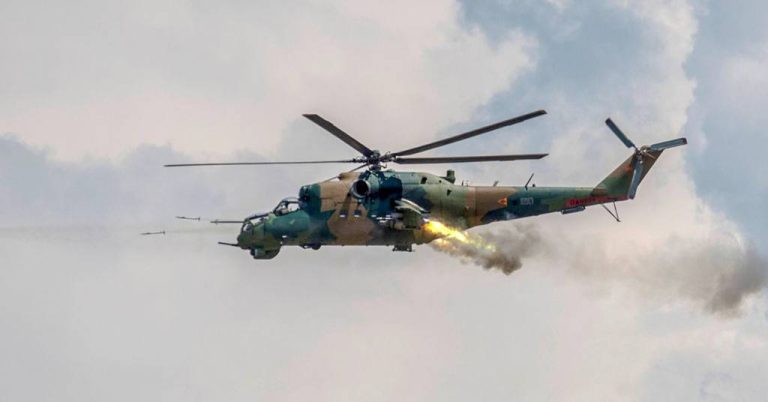
Paramount is offering composite blades for Mi-17s and Mi-24s, a fully interchangeable replacement for the original metallic ones, which offer logistical and operational benefits.

“Metal blades have a limit of around 4,000 hours of operational activity, whereas composite is almost infinite and closer to 20,000. Generally, most aircraft have limits based on time and hours operated. The time limit, that is the number of useful working years, would depend on storage, operational conditions and so on, but composite blades would far outlast metal ones,” the CEO of Paramount Aerospace Systems, Brian Greyling, told Defense News.

This alternative further allows individual blades to be replaced if damaged rather than the whole set. Although they are more expensive, the company says that the longer life usage they provide make the overall cost operations significantly cheaper. Composite blades become financially viable after 200 hours flight per aircraft.

Whereas African customers may have turned to Russian manufacturers for upgrades and MRO before, the UAE installations may give a significant advantage to Paramount in terms of seizing new business opportunities and closing certain existing gaps.

The group is providing MOR services, modernizing Algeria’s Mi-24s to advance to SuperHind standard. Many systems have also found success among Middle Eastern customers over the past few years. While Africa and the Middle East both face distinct challenges and have varying defense budgets, they also share intriguing similarities and demands, Griessel said.

“For example, there is a shared requirement for interoperability; the ready utilization of our land vehicles in border patrol, policing and peacekeeping and military support operations,” he said. “The need for the ability for technologies and mission systems to be rapidly substituted from reconnaissance to engagement scenarios is another one.”

Elisabeth Gosselin-Malo is a Europe correspondent for Defense News. She covers a wide range of topics related to military procurement and international security, and specializes in reporting on the aviation sector. She is based in Milan, Italy.

Edible And Medicinal Plants

0

Asia-Off-Grid submitted a new resource:

Edible And Medicinal Plants – Edible And Medicinal Plants

Read more about this resource…

Water Storage

0

Interesting article with a calculator.

Water Calculator: How Much Water Should You Store?

Blue Iris + Deepstack = Amazing NVR

0

Yeah, Windows…., not a big Windows fan by a long shot, but Windows does multimedia in my experience better than Linux, and this is a multimedia application. The suggestion to patch and then turn off automatic updates is made in every guide I read, but I know many will ignore or miss.

Also a good point about cams and security, which is why my network architecture is designed to prevent that. I have a PoE switch that I use for cameras that has no physical access to the Internet, so they are completely isolated. The only thing they have access to is the Blue Iris server which will be used for firmware and configuration as needed. The Blue Iris server is dual homed so it is accessible by the household LAN. Again, a lot of people miss the security concerns of the cameras or just don’t care.

As for performance, a 6th gen i3/5/7 CPU or later does H264 compression natively and that helps quite a lot. The setup used in the video runs 9 4K cameras, though it records a second stream from each at 1080. In a different video he mentions that CPU utilization with Deepstack and Home Assistant doing automation tasks is under 50%.

You might consider watching the configuration portions of the video. Blue Iris will work with minimal adjustments, but if you want to optimize it then it needs to be tweaked a bit.

I currently have it running on a $200 Dell 7020 2% CPU with one camera running in service mode. This has a 4th gen CPU so it’s doing the compression less efficiently in software. One thing I noted is that if I run the BI application that CPU utilization jumps from 2% to 7%. Using the web interface instead does not increase CPU utilization. So, in addition to checking the config settings, use the web interface to monitor the cameras and only open the non web UI to make changes.

When I get the cat-6 pulled I’ll likely have to get another refurbished computer that’s more powerful, but waiting until I need it and also I keep discovering that I need more cameras than I thought – I need six just to cover all the entrances and exits from my house, then the driveway, the backyard and two side yards. Now, I’m up to ten. Oops, doorbell so 11. Then perhaps a few internal…

Why the need for all that? The times they are a changing, or so the song goes. Yesterday I went to pick up a replacement monitor for my wife I found on FB marketplace. The exit I took from I-205 onto Foster is like all our off ramps – it’s a third world tent city. I’ve noticed over the last year that all the houses just off these off ramps now have the majority of their windows boarded up. Obviously tent cities bring crime. They are all choked with discarded shopping carts and piles of garbage. Permissive policies are like pouring water and fertilizer on weed beds and so it goes. I’m realistically stuck here for three years, but in a relatively safe area.


New VA motto | Survival Monkey Forums

0

The previous motto was from Lincoln’s second inaugural address in 1865: “To care for him who shall have borne the battle and for his widow, and his orphan.”

The new motto will still be based on Lincoln’s words but instead reads: “To fulfill President Lincoln’s promise to care for those who have served in our nation’s military and for their families, caregivers, and survivors.”

The use of male-specific language in the original mission statement has long drawn criticism from veterans advocates who note that women veterans are the fastest growing cohort of the community, expected to make up one in every five living veterans in America by 2040.

VA leaders said the decision was made after interviews with more than 30,000 veterans over the last two years. According to those surveys, the change was supported by the majority of every age group, racial group and gender group.

They noted that the motto change not only includes a wider scope of veterans, but also better emphasizes the role of veterans’ family in their care and benefits.

I thought it was perfectly clear the way it was, but I prefer the 1611 English translation of the Bible too.


Modern ‘shock and awe’ would be defined by aging jets, new tactics

0

The next “shock and awe” campaign may never drop a single bomb.

It’s been 20 years since black-and-green footage of Baghdad under attack flashed across television screens worldwide, broadcasting the explosive U.S.-led push to unseat Saddam Hussein and dismantle the Iraqi civil and military service.

The overwhelming show of strength represented the largest international military effort since World War II and the biggest U.S. operation since the Vietnam War. The air campaign relied on 1,800 aircraft — half of which belonged to the U.S. Air Force — and fired more than 500 cruise missiles in its first day. Airmen gained control of Iraqi airspace less than three weeks later, with limited American losses.

But could the United States do it again? Like most questions of military strategy: It depends.

Fighter technology has advanced; bombers have not. Their logistics chain has rusted as planes grow older and it becomes harder to supply spare parts. Cyber and drone warfare would be a cornerstone of any offensive, even as U.S. forces would face many of the same threats from an adversary. Battlefield tactics are increasingly complex and attuned to the digital age.

“It’s got a big asterisk,” said retired Air Force Gen. T. Michael “Buzz” Moseley, who led the air campaign in Iraq before becoming the service’s chief of staff in 2005. “Philosophically, can you do it? Yeah. Are you prepared to do it? Yeah. Are you trained to do it? Yeah. But do you have the assets to do it and sustain it?”

What that may look like largely depends on the precipitating event, and where the invasion happens, current and former Air Force officials and defense experts told Air Force Times. Is there an advanced military on the other end? Was the groundwork laid ahead of time for a smoother takeover? How far would American jets and their weapons need to travel?

And, they said, what’s the long game?

“There’s a bunch of things the United States could do to quickly blind [an adversary],” said Peter Bergen, a vice president at the Washington-based New America think tank and co-director at Arizona State University’s Center on the Future of War. “Regime change is something that we seem to be able to do very quickly. … The question is, what comes next?”

From Iran to North Korea, any air campaign must make sense with the political and military objectives it hopes to achieve, Air Forces Central commander Lt. Gen. Alexus Grynkewich said.

In the precision-attack era, backed by savvier cyber operations, that may not require weeks or even months of nonstop bombing.

“When I have seen the term ‘shock and awe’ used, and people say that ‘shock and awe’ failed, I often find that what we’re really talking about is, ‘We tried to do something cheap and easy at the beginning with a limited amount of military force,’ rather than thinking about how we could apply pressure and lethal effects across the entire enemy system at once,” Grynkewich said.

Harlan Ullman, the military consultant credited with coining the term “shock and awe,” believes a true shock and awe campaign would rely much more on psychological warfare and diplomacy to keep adversaries in check and shape conditions in America’s favor. Those operations have dwindled in the decades since the Vietnam War as the Pentagon prioritized a more traditional approach to combat.

“Let them know from the beginning: They’re not going to survive the war. … We’re going to turn them into the Stone Age” without putting a single plane in enemy airspace, said Ullman, a senior adviser at the Atlantic Council.

‘Not a meat ax’

If the U.S. were to go to war first with its electronic attack planes and a strong disinformation campaign, followed by cyberattacks and standoff weapons, Ullman said it could prove more effective and efficient than dispatching legions of hardware and troops.

For instance: Shock and awe in the Pacific could look like a defense force capable of preventing China’s military from reaching Taiwan, without striking first, he said. If that force also threatens to cut off China’s access to air and sea shipping, Beijing could capitulate.

“We need to be able to use a scalpel and not a meat ax,” Ullman said. “We don’t, because our default position, ultimately, is always military force.”

What people tend to envision as shock and awe, though, comes after containment fails. Then it’s a race against the clock — and enemy forces — to gain control of enemy airspace.

“You’re going to have to figure out a way to campaign plan the usage of the existing F-22s and F-35s, and at some point you’re going to end up having to use F-16s and F-15Es and perhaps A-10s,” Moseley said. “But not on day one, not on day two. You’re going to have to damage that [integrated air defense] and damage that opposing force.”

Today’s surface-to-air missiles are much more lethal than those wielded by the Iraqis. They’re also harder — but possible — to take down, he said.

“There’s a million ways to go after an integrated air defense system,” such as the Russian-built S-300 or S-400 surface-to-air missiles teamed with other radars, anti-aircraft artillery and command nodes, Moseley said: Confuse them, or the people running them. Attack them kinetically or non-kinetically. Stress them. Target their command and control. Jam them.

That could require a more sophisticated approach than the bombing runs against surface-to-air missiles and anti-aircraft artillery in Iraq.

Current Air Force officials envision a network of drones that would act as decoys and add frontline firepower without putting Americans in harm’s way. Those would be paired with more advanced electronic attack tools, long-range munitions and stealthy aircraft than existed in 2003, plus a more diverse array of intelligence-collection and communications nodes to maintain situational awareness.

“If we try to do shock and awe in a traditional sense of, ‘Oh, we’ll bomb a bunch of stuff and then wait,’ that sounds a little bit too ‘Rolling Thunder’ and not quite enough ‘Linebacker II’ to me,” Grynkewich said.

Operation Rolling Thunder was the three-year U.S. bombing campaign that tried to halt North Vietnam’s takeover of South Vietnam from 1965 to 1968; Operation Linebacker II came in 1972 to bring Hanoi to the table for peace talks.

Tactics that emerged in 2003 have continued to evolve as well, from the B-2 Spirit bomber’s combat debut to the first use of EC-130H Compass Call electronic attack planes for psychological warfare.

Airmen think more comprehensively about those options now, and are better at seeing a variety of solutions to a problem than they were 20 years ago, Grynkewich said.

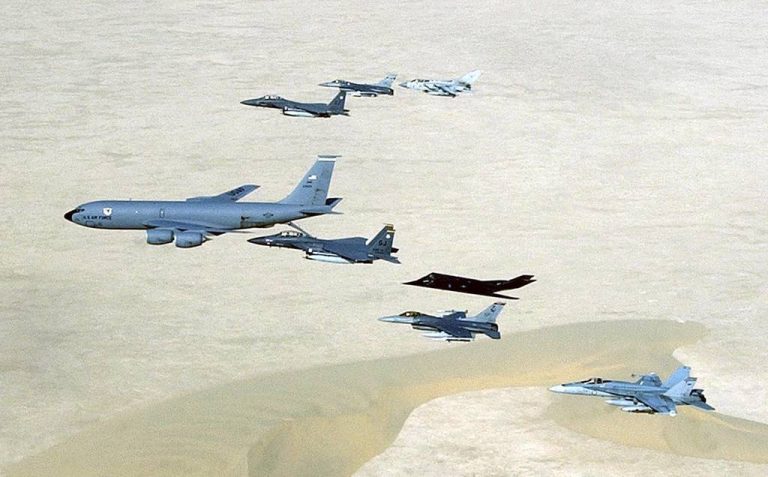
Considering the full spectrum of military options has grown more important as America’s air arsenal ages. The average fighter jet is nearly 30 years old; the oldest tankers first deployed in the 1950s.

Its workforce is shrinking, too: The active duty Air Force now has about 51,000 fewer troops than it did in 2003; the Air National Guard and Air Force Reserve have around 33,000 fewer troops in total.

Some experts worry those trends would weaken any U.S. attempt to gain control of enemy airspace and pummel them into submission.

“I believe we can do it. It’s just going to be harder because of the nature of the equipment that we’re forced to use,” Moseley said.

The Air Force’s stealthy F-117 Nighthawk fighter jets used during Operation Iraqi Freedom were replaced by the fifth-generation F-22 Raptor and F-35 Lightning II fighter jets after 2003. No new bombers have come online since OIF; the Air Force’s cargo, surveillance and refueling fleets are largely the same.

Future platforms like the B-21 Raider stealth bomber, E-7 Wedgetail aerial target tracking plane and a sixth-generation fighter remain years away. And going to war with older aircraft complicates maintenance and supply chain needs.

Moseley argues that, in lieu of a newly designed fighter, the Air Force needs more of the non-stealth F-22s in order to control enemy airspace. It would need a bomber fleet that can sustain airstrikes over longer periods of time. And it needs more KC-46 Pegasus tankers, now.

“The thing I worried about the most, the single-point failure for the entire campaign, to include air and ground campaign, was the tanker,” he said. “Do we have a new tanker in sufficient numbers, so that’s not a problem? … We don’t.”

Another potentially major point of failure: what Moseley believes is the U.S. military’s overdependence on satellite communications.

“If we can’t command and control forces, we don’t go blow stuff up,” he said. “Given the capabilities that we have seen with malware, cyber, [kinetic and non-kinetic attacks, and anti-satellite weapons], are we absolutely confident … that our command and control systems are intact and resilient? I suggest we’re not.”

The invasion of Iraq marked the first time the head of American airpower in the Middle East was put in charge of space operations. Now that’s the Space Force’s job.

Its new unit, U.S. Space Forces-Central, plans how to wield and protect space-related assets as part of an overall mission. That can help GPS, missile warning systems and other satellites and radars stay reliable when needed, and explore new ways to integrate them into offense and defense.

That expertise can come in handy especially as small drones continue to grow as a centerpiece of modern warfare. Those systems are also crucial to protecting overseas U.S. and coalition infrastructure that could be pelted with rockets or drones in retaliation.

One thing experts hope gets left in the early 2000s: the phrase “shock and awe” itself.

It’s too flippant for an act of war, misunderstood in its intent, carrying too much baggage 20 years later, they said.

“Frankly, I don’t care if they’re awed, I just care if they’re shocked,” Grynkewich said. “I care if I get the military outcomes that I’m looking at, from the perspective of having their … decision-making apparatus seize up, having their sustainment fall apart, and having them freeze in their place.”

Rachel Cohen joined Air Force Times as senior reporter in March 2021. Her work has appeared in Air Force Magazine, Inside Defense, Inside Health Policy, the Frederick News-Post (Md.), the Washington Post, and others.

Canning Chicken – Here’s Ho To Do It

0

As a child, my family lived in a rural area without the convenience of deep-freezers powered by electricity. This meant that my mom and grandma had to can food out of necessity, including my mom’s prized creation of home-canned chicken. Canning chicken is an economical and reliable way for those who raise chickens to make use of surplus meat.

However, even those who don’t raise their own chickens can take advantage of great deals on chicken at the butcher shop, supermarket, or from local farmers. Additionally, canning is a great way to extend the shelf life of poultry that’s about to expire in the freezer. It’s not just chicken that can be canned either – other poultry such as turkey, geese, ducks, and even rabbits can be preserved this way.

Once you have a supply of canned chicken, there are countless ways to use it in delicious recipes. One of my family’s favorites is my mom’s recipe for canned chicken and dumplings – a comforting and satisfying meal that’s perfect for winter evenings. Give it a try and see for yourself why canned chicken is such a valuable pantry staple.

The pressure canner

Nowadays, I find that canning chicken is much simpler than in my mom’s time, thanks to the pressure canner. This type of canner ensures the safe preservation of low-acid foods, such as meats, fish, and vegetables, by regulating and gauging the temperature to reach the appropriate level of sterilization. In contrast, in the olden days, mom and grandma used a “boiling water bath” canner over a woodstove, which involved guesswork and was not suitable for low-acid foods.

Although we never got sick from eating mom’s and grandma’s canned goods, improperly canned foods – particularly meats, fish, and vegetables – caused food poisoning for many people in the past. To avoid this, it is essential to use a pressure canner for low-acid foods according to the manufacturer’s directions to prevent botulism.

Pressure canners are available in various sizes, and it’s important to ensure that second-hand or older models are in good working order, with gauges that have been tested by the manufacturer or county extension agent.

It is also crucial to use approved canning jars that are free of nicks and have new two-piece, self-sealing lids. Outer bands can be reused if undamaged, but inner lids must never be reused. Old-fashioned jars with glass or zinc-lined lids, rubber bands, and galvanized screw tops are not safe for proper sealing. And, it’s essential to avoid using recycled jars from store-bought food, as they may not be strong enough to withstand the pressure and their lids lack sealing compound, which is necessary for a secure seal.

Getting started

To begin with, gather your canning equipment, including a pressure canner, jars, lids, a timer, and a jar lifter. Additionally, you will need the birds you wish to can. If you are using fresh chicken, make sure that they are thoroughly cleaned and all pin feathers have been removed.

In the case of processing previously frozen birds, thaw them overnight in the refrigerator, so they will be ready to use in the morning. While handling the birds, it’s recommended to keep the kitchen as cool as possible to ensure that they maintain their optimal condition when placed in the jar.

Methods of packing jars when canning chicken

There are two basic methods for canning poultry: the “raw pack” method and the “hot pack” method. My preferred method for canning chicken is the raw pack method, where the chicken parts are packed “raw” into prepared jars.

This method reduces the amount of work needed for canning and produces tender meat without precooking. However, it is important to follow the exact timing provided in the pressure canner manual to prevent the meat from falling apart or becoming stringy. Adjusting the manual directions is not recommended.

The raw pack method is the one I learned from my mom and the one I like to use. If you are canning only a few birds, such as three or four whole chickens in one session, it works well as it can fill a 6-quart sealer. For larger canners, you can process as many jars as it can accommodate in one session. If you have to process multiple batches, keep the unprocessed jars in the refrigerator until it is their turn for the canner, and do not leave them at room temperature.

In my experience, one quart of canned raw-packed chicken – which includes one half of a breast cut into two pieces, one leg, one thigh, and one wing – is sufficient to feed a family of four. If you want to add extra pieces to each jar, you can fit in another leg or thigh, or perhaps two.

However, keep in mind that the more chicken you add, the less broth you will have, and you will end up with fewer jars of the finished product. On the other hand, you can process more birds in a single batch. So, when deciding on the number of pieces of chicken in each jar, consider your needs, the desired amount of broth, and the number of chickens you want to process per batch.

The other common method of packing food into jars is the hot pack method. This involves precooking the chicken first. The chicken parts, whether whole or cut up, are boiled until tender, cooled, and deboned. The hot meat is then packed into jars and covered with the broth in which it was cooked. The jars are then processed in the pressure canner according to the directions for hot packed poultry in the manual.

This method allows you to process two or three times as much chicken in a single batch. Smaller jars may be more suitable for this method. The choice of jar size depends on how much meat your family needs per meal. Larger jars are good for serving guests if a quart is too large for a single-family meal. While I prefer the raw pack method mentioned earlier, you may wish to try both methods to determine which works best for you.

To can chicken using the raw pack method, I processed three plump whole birds, which produced six quarts of canned chicken meat in broth, excluding the necks, backs, and wing tips that I saved for making broth. While these pieces can be added to the jar, I find them better suited for the soup pot.

Before canning the chickens, I always make a rich chicken stock by simmering around five pounds of chicken soup parts (giblets, necks, wing tips, and backs) bought from my local butcher at reasonable prices. This provides ample broth to cover the meat in the jars for processing and leaves enough leftover chicken stock to make a batch of canned chicken soup the following day. Additionally, I can simmer the saved soup parts from the whole birds canned the day before to add to the stockpot, ensuring nothing goes to waste.

bake bread without yelectricity

Note that homemade chicken stock can be substituted with store-bought stock, bouillon powder or cubes, or even water, depending on preference. It is also possible to omit the liquid entirely, allowing the chicken to form its own juice during processing. However, adding salt to each jar is recommended for enhanced flavor.

To determine your preferred method, it is best to try both and compare. Personally, I find homemade stock worth the time and effort as it can be tailored to your taste. If using stock, heat it to boiling before use, and if using water, have a tea kettle ready to boil.

Start by washing jars and sterilizing them in boiling water for five minutes. While not required, I find it to be an extra safety measure and removes any food or odors from pre-used jars. Keep the jars hot until ready to fill and prepare the lids according to the manufacturer’s instructions.

If using whole chickens, cut them into uniform, serving-sized pieces. I use the “standard” cut, which involves removing the legs, thighs, wings, and back from the breast and then cutting the back into two pieces for stock-making. Leave the skin on for extra flavor.

Pack the cut-up chicken pieces into the hot jars, leaving 1 inch of headspace. For added flavor, add a sprig of fresh herb and a pinch of dried hot chile flakes to some of the jars. Pour boiling stock over the chicken and remove any air pockets with a spatula. Wipe the rims of the jars with a cloth dipped in vinegar to remove any grease.

Apply the prepared lids and lightly screw on the metal bands. Process the jars in a pressure canner according to the manufacturer’s directions, taking into account the jar size and altitude. The processing times will vary depending on whether the meat is bone-in or boneless.

After the processing time is up, let the pressure canner depressurize before removing the lid. Remove the jars from the canner and let them cool without disturbing. Inspect each jar carefully to ensure it has a proper seal. If the lid is flat or bulging, treat it as an improperly sealed jar and handle accordingly.

Safety check before eating home canned foods

Before using any jar from your pantry, it is important to carefully examine it. First, run your hand over the jar to check for any signs of grease or stickiness, which could be indicative of a leak. Look closely for rust or discoloration around the lid’s edges, and check if the lid is bulging.

Once you open the jar, observe it for any signs of activity, such as bubbling, spurting, off-odor, or discoloration. If you notice anything suspicious, do not consume the contents. Always follow the golden rule: when in doubt, discard it! And, remember, if you suspect the food has gone bad, dispose of it in a secure manner where pets or other animals cannot access it.

My two favorite recipes

herbed dumplings with canned chicken recipe

Herbed Dumplings with Canned Chicken Recipe

This recipe from my mom is a classic that has stood the test of time! It’s perfect for canned chicken since it requires minimal cooking time. I always choose recipes that don’t take too long to cook when using canned chicken.

To start, make the dumpling dough:

  • 1 1/4 cups flour
  • 2 tsp. baking powder
  • a pinch of salt and dried mixed herbs to taste (such as parsley, basil, and oregano)
  • 2 Tbsp. margarine or butter
  • 1/2 cup milk (more or less)

In a mixing bowl, combine the dry ingredients. Cut in the margarine with a fork until the mixture is crumbly. Add just enough milk to form a soft dough.

Now, on to the chicken:

  • 1 quart canned chicken with broth
  • 3/4 cup boiling water

Empty the canned chicken with broth into a saucepan. Pour one cup of boiling water into the jar to rinse out the jar and then add it to the chicken in the pan. Heat the mixture to boiling, and then drop spoonfuls of the dumpling dough onto the hot chicken. Reduce the heat, cover with a lid, and let it simmer for 12 minutes without peeking. When the time is up, test the dumplings with a fork. They should be light and fluffy. If they’re not quite done, cross your fingers, cover the pot again, and let it simmer for a few more minutes.

Chicken (or turkey) soup

Homemade chicken soup is a family favorite, and each recipe can be unique. Here is how I make mine, which can be easily adapted to your liking.

Ingredients:

  • 2 to 3 quarts of homemade chicken broth
  • Leftover cooked chicken or turkey meat
  • Vegetables (celery, carrots, cabbage, turnip, parsnips, onions) to taste, cut into large chunks
  • Barley (optional)
  • Fresh minced or dried herbs (oregano, parsley, rosemary, and basil) to taste
  • Salt and pepper to taste

Instructions:

  1. Put the homemade chicken broth into a stock pot and bring it to a boil.
  2. Add the leftover cooked chicken or turkey meat to the broth.
  3. Add the vegetables and barley (if using) to the broth. Cut them into large chunks so that they stand up better during the canning process.
  4. Add the fresh minced or dried herbs to the broth.
  5. Simmer the soup for 15 minutes.
  6. Remove the pot from the heat and season with salt and pepper.
  7. Ladle hot soup into prepared jars, dividing the vegetables equally among the jars.
  8. Wipe the rims of the jars with a cloth dipped in vinegar, put on lids and outer bands.
  9. Place the jars in a pressure canner and can according to the instructions in your pressure canning manual. Adjust for altitude and jar size used.
  10. Remove the jars from the depressurized canner and let them cool. Check for proper seals before storing.

Having a few jars of homemade chicken soup on the pantry shelf is super handy for any time a craving strikes. And remember, each homemade chicken soup recipe can be unique and is always delicious!

Suggested resources for preppers:

Harvesting and canning wild greens

The #1 food of Americans during the Great Depression

Survival Foods of the Native Americans

If you see this plant when foraging, don’t touch it!
Buying gold, silver when to start?

0

I remember when it was 800 then 500 and folks reminisced about when it was 800.. Will it drop to 500 an ounce again?? A1000 an ounce? OR.. 20 an ounce anyone?

PM’s are tied to the purchasing value of FRN’s and can be thaught as an exchange of value.

Buy a dozen egg’s for an ounce of gold ..
OR, $20,000.00 FRN’s if is value is adversly impacted by inflation..
I can trade for FRN’s, food, shelter, tools and transportation.. Oh, and defensive measures..
The medium for exchange would be based on it’s trading value. The storage considerations should be based on the speculation of future purchasing value.. Traditionaly, PM’s hold it’s trade value well.

As I see it, storage of the hours I have worked today will be based on by it’s future trade value..
Today, gold is available for trade for 1300 inflated FRN’s..
PM’s, bullets, beans, or bandaids.. What is your choice for storage of hours worked…


Kabocha | Survival Monkey Forums

0

Wifee loves kabocha. We even add it to the dogs’ meals along with brown rice.

I first made kabocha coconut curry for her and she really liked it, so I make it in various ways. We may start growing some.

Wifee even eats the plain ones I cook for the dogs.


Salads | Survival Monkey Forums

0

What’s your favorite salad?

Wifee and the little monkey like salads. Last time, I made a Mediterranean salad like an antipasto, topped it with couscous and then shrimp. They liked it a lot.

Tonight was a regular salad topped with pearl couscous topped with shrimp. Monkey said more shrimp, it’s yummy.