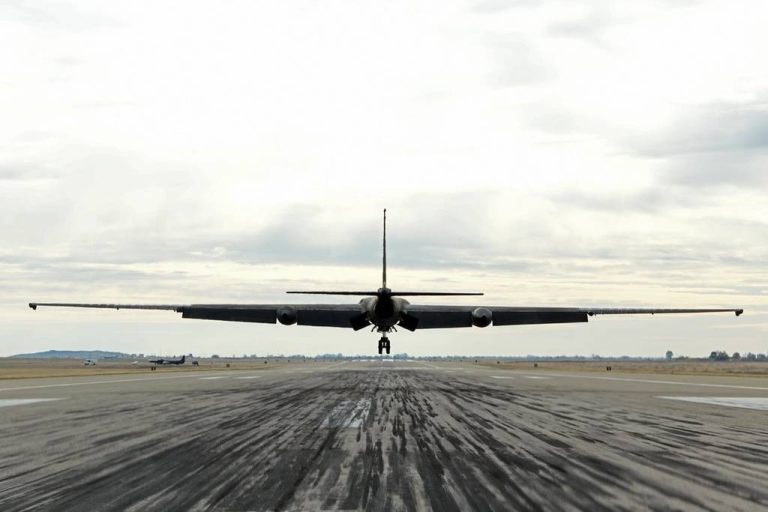
The Air Force is forging ahead with its plan to retire the storied U-2 Dragon Lady spy aircraft in fiscal 2026, as part of a yearslong effort to reshape how the service surveils American adversaries from above.
Air Force leaders have considered retiring the U-2 fleet for nearly two decades, asking Congress in some years to ditch the Cold War-era workhorse or, in others, to retire the RQ-4 Global Hawk drones that were meant to replace it. Now both are on the chopping block.
If Congress approves the divestment and lets the Air Force retire its remaining RQ-4s one year later, the service would finish out the decade without the high-altitude reconnaissance aircraft that peer across borders and track enemy movements.
Sen. Ted Budd, R-N.C., noted the service’s plan for the U-2 on Tuesday in a Senate Armed Services Committee hearing on the Department of the Air Force’s fiscal 2024 budget request. The pending retirement was briefly mentioned in military budget documents released earlier this spring.
The service’s previous spending requests have foreshadowed the end of the U-2 fleet in the mid-2020s, including in its asks for fiscal 2021 and 2022. Last year’s request did not specify when the airframe would retire but zeroed out modernization funds after 2025.
The newest slate of budget documents acknowledges that the Air Force plans to keep the U-2 fleet viable through the end of September 2025, before shifting that money to higher priorities.
The Air Force said it expects Congress to remove legislative language that has blocked the jet’s retirement in the past, allowing the service to “move forward with U-2 divestment in FY 2026.”
The annual defense policy acts approved by Congress have sought to ensure that the Air Force has a suitable replacement for the U-2 and RQ-4 before yanking the assets that commanders around the world rely on for intelligence.
But once it cuts those fleets, the Air Force would instead turn to space-based sensors to collect a similar set of high-altitude images, its budget request said.
The Air Force’s 27 U-2s are housed at Beale Air Force Base, California, and rotate through military installations around the world. The aircraft are famous for the 105-foot wingspan that allows them to glide at the edge of space, the pilots clad in astronaut-like pressurized suits, the bulbous nose radars and the chase cars that follow the wobbly planes down the runway to ensure they land safely.
Known for capturing the images that proved the Soviet Union was building nuclear missile sites in Cuba in 1962, sparking the Cuban Missile Crisis, the U-2 gained new fame for tracking a Chinese surveillance balloon’s journey across the United States earlier this year.
Until recently, the jets relied on wet-film cameras with enormous film canisters that had to be shipped to Beale and developed by the 9th Reconnaissance Wing there. That practice ended last summer in a pivot to the digital era.
Dragon Ladies have lately taken on a new role as testbeds for a host of more advanced reconnaissance and communication technologies, and have helped vet new artificial intelligence tools in the Air Force’s quest for more capable drones.
The U-2 is also being used as a surrogate platform in the Air Force’s Advanced Battle Management System program, which looks to dramatically improve data-sharing capabilities among military assets.
It’s unclear how the Air Force would repurpose U-2 pilots and others in that enterprise if the airframes are allowed to retire.
Rachel Cohen joined Air Force Times as senior reporter in March 2021. Her work has appeared in Air Force Magazine, Inside Defense, Inside Health Policy, the Frederick News-Post (Md.), the Washington Post, and others.
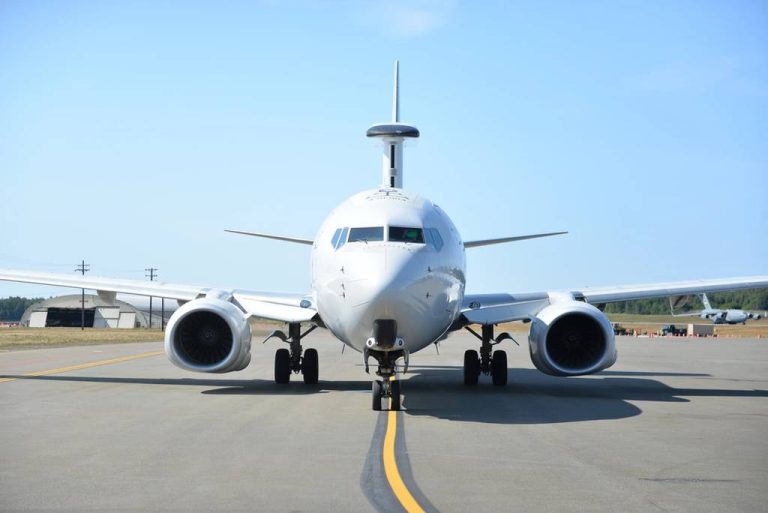
Around five dozen American airmen will head to Australia this summer to learn how to fly and repair the E-7 Wedgetail command-and-control jet, as the U.S. Air Force looks to accelerate the acquisition program by any means necessary.
Their visit — four years before the Air Force expects to receive its first E-7 — aims to speed up the service’s transition away from its nearly 50-year-old E-3 Sentry aerial target tracking jets.
Chief of Staff Gen. CQ Brown Jr. noted the upcoming trip at a Senate Armed Services Committee hearing Tuesday, in which Department of the Air Force leadership defended their budget priorities for the coming fiscal year.
“We’re going to be able to send … in June, close to 50 to 60 of our airmen to actually start training on the E-7s, so when we do get our aircraft, we’ll have trained operators and maintainers to help accelerate bringing the E-7 into our inventory,” Brown said.
The modern airframes would improve the Air Force’s ability to tell who is traveling in nearby airspace, where they are going and how quickly — information that’s crucial for keeping tabs on foreign forces or for directing friendly aircraft in an air campaign.
In February, the service awarded Boeing a $1.2 billion contract to begin work on two prototype jets that are slated for delivery in 2027. It plans to buy a total of 26 E-7s by 2032.
Australia, Turkey, South Korea and the United Kingdom already own, or are in the process of building, their own E-7s as well.
Readying the first two prototypes is expected to require $2.7 billion and four years in total: two years to build the commercial Boeing 737 airframes, plus another two years to outfit and test them with military-grade radars and communications equipment.
That timeline is still too slow for Air Force Secretary Frank Kendall, who said the service hasn’t found any feasible ways to accelerate the program’s early stages. The service is trying to make it possible for Boeing to deliver more aircraft faster once full production gets underway in 2025.
Pressed by Sen. Roger Wicker, R-Miss., on what became of an extra $200 million that Congress provided last December to speed up the acquisition, Brown said it helped pay for initial development and to get a head start on building up it`s inventory of E-7 parts.
But Kendall couldn’t say for certain whether receiving more money than requested has saved the program any time. He argued the initial jets will take four years regardless of how much money Congress throws at them.
“I did a personal review of the steps that are necessary to get it into the first phase of testing, and we couldn’t find a way to redo that,” he said.
More money would help speed later batches of aircraft, Kendall told lawmakers, but the service felt it couldn’t afford to ask for that funding in the fiscal 2024 budget. The Air Force requested $681 million to develop the jet in the coming year, plus another $633 million to speed its delivery as part of a separate wish list to Congress.
“That program has been moving as fast as we’re able to move it,” Kendall said.
While the E-7 is one of several programs that are designed to rapidly deliver prototypes, the service still faces funding shortfalls that may keep those from moving forward, according to the budget documents.
But demand for the aircraft is mounting as the E-3s grow more expensive and difficult to maintain. The Air Force is in the process of retiring its 31-jet Sentry fleet, which could number just 16 by the end of fiscal 2024.
The sooner the U.S. version of the Wedgetail can arrive to replace them, the better, Air Force officials argue.
“I just wanted more than twins,” Air Combat Command boss Gen. Mark Kelly said in February, referring to the first two E-7s. “I want as many of those kids as I can.”
Rachel Cohen joined Air Force Times as senior reporter in March 2021. Her work has appeared in Air Force Magazine, Inside Defense, Inside Health Policy, the Frederick News-Post (Md.), the Washington Post, and others.
BALTIMORE — The U.S. Department of the Air Force expects to move hundreds of applications to the cloud this year, according to Venice Goodwine, the director of enterprise information technology.
The department has already migrated at least 100 apps, relying on its Cloud One program, and has “almost 200″ more in the pipeline ready to go, she said at the AFCEA TechNet Cyber conference in Baltimore. Apps in the military run the gamut, from recruiting to base updates, health information to higher-security matters.
The focus on cloud comes as the department, which includes both the Air and Space forces, seeks additional digital durability and portability. The forces are among the most dispersed, with bases dotting the U.S., Europe and Asia.
“You’ll hear me say that data is the currency of the realm. And what I mean by that is, I have to make sure the data is available. It’s accessible, it’s where it needs to be, that the data can be actionable,” Goodwine said May 2. “I will need the cloud to do that.”
Cloud One was launched years ago, providing access to apps, information and broader connectivity using products from big-name players including Amazon and Microsoft. Science Applications International Corp. now holds the contract, worth hundreds of millions of dollars. The Air Force previously said the move to the cloud can save money, rid of outdated hardware, and reduce vulnerabilities.
RELATED
Cloud One’s successor, Cloud One Next, or C1N, was teased by the department in a November request for information.
The documents asked companies how they “might approach managing and modernizing Cloud One” while considering “recent government leadership direction.” The National Defense Strategy and the Air Force chief information officer’s strategy for fiscal 2023-2028 were attached to the notice.
Jay Bonci, the Air Force department’s chief technology officer, in December told C4ISRNET industry response to the request was diverse and substantive.
“We’re looking at a couple of different kind of economic models for how we continue to get cost efficiency and get scale for how we’re able to get more applications into the cloud,” he said at the time. “Really, the focus is going to be on adoption.”
Colin Demarest is a reporter at C4ISRNET, where he covers military networks, cyber and IT. Colin previously covered the Department of Energy and its National Nuclear Security Administration — namely Cold War cleanup and nuclear weapons development — for a daily newspaper in South Carolina. Colin is also an award-winning photographer.
WASHINGTON — By the end of the year, a new and unusual deal for the F-35 fighter′s spare parts could be in place — one that would flip the current supply model on its head.
If the proposed performance-based logistics contract works the way F-35 manufacturer Lockheed Martin has promised, it will save the government money, improve the availability of spare parts and give the company greater flexibility on how it assists repairs, such as making it easier to fix a broken part without fabricating a new one.
Lockheed has for years sought a performance-based logistics, or PBL, contract for the F-35, albeit in a different form. Instead of the traditional transactional model in place today, in which a contractor is paid for specific parts or services, a PBL deal pays the contractor based on how well it meets expected performance outcomes.
The PBL contract now in negotiations, referred to as a “demand reduction” deal, would be a more limited version of the “tip to tail” agreement Lockheed first proposed in 2019, and would cover only the spare parts needed to repair the fighter. Lockheed’s original tip to tail pitch would have also covered support and sustainment activities, and judged the company on overall mission-capable rates, but the Pentagon balked. The military’s F-35 Joint Program Office told Defense News it opted to scale back the deal’s scope to one “that incentivizes [Lockheed] to take risks in areas they have full control over.”
The JPO said it is on track to award the five-year deal to Lockheed by the end of this year, if a study using data from the Pentagon’s Cost Assessment and Program Evaluation office verifies to Congress that a PBL deal would either reduce cost or improve readiness. A companion deal, for repairs and other nonmaterial sustainment support and services not covered by the PBL contract, would also be awarded at the same time.
Officials from the JPO and Lockheed said in interviews with Defense News that a performance-based logistics contract could be better for both parties than the transactional model, particularly by encouraging the company to reduce the demand for new spare parts for the F-35.
Ed Apollo, the JPO’s product support manager, said a PBL contract incentivizes Lockheed to invest in new processes and improvements to make parts last longer.
“The lower the demand, the more gravy for industry,” Apollo said. “The higher the demand, the less the [profit] margins. … That is the No. 1 benefit that we’re looking at in a performance-based logistics contract.”
But some experts said the deal could carry risk; most notably, could a PBL contract handle a surge in capacity required during a war?
Brad Martin, director of the National Security Supply Chain Institute at the think tank Rand, said some major programs have used PBL deals in recent years, including the Aegis weapon system and the P-8 Poseidon aircraft. But they’re not as common as they once were, he told Defense News, “and they have a lot of baggage.”
“It yields to the contractor an awful lot of discretion as to how they’re going to fill the orders and how they’re going to deal with the demand,” Martin said. “As a result, [the contractor] is in a position of managing things up to the point where there’s a crisis — and then when there’s a crisis, what are you going to do?”
Martin said PBL deals were more customary in the early 2000s, when the Pentagon sought to achieve efficiencies of the kind typical in a private sector business. The department in 2001 identified PBL contracts as its preferred weapon system support strategy, according to a 2008 Government Accountability Office report.
But they didn’t always produce the promised cost savings, Martin said.
He said a PBL contract would likely incentivize Lockheed to maintain an inventory of parts sufficient for normal, day-to-day operations, such as flying standard patrols, training sorties or test flights.
But during a war that causes F-35s to fly significantly longer and harder, while possibly suffering wear and tear from battle, hard landings and more sorties, he said, it’s hard to say what kind of supply inventory and pace would be required, and whether a PBL approach could keep up.
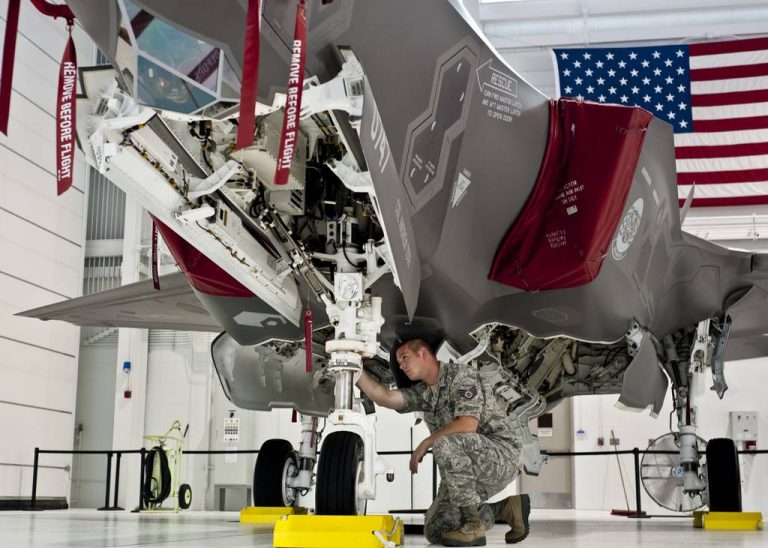
Staff Sgt. Andrew Martin, 944th Aircraft Maintenance Squadron crew chief, finishes preparing an F-35’s cockpit for flight on Jan. 29, 2019, at Luke Air Force Base, Ariz. (Staff Sgt. Lausanne Kinder/U.S. Air Force)
How would a PBL deal work?
The military has awarded Lockheed Martin multiple iterations of the current transactional contract to sustain F-35s since the fighter program’s inception, most recently in 2021. But for years the program has struggled to hold sustainment costs down and keep the plane’s readiness rates high enough. The average mission-capable rate for all U.S. F-35s is 56%, which falls below the 70% readiness rate the military wants for the Air Force’s F-35A, and the 75% goal set for the Department of the Navy’s F-35B and F-35C variants.
Today, Lockheed’s transactional sustainment contract spells out how many of the thousands upon thousands of spare parts needed to repair the planes will be on hand, Apollo said.
A supply chain-focused PBL contract would operate differently, Apollo added, as Lockheed wouldn’t need to keep specific numbers of parts on hand. Instead, the company would be judged on whether those parts are available when needed, or whether it can get those parts to the field within a certain amount of time.
Because PBL contracts are firm-fixed-price deals, he explained, Lockheed would bear the risk if it makes the wrong call on how many of each part to have on hand.
“They still have to provide … the products, the performance, but if they have to spend beyond the [firm-fixed-price], that is all industry risk,” Apollo said. “The benefit [to a PBL deal] is it incentivizes industry to reduce demand. A healthy supply chain system that we’re looking for is not one where industry is incentivized to buy more parts.”
There are several ways the JPO believes a PBL deal could push the contractor to reduce demand on parts. When the onus is on Lockheed Martin to keep demand low, the company will be motivated to have parts that last longer and to make process improvements that stretch out their time on the aircraft before repair or replacement, Apollo said.
For example, he added, if a part leaks due to a failing seal, under a standard transactional contract the government could pay Lockheed to fix the problem by removing it — sending it to the original manufacturer for repair before reinstallation.
Airman 1st Class Bryce Jarvis checks equipment needed for his shift on the flight line at Eglin Air Force Base, Fla. All equipment needed for the daily maintenance of the F-35A must be checked out from the supply desk to keep tools accounted for and in inspection order. (Senior Airman Andrea Posey/U.S. Air Force)
But under a PBL contract, Apollo said, Lockheed would have a reason to pressure the subcontractor that makes that part redesign it to avoid frequent failures. With that redesign, “lo and behold, they reduce demand of that part by an order of magnitude, with some level of investment that was enabled by a firm-fixed-price PBL contract.”
Apollo also said a PBL deal offers industry more authority, accountability and ownership of the supply chain. In many cases, he added, it’s faster and cheaper to repair a part than making a new one. This will increase the “velocity” of the supply chain, he explained, and get parts on shelves quicker, which is financially advantageous for Lockheed.
While Lockheed would take on more risk, company officials said the flexibility of such a deal is worth it, and theyhave expressed confidence in their ability to cut demand for F-35 parts. Audrey Brady, Lockheed Martin’s vice president for F-35 global sustainment, said in an interview that about half the parts on an F-35 haven’t had to come off the plane for repair or replacement, and that more than 90% of parts on the average F-35 are staying on the aircraftlonger than expected.
“Do we know exactly where the parts need to be and when?” Brady said. “When [maintainers] go to reach for the part, is it available to them? That’s what we’ll be measured on.”
Wartime surge
But Rand’s Martin said a PBL’s design could give Lockheed an incentive to keep its inventory — particularly of rare or expensive parts — near the minimum required. And the number of spares a defense program will need in wartime is almost always vastly more than in peacetime.
“When you need them, you really need them,” Martin said.
Dan Grazier, a defense analyst for the Project on Government Oversight, echoed those concerns.
“Imagine a contract like this being signed on Sept. 10, 2001, when no one could have foreseen what was [going to] kick off the next day,” Grazier said, referring to the 9/11 attacks on the United States. “And all those plans the day beforehand all of a sudden get thrown out the window.”
Grazier also said the global nature of the F-35 program could complicate the management of a performance-based supply contract. The JPO said earlier in April the supply chain-focused PBL would cover all F-35s worldwide.
“Who knows what some of these partner countries might get themselves into moving forward?” Grazier said.
Italian Air Force personnel celebrate after an F-35A made aviation history by completing the very first F-35 trans-Atlantic Ocean crossing, arriving at Naval Air Station Patuxent River, Md., from Cameri Air Base, Italy, on Feb. 5, 2016. (Andy Wolfe/U.S. Navy)
At the Sea-Air-Space conference in April, Lt. Gen. Michael Schmidt, the program executive officer for the F-35, criticized the program’s “just in time” supply chain, in which parts arrive right before they’re needed and little inventory is stockpiled.
“When you have that [just-in-time] mentality, a hiccup in the supply chain, whether it be a strike … or a quality issue, becomes your single point of failure,” Schmidt said.
Martin said a PBL contract could also lead to a “robbing Peter to pay Paul” situation, in which Lockheed might cannibalize parts from another aircraft or assembly line to meet supply requirements.
PBL deals “are almost the epitome of ‘just-in-time,’ ” Martin said.
Apollo and Brady said the PBL contract now under negotiation includes provisions for short-term fluctuations on a month-to-month basis. Brady noted that kind of short-term surge would cover a 10% fluctuation in expected flight hours.
Apollo said that “from a month-to-month standpoint, we have built in that capability [to] have industry execute these peaks and valleys and perturbations for higher demand” in flight hours than normal.
But Brady said the draft PBL deal doesn’t take into account longer-term surges that might come with a war or other event lasting one to six months, which could cause flight hours to significantly jump, and cause more wear and tear.
Lockheed and the F-35 Joint Program Office want to “wargame” those requirements, Brady and Apollo said.
“We’re working to … define: What does that surge look like?” Brady said. “And then be able to respond to what that would be. But the current construct [of the PBL draft] doesn’t have a war-level surge; it has a month-to-month flight hour surge.”
Brady said it will be important to look at different scenarios in which the U.S. military might use an F-35 in order to ensure a PBL deal can handle the requirements.
Apollo pointed to one option in an interview with Defense News that would see more funding added to the PBL approach to handle a lengthier surge. However, a follow-up email from the JPO explained the office could not address broader discussions at the Defense Department level in regard to requirements for a sustained surge environment.
Martin found it encouraging to hear Lockheed and JPO officials are considering wartime surge needs, but insisted they need to continue studying future needs, while also considering how to incentive Lockheed to meet a potential surge.
“If we had a war, God forbid, that builds up … to a fairly high-[operational] tempo — 10% [surge capacity] might be enough,” Martin said. “But we don’t know that, and we’re not going to know that without significantly more analysis. And then the problem will be that as that [conflict] occurs, it’s going to be too late to do much about it.”
Stephen Losey is the air warfare reporter for Defense News. He previously covered leadership and personnel issues at Air Force Times, and the Pentagon, special operations and air warfare at Military.com. He has traveled to the Middle East to cover U.S. Air Force operations.
The Biden administration promised 2023 would be “the most transformative year” for U.S. force posture in the Indo-Pacific region in a generation. With a trio of major political announcements and a proposed budget boost, 2023 is off to a strong start. But there is no time for a scenic overlook of recent accomplishments. To achieve the transformative effect needed to bolster deterrence against China, the Biden administration needs to keep its foot on the gas.
In January, the United States and Japan agreed to keep the U.S. 3rd Marine Division in Okinawa (instead of Guam) and to replace it with the new 12th Marine Littoral Regiment in 2025. The two countries also agreed to share ammunition storage at Kadena Air Base.
In March, the United States agreed as part of the AUKUS security partnership to increased U.S. submarine port visits to Australia and to rotate up to four Virginia-class submarines by as early as 2027.
Also in March, the Pentagon’s budget request included $2.3 billion for military construction west of the international date line — a $400 million increase from the prior year.
So far so good. But overcoming a decade-long “say-do” gap on Indo-Pacific posture and keeping pace with a rapidly evolving Chinese military threat will require sustained urgency matched by robust investment.
Building on recent political momentum is critical. With Japan, we need ambitious defense diplomacy to secure new access for U.S. forces and to make shared use of bases, ports, airfields and other facilities the rule, not the exception. And after years of legal and political challenges, the U.S. and the Philippines need to make up for lost time and maximize the potential of EDCA sites through accelerated investment and expanded combined training and operations.
More posture dollars should be focused directly on achieving a more distributed and resilient posture. Most investment in the Indo-Pacific is dedicated to maintaining existing facilities or executing legacy posture initiatives, some of questionable relevance to the current or future threat. That investment is also geographically concentrated. West of the international date line, the Pentagon plans to spend 75% of fiscal 2024 military construction funds in Japan and Guam — up from 66% the previous year. Going forward, more investment is needed in the second island chain, Oceania and Southeast Asia.
Beyond politics and budgets, achieving a “transformative” effect on Indo-Pacific posture requires actually moving forces. The Obama administration’s “pivot to Asia” was matched with two additional destroyers and fifth-generation fighters in Japan; an additional submarine and Terminal High Altitude Area Defense battery in Guam; and rotational littoral combat ships in Singapore, among other moves. The Biden administration needs to demonstrate similar follow-through, and there’s plenty of options to do so.
The Air Force has operated fifth-generation aircraft for nearly two decades, but it has no plan to permanently station its most advanced fighters in the Indo-Pacific. The Air Force has promised to maintain a continuous fighter presence at Kadena Air Base in Japan, including fifth-generation aircraft, as it withdraws and retires F-15C/D aircraft. Beyond that, it has offered no specifics. Basing F-35As at Misawa Air Base in Japan would be a strong next step.
The Multi-Domain Task Force is central to the Army’s contribution toward joint operations in the Indo-Pacific. But while it has based MDTFs in Washington state and Hawaii, the Army does not yet plan to station an MDTF west of the international date line. The Army chief of staff recently hinted this may change. The Biden administration should ensure it does, including by prioritizing access for an MDTF in defense diplomacy with Japan.
The Navy has long pledged to send its most advanced ships and aircraft to the Indo-Pacific. However, of the Navy’s 20 commissioned Virginia-class submarines — critical to the U.S. military’s advantage over China — the Navy has sent 14 to Atlantic ports and just six to Pacific ports. And none of the Navy’s most advanced attack boats are homeported west of the international date line. While keeping pace with Russia’s submarine threat is critical, the Biden administration should rebalance that laydown by stationing Virginia-class submarines in Guam and San Diego, California.
The Biden administration should also accelerate investment in the logistics network that is essential for credible deterrence and effective warfighting. Fuel storage and distribution is critical, especially with the planned closure of Red Hill Bulk Fuel Storage Facility. But the Pentagon is kicking the fuel can down the road. The Defense Logistics Agency plans to spend at least $360 million over the five-year Future Years Defense Program in projects for fuel facilities and storage west of the international date line. But it has requested no funding for those projects in next two fiscal years, and punted most projects to FY27 and FY28. Working with Congress, the Biden administration should accelerate these projects as able.
The weaknesses of U.S. force posture in the Indo-Pacific have contributed to the erosion of credible deterrence. But with sustained diplomatic urgency, robust investment and more advanced capabilities, a transformation of U.S. force posture can help restore and preserve credible deterrence in the Indo-Pacific.
Dustin Walker is a nonresident fellow at the American Enterprise Institute think tank. He was previously a professional staff member on the Senate Armed Services Committee and an adviser to Sen. John McCain, R-Ariz.
I finally got my osprey9 which is a recoil boosted silencer. I tried it with factory standard 115gr ammo, runs great. I tried some altor powder puff loads where I took the 115gr start load for WST and put it under a 90gr bullet, also that load is real close to the WST 90gr load for 380acp, still cycled the Beretta. So seems like one could cook up some real light loads with real fast burning powders that are really quiet.
I’m used to no moving parts silencers that can only be cycled by brute force, with the hottest 147gr 9mm+p loads.
I don't think this will pan out the way they imagine. It's hard work finding gold. Much easier to steal it from those who've already found it. This could be interesting. Ya'll have fun. I'll watch from here.
I’m 50 and I’m about the only one from my generation that could be bothered to learn the old ways. My family wasn’t an original buy-in on the butcher house Co-op so I paid my way with labor as a kid.
We had an 8’x10’ tin roofed wooden smokehouse that was about 50 years old when I started in the late 1970’s. Addition of a recirculating fan in the ‘90s was met with great concern but worked out well and cut times down 30% when hot smoking.
I’ve seen plans for dual purpose hot/cold smokehouses (often with salt boxes) and plan to build one myself this year. I know most of the temps, times, and brines.
If I don’t get this going and let my kids and other folks get involved what knowledge I gathered will be lost. Thats hundreds of combined years experience in smoking meat, drinking beer, moonshining, storytelling, aggravating, and playing dominoes that would be lost forever.