Now I'm just the tech and message / poster here .
The 2 Ladies who run the farm / ranch know more that I .
I built the incubator from old fridge and brooder .
Later this week the ducks will hatch , then the chicken eggs go in . I'll keep updating this thread.
Sloth
To say the least things with Mrs Krap have kept the world here a real crazy place for a while now. She had the Big Surgery that was scheduled for 8 hours and ended up taking 14.5 hours. She spent 2 weeks in the hospital post surgery. A week in the ICU and another week in a regular Room, She has been home a little over a week now. Basically the surgeon removed 1/2 of her pancreas, the lymph nodes, a section of a big vein the cancer had grown around and in to, part of the bile duct, a foot…
As many of you know I moved from Washington to Idaho. I went from close to sea level to 2850. I brought my 5 gallon propane tanks with me to idaho. Went to use the weed burner the kid gave me and it would not generate the flame the other one I have did. Wrote it off to bad valve. Bought a BBQ the other day and could not get it above 250 full on.
So I Google pressure change in propane tank based on elevation, no issue comes up but I see a listing that says at sea level then add butane to save money and it does not affect the burn at sea level. At elevation it does not generate BTU’s.
Short answer I filled the tanks with local gas and the BBQ is at 550 in a few minutes. SO for those moving small tanks from low to higher elevations beware.
Been lurking around here since 2021, I suppose it takes me awhile to start posting . This site seems pretty friendly to me with lots of good info in it.
WASHINGTON — Gen. CQ Brown stared directly into the camera.
It had been several days since Minneapolis police officers murdered George Floyd. Protests and civil unrest over racism and inequality had spread across the country.
Brown, then commander of Pacific Air Forces, was days away from a Senate vote that would determine whether he would be the Air Force’s next chief of staff — and become the first Black person to serve as a service chief in U.S. history.
He began to describe “how full I am with emotion” for Floyd and many other Black people who suffered similar fates. Known for his reserved countenance, his lower lip quivered — but only for an instant, before his usual demeanor returned.
He was initially “on the fence” about what he should do or say. His youngest son Ross was also struggling. And when Ross called his father and mother, Sharene Brown, to unburden himself, he asked his father a question that crystallized the matter.
“ ‘Hey Dad, what is Pacific Air Forces going to say?’ ” Brown told NPR. “As the commander of Pacific Air Forces, that was kind of code to me of: Dad, what are you going to say?”
Over the next few days, Brown made a video the Air Force ultimately posted in the early hours of June 5, 2020. In it, he spoke for nearly five minutes about his experience as a Black man in the United States and its military. It was a rare commentary among senior leaders — and for someone still awaiting Senate confirmation.
“I’m thinking about wearing the same flight suit, with the same wings on my chest as my peers, and then being questioned by another military member: ‘Are you a pilot?’ ” Brown said. “I’m thinking about how I sometimes felt my comments were perceived to represent the African American perspective, when it was just my perspective informed by being African American. … I’m thinking about being a captain at the [officers’ club] with my squadron and being told by other African Americans that I wasn’t ‘Black enough’ since I was spending more time with my squadron than with them.”
In his video, Brown also challenged himself to meet the historic moment, which he called a “heavy burden.”
“I can’t fix centuries of racism in our country, nor can I fix decades of discrimination that may have impacted members of our Air Force,” Brown said. But he also thought “about how I can make improvements personally, professionally and institutionally, so that all airmen both today and tomorrow appreciate the value of diversity and can serve in an environment where they can reach their full potential.”
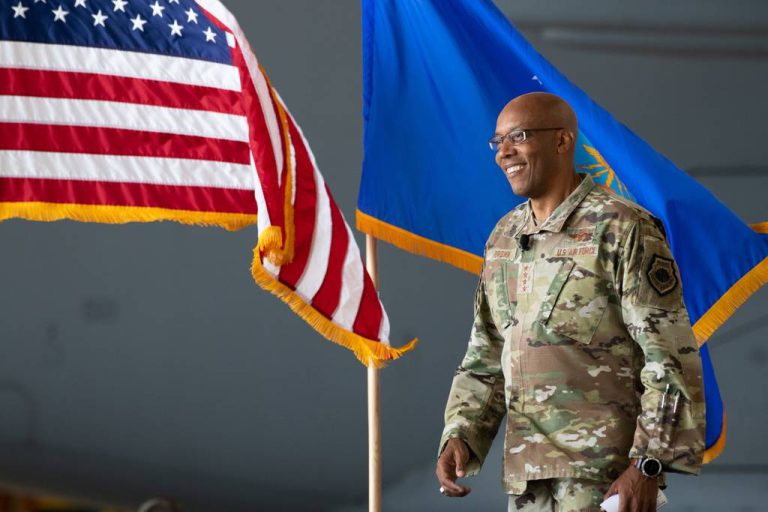
Gen. CQ Brown, here as Pacific Air Forces commander, offers his perspective as a senior Air Force leader and a Black man following the murder of George Floyd.
The video went viral online and brought the nation’s debate over racial injustice squarely into the military community.
“That took a lot of guts,” retired Air Force Gen. Larry Spencer, a former vice chief of staff who is also Black, told Defense News. “He hadn’t been confirmed yet. He made a video that was very heartfelt, knowing probably some people weren’t going to like it. … It was something that needed to be said at the time.”
Brown, 60, could soon have another historic opportunity: He has reportedly been selected to become the next chairman of the Joint Chiefs of Staff.
Two sources confirmed to Defense News that President Joe Biden has chosen Brown to succeed Army Gen. Mark Milley as the nation’s top military officer. On May 4, Politico, the New York Times and others reported Biden had selected Brown over Marine Corps Commandant Gen. David Berger for the top job, but several outlets added it was unclear when the president would announce the pick. A National Security Council spokesperson said in an email Friday that the final decision on a chairman has not yet been made.
For months, observers have considered Brown a front-runner to be the next chairman. And in a March 7 speech , Air Force Secretary Frank Kendall hinted Brown is under serious consideration for a new role.
“Gen. Brown is an exceptional leader with broad strategic perspectives, and a thoughtful, measured approach to any problem set,” Kendall said. “I would hate to lose such a great partner. But there is a chance someone who outranks me considerably might see those same attributes in CQ.”
If nominated and confirmed, Brown would be the most senior ranking member of the U.S. armed forces. He would advise the president on military matters, including the defense of Taiwan. Some in the Pentagon believe China will invade the island, which Beijing considers a rogue province, within the decade.
Brown would also collect top military leaders’ opinions on matters such as strategy, operations and budgets in order to present a range of advice to the president.
Over the last year, the current chairman of the Joint Chiefs of Staff has rallied allied nations and their militaries to support Ukraine, which is fighting off a Russian invasion. Brown would surely continue Milley’s efforts supporting Ukraine, if confirmed for the position.
In interviews with Defense News, former military leaders who served with Brown said his years in command in Asia, Europe and the Middle East prepared him well to advise the president and guide the military as it transforms.
Brown’s quiet and thoughtful personality, sharp intellect and professionalism, they say, makes him the ideal person to advise Biden on military matters and build relationships with other nations’ military leaders around the world.
Brown’s style is also markedly different from that of the blunt, tough-talking Milley.
A skilled F-16 pilot with more than 3,000 flying hours, including 130 hours in combat, Brown’s self-described introverted demeanor contrasts with the stereotypical image of the brash “Maverick”-esque fighter pilot from popular culture.
Former Air Force Secretary Heather Wilson described a 2018meeting of senior Air Force leaders — shortly after Brown took command of Pacific Air Forces and received his fourth star — where a sensitive topic was debated at length without agreement.
“He was very quiet until well into the conversation,” Wilson said in an interview with Defense News. “Then he spoke up, and he spoke for probably less than 60 seconds. And the debate was over.”
“He changed the course of the discussion by not jumping in and trying to make his points early, but by synthesizing and then suggesting what the best path forward should be,” Wilson added. “He was able to get others to agree with him and not feel left out. He found the consensus and was respected for doing so.”
In a March 7 interview with Defense News, Brown said he tends to “listen more than I talk” and absorb information, then uses his engineer’s mentality to break down tough problems and find a solution.
Then-Brig. Gen. CQ Brown, his wife Sharene, and sons Sean and Ross at the 31st Fighter Wing at Aviano Air Base in Italy in 2011. (Courtesy of the Brown family)
And in a July 2022 discussion at the Aspen Security Forum in Colorado, Brown joked his reticent nature sometimes gets him in trouble at home.
“I’m still an introvert,” Brown said. “My wife gets upset when I come home, and says: ‘Did you use all your words at work today?’ Yeah, pretty much I did.”
But John Venable, a defense policy expert at the conservative think tank Heritage Foundation and a retired F-16 pilot, said in an interview that Brown has not been aggressive enough to challenge the service’s ingrained attitudes and mindsets, and to make significant changes in preparation for a potential war.
In Venable’s view, Brown has not done enough to turn around aircraft readiness shortfalls, insufficient flying hours to keep pilots sharp, and the lagging procurement of fighter jets and other aircraft that might be needed to win against China.
Instead, Venable said, Brown has gone along with the service’s instinct to spend more money on research and development of future weapons that likely won’t enter service until well into the 2030s — if they even work — which might prove too late.
“He’s a corporate guy,” Venable said. “When you take the helm of an organization, you can go with the flow of the organization [and] continue propagating [its] core tenets. Or you can lead it in a direction like you’re watching [U.S. Marine Corps Commandant Gen. David] Berger do right now with the Marine Corps. That’s kind of the way Air Force leadership has run for a while … and you’re watching CQ right now not cause any ripples.”
A family in uniform
Brown grew up in an Army family, the oldest of three children and the son of a now-retired colonel who served in Vietnam. His grandfather, Army Master Sgt. Robert Brown, led a segregated unit during World War II.
Like many military families, the Browns frequently moved, but he spent some of his elementary and middle school years in San Antonio, Texas, and considers the state home.
Instead of heading to the Air Force Academy, he attended Texas Tech University on an ROTC scholarship. But as a young man, Brown never thought his military career would last as long as it did — or even get off the ground.
Speaking at the ceremony where he assumed command of the Air Force, Brown said he originally planned to only serve four years in uniform, and that he almost quit ROTC after his first semester.
“I’m in awe that I’m even standing here as the 22nd Air Force chief of staff,” Brown said during the August 2020 change of command ceremony at Joint Base Andrews in Maryland.
CQ Brown at key moments throughout his career. Clockwise from top left: His father, retired Army Col. Charles Q. Brown Sr., and mother, Kay Brown, pin wings onto his uniform as then-2nd Lt. CQ Brown graduates from pilot training at Williams Air Force Base, Arizona, in 1986. Then-Capt. Brown, lower left, poses with his class of F-16 Fighting Falcon graduates from the U.S. Air Force Fighter Weapons Instructor Course at Nellis Air Force Base in Nevada in 1991. Then-Lt. Col. Brown pilots an F-16 in support of Operation Southern Watch in Iraq in the early 2000s. Then-Secretary of the Air Force Barbara Barrett administers the oath of office to Brown at the change of command ceremony in which he became the service’s 22nd chief of staff. (Courtesy of the Brown family; Wayne Clark/U.S. Air Force)
His father — who Brown called “the most influential mentor in my career” and originally encouraged his son to apply for the ROTC scholarship — talked him out of quitting the program. He ended up sticking with ROTC, and that decision set him on a path to become a pilot.
During a summer camp, he took an incentive flight in a T-37 trainer that sparked his love of flying. He became a distinguished graduate of the program in 1984 when he received his civil engineering degree. And his father was there to commission him as an officer.
The next year, he began undergraduate pilot training at Williams Air Force Base in Arizona. In 1986, he began learning to fly the fighter that would define his career — the F-16 — at MacDill Air Force Base in Florida.
Brown excelled as an F-16 pilot. He spent a year and a half flying at Kunsan Air Base in South Korea before returning to the U.S. to become an F-16 instructor pilot. In late 1992, he became an instructor at the Air Force Weapons School at Nellis Air Force Base in Nevada — a job reserved for the best pilots.
Retired Gen. Hawk Carlisle, former head of Air Combat Command, first met Brown at Nellis around that time. Carlisle recalled being immediately struck by the young pilot’s talent and confidence.
In the cockpit, Brown was able to think and make decisions swiftly, Carlisle said. And when students struggled to learn something new, Carlisle said Brown knew how to simplify the concepts.
In a March 7 interview with Defense News, Brown said he still tries to lead others by helping them break down problems in that way. That’s often the only means to achieve “stretch goals,” such as the “Accelerate Change or Lose” transformational effort, he noted.
“I’m not afraid of a big challenging problem,” Brown said. “If you try to take down the whole elephant at one time, you’re not going to be able to do it.”
Then-Lt. Col. CQ Brown is shown here deployed as an F-16 squadron commander in support of Operation Southern Watch in 2001. (Courtesy of the Brown family)
Brown’s skill in the cockpit was put to the test in the skies over Florida in January 1991, when a suspected lightning strike to his F-16 ignited and exploded his fuel tank, sparking a fire that started to engulf the aircraft. Brown punched out and parachuted safely to the ground, and he was back in a cockpit the following week.
In late 1994, Brown first came to the Pentagon to serve as aide-de-camp to then-Air Force Chief of Staff Gen. Ron Fogleman. Brown attended Air Command and Staff College at Maxwell Air Force Base in Alabama from August 1996 to June 1997, then the Armed Forces Staff College in Norfolk, Virginia, in 1997. Afterward, he served as an air operations officer for U.S. Central Command and then again as an F-16 instructor pilot.
Gaining a wider perspective
Brown returned to the Pentagon in 2004 as a lieutenant colonel, where he worked directly for Carlisle in the Air Force’s programs directorate to build the service’s classified budget.
“You could tell he had matured in the way that he carried himself and interacted with the most senior levels of the Air Force,” Carlisle said. “There was no doubt in your mind that he knew how to be at the Pentagon.”
From then on, Carlisle said, Brown broadened his worldview beyond “the fighter tribe.” Brown grew to understand how to manage the dynamics among different major commands, the nuances of dealing with Congress and international relations, and the varying components of the Air Force, such as mobility, space and acquisition, Carlisle added.
Air Force Chief of Staff Gen. CQ Brown, Jr., speaks with airmen at an all-call during his stop at Travis Air Force Base, California, Aug. 4, 2022. (Senior Airman Alexander Merchak/Air Force)
That broadening of Brown’s perspective will pay off as chairman, Carlisle said, where the general would have to take into account the bigger picture encompassing the entire military.
Brown returned to the Weapons School in 2005 — this time as commandant — and then led F-16 fighter wings at Kunsan and Aviano Air Base in Italy.
He next began to take on senior roles with U.S. Air Forces Central Command and U.S. Central Command. He assumed command of the former in summer 2015, directing the air war against the Islamic State group. The following year he became deputy chief for U.S. Central Command under Army Gen. Joseph Votel.
The stakes were high, as the war against the Islamic State group, dubbed Operation Inherent Resolve, was coming to a head. The anti-ISIS coalition of American and allied troops, the Iraqi military, and the Syrian Democratic Forces were planning major campaigns to drive the militant group out of the critical cities of Mosul, Iraq, and Raqqa, Syria. With the campaigns to being in a few months’ time, and Votel often traveling, Brown became a vital partner to the general.
Votel said that Brown managed Central Command’s headquarters in Tampa, Florida, and represented the organization in major National Security Council meetings and other sessions to plan operations and strategy.
“He’s a steady hand,” Votel said. “Easy to get along with, calm on the surface, but there’s tension underneath. There’s a sense of urgency.”
In summer 2018, Brown made his next move, taking command of Pacific Air Forces; in March 2020, he was nominated to succeed Goldfein as chief of staff.
What would Chairman Brown do?
Brown has the right personality to run the Joint Chiefs of Staff, according to Arnold Punaro, a retired Marine general and former Senate Armed Services Committee staff director.
As chairman, Punaro said, Brown would need to play a key diplomatic role — not just building and strengthening alliances with the militaries of friendly nations and dealing with potential adversaries, but also with the American people.
With the military struggling to recruit and public trust falling, Punaro noted, it will be important for Brown to talk to the nation’s population about the role the military plays in today’s democracy.
“The world is more dangerous and unstable than [it was during] the peak of the Cold War,” Punaro said. “He’s going to have to try to help educate the American people of the challenges that we have with China.”
While Brown regularly emphasizes the need to prepare for a possible fight against China, he speaks carefully and avoids hyperbolic language that could be seen as saber rattling — and he expects his subordinates to take similar care.
At the Warfare Symposium on March 7, Brown delivered an unusually public rebuke of one of his top officers, Air Mobility Command head Gen. Mike Minihan. The general wrote a memo that predicted war with China in 2025. In the document, leaked online in late January, Minihan used provocative language such as “aim for the head” to describe the need for “unrepentant lethality” in preparing for conflict.
“There’s aspects of that memo I was disappointed in,” Brown told reporters in a roundtable at the conference. “It detracted from the key message of the sense of urgency that is required.”
Spencer, the former Air Force vice chief of staff, said that if Brown is nominated and confirmed as chairman, he would likely make himself more visible to the public than Milley or other previous chairmen. Brown would also be an effective “diplomat” to represent the military services for the American people, particularly as they try to solve lingering recruiting challenges, Spencer added.
“The reality of it is, of course, he represents that anyone — regardless of your ethnicity, your background, your race or your gender — if you have the kind of talent and drive and initiative and leadership capability and warfighting credentials that he has, it doesn’t matter what you look like,” Spencer said. “You can go to the top job.”
But Brown brings much more to the table, Spencer noted, because he speaks his mind and doesn’t “sugarcoat” things, while his amiable personality when delivering hard truths means “the media will flock to him.”
“I don’t think most people you stop on the street know who the chairman of the Joint Chiefs is,” Spencer said. “I predict that he will be more visible and more recognizable [than previous chairmen], which I think will go a long way to improve the recruiting challenge that some of the services have. I think he will be viewed by parents and folks on the Hill as: This is what the military is all about, and I want my kids to be like him.”
But before Brown took command of the Air Force in 2020, becoming the first Black person to serve as a U.S. service chief, he felt compelled to speak out. As a result, he found himself drawn to the spotlight in an unexpected way.
‘The right thing to do’
On May 25, 2020, Minneapolis police killed a Black man named George Floyd during an arrest for allegedly using a counterfeit bill to buy cigarettes. Officers pinned the handcuffed Floyd on the ground, and video later showed that one white officer knee2led on his neck for more than nine minutes. Floyd repeatedly said he could not breathe, but the police did not let him up.
Video of Floyd’s death swept across the country and generated outrage, prompting mass protests against police brutality and igniting a nationwide conversation about racism and inequality.
The debate spread in the military as well. Then-Chief Master Sergeant of the Air Force Kaleth Wright, who is Black, on June 1 posted a lengthy message on social media on racial injustice. At one point in his post, Wright wrote: “I am George Floyd.”
In his own video, Brown spoke about what it was like “living in two worlds” — both as a Black man and as an officer in the U.S. military.
His speech invoked the ideals of equality in the Declaration of Independence and the Constitution “that I have sworn my adult life to support and defend.” But he also spoke about the history of racial issues in the country he loves and serves, and discussed “my own experiences that didn’t always sing of liberty and equality.”
To Spencer, what made Brown’s video strike a chord was precisely the plain-spoken nature for which the general is known.
“He comes across [in the video] as, ‘I’m telling you facts here,’ ” Spencer said. “ ‘I’m just telling you how I feel, how a lot of folks feel.’ ”
After the video went viral, Spencer said several retired three- and four-star generals he had served with called to ask about it, wondering whether Spencer has similar experiences to Brown’s.
“Absolutely I did,” Spencer told his white counterparts in those calls. Brown “opened up, even though it was a short window … a dialogue that I thought was very healthy.”
Four days after the video hit the web, the Senate unanimously voted to approve Brown as Air Force chief of staff.
In the December 2020 interview with NPR, Brown acknowledged the video could be challenging for his career, but said even if he had sacrificed his chances of becoming Air Force chief of staff to speak out, it would’ve been worth it.
“I thought it was more important than, in some cases, confirmation,” Brown told NPR. “If confirmation had been withheld for some reason, I knew in my heart of hearts I did what I thought was the right thing to do. And that’s the way I approach life.”
Rachel S. Cohen contributed to this report.
Stephen Losey is the air warfare reporter for Defense News. He previously covered leadership and personnel issues at Air Force Times, and the Pentagon, special operations and air warfare at Military.com. He has traveled to the Middle East to cover U.S. Air Force operations.
Perhaps you find yourself drawn to the idea of embracing your survivalist instincts, envisioning a life immersed in nature and self-sufficiency when society inevitably crumbles. Alternatively, you might simply be an ardent outdoors enthusiast who thrives in the wilderness long before any doomsday scenario unfolds.
Regardless of how you ended up here, stumbling upon this article has undoubtedly sparked your curiosity about wilderness survival. Allow this guide to enlighten you on the crucial dos and don’ts of hunting reptiles in their natural habitat.
Discover which reptiles are suitable for hunting, learn which ones are best avoided, understand how to identify and capture them, and finally, master the art of preparing these creatures for a meal. For those who foresee meals consisting of lizards or snakes in their future, this article is an indispensable resource.
Which Reptiles are Suitable for Hunting?
Lizards:
When traveling in the Southern Hemisphere, it’s important to avoid certain venomous species of lizards. In the United States, the only lizard to be cautious of is the Gila monster. Theoretically, all other native U.S. lizards are safe to consume, although there is a risk of bacteria and parasites, which we will discuss further in the section on cooking reptiles.
It’s worth noting that most lizards you come across are relatively small and don’t provide a substantial amount of meat. Hunting multiple lizards will be necessary to satisfy your hunger. However, capturing lizards can be challenging due to their agility and speed. If possible, considering other species might increase your chances of success.
Snakes:
Removing the snake’s head ensures you won’t ingest venom. However, it’s advisable to avoid hunting venomous species (such as cottonmouths, copperheads, coral snakes, and rattlesnakes in the U.S.) due to the risk of getting bitten during the hunt.
For reptile enthusiasts, killing a snake that resembles a pet can be difficult. Keep in mind that most pet snakes are not native to the U.S. and won’t be encountered in the wild. If you own snakes as pets, consider whether you’d be comfortable hunting a creature resembling your beloved reptile.
Turtles:
Turtles are relatively easy to hunt as they move slowly and can’t swiftly escape like lizards. However, certain turtle species, like box turtles, consume mushrooms that may contain fungi harmful to humans. When consuming a turtle, you also ingest what they have eaten, which can pose health risks.
One commonly found and safe-to-eat turtle in North America is the snapping turtle. The challenge lies in catching it—be sure to handle it from behind the neck and tail, keeping your hands out of reach of its sharp teeth.
Crocodiles and Alligators:
Alligator meat is considered a delicacy and is praised for its high protein content and low fat in some regions. However, attempting to hunt these creatures in the wild for a meal is not recommended. Commercial alligator meat is sourced legally from alligator farms, and hunting these reptiles is only permitted in a few states, such as Florida and Texas, where you may need a special license or permit.
Hunting crocodiles is illegal in the United States, and being caught can result in severe fines. Both alligators and crocodiles can be aggressive, and without proper knowledge and equipment, engaging with them can lead to serious trouble. Unless you have experience and the necessary tools, it’s best to avoid hunting these reptiles to ensure your safety.
What About Frogs?
While frogs may share some similarities with snakes, lizards, and turtles, they actually belong to the amphibian class. In the United States, the majority of frog species are considered safe for consumption. However, it is essential to exercise caution and avoid brightly colored frogs as their vibrant skin serves as a warning sign of their poisonous nature.
You might be familiar with the concept of eating frog legs as a cultural delicacy. However, when it comes to survival in the wild, hunting reptiles would be a more practical choice. The reason is simple: Capturing a sufficient amount of wild frogs to obtain an adequate protein intake for a meal would require a significant effort.
How to identify reptiles
It is impractical to provide a comprehensive guide on identifying every possible reptile you may encounter in the wild. If you are planning to venture into the wilderness, it is crucial to conduct your own research beyond the scope of this article. Therefore, for the sake of brevity, we will focus on identifying dangerous reptiles that should be avoided.
When it comes to pit vipers, it is advisable not to attempt hunting them. This group includes cottonmouths, copperheads, and rattlesnakes. They possess blocky triangular heads with well-defined necks, cat-like eyes, and thick, robust bodies. These venomous snakes can be consumed in dire circumstances, but the risks associated with hunting them often outweigh the benefits of acquiring snake meat.
Additionally, it is recommended to steer clear of box turtles due to their tendency to consume poisonous mushrooms. These turtles can be identified by their high-domed, ridged carapaces that flare out at the edges. They also exhibit distinctive skin patterns in shades of brown, yellow, and orange.
How to Hunt
The methods employed for hunting will depend on the equipment available to you, but they generally fall into two main categories: hunting and trapping.
When engaging in hunting, it is vital to maintain constant awareness of your surroundings. Avoid becoming so fixated on your prey that you fail to notice potential hazards, such as approaching the edge of a precipice. For hunting, there are numerous possibilities to consider. You can utilize a firearm, bow, spear, slingshot, knife, or even a rock to immobilize the targeted reptile.
To effectively trap a reptile, particularly turtles and certain snakes, the recommended approach involves creating a hole with steep sides from which the reptile cannot escape. As for bait, you can utilize a combination of vegetation, fungi, or insects based on the preferences of your intended prey.
Here are five reptiles that can be effectively hunted in the wild, along with additional information on how to hunt or trap them:
Iguana
Green iguanas are considered invasive species in Florida, and the state encourages their hunting. In the Caribbean, they are often referred to as “pollo de los árboles” or “chicken of the trees.” To hunt iguanas, it is recommended to use a firearm or a bow to ensure accuracy and a swift kill. Approach cautiously and take aim at their head for an effective hunt.
Black rat snake
The black rat snake, also known as the Western rat snake or black snake, is an excellent choice for novice reptile hunters. These snakes are harmless to humans, and their long and thick bodies provide a substantial amount of meat per animal. Hunting black rat snakes can be done using a firearm, a bow, or a spear. Aim for the head or neck to dispatch them quickly.
Garter snake
Garter snakes, although relatively slender and offering less meat compared to larger reptiles, have a significant advantage of being prolific across the United States. They are one of the most common snake species in the country. Garter snakes can be captured by hand or with the aid of a snake hook or snake tongs. Ensure proper identification to avoid mistakenly hunting venomous snakes.
Red-eared gilder
Red-eared sliders are the most popular turtle species in the American pet trade. However, due to frequent abandonment, they have become classified as invasive species in many states. To hunt red-eared sliders, the most effective method is through trapping. Construct traps using wire mesh or use baited lines with hooks. Ensure compliance with local regulations regarding hunting or trapping turtles.
Snapping turtle
Snapping turtles are large terrapins found across the Eastern United States. They are professionally harvested for food in certain regions and make for a hearty and protein-rich meal. When hunting snapping turtles, it is crucial to exercise caution due to their powerful jaws and sharp claws. The most effective method is to trap them using baited wire mesh traps or hoop nets submerged in water.
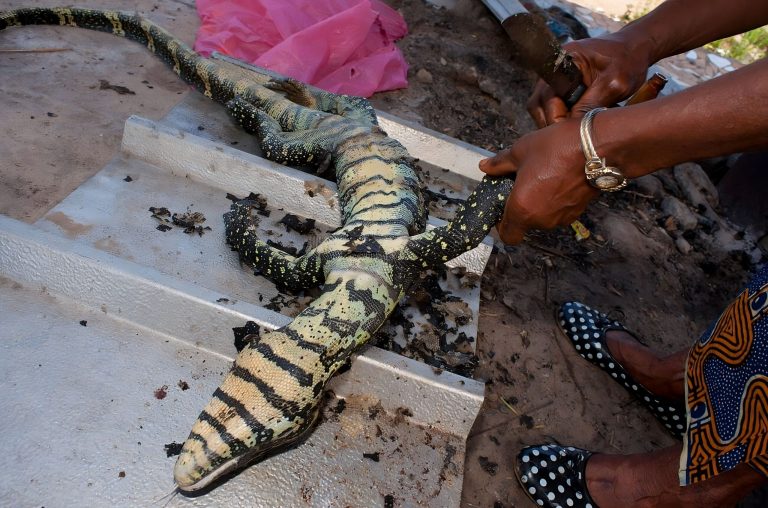
Argentine Black and White Tegu
Native to South America, Argentine Black and White Tegus have become invasive species in Georgia. As the largest tegu lizards, growing up to 2 feet in length, they can provide a substantial amount of meat. When hunting tegus, it is advisable to use a firearm, bow, or a sturdy snare trap. Aim for a quick and humane kill.
How to prepare reptile meat for consumption
One crucial takeaway from this article is the importance of thoroughly cooking any reptile meat before consuming it. Regardless of whether you have chosen a nonvenomous and nonpoisonous species, wild animals, including reptiles, carry bacteria and parasites that can lead to infection and illness if ingested.
Reptiles, in particular, are notorious carriers of salmonella bacteria, which reside in their digestive tracts. Unfortunately, it is impossible to determine if a reptile carries the bacteria until it’s too late. Symptoms of salmonella infection include diarrhea, vomiting, and stomach cramps. However, there is a simple step you can take to significantly reduce the risk of contracting salmonella: cooking the reptile thoroughly. Cooking the meat will effectively kill the bacteria, ensuring a safer and more palatable meal. Additionally, remember to wash your hands, cooking surfaces, and utensils that have come into contact with raw reptile meat.
When in the wilderness and consuming reptiles, you may not have access to fancy cooking equipment like a George Foreman grill. However, you can still safely cook your fresh meat without any elaborate tools. Start by boiling the reptile in water to sanitize it, and then roast it over a fire to achieve a desirable sear. If you have access to additional ingredients, consider preparing snake tacos or iguana stew for a more satisfying and well-rounded meal.
After finishing your meal, it is crucial to dispose of any remaining remnants such as bones and skin far away from your campsite. Leaving these leftovers around can attract scavengers, putting you at risk. Additionally, any unwanted pieces of meat or organs can be repurposed as bait for fishing and trapping, allowing you to make the most of your meal by potentially securing a second source of sustenance.
Remember, proper cooking, hygiene, and responsible waste disposal are essential for ensuring a safe and enjoyable dining experience when consuming reptile meat in the wilderness.
Concluding
When navigating the challenges of wilderness survival, it’s wise to initially focus on seeking out commonly consumed animals like mammals and fish. However, should the situation demand it, a diverse range of reptiles can provide sustenance as well. It is crucial to prioritize safe-to-hunt and eat reptiles while ensuring meticulous cooking techniques before indulging in your wild feast.
Remember, making informed choices and following proper cooking procedures are paramount for a successful and nourishing wilderness dining experience.
3 1 He foretelleth the dangerous times that are to ensue: 9 but with the certain hope of victory, 10 he encourageth him to the combat, 14 setting out especially the trial of sound doctrine.
1 This know also, that in the last days shall come perilous times.
2 For men shall be lovers of their own selves, covetous, boasters, proud, cursed speakers, disobedient to parents, unthankful, unholy,
3 Without natural affection, truce breakers, false accusers, intemperate, fierce, no lovers at all of them which are good,
4 Traitors, heady, high-minded, lovers of pleasures more than lovers of God,
5 Having a show of godliness, but have denied the power thereof: turn away therefore from such.
6 For of this sort are they which creep into houses, and lead captive simple women laden with sins, and led with divers lusts,
7 Which women are ever learning, and are never able to come to the acknowledging of the truth.
8 And as Jannes and Jambres withstood Moses, so do these also resist the truth, men of corrupt minds, reprobate concerning the faith.
9 But they shall prevail no longer: for their madness shall be evident unto all men, as theirs also was.
10 ¶ But thou hast fully known my doctrine, manner of living, purpose, faith, longsuffering, love, patience,
11 Persecutions, and afflictions which came unto me at Antioch, at Iconium, and at Lystra, which persecutions I suffered: but from them all the Lord delivered me.
12 Yea, and all that will live godly in Christ Jesus, shall suffer persecution.
13 But the evil men and deceivers shall wax worse and worse, deceiving, and being deceived.
14 But continue thou in the things which thou hast learned, and which are committed unto thee, knowing of whom thou hast learned them:
15 And that thou hast known the holy Scriptures of a child, which are able to make thee wise unto salvation, through the faith which is in Christ Jesus.
16 For the whole Scripture is given by inspiration of God, and is profitable to teach, to convince, to correct, and to instruct in righteousness,
17 That the man of God may be absolute, being made perfect unto all good works.
This tells me what I need to know. It speaks directly unto our times today for us to understand. It is up to us to accept it and live unto glory.
The senate voted to confirm the leftist/activist Jackson to the Supreme Court. 57 to 43 thanks to the spineless RINO's. We the People will surfer for years to come with her leftist rulings