da Kilauea Volcano in Hawaii is eruptin agin – livestream

0

da Kilauea Volcano in Hawaii is eruptin agin

da USGS is monitorin it

dey has a livestream on da tube

https://www.youtube.com/usgs/live [ USGS / youtube ] dere is some stream delay, tis live tho

live streams cant be embedded on da forum, yall have ta watch on youtube


Here are metrics used to measure US Air Force networking success

0

NATIONAL HARBOR, Md. — As the U.S. Air Force develops its next generation of command and control, it is using two measures of success: how quickly forces can be tasked and coordinated in a fight; and how tolerant digital systems are of new technologies and applications.

To ensure the U.S. military outwits, outmaneuvers and outshoots a powerful adversary such as China or Russia, the Pentagon has pursued a strategy known as Combined Joint All-Domain Command and Control, linking sensor to shooter from the cyber realm to space. The Advanced Battle Management System, or ABMS, is the Air Force’s contribution to the multibillion-dollar endeavor.

“There’s two different, fundamental rails that we’re looking at,” Brig. Gen. Luke Cropsey, the integrating program executive officer for command, control, communications and battle management, told reporters Sept. 11 on the sidelines of the Air, Space and Cyber Conference at National Harbor in Maryland.

“There’s the combat-effectiveness set of metrics that we’d go look at, with regards to how well we’re actually employing combat capability,” he said. “But then there’s also the backend side of that.”

Cropsey was tapped last year by Air Force Secretary Frank Kendall to oversee a sprawl of connectivity campaigns and represent the service when working with the Office of the Secretary of Defense — a role he described as one of the most difficult he has assigned someone “by a wide margin.” The Pentagon’s fiscal 2024 budget blueprint allocated $1.4 billion for CJADC2.

Key to benchmarking and maturing the Air Force’s future communication abilities is the Shadow Operations Center-Nellis, or ShOC-N, at Nellis Air Force Base, Nevada. There, experts can tinker with emerging tech and “assess industry bringing in battle-management applications, et cetera,” said Brig. Gen. Daniel Clayton, the director of the ABMS Cross-Functional Team.

“In our model, we have 13 discrete functions that we have identified that battle managers have to perform,” he said at the conference. “Can your application do all 13 of those? Yes or no.”

Other opportunities for testing exist in military exercises such as the Army’s Project Convergence. Last year’s iteration featured maritime- and land-centric scenarios colored by threats seen in the Indo-Pacific and Europe.

Additional metrics are being kicked around and could be rolled out in the future, according to Cropsey.

“There are, actually, myriad different opportunities that are out there for us to go plug things into and actually experiment and prototype to figure out, ‘OK, where are we moving the needle? Where do we need to go back and make more adjustments?’” he said.

Colin Demarest is a reporter at C4ISRNET, where he covers military networks, cyber and IT. Colin previously covered the Department of Energy and its National Nuclear Security Administration — namely Cold War cleanup and nuclear weapons development — for a daily newspaper in South Carolina. Colin is also an award-winning photographer.

Five teams to change how US Air, Space forces prepare to fight China

0

NATIONAL HARBOR, Md. — The U.S. Air Force secretary on Monday said the service is launching a new effort to revamp how it organizes, trains, equips and carries out missions to deter or defeat China.

Over the next few months, the Department of the Air Force’s senior leadership will lead this review to find ways to make itself and the Space Force operate better in an era of great power competition, Frank Kendall said in his keynote address at the Air and Space Forces Association’s Air, Space and Cyber Conference in National Harbor, Maryland.

Kendall added that he wants the department to start implementing changes by January 2024 and move rapidly that year.

The five teams working on this effort will focus on how the department is organized, both in its headquarters and the field; how the force is equipped; recruitment, training and retention of personnel; readiness; and how the department supports operational air and space missions, including mobilization and demobilization as well as providing installations for service members.

Kendall said the Air Force has no choice but to change to counter the threat from China, which is successfully modernizing its air and naval forces, and has a rocket force capable of targeting crucial U.S. assets such as aircraft carriers, airfields and logistics hubs.

“China has been re-optimizing its forces for great power competition and to prevail against the U.S. in the Western Pacific for over 20 years,” Kendall said. “We must do the same.”

The Air Force in recent years has transformed in several ways, including standing up a new command, control, communications and battle management effort overseen by its own program executive officer, as well as creating multi-capable airmen able to do more than one job on deployment. But more must be done, Kendall noted.

Kendall also urged Congress to swiftly pass a budget so the department doesn’t have to operate under a continuing resolution, and decried the hold Sen. Tommy Tuberville, R-Ala., has on hundreds of general officer nominations.

Kendall also pointed to the Pentagon’s so-called quickstart proposal to Congress — which would allow the military to begin work on some of its most vital new programs before a budget is passed — as an example of a reform that would allow the department to operate more efficiently and “prevent us from losing ground unnecessarily.”

Stephen Losey is the air warfare reporter for Defense News. He previously covered leadership and personnel issues at Air Force Times, and the Pentagon, special operations and air warfare at Military.com. He has traveled to the Middle East to cover U.S. Air Force operations.

Edge Weapon Defense Tactics

0

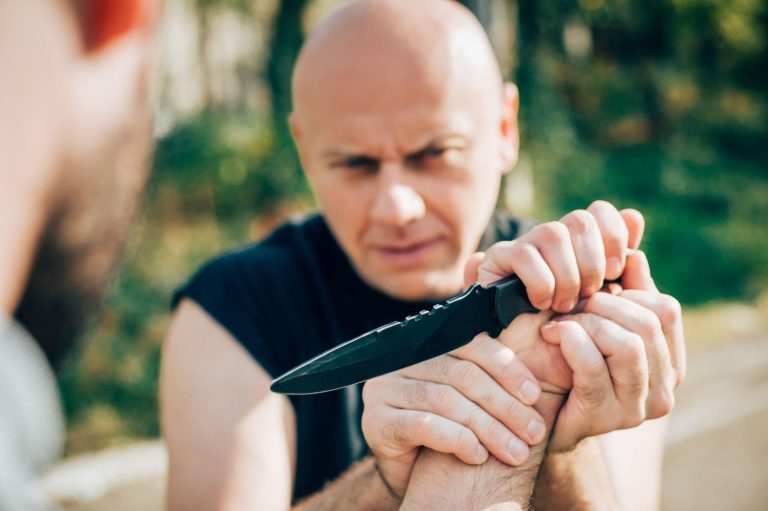
Walking down the street or unexpectedly encountering someone in a market or parking lot can quickly take a dangerous turn when you come face to face with someone carrying a weapon. When that weapon happens to be a sharp-edged one, the threat escalates significantly, and you could find yourself in a life-or-death situation in an instant.

Whether your assailant brandishes a flashy, oversized blade, a small pocket box cutter, or even a sharpened screwdriver, it’s essential to follow some common-sense guidelines to improve your chances of avoiding victimization. Some strategies might help you completely evade a confrontation, while others can be your last resort if there’s no other option but to defend yourself.

While it’s important to remember that each situation is unique, these general principles can provide you with an advantage, albeit a small one, to increase your chances of safely returning home without sustaining serious injuries. This is especially crucial when it comes to edge weapon defense.

Edge weapons defense tactics:

Mastering Weapon Control

When dealing with an attack involving an edged weapon, one of the most critical aspects of personal defense is gaining control over the weapon. It’s an essential concept in edge weapon defense that should never be underestimated—nothing else takes precedence.

If you can’t establish control over the weapon, it remains a potent threat capable of causing harm, inflicting damage, or even leading to severe injuries, including fatality. The key to controlling the situation and effective edge weapon defense is to ensure the weapon is no longer a danger to you. Regardless of how proficient you are in self-defense techniques, they become meaningless if your assailant can still wield their intended knife or another cutting or stabbing tool, leaving you vulnerable and at their mercy.

True weapon control occurs when you physically secure your attacker’s striking hand or arm, or when you disarm the assailant, effectively removing the weapon from the immediate conflict zone.

Prioritizing Avoidance Over Confrontation

What’s a smarter choice when confronted by someone wielding a sharp or edged weapon, an option better than engaging in a potentially deadly conflict? The straightforward answer is to escape, and do it swiftly, especially when it comes to edge weapon defense.

If you have the opportunity to flee an attack rather than choosing to stay and fight, the wise course of action is to run. Even with the best training, why take unnecessary risks when you can distance yourself from the danger and avoid potential injury altogether, particularly in situations involving edge weapon defense?

In an open area, make a beeline for the nearest source of help or shelter as fast as you can. It’s highly unlikely that your assailant will pursue you, and if you raise a loud alarm, shouting and screaming with intensity, they may become nervous or fearful and decide to retreat themselves.

Remember, when a knife is menacingly waved in your direction, it’s not the time to play the “tough guy” and stand your ground. There’s no shame in fleeing from a potentially life-threatening situation. Don’t let your pride put your life in jeopardy!

Stay aware at all times

In today’s fast-paced world, it’s all too common for people to become engrossed in their cell phones, lost in the latest music streaming on their devices, or attempting to juggle multiple tasks while rushing from one commitment to another. Unfortunately, this distraction often leads them to overlook potential dangers unfolding around them, making them vulnerable to armed assailants, especially in situations involving edge weapon defense.

Instead of immediately sending that email or text (which can likely wait), prioritize keeping your head held high, maintaining awareness of your surroundings, and confidently navigating your day. Just as four-legged predators target the weak, distracted, or injured, two-legged predators operate in a similar fashion. Therefore, don’t fall victim to them by updating your social media status or uploading a photo at an inopportune moment.

Staying vigilant is essential to your safety and well-being, particularly when considering edge weapon defense.

Interpreting Nonverbal Cues for Enhanced Awareness

Have you ever wondered if you can decipher someone’s intentions without them uttering a word? The answer lies in reading their body language, a crucial skill in edge weapon defense. A person’s facial expressions and their posture, gait, or how they position themselves nearby can offer clues about their intentions, which might not be benign.

When you encounter someone whose hand you can’t see due to their positioning, it’s wise to assume they might be concealing a knife or another weapon—this isn’t paranoia; it’s a heightened state of alertness and situational awareness, especially in the context of edge weapon defense. Trust your instincts; if a situation feels off, heed your inner voice and steer clear.

Equipping Yourself for Edge Weapon Defense

If you possess a concealed weapon permit and have honed your skills with a defensive tool, having a baton, cane, or even a personal knife can provide a valuable edge in edge weapon defense against an armed attacker wielding an edged weapon.

A baton or cane extends your reach beyond that of your assailant’s weapon, granting you the upper hand in both offense and defense in the realm of edge weapon defense. On the other hand, a knife not only aids in close-quarter combat but may also deter a confrontation from escalating physically due to the sheer intimidation factor it presents.

Size Doesn’t Always Matter in Edge Weapon Defense

While a large Bowie knife may appear intimidating, it’s often easier to defend against than a compact pocket-sized razor cutter in the context of edge weapon defense. Size doesn’t always correlate with the threat a weapon poses in the realm of edge weapon defense. A small box cutter, for instance, is challenging to spot or grab, inflicts hard-to-close wounds causing excessive bleeding, and is readily accessible to almost anyone at a local hardware store, making it a formidable weapon in edge weapon defense scenarios.

svmd longbanner1

Using Barriers in Edge Weapon Defense

When faced with the daunting prospect of an edged weapon attack and no alternative but to defend yourself, employing anything at your disposal to create a protective barrier between you and the deadly weapon becomes paramount in edge weapon defense.

Whether it’s an umbrella, your trusty backpack, briefcase, or even a bag of groceries, any object you can wield to deflect the impending blade becomes a viable option. Additionally, don’t overlook nearby items that could be used to obstruct the path between you and your assailant in your strategy for edge weapon defense. This includes chairs, bicycles, or even your motor vehicle if the confrontation occurs in a parking lot or your own driveway.

In the realm of edge weapon defense, safeguarding yourself should be your utmost priority, and successfully escaping the scene stands as a significant victory.

Simplicity Reigns Supreme

When it’s time to physically engage an armed assailant, remember that simplicity reigns supreme. Quick, straightforward techniques prove far more effective than complicated, flashy maneuvers in the context of edge weapon defense. Your primary goals are to control the weapon, strike effectively, and either secure your attacker or make a swift exit. Utilizing intricate locks or flashy kicks increases the risk of errors or mishaps, potentially resulting in injury or even fatality.

Shielding Vital Areas

If you find yourself without any protection when a knife or another sharp weapon is thrust at you, safeguarding the critical areas of your body becomes imperative, even if it means enduring some impact in the process.

Use your forearms as shields to maintain distance and prevent the blade from penetrating your lungs, slashing your throat, or severing vital blood vessels around your neck. Your midsection and neck are prime targets that can lead to immediate incapacitation. Remember, it’s far more manageable to have superficial wounds on your arms or legs requiring stitches than to undergo major surgeries or endure lifelong physical disabilities as a consequence of neglecting your vital areas in the context of edge weapon defense.

Invest in Training for Edge Weapon Defense

Equipping yourself with self-defense training can provide a significant advantage over those who lack such knowledge, and this comes as no surprise. Why not seize the opportunity to enhance your chances of surviving an attack involving an edged weapon?

Numerous martial arts schools and basic self-defense classes offer specialized training in weapon defense and weapon disarming techniques. Among them, disciplines like Aikido, Krav Maga, Japanese Ju-jitsu, and Jeet Kune Do emphasize defense-oriented skills that can be invaluable in the context of edge weapon defense.

It’s essential, however, to steer clear of training programs that prioritize sports competitions or offer “fitness-style” kickboxing or aerobics. Not all martial arts feature self-defense techniques suitable for real-world scenarios, so conducting thorough research is vital. Attend a few classes to get a sense of the curriculum and determine if it aligns with your goals.

Remember, becoming an expert doesn’t happen overnight; it’s a gradual process that requires continuous repetition. With time and practice, these techniques and movements will become second nature, providing you with valuable skills for edge weapon defense.

Taking Control of Your Self-Defense Education

taking control of your self defense education

Considering a self-defense class? To ensure you’re making the right choice, follow these steps for a well-informed decision.

Research Diverse Martial Arts: Martial arts encompass a wide range of disciplines, from those grounded in philosophy to those treated as sports, and others focused purely on practical self-defense. Start by exploring the various martial arts options available, aligning them with your own expectations and eliminating those that don’t fit your goals.

Observe a Class: Before committing, visit a class and sit in the background as an observer. Pay attention to the teaching style. Is the head instructor actively involved in teaching, or does most of the instruction fall on their top students? Does the curriculum include edge weapon defense techniques? Assess the overall environment; is it one where you’d want to spend several hours a week? If any answers are negative, continue your search until all your criteria receive a resounding “yes.”

april banner 1Participate in a Class: Trying a class is where you truly get a sense of whether the school or class suits you. Gauge the energy level within the class – are the students engaged and invested in the material, or are they just going through the motions? Energy is contagious; low energy may not be conducive to your growth. Take note of the instructor’s intentions; are they genuinely committed to sharing knowledge, or are they focused on boosting their ego? If everything feels right, it’s time to consider signing up.

Be Cautious with Contracts: Martial art schools often use long-term contracts to secure steady income. Read contracts carefully and seek clarity on any unclear terms. If you feel pressured or uncomfortable signing, hold off until you can review it with someone experienced, even a lawyer. Learning self-defense is valuable, but you don’t want to be locked into an agreement long after your interest wanes.

Regularly Reevaluate Your Classes: After a few months, reassess your classes. Are you continually learning new material while reinforcing the basics? Are you achieving your initial goals? Sometimes, unexpected opportunities may arise, allowing you to explore new aspects of self-defense. However, if the teachings become stagnant, it might be time to consider other options.

Prioritize Consistent Practice: Regardless of the classes you choose, nothing can replace the benefits of regular, dedicated practice. Commit to a consistent workout schedule and go the extra mile to learn, correct mistakes, and improve. Your progress is ultimately in your hands, and consistent practice is the key to your self-defense development.

Other Useful Resources:

Buying your first gun – Things you should know

Find Out What’s the Closest Nuclear Bunker to Your Home

Knowledge to survive any medical crisis situation during a major disaste

Kali in Indiana Jones | Survival Monkey Forums

0

Most people will remember that disturbing scene in Indiana Jones and the Temple of Doom where that evil guy rips out some poor suckers heart, and then sends him down into a pit of lava.

I just caught that again on the boob tube, and I wondered what that was all about. As we know, Hollywood takes every opportunity to show the occult, so there must be something behind it.

Low and behold, there was. Apparently this is a depiction of the Thugees from India who worshipped a god called Kali.

[​IMG]

Kali was associated with doomsday and death.
Kali – Wikipedia

The Thuggees were a murderous group of assassins:
Thuggee – Wikipedia

When reading about Kali, it reminded me of the statue at CERN, which is apparently of the Indian god Shiva:

[​IMG]

When you look closely at the statue, it is very similar to the God Kali. Stepping on the husband, the husband has his tongue out, skull headdress (Kali has a severed head necklace). There is some relationship between the two gods. They don’t give you a warm and fuzzy feeling.

There is something to the “sticking the tongue out” thing too. Apparently this is the inspiration behind the Rolling Stones logo. I also suspect it’s probably why Miley Cyrus’ handlers put her up to sticking her tongue out all the time.


Legal Monarchical Cognitive Dissonance | Survival Monkey Forums

0

Cognitive Dissonance is presenting two contradictory ideas in order to confuse.

The state of Massachusetts uses a tactic, which I refer to as “Legal Monarchical Cognitive Dissonance”, by which they have a contradictory law for every law on the books, with a particular emphasis on firearm laws, so that they can, in effect, rule like a monarch (a king, a queen, a dictator) and pick and choose which rule they would like to follow, depending on the given circumstance.

So if Joey (a Trump supporter and a Republican) is pulled over with a gun in his car, and he is arrested for having a firearm in his car, and goes to court, the judge can reference law 2342.232.3234 section B, that states that it’s illegal to transport a firearm in your vehicle.

However, if Maura Healey’s cousin Sam (a Biden supporter with strong political connections to the elite) is pulled over with a gun in his car, the judge can reference 2342.232.3234 section C, which states that it is legal to transport a firearm in your vehicle, and let him off the hook.

See how that works?

Contradictory laws exist so that judges can act like kings and queens and do whatever they want, depending on the circumstance, because there is a law for every circumstance that the judge might want.


Royal Air Force faces significant aircraft shortfalls, report finds

0

LONDON — British lawmakers say the Royal Air Force now lacks capabilities across combat, air transport and early warning aircraft.

A Ministry of Defence command paper in 2021 ordered cuts to aircraft numbers that are creating a combat air shortfall in jet numbers that will persist into the 2030s, the Parliamentary defence committee said in a report on aviation procurement released Sept. 10.

The committee said the British combat jet fleet now only provides a boutique capability and lacks numerical depth and an inadequate attrition reserve.

“Combat aircraft numbers are already low. The defence command paper cuts will create a combat air capability gap which, on current plans, will persist well into the 2030s. This is unacceptable. The [Ministry of Defence] and RAF must consider as a matter of urgency how they can increase combat air mass in the short term,” said the report.

Figures in the report show Britain having the smallest number of jets among the four major European military powers with a fleet of 169 aircraft made up of Typhoons and F-35s.

The next smallest is Italy with 199 jets, while Germany and France each have over 200 combat aircraft.

“Since the end of the Cold War, the RAF’s fleet has taken a nosedive in numbers, down to just a third of its previous size. Our report found that budget cuts — including those in the last defence command paper — have led to gaps in air capability that will persist into the next decade,” said committee chair Tobias Ellwood.

“The RAF has prioritized quality at the expense of quantity, leaving us with a fleet of combat aircraft that are high-spec and expensive yet alarmingly low in number. Our current fleet fails to reach the mass necessary to survive the attrition of an all-out war with a peer adversary. Fixing this is a matter of urgency,” he said.

The MoD updated the 2021 command paper earlier this year in light of the changed security situation in Europe since Russia’s invasion of Ukraine, but left aircraft deletions untouched.

The committee saved much of its criticism for the MoD’s decision to reduce an order for airborne early warning aircraft and the axing of an entire fleet of Hercules C-130s earlier than planned.

An order for five Boeing Wedgetail E-7 was cut from five aircraft to three to save money.

Reducing the fleet size to three was labeled by the Parliamentarians as the “most perverse” decision in the command paper.

The 40% reduction in Wedgetail fleet size resulted in a cost saving of just 12%, said the report.

The committee, which has influence but no actual teeth, said the cut needs to be reversed with a new commitment to at least five of the airborne early warning and control jets .

Shrinking the fleet will leave Britain unable to meet its NATO commitments and its own sovereign needs, said the Parliamentarians.

“The MoD has committed almost £2 billion [$2.5 billion] for a fleet of aircraft that, due to its reduced size, will be unable to meet the basic capability requirement,” said the lawmakers.

Perhaps the most controversial decision of the 2021 command paper was the move to stand down the RAF’s C-130J Hercules fleet some seven years before its planned out-of-service date.

Witnesses giving evidence to the committee were almost unanimously critical of this decision, which significantly reduced the overall capacity of the air mobility fleet and created a capability gap that could hamper special forces who widely use the aircraft, said the report.

The fleet of aircraft were finally withdrawn earlier this summer and are now up for sale.

“The RAF has been left scrambling to migrate essential capabilities onto the A400M Atlas and will be reliant on this aircraft which, however capable it may be on paper, has a poor track record of reliability,” said the Parliamentarians.

Andrew Chuter is the United Kingdom correspondent for Defense News.

Dr. James Giordano: The Brain is the Battlefield of the Future

0

This dude is scary. He's talking about neuroscience as a Weapon of Mass Destruction technology. Not sure if this is at West Point?

Talks about Havana syndrome. He was probably one of the scientists who deployed it, if I had to guess.