Everyday Survival In High-Rise Buildings

0

The memories of individuals jumping from the Twin Towers on September 11th will always trouble us. Are we genuinely secure in these contemporary steel and concrete structures, or are we essentially residing in steel and concrete tombs?

Many of us spend our days or nights in tall city buildings, and one of our greatest fears is the potential disasters that could affect us. The key factor in all stories of survival is being ready—and, naturally, a touch of good fortune.

Emergency preparedness

Being ready for a disaster is more about your mental and emotional state than having expensive equipment. Being aware of your surroundings is crucial for survival. When it comes to life-threatening situations, 90 percent of it is in your head – it’s all about mental preparedness, while only 10 percent depends on having the right equipment.

In most cases, you won’t have the opportunity to practice for emergencies in the building where you work, apart from the occasional fire drill, if they even happen. However, you can still prepare yourself mentally by thinking about and planning for these situations so that they become familiar to you. This kind of psychological preparedness is something every survivalist should embrace.

Knowing the emergency exits is essential for anyone working or living in a tall building. You should be familiar with where they are located and how to reach them. High-rise buildings typically have floor maps near the elevators, clearly marking emergency routes and exits. Hotels usually provide this information behind your room’s door. Even if you’re just visiting, take a moment to look at them and remember the details, similar to how you would count the seats from your seat to the exit on an airplane.

Understanding the location of fire extinguishers is also crucial. Do you know where the nearest one is, and do you know how to use it? Most buildings have A-C type fire extinguishers (effective against ordinary combustibles and electrical fires), but there may be other types in some situations. Only attempt to use a fire extinguisher when the fire is small and controllable.

Remember the “PASS” technique: Pull the pin at the top of the extinguisher to release the lock, Aim the nozzle at the base of the fire, Squeeze the handle, and Sweep the nozzle from side to side to douse the flames. Practice might be rare, so it’s important to remember these steps for when you need them.

Don’t forget the basics

Medical Supplies: Are you aware of the location of the first aid kit in your workplace? Is it fully equipped and up-to-date? Unfortunately, many first aid kits are not adequately stocked. It’s essential to take it upon yourself to ensure that it remains well supplied at all times.

Healthy Office Snacks: Opt for healthier and longer-lasting options. Instead of a candy bar, consider keeping a jar of nuts and dried fruits on hand. They have a longer shelf life and can come in handy during unexpected situations. While it’s unlikely that an earthquake will strike tomorrow, make sure your emergency snacks can be stored for an extended period.

Emergency Contact Information: Do you have the contact information for your emergency contacts readily available? Whether it’s your family, a friend, or a colleague, having these numbers saved on your phone or written down can be invaluable during a crisis.

Backup Power: In case of a power outage, do you have a backup power source for essential devices like your phone or laptop? Portable chargers or power banks can keep you connected in critical situations.

Water Supply: Don’t underestimate the importance of water. Stash a few bottles of water at your workplace or in your car, especially if you live in an area prone to extreme weather events or long commutes. Having access to clean water can make a big difference in an emergency.

Flashlight: A simple flashlight can be a lifesaver during a sudden blackout. Keep one in your office drawer, at home, and in your car. Make sure the batteries are fresh and regularly check that it’s functioning correctly.

Evacuation Plan: Familiarize yourself with the emergency evacuation plan for your workplace or residential building. Know the designated meeting points and escape routes. Being well-prepared can help you stay calm and make the right decisions in an emergency.

Things to keep in mind

Hazardous Materials: Are there flammable or hazardous materials stored in your workplace? Stay informed about their presence and location. It’s crucial to be aware of potential risks and how to handle them safely.

Supporting Disabled Colleagues: Depending on the situation and the nature of their disability, you may need to assist disabled co-workers in finding a safe place during emergencies. Many modern buildings have designated refuge areas, which can be standalone, protected compartments, rooms on the floor, or oversized landings in stairwells with fire doors on both sides. Familiarize yourself with these locations and ensure they have attention-catching items like flashlights and/or whistles. Being prepared can make a significant difference in ensuring the safety of everyone.

Emergency Communication: Have a plan for staying in touch with family members during a crisis. Establish a meeting point or use a designated messaging app to keep each other informed of your whereabouts and safety.

Safety Gear: Depending on your location and job, consider having personal protective equipment (PPE) readily available. Items like gloves, masks, and safety goggles can be crucial in various emergency situations.

Allergies and Medical Conditions: If you have allergies or a medical condition that requires specific medications, always carry them with you. Ensure that your colleagues or loved ones are aware of your condition and know where to find your medications if needed.

Fire Safety: Know the location of fire extinguishers, fire alarms, and emergency exits in your workplace or home. Familiarize yourself with the proper use of fire safety equipment.

Emergency Transportation: Consider alternative transportation options in case your regular mode of transportation becomes unavailable. This could include a bicycle, walking shoes, or a public transportation pass.

Emergency Cash: Keep some cash in a secure place, as ATMs and electronic payment systems may not be available during certain emergencies. Having cash on hand can be essential for purchasing necessities or accessing services.

Surviving earthquakes in high-rise buildings

During an earthquake, high-rise buildings experience side-to-side swaying due to the lateral movement of the earth. It’s essential to stay low in such situations. Most earthquake-related injuries occur when individuals fall due to the shifting ground or when furniture and building fixtures topple onto them. Here are some crucial steps to take:

Seek Interior Shelter: Get inside the high-rise building and keep a safe distance from windows. The glass is likely to shatter as the window frames buckle. Find cover under a desk or a sturdy table, like a conference room table.

Consider Historic Brick-Clad Buildings: Some historic brick-clad buildings can reach heights of up to 32 stories, like San Francisco’s renowned Russ Building. Many of these structures were constructed in the 1920s and pose a unique challenge. Their wall cladding isn’t securely anchored to the floors, making them behave differently during an earthquake.

Prioritize Safety in Historic Buildings: Unless these buildings have undergone retrofitting, the walls may separate from the floors, leading to collapse. In such cases, your safest option is to position yourself in the middle of the building and wait for the quake to subside before attempting to exit.

Assess the Situation: Once the building stops moving, take a moment to evaluate the situation before leaving your shelter. Be mindful of potential aftershocks. Locate the nearest exit and leave promptly. Pay attention to your surroundings, as falling debris like masonry or glass can pose a danger.

Stay Put If the Building Collapses: In the event of a building collapse, your best course of action may be to stay in place and find a sturdy piece of furniture, such as a heavy desk. Stand beside it with your head protected by your arms. This furniture can potentially support a collapsing wall or ceiling, creating a small pocket of space. While you may sustain injuries, chances of survival increase, and rescuers may be able to extract you safely.

Remember that earthquake safety in high-rise buildings demands quick thinking and careful consideration of your surroundings. Staying informed and prepared can make a significant difference in ensuring your safety during these critical moments.

Surviving fire in high-rise buildings

surviving fire in high rise buildings

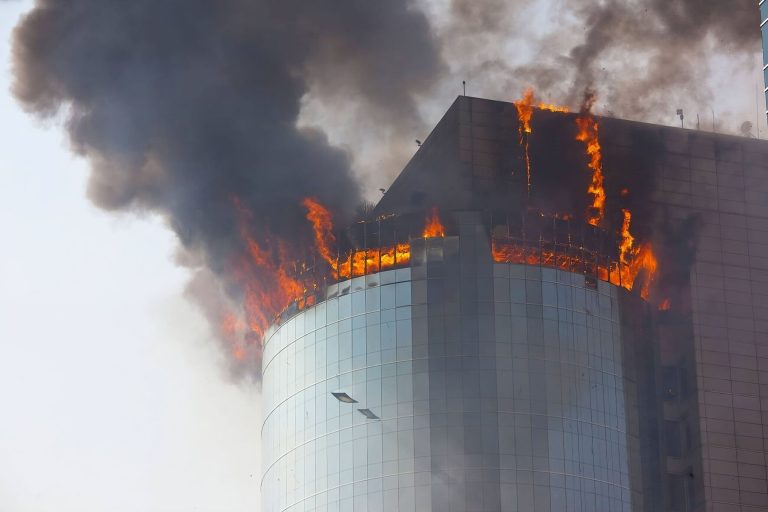
According to the National Fire Protection Association, there are more than 15,000 fires annually in high-rise buildings throughout the United States. A significant number of these fires originate on the lower floors, typically the sixth floor or below. High-rise buildings are equipped with several safety features, including heavy fire doors in stairwells, sprinkler systems to contain fires, and mandatory fire alarm systems with emergency voice communication capability.

Assessing the Situation: When confronted with a fire in a high-rise building, it’s crucial to assess your surroundings carefully. Determine whether the fire is above or below your location. Are the hallways and stairwells filled with smoke? Do you know the location of the nearest alternative stairwell? In such situations, situational awareness is paramount. Listen for instructions from emergency response personnel, who will provide guidance for evacuating the affected floor and those above and below.

Two Appropriate Reactions: There are two appropriate responses to a building fire:

Exit via Stairs: If conditions permit, use the stairs to evacuate the building. This is the preferred option when it’s safe to do so.

Stay Put: If leaving the building is not a viable option due to fire severity or blocked escape routes, stay where you are. It’s important to note that rooftop rescues involving helicopters, often seen in movies, are not standard fire safety procedures. Severe fires generate strong thermal currents that can make helicopter rescues challenging to control. Helicopter rotor downwash can also push smoke and superheated air onto those below.

If Trapped: If you find yourself trapped above a fire, move to several floors above the fire-affected area and remain in place. Contact the fire department to relay your location. Additionally, signal your presence by placing something light-colored, like a whiteboard or your shirt, on a window. Avoid breaking the window, as it may worsen the situation by allowing smoke to enter and potentially creating a chimney effect, drawing smoke and flames upward.

Navigating Smoke: If you are on the move and smoke is thick, drop to your hands and knees and crawl. Since hot air rises, the air near the ground is typically clearer. Test doors with the back of your hand before attempting to open them, as it is more sensitive to temperature changes. While not the recommended approach, a survivalist may explore external devices such as window-cleaning rigs or rappelling devices if available in their office.

Surviving a shooter/hostage situation in high-rise buildings

In high-rise buildings, the guidance from public safety officials during active shooter situations emphasizes the importance of swift action and critical decision-making:

Evacuate the High-Rise Building: The primary recommendation is to evacuate the high-rise building as quickly as possible, using any available means while avoiding drawing the shooter’s attention, if feasible and safe to do so. High-rise buildings provide various exit routes, and it’s crucial to be familiar with them.

If Unable to Escape, Hide or Barricade: If escaping is not an option, find a secure hiding place or barricade yourself. Heavy office furniture like desks can be used as barriers. Tables, chairs, and trash cans can also serve as obstacles to slow down or obstruct the shooter’s advance.

Avoid Obvious Gathering Spots: Avoid gathering in lunchrooms or conference rooms, as these areas may be targeted by the shooter. In such situations, it’s better to disperse and find separate hiding spots rather than remaining in a group. Having a colleague as a buddy can be helpful for mutual support and protection.

As a Last Resort, Engage: If all else fails and as a last resort, consider engaging with whatever improvised weapons are available, whether it’s a chair or a heavy flashlight. Attempt to approach the shooter from behind, if possible. Remember, once you engage, do not stop; continuous movement is vital to reduce the risk of becoming an easy target.

Coordinated Action: If you are with a trusted colleague, coordinating your actions as a pair can provide added strength and vigilance. Keep an eye out for each other’s safety and well-being.

Interacting with Law Enforcement: If you find yourself behind a locked door when law enforcement arrives, ask for identification or call dispatch to verify the officer’s identity before opening the door. Cooperate fully with their instructions, understanding that they may not distinguish you from the threat until the situation is clarified.

If Taken Hostage: If you become a hostage, prioritize your survival. Avoid attempting to negotiate or argue with the gunman, as many are unpredictable. Patience is crucial in this situation. Stay vigilant and observant; there may be opportunities for release or escape, and the safety of others could rely on the information you provide.

In high-rise buildings, where escape routes and hiding places may differ from traditional settings, these guidelines can help increase your chances of survival during an active shooter incident. Remember that quick thinking, adaptability, and cooperation with law enforcement are vital in such critical situations.

Surviving tornadoes in high-rise buildings

Tornadoes can form so rapidly that little warning is possible, unlike hurricanes that gradually build up. Just like with any disaster preparation, individuals in high-rise buildings must stay vigilant regarding weather conditions. Here are some crucial tips for staying safe:

Recognize Tornado Warning Signs: There are distinct signs that indicate conditions are ripe for a tornado to form:

  • Dark, often greenish sky
  • Large hail
  • Low-lying, dark, swirling clouds
  • A loud roar similar to a freight train

Avoid Windows: During a tornado, it’s vital to stay away from windows. Even if the glass doesn’t shatter due to the strong winds, the building’s movement or debris carried by the tornado may pose a significant threat. Flying debris is a leading cause of injuries during tornadoes.

Seek Shelter on the Lowest Floor: Make your way to the lowest floor possible and find an interior room, stairwell, or hallway. Avoid large, clear-span areas like sales floors, which may be more vulnerable to damage. If you suddenly find yourself trapped, locate an interior room and hunker down beside a sturdy piece of furniture, with your arms over your head for protection.

Know Designated Refuge Areas: Most high-rise buildings in hurricane- and tornado-prone areas have designated refuge areas within the building. Familiarize yourself with the location of these safe zones in advance, as they offer enhanced protection during severe weather events.

According to the National Weather Service, whether facing tornadoes, waterspouts, or hurricanes, the best advice is to seek shelter in an interior part of the lowest floor of a sturdy building. Avoid being outside, even when faced with unusual circumstances, like the possibility of sharks falling from the sky. Staying indoors in a secure location remains the safest course of action during extreme weather events in high-rise buildings.

LOY banner 2 1

Surviving blizzards in high-rise buildings

Imagine this scenario: You’ve been working late on a project, completely unaware of the weather outside. Suddenly, the lights and your computer go out. A glance at your phone reveals it’s 8 p.m., and the winter storm watch has escalated into a full-blown blizzard, leaving you trapped inside your high-rise building. Here’s what to do:

Check Your Supplies: Assess your essentials. Is your smartphone charged, and do you have an external battery in your backpack? These will be crucial for communication and staying informed.

Know Your Building: Determine if you’re in a modern high-rise with emergency backup systems or an older one relying on boilers in the basement and radiator heat. If the backups haven’t kicked in, contact maintenance or building management for assistance.

Collaborate with Others: You’re likely not alone in the high-rise building. Seek out cleaners, maintenance workers, or security personnel who may be present. Pool your resources and knowledge. They might have access to upper or warmer floors, such as the basement with boilers in older buildings, or other offices where you can find food and snacks. Don’t hesitate to share someone’s lunch if necessary, but be courteous and leave a note.

Prioritize Survival: After alerting emergency personnel, loved ones, and your boss about your situation, focus on staying warm, fed, and hydrated. If you commute, your heavy coat, scarf, hat, and gloves should be on hand. If you have a car in the building, retrieve your survival kit, which should include an emergency thermal blanket.

Stay Warm: Protect your head, neck, and wrists as they lose heat quickly when exposed to cold air. Wear your scarf and hat to keep warm. If your office has large coffee thermoses, fill them with hot water while it’s available. Collect food and water supplies, find a small office space, and block any drafts. Prevent heat from escaping by closing blinds and curtains.

Conserve Phone Battery: Conserve your smartphone battery by limiting unnecessary usage. Keep it warm, as cold temperatures can drain the battery faster.

Share Body Heat: If you’re with others, don’t underestimate the benefit of sharing body heat. Being in a small office with several people will help maintain warmth, even if you’re not snuggled up.

In high-rise buildings during winter storms, it’s essential to stay resourceful, collaborative, and focused on staying warm and nourished until help arrives or conditions improve.

Evacuating your pet

evacuating your pet from a high rise building

For survivalists who bring their dogs into the workplace, ensuring the safety of their furry companions is paramount, especially during times of natural disasters. Here’s what you need to know:

Pet Evacuation Standards: In the wake of Hurricane Katrina, the Pet Evacuation and Transportation Standards were enacted into law to address the needs of individuals with pets and service animals during emergencies. This means that your pet’s rescue and well-being are now an integral part of disaster preparedness efforts.

Your Presence is Their Best Chance: The best chance for your pet to survive any disaster is with you. Do not assume that your pet will fare better on its own. Keep your dog leashed and close to you to maintain their composure and safety during chaotic situations.

Valuable Resources: For detailed disaster preparedness information specific to pets, visit the American Veterinary Medical Association’s website at avma.org/disaster and the Humane Society’s website at humanesociety.org. These resources provide valuable guidance on how to protect and care for your beloved pet during crises.

Ensuring the safety and well-being of your canine companion in the workplace during emergencies is not just a responsibility but also a key element of effective disaster preparedness. Be informed, stay prepared, and remember that your pet’s safety depends on your actions.

Concluding

Disaster preparedness is a critical aspect of safeguarding yourself and others in high-rise buildings during various emergencies, from fires and active shooter situations to natural disasters like tornadoes, hurricanes, and earthquakes.

Staying informed, knowing your building’s safety features, and having a plan in place can make a significant difference in ensuring your safety and the safety of your colleagues or loved ones. Whether it’s seeking shelter, evacuating, or knowing how to react in unexpected situations, being prepared and aware is the key to surviving and minimizing risks in high-rise environments.

Recommended resources for preppers and homesteaders:

Buying your first gun – Things you should know

How to build an underground cellar for less than $400

10 Best MREs for Emergency and Survival Scenarios

Ingenious DIY projects for a Self-Sufficient Homestead

US military resumes counterterrorism missions out of Niger bases

0

NATIONAL HARBOR, Md. — The U.S. military has resumed counterterrorism missions in Niger, flying drones and other aircraft out of air bases in the country more than a month after a coup temporarily halted all those activities there, the head of U.S. Air Forces for Europe and Africa said Wednesday.

Since the July coup, the 1,100 U.S. forces deployed in the country have been confined inside their military bases. Last week the Pentagon said some military personnel and assets had been moved from the air base near Niamey, which is the capital of Niger, to another in Agadez. Niamey is about 920 kilometers away from Agadez.

In recent weeks some of those intelligence and surveillance missions have been able to resume due to U.S. negotiations with the junta, said Gen. James Hecker, the top Air Force commander for Europe and Africa.

“For a while we weren’t doing any missions on the bases, they pretty much closed down the airfields,” Hecker said. “Through the diplomatic process, we are now doing, I wouldn’t say 100% of the missions that we were doing before, but we’re doing a large amount of missions that we’re doing before.”

Hecker, who spoke to reporters at the annual Air and Space Forces Association convention at National Harbor, Maryland, said the U.S. is flying both manned and unmanned missions and that those flights resumed “within the last couple of weeks.”

The significant distance between the two bases also means that the while flights are going out, some missions are “not getting as much data, because you’re not overhead for as long” because of the amount of fuel it takes to get out and back, he said.

The U.S. has made Niger its main regional outpost for wide-ranging patrols by armed drones and other counterterror operations against Islamic extremist movements that over the years have seized territory, massacred civilians and battled foreign armies. The bases are a critical part of America’s overall counterterrorism efforts in West Africa.

The U.S. has also invested years and hundreds of millions of dollars in training Nigerian forces.

In 2018, fighters loyal to the Islamic State group ambushed and killed four American service members, four Nigeriens and an interpreter.

West Africa recorded over 1,800 extremist attacks in the first six months of this year, which killed nearly 4,600 people, according to ECOWAS, the Economic Community of West African States.

The Islamic extremist group Boko Haram operates in neighboring Nigeria and Chad. Along Niger’s borders with Mali and Burkina Faso, the Islamic State in the Greater Sahara and al-Qaida affiliate Jama’at Nusrat al-Islam wal-Muslimin pose greater threats.

At Air Force conference, officials call out effect of Tuberville holds

0

NATIONAL HARBOR, Md. — Top Defense Department officials at an Air Force conference this week repeatedly decried — at times in direct and colorful language — a senator’s wide-ranging hold on confirmations of general officers and called on him to lift it.

The comments at the Air and Space Forces Association’s Air, Space and Cyber Conference here continued the Pentagon’s recent pattern of confronting Sen. Tommy Tuberville, R-Alabama, over his six-month blockade of general officer nominations over the department’s abortion policy. And they mark a noticeable difference in how Pentagon officials, particularly uniformed officers, tend to approach differences with Capitol Hill, which are usually handled behind the scenes or with gentler public phrasing.

Tuberville objects to the Pentagon’s decision, after the U.S. Supreme Court overturned Roe v. Wade, to allow troops to take leave to travel to another state to receive abortion services if they serve in a state that bans such care.

More than 300 general officer nominations are now held up by Tuberville’s holds, including Air Force Chief of Staff Gen. CQ Brown’s nomination to succeed Army Gen. Mark Milley as chairman of the Joint Chiefs of Staff. Milley is required by law to retire at the start of October. The Army, Navy and Marine Corps also are without confirmed service chiefs due to the hold.

Gen. Mark Kelly, the retiring head of Air Combat Command, warned in a roundtable with reporters Tuesday that the disruption and unfilled positions caused by the hold have not just unsettled allies and caused them to lose confidence in the United States’ competence but have also emboldened the nation’s adversaries.

“If you drive north … on Connecticut Avenue, that popping sound is not straight gunfire,” Kelly said. “It’s champagne corks in the Chinese Embassy, bouncing off the walls.”

In his keynote address to AFA on Monday, Air Force Secretary Frank Kendall led a round of applause for several general officers who have been waiting — in some cases up to half a year — for the Senate to confirm them in their new roles.

Though Kendall did not mention Tuberville by name in his address, he did call out the senator over perceived consequences.

“This is a situation that one senator has created for us,” Kendall said. “All these men and women, and their units and their families, are having their readiness and their lives negatively affected by your unprecedented actions.

“They are all doing their duty and making whatever sacrifice we ask of them — including the ones associated with your holds.”

Kendall, along with Army Secretary Christine Wormuth and Navy Secretary Carlos Del Toro, also co-authored an op-ed in the Washington Post and appeared on CNN earlier this month blasting Tuberville’s hold.

At AFA on Tuesday, Kelly — who noted he expected to be retired by now after Gen. Kenneth Wilsbach would have succeeded him — said he’s worried about the effect the hold is having on the military’s officer corps, allies and adversaries.

Officers and their families give a great deal when they serve in the military, he said, citing the disruptions to their children’s education and spouses’ employment opportunities that can come with military life.

But, Kelly said, their tolerance is not unlimited.

“Each [officer] has their own individual red line,” Kelly said. “I talk to them every day. And we’re on the fringe of losing a generation of champions, [in] my opinion.”

Kelly said the United States’ allies look to its military as “a beacon of competence and confidence” — but the nation’s current dynamic “does not instill confidence.”

“Some of them are interested and vexed, some of them are downright concerned,” Kelly continued. “We try to allay those concerns as much as possible, but it’s getting more challenging by the day.”

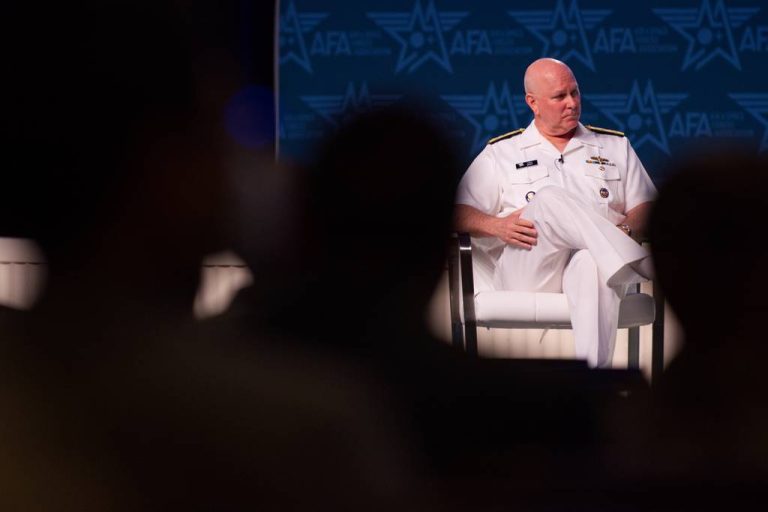
In his own remarks at AFA on Wednesday, Navy Adm. Christopher Grady, vice chairman of the Joint Chiefs of Staff, also highlighted the “human cost” to the hold and said it must be considered.

“It goes beyond” the general and flag officers, he said. “It goes all the way down to those [lieutenant colonels], who are looking up and waiting to move forward and can’t do it right now. That is challenging.”

“The fact that folks can’t plan for their moves or get their kids in school, that’s also challenging,” Grady continued. “There’s a very significant human dimension to this.”

Grady said Brown “definitely is the right man at the right time” to succeed Milley, and called for him to be confirmed.

Kendall said he and other defense leaders had constructive conversations with Tuberville in the past, and are happy to talk with him about the hold. But the secretary drew a line against changing the abortion policy that has incensed the Republican.

“As far as I can tell, we’re not going to change the policy. I see no indication of that,” Kendall said. “And I don’t think we should, quite frankly.

“So, we need to resolve this,” he continued. “It’s gone on long enough. It’s doing a lot of harm.”

Stephen Losey is the air warfare reporter for Defense News. He previously covered leadership and personnel issues at Air Force Times, and the Pentagon, special operations and air warfare at Military.com. He has traveled to the Middle East to cover U.S. Air Force operations.

Colin Demarest is a reporter at C4ISRNET, where he covers military networks, cyber and IT. Colin previously covered the Department of Energy and its National Nuclear Security Administration — namely Cold War cleanup and nuclear weapons development — for a daily newspaper in South Carolina. Colin is also an award-winning photographer.

Electronic warfare in Ukraine informing US playbook

0

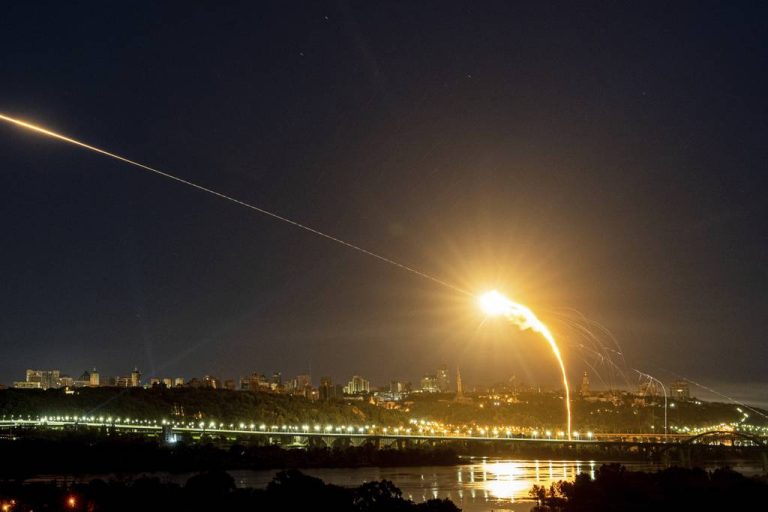
NATIONAL HARBOR, Md. — Ukrainian forces are exploiting gaps in Russian jamming and spoofing capabilities, opening seams in which they make noticeable gains on the battlefield, according to a U.S. Air Force commander.

While the Russian military seeks to break Ukrainian command and control and block access to the electromagnetic spectrum, used for communications and weapons guidance, among other vital tasks, Ukrainians are resilient and resourceful in their application of electronic warfare, said Col. Josh Koslov, the leader of the 350th Spectrum Warfare Wing.

“The agility being displayed by both parties, in the way that they’re executing operations in the spectrum, is awesome,” he told reporters during a discussion at the Air, Space and Cyber Conference in National Harbor, Maryland. “Both sides are doing the cat-and-mouse game very, very well.”

The U.S. is observing the invisible back-and-forth and is taking notes as the Pentagon works to reinvigorate jamming and deception arsenals in preparation for potential conflicts with China or Russia.

The spectrum would be hotly contested in a fight with either.

“In the future, for us, if we do confront a peer, being agile and being rapid is the key to success in the spectrum,” said Koslov, whose team at Eglin Air Force Base in Florida works to quickly upgrade electronic-warfare tools aboard aircraft. “Not having control of spectrum leads to fatalities, leads to getting killed. And we’ve seen that time and time again in that conflict.”

The 350th Spectrum Warfare Wing, established two years ago, is the first of its kind and the outgrowth of an electromagnetic spectrum superiority study.

Air Force Chief of Staff Gen. CQ Brown this year warned Congress the Defense Department was losing its ability to fend off attacks on the electromagnetic spectrum, leaving troops exposed. Prioritization of high-end electronic warfare systems fell off following the Cold War.

Koslov, in an interview last month, told C4ISRNET he agreed with Brown’s assessment and was working to address the issue.

“I think where we have to focus is on the highest-end or most-difficult problems, because I believe in the lesser-included threat, which means if I could do it at the highest end, I should be able to adapt to lower-end threats,” he said at the time.

Colin Demarest is a reporter at C4ISRNET, where he covers military networks, cyber and IT. Colin previously covered the Department of Energy and its National Nuclear Security Administration — namely Cold War cleanup and nuclear weapons development — for a daily newspaper in South Carolina. Colin is also an award-winning photographer.

Ukraine could be flying F-16s early in 2024, Air Guard chief says

0

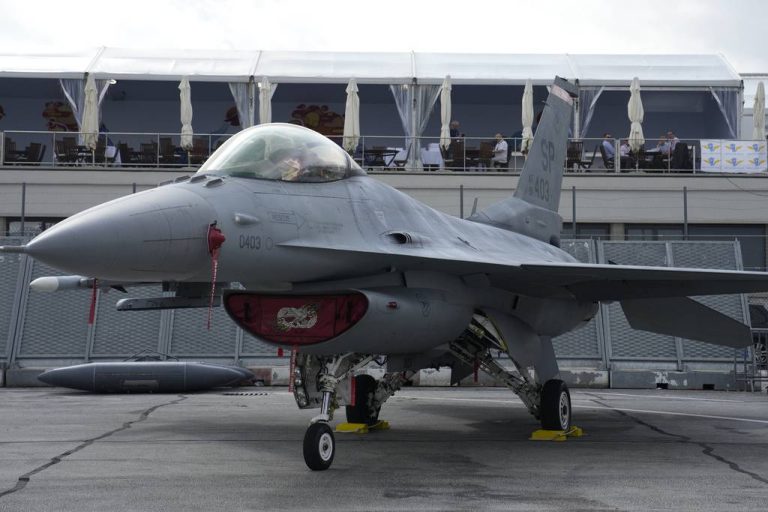
NATIONAL HARBOR, Md. (AP) — The U.S. could have the first Ukrainian pilots trained on F-16 fighter jets before the end of the year, though it will be longer than that before they are flying combat missions, the director of the U.S. Air National Guard said Tuesday.

The Ukrainian pilots are expected to arrive at Morris Air National Guard Base in Tucson, Arizona, by October. Those aviators are being evaluated for English language skills right now, and depending on their proficiency and previous fighter jet experience, they could complete the U.S. training within three months, Lt. Gen. Michael Loh, director of the U.S. Air National Guard, said at the annual Air Force Association convention in National Harbor, Maryland.

“As soon as they’re given a go-ahead, they’ll be coming over and they’ll start their training immediately,” Loh said.

To meet the quick training timeframe, Tucson will likely shift some of its other international pilot training commitments to move Ukraine to the front of the line, he said.

“It’s a national priority,” Loh said.

However, after completing the U.S. training, the Ukrainians would need to return to Europe for additional NATO training. NATO allies are also training Ukrainians on how to maintain the aircraft, and that will also need to be completed before the jets would be flying combat missions. Loh did not have an estimate of how much time the additional training would take.

Gen. David Allvin, the nominee to become the next chief of the Air Force, told senators at his confirmation hearing Tuesday that, on average, the F-16 training will take six to nine months.

Ukraine’s leaders have asked for fighter jets from the West since the earliest days of the war. For the first year and a half, the U.S. and other allied partners focused on providing other weapons systems, citing the jets’ cost, concerns about further provoking Russia, the number of deadly air defense systems Russia had covering Ukrainian airspace and the difficulty in maintaining the jets.

Since then the war has become a gruesome, slow-moving fight with ground tactics and trench warfare reminiscent of World War I, and for that, the F-16′s ability to suppress enemy air defenses and conduct low-altitude attacks could help Ukraine, Loh said. In addition, unlike some other systems pledged to Ukraine, the F-16 is still in production, and because it is widely used by a number of international partners, there are plenty of spare parts.

“I definitely think it can be a game changer,” Loh said.

Sen. Richard Blumenthal, D-Conn., asked Allvin if the training could be accelerated, noting that the Ukrainian forces learned how to operate other systems, such as the Stryker and Bradley fighting vehicles, faster than anticipated.

“I can assure you that if the folks in Tucson see the advancement, they will not hold them back,” Allvin, who is currently the vice chief of the Air Force, told the Senate Armed Services Committee. “They will train them to the level of their competency, and if that takes less time, then all the better.”

Ukraine is seeking up to 50 F-16 fighter jets, or the equivalent of three fighter squadrons from coalition nations; in August, Ukrainian President Volodymyr Zelenskyy said Kyiv was set to receive 42 of the jets.

Loh said the Air National Guard assessed the three-month timeline based on training Ukrainian pilots received on Fresno, California-based F-15Cs, another advanced Air National Guard fighter jet. That exposure allowed the Air National Guard to assess that Ukraine’s aviators were already using more Western tactics in flying and that it would not take long to bring them up to speed, he said.

The nine-month timeframe is the estimate to get pilots with no previous fighter jet experience flying the F-16s, Loh said.

Air Force ‘crystal clear’ on drone wingmen urgency

0

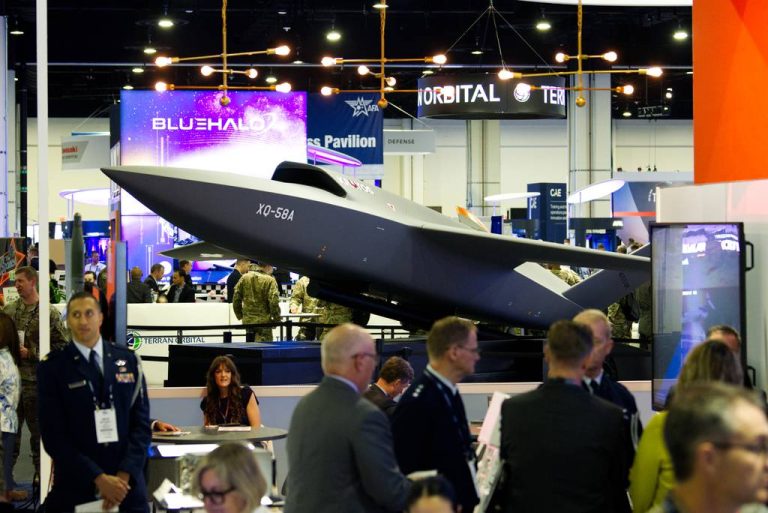
NATIONAL HARBOR, Md. — The U.S. Air Force has clearly expressed its desire for a futuristic fleet of drone “wingmen” considered vital to countering Russia and China, defense company executives said.

The exchange of info between buyer and builder for the collaborative combat aircraft endeavor, or CCA, has so far been “crystal clear,” according to David Alexander, the president of General Atomics Aeronautical Systems, the maker of the Gray Eagle and Reaper unmanned aerial vehicles, among others.

“That’s helpful, especially for companies that want to invest and lean forward and see how we can get speed,” Alexander said Sept. 11 at the Air, Space and Cyber Conference in National Harbor, Maryland. “I really appreciate the clarity on that.”

The Air Force in the coming years wants to pair pilots with CCAs to afford them greater flexibility and firepower. The uncrewed aircraft could carry out a variety of missions: conducting reconnaissance and gathering intelligence; jamming signals and serving as decoys; and striking targets with their own missiles. Service officials have also said CCAs could range in cost and complexity, with some being expensive and precious while others could be easily traded in combat.

Robert Winkler, a vice president at Kratos, a California-based developer of uncrewed defense platforms, said the Air Force and Department of Defense have “100%” communicated their desires. The Air Force’s proposed budget for fiscal 2024 includes new spending to help it prepare for a future with drone wingmen, including an effort known as Project Venom that involves self-flying F-16 fighters.

“The number of people that are sitting in this room is a clear demand signal that this is an important portion of force design for the United States Air Force and for the Department of Defense,” Winkler said at the conference, where several keynotes and panel discussions were standing-room only.

A Kratos Valkyrie drone was earlier this year piloted by artificial intelligence algorithms as part of an Air Force Research Laboratory experiment.

Brig. Gen. Scott Cain, commander of the research lab, in a statement at the time said AI “will be a critical element to future warfighting and the speed at which we’re going to have to understand the operational picture and make decisions.” The Pentagon was juggling more than 685 AI-related projects, including several tied to major weapons systems, as of 2021.

“AI, autonomous operations, and human-machine teaming continue to evolve at an unprecedented pace and we need the coordinated efforts of our government, academia, and industry partners to keep pace,” Cain said.

Defense News reporter Stephen Losey contributed to this article.

Colin Demarest is a reporter at C4ISRNET, where he covers military networks, cyber and IT. Colin previously covered the Department of Energy and its National Nuclear Security Administration — namely Cold War cleanup and nuclear weapons development — for a daily newspaper in South Carolina. Colin is also an award-winning photographer.

FDA has decided that Sudafed and benadryl no longer work and they will be removed from stores

0

  1. FDA rules TODAY that ingredient in Benadryl and Sudafed from pharmacy shelves doesn’t work | Daily Mail Online
    Took me a few minutes to find an original pic that wasn’t all grainy as hell.
    It looks like they want to ban oral use of Phenylephrine. The FDA is claiming the Phenylephrine is immediately broken down by digestive processes rendering it ineffective.
    But Phenylephrine nose spray will still be available.
    What shitty timing right before cold and flu season.
    I’m not saying buy Phenylephrine. I’m saying all the most popular cold and flu medications use it, they’ll get pulled, creating an intentional cold and flu medicine shortage since drug companies have been manufacturing this shit all year, have wearhouses full of it and now possibly can’t sell it. Not because it’s dangerous but because one of the ingredients doesn’t do anything.


    Last edited: Sep 13, 2023 at 8:48


survivalmonkey SSL seal


survivalmonkey.com warrant canary

US Air Force receives first new Compass Call electronic warfare plane

0

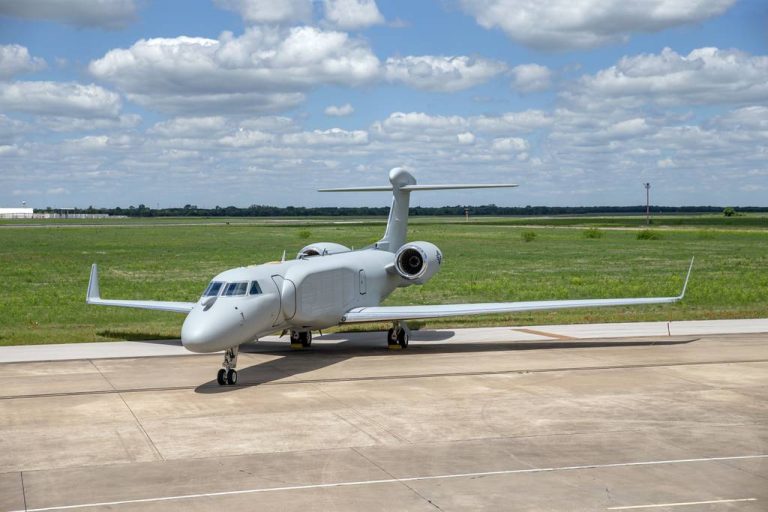
NATIONAL HARBOR, Md. — The U.S. Air Force has received its first EC-37B Compass Call electronic warfare aircraft from contractors BAE Systems and L3Harris Technolgies, industry officials announced Tuesday.

BAE Systems said in a release that the Air Force will next start combined developmental and operational testing for this Compass Call, the first of 10 aircraft planned for the Air Force.

The new EC-37B fleet will replace Air Combat Command’s decades-old EC-130 aircraft, which the service is now retiring. BAE builds the electronic attack components of the new Compass Call in Hudson, New Hampshire, and L3Harris integrates that mission-specific hardware into a Gulfstream G550 business jet at its facility in Waco, Texas.

The Compass Call will conduct a variety of electronic warfare missions to jam enemy signals, including communications, radar and navigation systems. BAE said this will include suppressing enemy air defenses by blocking their ability to transmit information between weapon systems and command-and-control networks.

In a roundtable at the Air and Space Force Association’s Air Space and Cyber conference here, ACC Commander Gen. Mark Kelly said the EC-37B’s jamming capabilities will protect friendly ships and aircraft from enemy attack, and allow them to get closer to their targets.

The EC-37B’s mission and capabilities won’t be wildly different from the EC-130, Kelly said, especially since the Air Force updated the older Compass Call’s capabilities.

But the altitude and speed improvements that will come with the EC-37B will make it a considerable step up from its predecessor, Kelly said. The EC-130 has a ceiling of 25,000 feet and can fly at up to 300 miles per hour. G550s can fly past 40,000 feet and nearly twice that speed, which an L3Harris executive in 2021 said would allow the EC-37B to be able to target a greater range of enemy activities.

The EC-130 also is worn out, Kelly said, and the Air Force needs the EC-37 “yesterday.”

“There comes a point of every piece of equipment’s lifespan, we’ve squeezed every last drop of combat capability out of it,” Kelly said.

BAE would not say exactly what day, and where, the first new Compass Call was delivered. The Air Force did not immediately respond to a request for more information on the delivery.

Kelly said the EC-37B testing will primarily focus on making sure the integration of its mission systems is working correctly, since the Gulfstream air frame it is built from is known to be a solid aircraft.

That will include making sure the new Compass Call’s systems are talking to each other at the right time, and that its jamming capabilities are functioning and not straining the plane’s environmental systems, Kelly said.

“When we dial up the jamming power, or ask for a specific waveform, that waveform needs to come out in exactly the amount of ramp and power and frequency we asked for,” Kelly said.

Kelly said he doesn’t see the Air Force’s planned drone wingmen, or collaborative combat aircraft — some of which might be able to conduct electronic warfare operations — as something that could eventually replace the Compass Call.

Instead, he said, CCAs will complement the Compass Call fleet, along with the F-35 and F-15EX’s own EW capabilities.

However, he warned that the Air Force needs to make sure that as these different platforms operate in the same airspace, that they don’t inadvertently interfere with one another.

“It’s all got to merge together, and they have to operate — and oh, by the way, [let’s] be sure they don’t [commit] electronic fratricide on each other,” Kelly said.

Stephen Losey is the air warfare reporter for Defense News. He previously covered leadership and personnel issues at Air Force Times, and the Pentagon, special operations and air warfare at Military.com. He has traveled to the Middle East to cover U.S. Air Force operations.

U.S. Air Force has its first new Compass Call electronic warfare plane

0

NATIONAL HARBOR, Md. — The Air Force has received its first EC-37B Compass Call electronic warfare aircraft from contractors BAE Systems and L3Harris, industry officials announced Tuesday.

BAE Systems said in a release that the Air Force will next start combined developmental and operational testing for this Compass Call, the first of 10 aircraft planned for the Air Force.

The new EC-37B fleet will replace Air Combat Command’s decades-old EC-130 aircraft, which the service is now retiring. BAE builds the electronic attack components of the new Compass Call in Hudson, New Hampshire, and L3Harris integrates that mission-specific hardware into a Gulfstream G550 business jet at its facility in Waco, Texas.

The Compass Call will conduct a variety of electronic warfare missions to jam enemy signals, including communications, radar and navigation systems. BAE said this will include suppressing enemy air defenses by blocking their ability to transmit information between weapon systems and command-and-control networks.

In a roundtable at the Air and Space Force Association’s Air Space and Cyber conference here, ACC Commander Gen. Mark Kelly said the EC-37B’s jamming capabilities will protect friendly ships and aircraft from enemy attack, and allow them to get closer to their targets.

The EC-37B’s mission and capabilities won’t be wildly different from the EC-130, Kelly said, especially since the Air Force updated the older Compass Call’s capabilities.

But the altitude and speed improvements that will come with the EC-37B will make it a considerable step up from its predecessor, Kelly said. The EC-130 has a ceiling of 25,000 feet and can fly at up to 300 miles per hour. G550s can fly past 40,000 feet and nearly twice that speed, which an L3Harris executive in 2021 said would allow the EC-37B to be able to target a greater range of enemy activities.

The EC-130 also is worn out, Kelly said, and the Air Force needs the EC-37 “yesterday.”

“There comes a point of every piece of equipment’s lifespan, we’ve squeezed every last drop of combat capability out of it,” Kelly said.

BAE would not say exactly what day, and where, the first new Compass Call was delivered. The Air Force did not immediately respond to a request for more information on the delivery.

Kelly said the EC-37B testing will primarily focus on making sure the integration of its mission systems is working correctly, since the Gulfstream air frame it is built from is known to be a solid aircraft.

That will include making sure the new Compass Call’s systems are talking to each other at the right time, and that its jamming capabilities are functioning and not straining the plane’s environmental systems, Kelly said.

“When we dial up the jamming power, or ask for a specific waveform, that waveform needs to come out in exactly the amount of ramp and power and frequency we asked for,” Kelly said.

Kelly said he doesn’t see the Air Force’s planned drone wingmen, or collaborative combat aircraft — some of which might be able to conduct electronic warfare operations — as something that could eventually replace the Compass Call.

Instead, he said, CCAs will complement the Compass Call fleet, along with the F-35 and F-15EX’s own EW capabilities.

However, he warned that the Air Force needs to make sure that as these different platforms operate in the same airspace, that they don’t inadvertently interfere with one another.

“It’s all got to merge together, and they have to operate — and oh, by the way, [let’s] be sure they don’t [commit] electronic fratricide on each other,” Kelly said.

Stephen Losey is the air warfare reporter for Defense News. He previously covered leadership and personnel issues at Air Force Times, and the Pentagon, special operations and air warfare at Military.com. He has traveled to the Middle East to cover U.S. Air Force operations.