LONDON — The Bulgarian Defence Ministry is expected to select its new three-coordinate radar in the coming weeks, according to industry representatives present at this year’s DSEI show in London.
On Aug. 24, Bulgariam Deputy Defence Minister Stanimir Georgiev said the planned acquisition of seven new radars is crucial for the country’s ongoing efforts to modernize its Air Force.
According to the ministry, five companies submitted their offers: France’s Thales; Israel Aerospace Industries subsidiary Elta Systems; Italy’s Leonardo, Spain’s Indra; and U.S company Lockheed Martin.
Taschko Nikolov, the director for business development in Bulgaria for Thales, said the company is offering a radar from its Ground Master family for the Air Force, per a statement provided to Defense News by the French firm’s communications team at DSEI.
John Neilson, the director for international communications at Lockheed Martin, told Defense News the company has proposed the TPS-77 radar to Bulgaria. “We await feedback from the Bulgarian MoD on next steps in the process,” Neilson said.
The forthcoming acquisition is worth about 400 million leva ($219 million). The main criteria under consideration are price, maintenance costs, operational capacities, industrial cooperation opportunities and warranty maintenance terms, according to the ministry.
Defense News has contacted Leonardo, Elta and Indra for comment.
Jaroslaw Adamowski is the Poland correspondent for Defense News.
LONDON — Executives at helicopter maker Leonardo pushed back against a competitor’s assertion that the Italian company’s AW149 helicopter, in play for the British New Medium Helicopter program, isn’t military-grade enough.
Mike Morrisroe, the company’s lead for U.K. helicopter campaigns, on Wednesday disputed a claim by a Lockheed Martin executive from the previous day at the DSEI arms fair in London that the U.S.-based company’s offering of the Black Hawk was the only one developed purely for military use.
The AW149 meets relevant crashworthiness standards and is built for survivability on the battlefield, with a construction meant to “minimize” the impact of small-arms fire against the cabin and the blades, he said.
Paul Livingston, CEO of Lockheed’s U.K. subsidiary, had illustrated the Black Hawk’s military utility by saying the company’s offering is the only one offering retractable seats capable of withdrawing injured pilots to the helicopter cabin without having to exit the aircraft.
For Leonardo’s Mark Burnand, the company’s chief test pilot, the utility of such a setup is questionable if the helicopter’s self-defense features work properly.
“You’re not going to find yourself in that situation in the first place,” he said.
Leonardo presented itself as a bastion of U.K. helicopter building at the start of DSEI, boasting of £1.6 billion ($2 billion) in exports over the last 18 months including orders for the design, development and manufacture of new aircraft, upgrade programs and support deals.
The firm said the number added to a further £5bn in helicopters exports from the U.K. secured over the preceding nine years.
It’s the only firm with “end-to-end helicopter manufacturing capability” in the country, with more than half of the U.K. military’s frontline fleet starting life at Leonardo’s Yeovil facility in Somerset, England.
No wonder, Leonardo said, that its U.K. onshore helicopters business has recently been granted official status as the “Home of British Helicopters.”
Should its AW149 win the U.K.’s New Medium Helicopter contest, the firm will build the platform at Yeovil and has promised that 60-70% of its content and through-life support would be carried out in the country.
“Investment in skills and research generates valuable U.K. intellectual property and sustains an onshore industrial base that provides” the U.K. Ministry of Defence “with direct access to critical skills and capabilities that underpin operational independence and technological advantage,” it said.
Sebastian Sprenger is associate editor for Europe at Defense News, reporting on the state of the defense market in the region, and on U.S.-Europe cooperation and multi-national investments in defense and global security. Previously he served as managing editor for Defense News. He is based in Cologne, Germany.
Tom Kington is the Italy correspondent for Defense News.
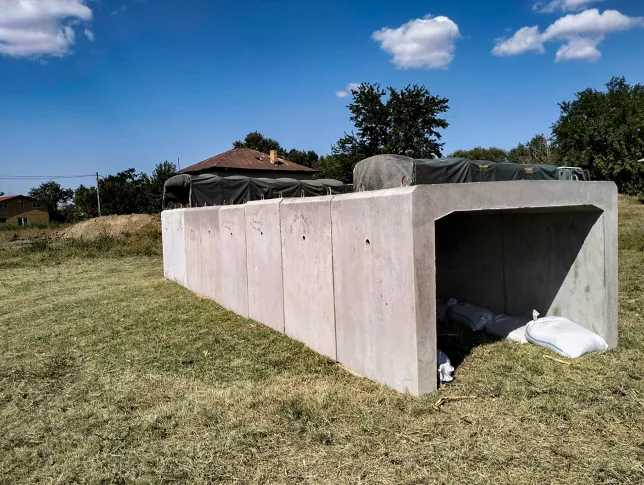
A bit of bleed over into Romania and Poland. The WW II Anderson shelters are not as stout as the 2023 Romanian shelters, and obviously there is room for improvement with the Romanian shelters a few feet underground and a bit of dirt on top. /////////////////////////////////////////////////////////////////////////////////////////////////////////////////////////// Romanian residents have been forced to take shelter because of ongoing Russian drone attacks near the border with Ukraine.
Emergency alerts were issued on Wednesday morning urging people to find cover in their basements or makeshift concrete shelters built by the national army’s engineering units.
The warning came as Ukrainian ports across the Danube were targeted in strikes by Vladimir Putin’s forces.
Eight villages in eastern Romania were sent messages on their phones to warn of ‘the possibility of falling objects from the surrounding airspace’, reports the BBC.
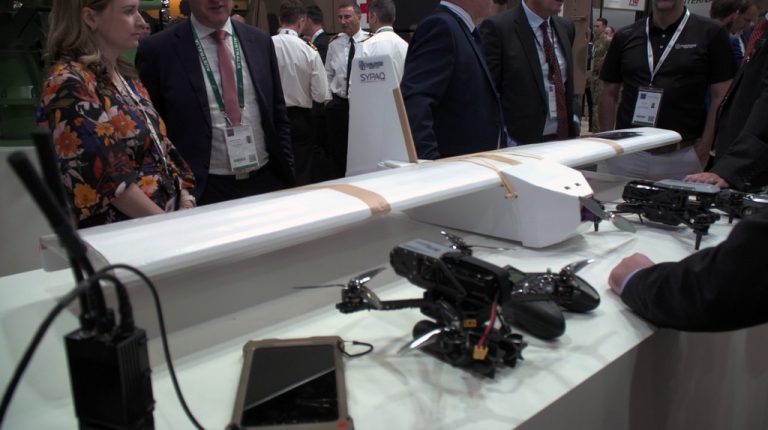
Made with cardboard, wooden dowels and rubber bands, this disposable drone adds another flexible option to militaries around the world — including Ukraine.
NATIONAL HARBOR, Md. — A new era of war fought in the digital realm, touching all aspects of combat and rife with disinformation, will require the Air Force to redefine its jobs and reinforce its rigor, the service’s top enlisted airman said here Wednesday.
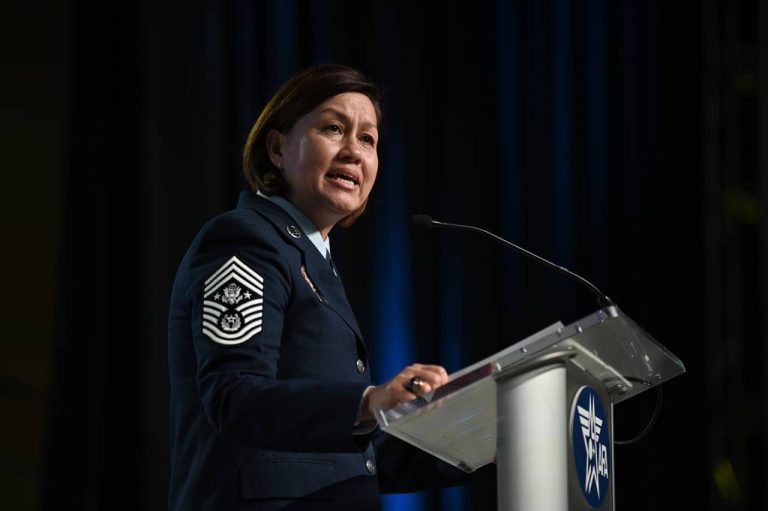
In what may be her last major speech to the force while in the job, Chief Master Sergeant of the Air Force JoAnne Bass cautioned airmen not to “underestimate the cyber and the information domains” as major drivers and amplifiers of conflict.
“Warfare has taken on a new dimension,” Bass told a packed room at the Air and Space Forces Association’s annual Air, Space and Cyber Conference.
“Our adversaries understand the power of information, and they seek to exploit it, weaponize it and use it against us,” she said. “They aim to sow discord, erode trust and destabilize nations through the spread of disinformation and propaganda through emerging technology.”
She warned that “armies of bots, swarms of trolls and legions of ‘sock puppets’” run by nefarious parties are manipulating information online to distort perceptions of reality and shape society to their advantage.
That can look like Russian-linked social media operations to influence American voters in U.S. elections, phishing and hacking campaigns, or fake text and images generated by artificial intelligence.
Without naming specific social media, Bass said the service must educate airmen on the difference between “using these platforms and being used by them.” To prove her point, Bass said she had used the artificial intelligence language model ChatGPT to generate part of her speech.
Air Force leaders often raise concerns about falling behind in an age of digitally driven asymmetric warfare, and the changes that keeping up will require. The service in 2019 pulled information operations under the same umbrella as its intelligence and cyber divisions to begin bridging those gaps, but has struggled to recruit and retain the workforce to handle those missions.
Chief Master Sergeant of the Air Force JoAnne Bass becomes emotional as she reflects on her 30 years of service. (Mike Tsukamoto/Air & Space Forces Magazine)
In an exclusive interview with Air Force Times on Aug. 28, Bass said she believes the Air Force has too many career fields overall, and too few in the areas that will matter most in tomorrow’s wars.
“We have to take a strong look at our weapon systems, our platforms, the [jobs] that fill our Air Force,” Bass said. “Probably where we need to expand is in information, cyber and space.”
She declined to specify which Air Force specialty codes could be on the chopping block, or how many airmen the service might need to fill cyber and information ops jobs.
“I am not the best person to be able to say, ‘Here’s what we have too much of,’” she said. “What I’ve asked is [for] the career field managers to think deeply about their career fields, think deeply about what our Air Force is going to look like 10 years from now.”
She pointed to teams of airmen who are exploring what the future force could look like and said data analysis is underway to illuminate the way forward.
“We will continue as an Air Force to iterate to what we need to look like,” she added. “But we’re doing a lot of the groundwork and the homework right now.”
During her keynote, Bass reminded airmen that falling short of the Air Force’s conduct and appearance standards ultimately hurts the larger objective: presenting a unified front against America’s adversaries.
In June, she published an open letter to the force that pushed airmen to hold each other to high standards of professionalism to avoid damaging the service’s reputation and abilities.
“History shows that when standards erode, military capabilities and readiness decline,” she wrote. “We can’t afford to let this happen and still expect to keep pace with the rapid expansion of the Chinese military, Russian aggression, and other emerging global challenges.”
The Air Force has tried to implement more common-sense regulations for hairstyles, clothing and more that allow flexibility without hindering combat capability or unit cohesion. But Bass warned of taking it too far.
“If we are more focused on … ourselves, instead of the greater good of the force, then we are probably off-target,” she said.
Reflecting on her 30 years of service, Bass began to cry.
“I have greatly loved four things in life: my faith, my family, my country and this Air Force,” she said. “This is more than just a job. … This is our higher calling.”
Rachel Cohen joined Air Force Times as senior reporter in March 2021. Her work has appeared in Air Force Magazine, Inside Defense, Inside Health Policy, the Frederick News-Post (Md.), the Washington Post, and others.
The Pentagon said Thursday that it has not restarted counterterrorism operations in Niger, a day after the head of U.S. airpower for Europe and Africa said those flights had resumed.
Gen. James Hecker, responding to a question from The Associated Press at a security conference Wednesday, said the U.S. military has been able to resume some manned aircraft and drone counterterrorism operations in Niger.
But the Pentagon issued a statement Thursday saying those missions are only for protecting U.S. forces and not the more sensitive, and broader, counterterrorism operations U.S. forces have successfully run with the Nigerien military in the past, adding “stories to the contrary are false.”
“We are just flying ISR (intelligence, surveillance and reconnaissance) in order to monitor for any threats,” Pentagon spokeswoman Sabrina Singh said at a press briefing Thursday. “We are flying ISR for force protection purposes and that’s it.”
Niger’s president was ousted in late July by a military junta. In the weeks since, the approximately 1,100 U.S. forces deployed there have been confined inside their military bases. News that some flights had resumed was seen as a good sign that State Department diplomatic efforts with the junta were improving security on the ground. For weeks the political uncertainty following the coup and the unstable security situation that followed has led to the U.S. consolidating some of its forces at a base farther from Niamey, Niger’s capital.
In a clarifying statement Thursday, the spokesman for air forces in Africa, Col. Robert Firman, said that in his Wednesday remarks, Hecker was just referring to the air component perspective and was not addressing the overall counterterrorism program in Niger.
In a preview provided by Hecker’s staff of an Atlantic Council taped program set to air Friday, he further elaborated on the efforts on the ground in Niger.
“The last thing we want to have happen is, we don’t want a shooting war over there. And the good news is we’ve been vastly successful at doing so with the help of the State Department,” Hecker said. “The airspace is starting to slowly come back up. And we’re able to do some of our surveillance operations primarily for force protection in the area. So that’s helping us up quite a bit to make sure that we’re comfortable.
“And all the intelligence shows right now that the risk to to our forces is fairly low. But we need to make sure that if something happens, we’re ready to go. And we’re in a good position now that they’re starting to allow us to use some of our surveillance for force protection.”
The U.S. has made Niger its main regional outpost for wide-ranging patrols by armed drones, training of host nation forces and other counterterrorism efforts against Islamic extremist movements that over the years have seized territory, massacred civilians and battled foreign armies. The bases are a critical part of America’s overall counterterrorism efforts in West Africa.
NATIONAL HARBOR, Md. — In the time it takes to watch Christopher Nolan’s dawn-of-the-nuclear-age opus “Oppenheimer,” one U.S. Air Force official wants to be able to siphon threat information from the battlefield, retool electronic warfare systems with it and see the digital updates in action on the front lines.
While 180 minutes may seem like a long time to sit in a theater, processing huge amounts of data and updating fighting systems in so short a period is a challenging target for Col. Josh Koslov, the commander of the 350th Spectrum Warfare Wing.
“They have some wicked threats out there, and it takes us a little bit, working with our engineers, working with intel, to really crack the code,” Koslov said Sept. 13, speaking to reporters on the sidelines of the Air, Space and Cyber Conference at National Harbor in Maryland.
The 350th Spectrum Warfare Wing develops waveforms and updates jamming, spoofing and spying kits aboard aircraft such as the F-35. It’s an outgrowth of an electromagnetic spectrum superiority study conducted by the Department of Defense as it seeks to rejuvenate the military’s electronic warfare capabilities. At just 2 years old, the wing’s legacy thus far is short. But its potential reach is long.
“Our goal, our moonshot, is three hours,” Koslov said. “If you think about trying to get data to fighters, to bombers, to weapons, to countermeasures, to all the things that we do, that’s a good number.”
“The way we used to do it was, kind of, an industrial production-based model,” he said. “We updated B-52s and F-15s on this quarterly process, and that’s how it worked, until we went to a conflict. During the Cold War, there wasn’t a ton of conflicts where we were using those systems. So we got by with that.”
RELATED
Modern militaries rely on the spectrum to communicate, navigate and guide weapons to their targets; the fight over it — access, manipulation and more — can make or break success. The associated U.S. arsenal atrophied in the years following the Cold War, but officials are reprioritizing in preparation for a fight with Russia in Europe or China in the Indo-Pacific.
“We had such overmatch in the past, with the assets that we possessed, and our enemies possessed, that it wasn’t as emphasized. We no longer have conventional overmatch,” Koslov said. “The way we’re going to win is by dominating the spectrum.”
At its Eglin Air Force Base home in Florida, personnel with the 350th Spectrum Warfare Wing tinker with the latest software and code to counter what’s observed in the field. Crews have hands on more than 70 systems, by Koslov’s count, and each has a different timeline, making apples-to-apples comparisons difficult.
“For us, our key platforms are platforms like the F-35, the B-21, our modern platforms. We get that data transported back to Eglin, then allow our engineers to work on it, and then push it back out to the edge as quickly as possible,” he said. “Our older systems are a little bit clunkier than our modern systems.”
Updates in peaceful years past have rolled out on a regular basis or in chunks, ultimately lacking the nimbleness the 350th Spectrum Warfare Wing wants.
“That’s not good enough in a rapid-and-agile spectrum world that we do live in today,” Koslov said. “So we’re changing.”
Key to the commander’s desired three-hour window are crowdsourced data, plucked from the latest sorties, and ensuring the right info-shuttling networks are in place and insulated. Terabytes of data will be flowing, straining both pipes and parsers.
The Air Force is constructing what’s known as the Advanced Battle Management System, part of the Defense Department’s larger Combined Joint All-Domain Command and Control effort to connect forces across land, air, sea, space and cyber. By linking once-disparate troops and databases, the U.S. hopes to outwit and outshoot tech-savvy adversaries.
U.S. Air Force Col. Josh Koslov, the commander of the 350th Spectrum Warfare Wing, talks about electronic warfare and the electromagnetic spectrum Sept. 13, 2023, at the Air, Space and Cyber Conference in Maryland. (Colin Demarest/C4ISRNET)
“We’re going to be in a contested spectrum environment. There’s no doubt about that,” said Koslov, who previously led the 609th Air Operations Center in Qatar. “It’s going to be critical that we have a PACE plan, a backup plan, in order to be able to push data and track who has data and who doesn’t, right?”
Koslov does not feel the need to scatter specialists across a theater of war to effectively execute the reprogramming mission. Instead, he said, there is value in concentrating operations, as is now the case on the Florida panhandle.
“I don’t foresee putting reprogrammers out on rocks in the Pacific,” he said. “I think that’s a bad idea.”
Air Force Chief of Staff Gen. CQ Brown this year warned Congress the Defense Department was losing its ability to fend off attacks on the electromagnetic spectrum, leaving troops susceptible on the high-tech battlefields of tomorrow.
Koslov in a separate interview last month agreed with Brown’s appraisal and said his wing takes seriously the charge of building back the necessary muscle memory.
“Everyone has recognized that the future of warfighting is about data, is about the spectrum. So we’re all rushing toward the same objective of being able to fight and win in the spectrum,” he said at the time. “Each of them, our adversaries, have approached the problem a little bit differently. But they’re definitely raising their game.”
Colin Demarest is a reporter at C4ISRNET, where he covers military networks, cyber and IT. Colin previously covered the Department of Energy and its National Nuclear Security Administration — namely Cold War cleanup and nuclear weapons development — for a daily newspaper in South Carolina. Colin is also an award-winning photographer.
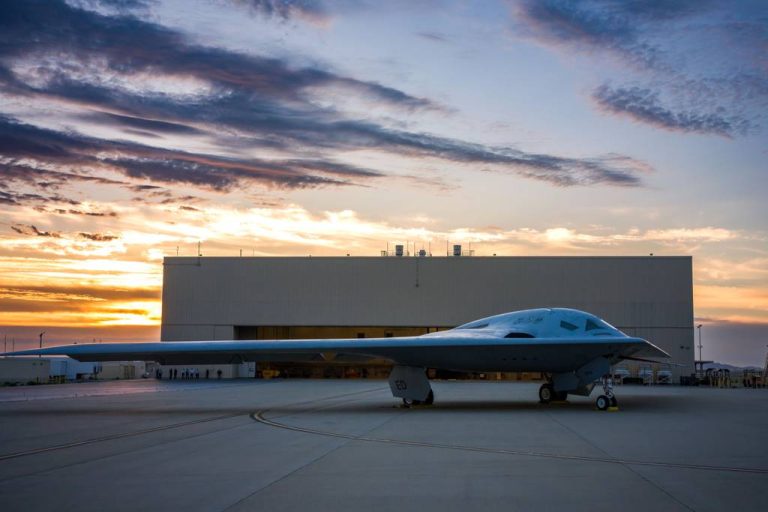
The Raider, which the Air Force unveiled in a highly publicized ceremony in Palmdale, California, in December, is in the midst of an extensive series of ground tests for several systems, officials said at the Air and Space Forces Association’s Air, Space and Cyber Conference in Maryland. The testing is required before the aircraft can fly for the first time.
The Air Force intends this new highly classified bomber, which in about a decade will replace the B-1 Lancer and B-2 Spirit, to be a significant new weapon in its arsenal to deter adversaries such as China from acts of aggression. It has significant range and advanced stealth capabilities the Air Force hopes will allow it to slip undetected into enemy territory to carry out penetrating strike missions. The service views it as the “backbone” of its future bomber force.
Air Force Global Strike Command head Gen. Thomas Bussiere said in a Tuesday panel that the Air Force and Northrop Grumman are conducting engine runs to test the B-21′s propulsion systems at Plant 42 in Palmdale, California.
In an interview with Defense News on Wednesday, Tom Jones, president of Northrop Grumman’s aeronautics systems unit, declined to say when the engine runs began or what further tests must occur before the first flight can take place, citing security concerns.
Engine runs are performed with the B-21 restrained in a dock, Jones said, and are meant to ensure the engines are working correctly and responding to the bomber’s throttles. But other prep work done on the Raider in recent months, Jones added, included activating its systems, checking to ensure its control actuation systems work, and ensuring doors and landing gears open or extend properly.
“We’ve made a substantial dent in the work scope that needs to get done in ground check, and we’re very confident we’re going to make the flight this year,” Jones said.
The Air Force rolled out this first test B-21, which is a production-representative aircraft almost identical to the final model, in a December 2022 ceremony in Palmdale, Calif. (U.S. Air Force)
The B-21 team also conducted troubleshooting reviews of the bomber’s fuel systems, William Bailey, director of the Air Force’s Rapid Capabilities Office that oversees the B-21, said in a Wednesday panel. The digital tools used to check the bomber’s fuel infrastructure allowed it to move to the engine run phase in less than five days, he added.
Jones said that on any new aircraft’s development, such checks are crucial to ensuring the fuel moves around to different places as intended.
Even under the best of circumstances, Jones explained, the process can be time-consuming. But if something is faulty, technicians have to get down into hard-to-reach nooks and crannies of the plane to locate the problem and fix it.
“Getting that right is a big deal on any aircraft,” Jones said. “But on a flying wing [such as the B-21], it’s critical to stability.”
Jones said Northrop Grumman has found and fixed things that need to be adjusted or that were installed incorrectly on the Raider during tests such as engine runs, but that those discoveries are part of the normal process of fine-tuning an entirely new aircraft.
He added that investments the company made in digital models and software simulations paid off by helping catch issues and fix them faster, including during fuel checks. And the fact that functional fuel checks were able to take place in just five days showed the B-21′s underlying software is solid, he said.
That software testing is now complete, and only ground tests of its hardware remains, which Jones said is a reversal from how new airplane tests typically work. “Every aircraft that’s ever been made, the airplane has been waiting for the software — at least the ones that have software,” he explained.
In his panel, Bailey joked that the B-21′s software engineers “smack talk” the hardware team, “saying: ‘Would you please hurry up? We’re done.’ ”
The scheduled first flight will take the first bomber to Edwards Air Force Base in California for even more extensive flight tests. It’s taken longer for the B-21 to reach its first flight than its predecessor, the B-2, which had its first flight eight months after its November 1988 rollout.
Jones said the increased complexity of the B-21, including more than 30 years of advancements in technology, led to the longer schedule. But building this first test B-21 as a production-representative aircraft instead of a “bespoke” experimental model — while making things more complicated — will pay off down the road by making it easier to shift into production and leverage economies of scale, he said. For example, the initial B-21 has the mission systems and low-observable stealth coatings all production bombers will have.
“It took a little bit of extra time, [but] it’s going to pay dividends,” Jones said.
In March, Air Force Secretary Frank Kendall sounded a note of caution about the B-21′s first flight, saying it had slipped a few months but was within the baseline schedule.
At the AFA conference this week, Air Force officials such as Kendall, acquisition chief Andrew Hunter and Bussiere expressed satisfaction with the B-21 program. Kendall said he is hopeful the first flight will happen this year, “absent any unexpected surprises.”
“But surprises do happen in acquisition programs,” Kendall added.
Stephen Losey is the air warfare reporter for Defense News. He previously covered leadership and personnel issues at Air Force Times, and the Pentagon, special operations and air warfare at Military.com. He has traveled to the Middle East to cover U.S. Air Force operations.
LONDON — As the U.S. Defense Department looks to buy thousands of autonomous systems over the next few years through its Replicator initiative, Pentagon officials and industry leaders say production readiness and capacity will drive its selection process.
Deputy Defense Secretary Kathleen Hicks in late August unveiled the initiative, which aims to field a fleet of small, attritable, uncrewed systems across multiple domains over the next 18 to 24 months. Replicator is meant to change the way the department buys high-need capability to counter China’s military advantage.
Officials have been light on details about many aspects of the initiative, including where those platforms will come from and how the Pentagon will field them at such a rapid pace. Speaking to reporters Sept. 13 on the sidelines of the Air Force Association’s Air, Space and Cyber Conference in National Harbor, Md., Undersecretary of Defense for Acquisition and Sustainment Bill LaPlante said that as the department considers which systems to field through Replicator, production capacity will be a factor.
“One of the criteria of whatever the approach [is] that’s gone through should look . . . at production capacity,” he said. “Not just the capacity, but how close we are to production. There are some capabilities . . . some things that can go into production pretty fast. So, I’m not ruling out one or the other, but you should look at that as well.”
Across the Atlantic at the DSEI conference here, industry executives emphasized the need for clear signaling from the Defense Department to help companies — particularly small and mid-size firms — make smart investments in the manufacturing capacity needed to deliver on programs like Replicator.
“You can’t just make the thing. You’ve got to make the thing bankable,” Thurgood said during a Sept. 13 panel hosted by Defense News. “As soon as it looks like the user has a viable need for this, then you have to make the investment in the manufacturing process to keep pace with the decision.”
He continued: “There are a lot of examples in the U.S., U.K., Israel, other countries, where they made a decision and went right to scale — lots of examples where that worked really good because companies invested in a manufacturing process. And there are some examples where we didn’t quite invest fast enough, and it didn’t go as well as we wanted it to.”
Andrea Garrity, chief growth officer at mobile mesh networking company goTenna, stressed that companies must play close attention to DoD messaging to ensure their supply chain can meet those demands. She noted her company moved its manufacturing to the U.S. last year due to supply chain concerns and growing demand from U.S. government customers.
Still, it would help to have more insight from the government into their plans, she said — especially as the military prepares for a potential conflict with China in the coming years.
“If somebody came in and dropped a 10,000 goTenna order, we’ll work to scale up the manufacturing to get that delivered,” Garrity said. “But I always go back to the partnership discussion. If we know things are coming, then we can plan to ramp up to make sure that . . . we’re delivering capability that we need to deliver when it needs to be delivered where it needs to be delivered.”
On Replicator, given its short delivery timelines and potentially large quantities, some level of certainty from DoD is critical, according to Tom Foldesi, chief revenue officer at Saildrone.
Foldesisaid the effort could be “game changing,” especially if DoD makes its capacity and capability needs clear and consistent enough for industry to adapt its supply base to the new cadence.
“Before we can even make things makeable, we have to be able to send a reliable supply chain signal,” he said. “For us to send a reliable supply chain signal, we have to have certainty.”
Brendan Groves, vice president of regulatory and policy affairs at Skydio, said dual-use companies that have a commercial and defense market are in a good position to respond to DoD’s near-term production needs for Replicator.
Skydio, a U.S. drone manufacturer that has supplied hundreds of systems to Ukraine, opened a new manufacturing facility in California earlier this year, creating a tenfold increase in its production capacity. That growth, Groves said, prepares the company to respond to DoD’s production needs, and he expects other dual-use companies are in a similar position.
“A lot of dual-use companies will be ready for this first phase, in part because they’re not waiting for the government,” he said. “We’re serving real needs right now across the U.S. government, across the enterprise. Those are the companies that will be ready to answer that call.”
Courtney Albon is C4ISRNET’s space and emerging technology reporter. She has covered the U.S. military since 2012, with a focus on the Air Force and Space Force. She has reported on some of the Defense Department’s most significant acquisition, budget and policy challenges.
Stephen Losey is the air warfare reporter for Defense News. He previously covered leadership and personnel issues at Air Force Times, and the Pentagon, special operations and air warfare at Military.com. He has traveled to the Middle East to cover U.S. Air Force operations.
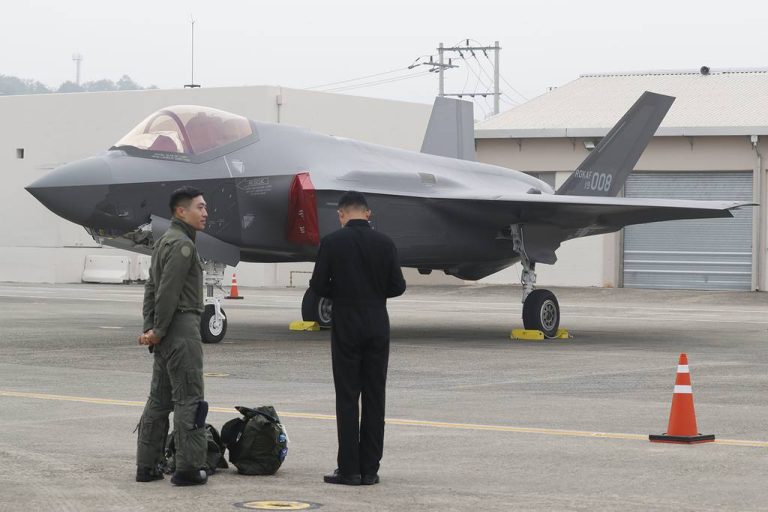
MELBOURNE, Australia — The U.S. State Department has approved a $5.06 billion sale of 25 F-35A fighter jets for South Korea.
The Defense Security Cooperation Agency on Wednesday announced the possible deal, which could change in quantity and contract value during the negotiations process.
The potential sale, which now goes to Congress for consideration, would also include 26 Pratt & Whitney F135-PW-100 engines for the aircraft, an upgrade to the Block 4 standard, as well as cryptographic appliques and electronic warfare support.
If approved, the sale will bring South Korea’s fleet to 65 F-35A conventional-takeoff-and-landing aircraft. The country’s Air Force is currently in the process of taking delivery of 40 F-35As it previously ordered to equip its 17th Fighter Wing at Cheongju.
South Korea is using its F-35As to replace it fleet of McDonnell Douglas F-4E Phantom II fighter jets. It had previously considered buying the F-35B short-takeoff-and-vertical-landing variant to equip its planned aircraft carrier.
However, the Defense Ministry said earlier this year it is looking at the feasibility of building a 50,000-ton aircraft carrier, which is considerably larger than originally planned. Such a ship would enable the South Koreans to operate catapult-launched carrier aircraft instead of the F-35B. This would likely be a naval version of the locally designed Korea Aerospace Industries KF-21 Boramae fighter. South Korea’s defense acquisition agency concluded in January that developing a carrierborne KF-21 was feasible within a 10-year time frame.
South Korea is technically still at war with its nuclear-armed neighbor North Korea, as the two countries have not signed a formal peace treaty following the 1953 armistice that ended the Korean War.
Mike Yeo is the Asia correspondent for Defense News.