Air Force awards Boeing $2.3B contract for 15 more KC-46s

0

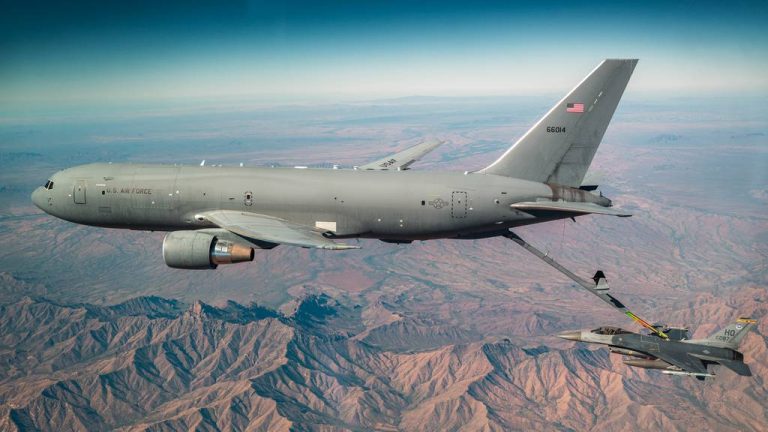
WASHINGTON — The Air Force has awarded Boeing a $2.3 billion contract for 15 more KC-46A Pegasus refueling tankers.

The award, announced by the Pentagon Tuesday evening, brings to 153 the number of KC-46s Boeing has on contract to build for the United States and allies. The Air Force plans to buy 179 KC-46s, and Boeing said it has so far delivered 76 of those.

The Japanese Air Self-Defense Force has two KC-46s in its fleet and four more on contract with Boeing, and Israel has ordered four of its own.

The Pentagon said work on these aircraft, which will be the KC-46′s tenth production lot, is expected to be complete by the end of July 2027. Boeing builds KC-46s at its factory in Everett, Washington.

This contract follows another issued in January for the ninth production lot, which was also for 15 tankers and valued at $2.3 billion.

The Air Force has steadily increased the presence of the KC-46 in its fleet and its abilities. In September 2022, the service cleared the KC-46 to refuel all aircraft, except the A-10 Warthog, and carry out all refueling missions around the world.

In July, Travis Air Force Base in California received its first of 24 planned KC-46s, which will replace the base’s aging KC-10 Extenders. Travis, the largest and furthest west of Air Mobility Command’s installations, is nicknamed the “Gateway to the Pacific” due to its location and status as a major hub for logistics and other mobility operations.

KC-46s also took part in July’s Mobility Guardian 23 exercise in the Indo-Pacific region, during which the tankers flew sorties of up to 35 hours straight. The service said in a release this showed the aircraft’s ability to carry out complex long-distance, long-duration missions to refuel fighters and other aircraft during operations.

And this fall, five KC-46s and about 12 service members from Joint Base McGuire-Dix-Lakehurst in New Jersey took part in a force generation certification event during the two-week Neptune Series exercise at Travis.

In addition to aerial refueling, the KC-46 can transport cargo, passengers and medical patients in aeromedical evacuation support missions, and can share data among other aircraft and ground operations centers to provide a fuller picture of the battlefield.

The Air Force awarded Boeing a $184 million contract in March to upgrade the KC-46′s communications systems with capabilities including antijamming and encryption features for its line-of-sight and beyond-line-of-sight communications technologies.

The Air Force also may buy an additional wave of 75 KC-46s as part of its planned recapitalization of its KC-135 fleet. Boeing’s chances of scoring that contract rose in October, when Lockheed Martin announced it would not compete for the interim tanker. But Airbus, which had partnered with Lockheed to jointly pitch their LMXT tanker, said it still plans to compete to replace the KC-135s.

Stephen Losey is the air warfare reporter for Defense News. He previously covered leadership and personnel issues at Air Force Times, and the Pentagon, special operations and air warfare at Military.com. He has traveled to the Middle East to cover U.S. Air Force operations.

Top air force officials ponder new leadership styles as AI takes root

0

DUBAI, United Arab Emirates — The advent of artificial intelligence in defense is prompting a reevaluation of decades-old military leadership traditions, top air force officials from across the globe said at a gathering here earlier this month.

The Nov. 12 Dubai Air Chiefs Conference, or DIACC, that kicked off this year’s iteration of the Dubai Air Show explored the fundamental changes airmen should expect as a result of AI permeating their professions.

“Traditional leadership style is seen as somewhat archaic or outdated, and understandably,” Brig. Gen. Azzan Ali A. Al Nuaimi, commander of the UAE’s air warfare and missile center, told the audience. “A top-down approach or hierarchy-based decision making is no longer well-suited for an operational environment where information is more fluid and rapid,” he added.

Armed forces across the globe are embracing the promise of artificial intelligence in military tasks. The level of complexity in the technologies varies greatly, from speeding up rote analysis tasks that previously took days or weeks for humans, to generating novel courses of action on the battlefield based on a vast amount of contextual data.

Sophisticated AI algorithms carry the risk of making undesirable calls, especially when it comes to targeting and killing. That fear has prompted leaders to keep humans in the loop for sensitive tasks. “It is key to strike a balance between trusting AI and human decision-making,” Al Nuaimi said.

Air Vice Marshal Glen Braz, who manages readiness for the Australian Air Force, argued that the speed of future conflicts means command-and-control networks must keep up.

“AI has increased the space and pace of warfare,” he said. “There will be more needs moving forward to delegate decision making in a fast-paced environment, where disconnectivity is present.”

Italian Air Force Chief of Staff Lt. Gen. Luca Goretti struck a similar chord, arguing that Russia’s invasion of Ukraine has proven the need to prize connectivity above all else.

“If you can manage the data, you win. If you cannot manage or process it, you lose,” he said. “If you keep a piece of information to yourself, you lose. The Ukraine war has taught us the need for that, to share the data.”

While the consensus among top officers here was to favor shorter chains of command to accommodate next-generation of AI in the military, other experts believe there is another side to the argument.

“While there may be some compression of chains of commands due to the increased potential speed of AI-supported decision making, this will not always be the case,” said retired Australian Army Maj. Gen. Mick Ryan. “Sometimes we may use it to slow down decision-making so we can be more strategic in our thinking.”

Elisabeth Gosselin-Malo is a Europe correspondent for Defense News. She covers a wide range of topics related to military procurement and international security, and specializes in reporting on the aviation sector. She is based in Milan, Italy.

Sidney Powell Files Lawsuit in Georgia Alleging ‘Massive Election Fraud’

0

Attorney Sidney Powell filed a federal lawsuit late Wednesday alleging “massive election fraud” and multiple violations of the Constitution and Georgia’s state laws in the 2020 general election, as well as issues pertaining to Dominion Voting Systems.

Georgia

By Mimi Nguyen Ly
November 26, 2020 Updated: November 26, 2020
Print

The civil action alleges that the purpose of the scheme was for “illegally and fraudulently manipulating the vote count to make certain the election of Joe Biden as president of the United States.” A similar separate suit was filed in Michigan.

The Georgia suit (pdf) was filed in the U.S. District Court Northern District of Georgia Atlanta Division against Georgia Gov. Brian Kemp, Secretary of State Brad Raffensperger, and other election officials.

The suit seeks to compel the court to invalidate the election results in Georgia. It was filed on behalf of plaintiffs including Republican Party nominees for the electoral college, the chairman of the Cobb County Republican Party Jason Shepherd, and the Assistant Secretary of the Georgia Republican Party, Brian Jay Van Gundy.

The 104-page complaint argues that “incontrovertible evidence Board of Elections records demonstrates that at least 96,600 absentee ballots were requested and counted but were never recorded as being returned to county election boards by the voter. Thus, at a minimum, 96,600 votes must be disregarded.”

According to the suit, fraud was also allegedly “executed by many means” but the “most troubling, insidious, and egregious” way was the “systemic adaptation of old-fashioned ‘ballot-stuffing.’” It alleges computerized ballot-stuffing and manipulation by software created and run by domestic and foreign actors. The complaint cited affidavits from multiple witnesses, documentation, as well as expert testimony that raised “sheer mathematical impossibilities” in the election results supporting the claims.

“Especially egregious conduct arose in Forsyth, Paulding, Cherokee, Hall, and Barrow County,” the complaint read. “This scheme and artifice to defraud affected tens of thousands of votes in Georgia alone and ‘rigged’ the election in Georgia for Joe Biden.”

In particular, the suit took issue with election software and hardware from Dominion Voting Systems, which it noted was recently purchased and “rushed into use” by Kemp, Raffensperger, and the Georgia Board of Elections.


Georgia Secretary of State Brad Raffensperger speaks during a news conference in Atlanta, Ga., on Nov. 11, 2020. (Brynn Anderson/AP Photo)
Plaintiffs allege that the design and features of the Dominion software do not allow for a simple audit to see whether votes were misallocated, redistributed, or deleted, pointing to a Jan. 24 decision by the Texas secretary of state to deny certifying the software “because of a lack of evidence of efficiency and accuracy and to be safe from fraud and unauthorized manipulation.”

“First, the system’s central accumulator does not include a protected real-time audit log that maintains the date and time stamps of all significant election events. Key components of the system utilize unprotected logs,” the filing reads. “Essentially this allows an unauthorized user the opportunity to arbitrarily add, modify, or remove log entries, causing the machine to log election events that do not reflect actual voting tabulations—or more specifically, do not reflect the actual votes of or the will of the people.”

The suit also alleges “incontrovertible physical evidence that the standards of physical security of the voting machines and the software were breached, and machines were connected to the Internet in violation of professional standards and state and federal laws.”

Part of the suit mentions a delay in voting at State Farm Arena in Fulton County, where video on Nov. 3 shows that election workers “falsely claimed a water leak required the facility to close.” It adds, “All poll workers and challengers were evacuated for several hours at about 10:00 PM. However, several election workers remained unsupervised and unchallenged working at the computers for the voting tabulation machines until after 1:00 AM.”

Another part of the complaint said that cybersecurity expert Navid Keshavarz-Nia testified that “U.S. intelligence services had developed tools to infiltrate foreign voting systems including Dominion.” Pointing to vulnerabilities in the Dominion’s software, he claims that “hundreds of thousands of votes” were transferred from President Donald Trump to Democratic presidential nominee Joe Biden in battleground states.

The complaint also cites a former electronic intelligence analyst under the 305th Military Intelligence Battalion, who declared that the Dominion software was accessed by agents acting on behalf of China and Iran to monitor and manipulate elections, including the 2020 U.S. general election.

A former U.S. Military Intelligence expert had analyzed the Dominion software system and concluded that the system and software “were certainly compromised by rogue actors, such as Iran and China,” according to another part of the complaint.

“By using servers and employees connected with rogue actors and hostile foreign influences combined with numerous easily discoverable leaked credentials, Dominion neglectfully allowed foreign adversaries to access data and intentionally provided access to their infrastructure in order to monitor and manipulate elections, including the most recent one in 2020,” the filing said.

The lawsuit also claims: “Georgia’s election officials and poll workers exacerbated and helped, whether knowingly or unknowingly, the Dominion system carry out massive voter manipulation by refusing to observe statutory safeguards for absentee ballots. Election officials failed to verify signatures and check security envelopes. They barred challengers from observing the count, which also facilitated the fraud.”

The Georgia secretary of state and Dominion Voting Systems did not immediately respond to The Epoch Times’ requests for comment on the suit.

Dominion released a statement on Wednesday saying: “Claims that Dominion deleted or switched votes are completely false. Dominion systems are 100 percent auditable.”

The lawsuit comes after election results were certified for Georgia on Nov. 20. At the time, Kemp did not clearly endorse the results but said the law required him to “formalize the certification, which paves the way for the Trump campaign to pursue other legal options and a separate recount if they choose.”
 

Pratt to start receiving F-35 engine upgrade contracts in early 2024

0

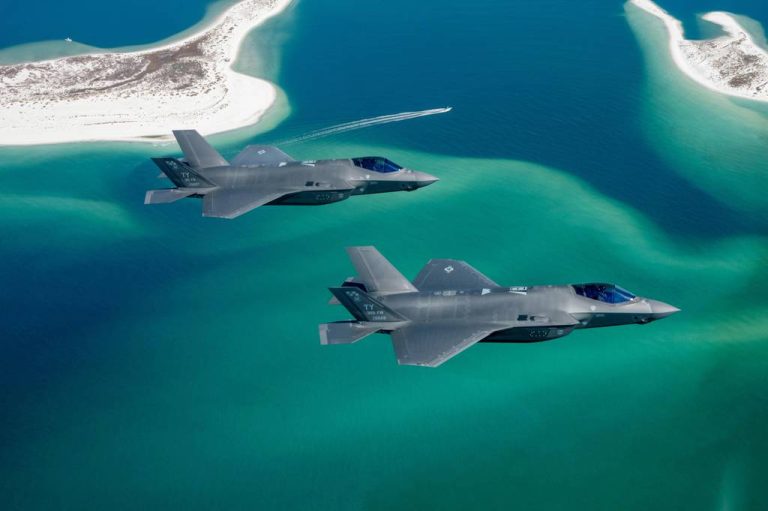
WASHINGTON — The Pentagon expects to start issuing early next year the first in a series of sole-source contracts to Pratt & Whitney to upgrade the F-35 Joint Strike Fighter’s engines.

In a notice posted online Monday, the government said the follow-on contract actions to RTX-owned Pratt & Whitney will begin in the second quarter of fiscal 2024, and continue through the end of December 2031.

The estimated value of the contracts was not immediately available, but Jen Latka,, vice president for Pratt’s F135 program, told reporters in December 2022 the ECU’s development would likely cost about $2.4 billion.

Pratt & Whitney, which makes the F135 engines that power all three version of the F-35, said in a separate statement Tuesday it expects to finish the preliminary design of its Engine Core Upgrade for the F-35 Joint Strike Fighter in December. The company added that it will be ready for the government’s official review of that design the following month.

The Engine Core Upgrade is intended to provide more power and cooling capabilities to the F-35 without requiring its current F135 engines to be replaced with a new design. Defense officials say the power and cooling boost will be necessary as the F-35 continues to be upgraded, particularly with a slate of improvements known as the Block 4 modernization, which will include greater weapons capacity, new sensors, and improved electronic warfare and target recognition capabilities.

“Pratt & Whitney has 600 employees fully dedicated to this effort, and we’re on track to deliver F-35 operators the power needed to enable Block 4 capabilities and beyond starting in 2029,” Jen Latka, vice president for Pratt’s F135 program, said in a statement.

The Pentagon’s sole-source notice said the upcoming contracts will cover work for the ECU’s engineering and manufacturing phase, including maturing its design, manufacturing and developing test articles and integrating weapon systems.

The notice did not say how much the contracts might be worth, but Latka told reporters in December 2022 the ECU’s development would likely cost about $2.4 billion.

The Pentagon had also considered a new engine design from General Electric Aerospace, dubbed the XA100, based on adaptive engine technology. The Air Force was keenly interested in GE’s XA100 and its greater power and cooling abilities for the F-35A jets it flies.

However, the Pentagon concluded GE’s design likely wouldn’t work for the Marine Corps’ vertical takeoff F-35B variant, and had doubts about its suitability for the Navy’s carrier-based F-35C. Those worries, as well as concerns over the GE adaptive engine’s potential costs, led the Pentagon to stick with and upgrade the F-35′s current engine in a big win for Pratt & Whitney.

Stephen Losey is the air warfare reporter for Defense News. He previously covered leadership and personnel issues at Air Force Times, and the Pentagon, special operations and air warfare at Military.com. He has traveled to the Middle East to cover U.S. Air Force operations.

“America is a Terrorist State!”

0

Godless, Christian-Hating, Pro-Palestinian Mob Disrupts Christmas Tree Lighting in Ypsilanti, Michigan – Chanting “America is a Terrorist State!” (VIDEO)

The group comprised of members from the LGBT community, Antifa, socialists and pro-Palestinian groups disrupted festivities for Michigan families attending a Christmas carol event and tree lighting.

They shouted slogans such as “America is a terrorist state” which forced the crowd to relocate to the Freighthouse.

This unfortunate incident ruined an evening that was meant to be enjoyed by all.

Godless, Christian-Hating, Pro-Palestinian Mob Disrupts Christmas Tree Lighting in Ypsilanti, Michigan – Chanting “America is a Terrorist State!” (VIDEO)


The Reluctant Partisan, Volume One: The Guerrilla

0

The Reluctant Partisan, Volume One: The Guerrilla

In his first book, the author of the Mountain Guerrilla Blog, “John Mosby,” offers a comprehensive look at the skills used by the traditional guerrilla force, in accordance with Special Forces Unconventional Warfare doctrine, and applies them to the modern prepared citizen’s needs.

Beginning with mindset and physical fitness, as well as other individual skills like rifle handling, land navigation, and tactical combat casualty care, John moves on to provide an in-depth primer on small-unit tactical skills, from patrolling to the most important battle drills for dismounted infantry, before moving on to planning considerations, escape-and-evasion, and more, before closing the book with appendices that include several of his own training programs for combat rifle and TCCC.

A complete training program, including what and–more importantly–why of all the skills and tasks discussed.


I want to be sugar-free

0

Do I dare do this right around the holidays and right before I’m planning to travel?
Why not?

I have been following a low-carb, moderate – high protein, high fat protocol since February 2023 and I’m very happy with my results so far:

  • Since then I have lost 30 lbs.
  • Shed 8 inches from my waistline.
  • Built muscle.
  • Changed my body composition.
  • Feel better about myself.
  • Have more energy and motivation.

I started this journey when I got my bloodwork back and found out that I had high blood pressure, was pre-diabetic, and had a vitamin D deficiency (this was a surprise since I live in the tropics and used to spend 1 – 5 hours working outside daily.)

I’m so thankful that I finally got enough of a wake-up call to make these big lifestyle changes and stick with them.

Our accountability thread on this forum has really helped me a lot. Thank you so much for sharing your tips and tricks and helping me to stay accountable!

If you are working towards fitness goals or any goals please feel free to join us:

What are your health / fitness goals? Accountability

This morning I listened to Dr. Ekberg’s Video and it inspired me to go completely sugar free for at least the next 30 days:

The link doesn’t want to work here, but the video is called:
What If You Totally Stop Eating Sugar For 30 Days?

I hit a plateau over these last 2 months that I would like to break through. While I’m doing much better overall, there are still some areas that I would like to clean up. According to charts for my height (4’11”) I could still stand to lose 30 more lbs. I still crave sweet things and I think that splenda in my coffee has affected me. I also had a few of the “keto friendly products” and I think I need to switch to whole foods and do my best to stay away from packaged items. My doctor told me that I shouldn’t lower my calories because she doesn’t want my metabolism to slow down, but I should make sure that I get enough quality protein and do some strength training (I currently do dumbbell workouts 5 times a week so I think I’m on the right track there).

Have you ever broken up with sugar before? What are some of the benefits that you’ve experienced? How did you overcome the obstacles?

Wish me luck!

~Alana


Ran across this today

0

found this on the web page set of Marie Osmond, the singer.

L3Harris to sell commercial aviation unit to private-equity affiliate

0

WASHINGTON — L3Harris Technologies on Monday announced it will sell its commercial aviation business to a private-equity firm affiliate for as much as $800 million, in a move to pay down debt and focus more on national security and technology.

The agreement to sell L3Harris’ Commercial Aviation Solutions unit to New York-based private-equity firm TJC comes four months after L3Harris closed its $4.7 billion purchase of engine and propulsion firm Aerojet Rocketdyne.

L3Harris chief executive Christopher Kubasik said in a statement the deal will speed up how quickly the company can reach its desired debt load.

“Today’s announcement is consistent with our multi-year strategy to optimize our national security, technology-focused portfolio,” Kubasik said. “Aligned with our capital allocation priorities, we plan to use the proceeds from this transaction to repay debt, which will accelerate our timeline to reach our debt leverage objective.”

L3Harris said in a statement it expects to close the deal in the first half of 2024, if regulators approve.

The company declined to comment further beyond the information in its release. TJC did not immediately respond to requests for comment.

About 1,450 people work at L3Harris’ commercial aviation business, whose offerings include pilot training courses and technologies, flight data analytics, avionics and advanced air mobility solutions.

TJC is a middle-market private-equity firm previously known as The Jordan Company.

L3Harris said in its statement the deal could include its surveillance joint venture, and the sale would be subject to a right of first refusal. If that is exercised, the TJC affiliate would acquire the remainder of the commercial aviation business, L3Harris said.

As part of this deal, L3Harris said it would receive $700 million in cash, and a $100 million earnout based on financial performance targets in 2023 and 2024.

Stephen Losey is the air warfare reporter for Defense News. He previously covered leadership and personnel issues at Air Force Times, and the Pentagon, special operations and air warfare at Military.com. He has traveled to the Middle East to cover U.S. Air Force operations.

German air force plans major Asia-Pacific tour in 2024

0

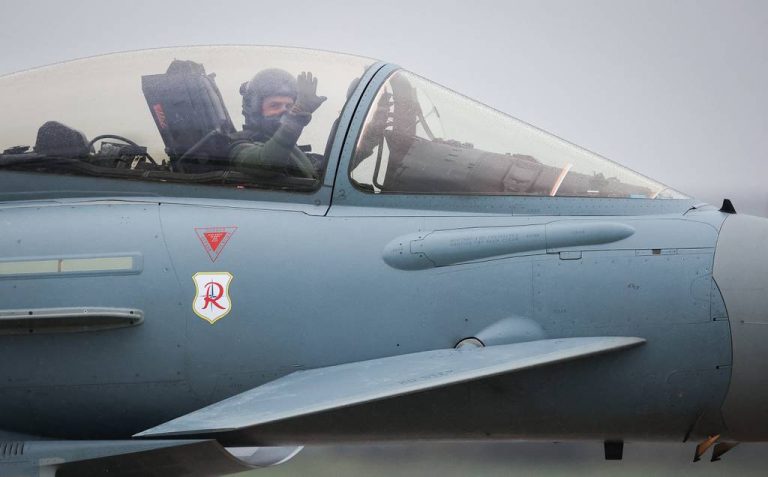
COLOGNE, Germany — The German air force is planning an exercise tour through the Asia-Pacific region in 2024, accompanied by aircraft from France and Spain, the partners in the trinational Future Combat Air System, according to defense officials.

The weekslong deployment next summer, which also involves at least one German navy ship, follows Berlin’s logic that Germany must help stabilize an economically important region as China looks to grow its influence.

“We recognize that the region’s interests touch on ours, at least, or even are the same as ours,” Defense Minister Boris Pistorius said Nov. 16 at event in Berlin organized by the Women in International Security network. “We are coming to stay.”

Also part of the government’s calculus is that any German engagement on the other side of the globe will save the United States from having to get involved there, freeing up American forces to remain focused on Europe, Pistorius added. “You can see the cascading effect.”

Next year’s deployment of aircraft will be “much, much bigger” than the air force’s initial foray to the Asia-Pacific region in 2022, service chief Lt. Gen. Ingo Gerhartz said in an interview. That deployment aimed to prove that a smattering of aircraft — six Eurofighters, four A400M multirole aircraft and three A330 tankers — could reach Singapore in 24 hours and join various training activities from there.

The upcoming trip will take the opposite direction, flying across the north Atlantic to Alaska for a first stop. According to Gerhartz, the idea is to show up in the region with a “European face,” consisting of the three FCAS partner nations and possibly also involving aircraft from the U.K. and Italy along the way.

Air National Guard Director Lt Gen. Michael Loh, whose pilots will train with German counterparts during the Arctic Defender drill in July, lauded the Europeans’ exercise plans. “It is critically important that Europe comes over to the Pacific to show interoperability and support with the U.S. and other members of the region,” he said in an interview.

As of last month, the following contingent of European warplanes was set to partake in various drill elements during the summer: eight German and four Spanish Eurofighters, 12 German Tornados, six French Rafales, four German and four French-Spanish A400Ms, and four German and three A330s, according to a Luftwaffe briefing slide.

Parts of the formation will aim to participate in the Hawaii-based Rim of the Pacific, or RIMPAC, exercise in late July, following a pit stop in Japan for a few days of what the German air service dubs “local flying” with Japanese crews there, the slide states. While in Hawaii, the German air force aims to rendezvous with a Germany Navy frigate, the plan goes.

Next on the calendar is exercise Pitch Black in Australia in late July, followed by a stop either in Indonesia or Malaysia before ending the deployment in India, a country defense and foreign policy leaders in Berlin have been eying as a particular anchor in the region.

In India, the European contingent will aim to partake in the country’s international Tarang Shakti exercise, if the timing works out, or perform “local flying” activities outside of that drill, according to the Luftwaffe.

Sebastian Sprenger is associate editor for Europe at Defense News, reporting on the state of the defense market in the region, and on U.S.-Europe cooperation and multi-national investments in defense and global security. Previously he served as managing editor for Defense News. He is based in Cologne, Germany.