Baltimore bridge collapse may have been Cyber atttack

0

Per Lara Logan:
https://twitter.com/laralogan/status/1772675651599770093?t=XUXv-PfEn1uWbkOBtaobBQ&s=19

Multiple intel sources: Baltimore bridge collapse was an “absolutely brilliant strategic attack” on US critical infrastructure – most likely cyber – & our intel agencies know it. In information warfare terms, they just divided the US along the Mason Dixon line exactly like the Civil War.

Second busiest strategic roadway in the nation for hazardous material now down for 4-5 years – which is how long they say it will take to recover. Bridge was built specifically to move hazardous material – fuel, diesel, propane gas, nitrogen, highly flammable materials, chemicals and oversized cargo that cannot fit in the tunnels – that supply chain now crippled.

Make no mistake: this was an extraordinary attack in terms of planning, timing & execution.

The two critical components on that bridge are the two load-bearing pylons on each end, closest to the shore. They are bigger, thicker and deeper than anything else. These are the anchor points and they knew that hitting either one one of them would be a fatal wound to the integrity of the bridge.

Half a mile of bridge went in the river – likely you will have to build a new one. Also caused so much damage to the structural integrity of the bottom concrete part that you cannot see & won’t know until they take the wreckage apart. Structural destruction likely absolute.

Attack perfectly targeted.

“They have figured out how to bring us down. As long as you stay away from the teeth of the US military, you can pick the US apart. We are arrogant and ignorant – lethal combination. Obama said they would fundamentally change America and they did. We are in a free-fall ride on a roller coaster right now – no brakes – just picking up speed.”

The footage shows the cargo ship never got in the approach lane in the channel. You have to be in the channel before you get into that turn. Location was precise/deliberate: chose a bend in the river where you have to slow down and commit yourself – once you are committed in that area there is not enough room to maneuver.

Should have had a harbor pilot to pilot the boat. You are not supposed to traverse any obstacles without the harbor pilot.

They chose a full moon so they would have maximum tidal shift – rise and fall. Brisk flow in that river on a normal day & have had a lot of rain recently so water was already moving along at a good pace.

Hit it with enough kinetic energy to knock the load-bearing pylon out from under the highway – which fatally weakens the span and then 50 percent of the bridge fell into the water.

All these factors when you look at it – this is how you teach people how to do this type of attack and there are so few people left in the system who know this. We have a Junior varsity team on the field.

Tremendous navigational obstruction. Huge logistical nightmare to clean this up. Number of dead is tragic but not the whole measure of the attack.

That kind-of bridge constantly under repair – always at night because there is so much traffic and they cannot obstruct that during the day. So concern is for repair guys who were on foot (out of their vehicles) working who may now be in the water – 48 degrees at most at this time of year.

When you choke off Baltimore you have cut the main north-south hazardous corridor (I95) in half. Now has to go around the city – or go somewhere else.

To move some of that cargo through the tunnel you may be able to get a permit but those are slow to get and require an escort system that is expensive and has to be done at night.

For every $100 dollars that goes into the city, $12 comes from shipping. Believe this will cripple the city of Baltimore at a time when they do not have the resources to recover.


US Air Force wish list asks for spare parts, but no more fighters

0

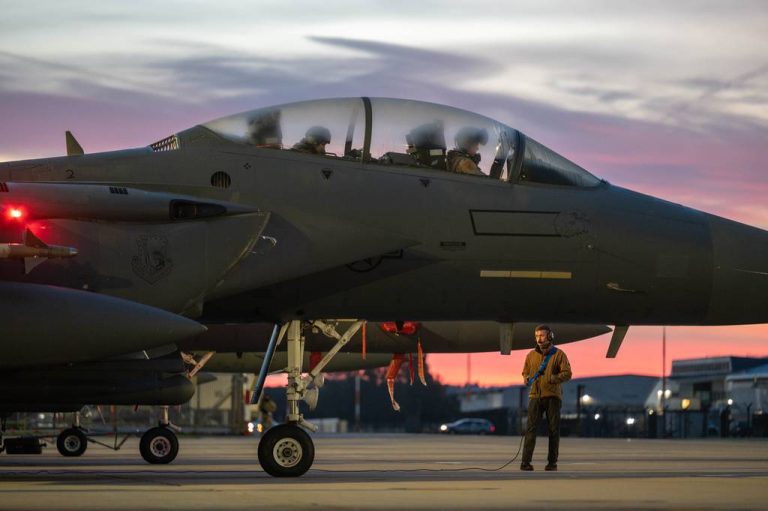
The U.S. Air Force’s $3.5 billion budgetary wish list for fiscal 2025 includes more funds for spare parts to get grounded planes back in the air, and seeks resources to be able to deploy more personnel and fighter jets.

The unfunded priorities list the service submitted to Congress, dated March 21, asks for another $1.5 billion to restock spare parts; $612 million to create nine new deployable units called mission generation force elements; $1.1 billion for construction projects worldwide; and $266 million to fund exercises in the Pacific region.

The Air Force did not ask Congress for additional funds to buy more aircraft, as it sometimes has in previous years’ unfunded priorities lists. The service’s $188.1 billion budget request for FY25 trims six F-35A Joint Strike Fighters and six F-15EX Eagle II fighters from what it originally planned, and the wish list does not aim to change that.

In the unfunded priorities list, the Air Force said its additional $1.5 billion request for spare parts — the largest component in the list — is necessary because the tight budget environment prevented it from asking for all the parts it needed.

The spare parts request asks for:

  • $167 million for B-52H Stratofortress bombers.
  • $564 million for F-16 Fighting Falcon jets.
  • Nearly $61 million for F-15E Strike Eagle jets.
  • Nearly $62 million for the HC-130J Combat King personnel recovery aircraft.
  • $195 million for RC-135 intelligence aircraft.
  • $7 million for C-130J Super Hercules cargo planes.
  • Almost $450 million for the KC-135 Stratotanker aerial refueling plane.

The service also said its $612 million request to create new mission generation force elements would allow it to deploy as many as 208 additional combat-coded fighters.

Mission generation force elements are part of the service’s new Air Force Generation deployment concept, which allow it to send fighter aircraft overseas. Those elements include both the equipment, jets and airmen needed to fly and maintain the aircraft. They also include munitions operations, weather-tracking capabilities, and intelligence and cyber capabilities.

This request would cover a one-time purchase of spare parts, aviation support equipment and munitions support equipment. But the elements would be created using personnel and fighters already in the service, and the funds would not pay for more jets or airmen.

The Air Force said its $1.1 billion request for additional construction funds would allow it to whittle down a $46.8 billion backlog on infrastructure and facilities that it needs to prepare for a potential conflict against China.

That includes $158 million for planning and design work on the Survivable Airborne Operations Center aircraft that will replace the aging E-4B Nightwatch fleet. The E-4B, nicknamed the “doomsday plane,” would allow the president to direct forces in case of a nuclear war or other devastating emergency that destroys command-and-control centers on the ground.

It also asks for another $215 million in construction funds for basic military training classrooms and a dining facility at Joint Base San Antonio-Lackland in Texas, plus $148 million for a multidomain operations complex at Beale Air Force Base in California.

The Air Force also asked for another $28 million to build infrastructure needed for the F-35 Joint Strike Fighter and the T-7A Red Hawk trainer at Hill Air Force Base in Utah.

And the service wants additional funds to allow Pacific Air Forces to conduct a theaterwide exercise to practice the Agile Combat Employment concept. That approach aims to spread out deployed airmen across more bases to make it harder for an adversary, such as China, to destroyer large portions of the force.

After the first theaterwide Agile Combat Employment exercise in 2025, the Air Force wants to keep holding those drills every other year, and plans to use $5 million to plan and prepare for them.

Stephen Losey is the air warfare reporter for Defense News. He previously covered leadership and personnel issues at Air Force Times, and the Pentagon, special operations and air warfare at Military.com. He has traveled to the Middle East to cover U.S. Air Force operations.

Oregon Makes ALL farming and food production Illegal!

0

Holy Crap, you guys seeing this,……….. the state of OryGun has started enforcing a law passed in 2021 that bans all agricultural operations including your little tomato garden! Sure glad I GTFO of Oregon finally, but this still hits me right between the eyes! I'm awaiting my Attorney's call telling me what and when for our farms, and now that this is in effect, now we can sue the living shit out of the state, always one of my favorite things to do! How much of a Retard do you need to…

Oregon Makes ALL farming and food production Illegal!

why you need garden gnomes

0

So letting my mind wander to strange places one day I realized that I need garden Gnomes. You may ask why a survival minded fellow such as myself would want little ceramic gnomes anointing my property.

I realized that if one were to place Tannerite inside sed gnomes they would stand as an innocuous defensive force worthy of Tyrell Lannister in GOT.

And one could feed the little devils BB’s or some other fortifying food to increase their defensive power, they would join the rock covered air bag in fame and lethality.


US Army experiments with human-machine warfare

0

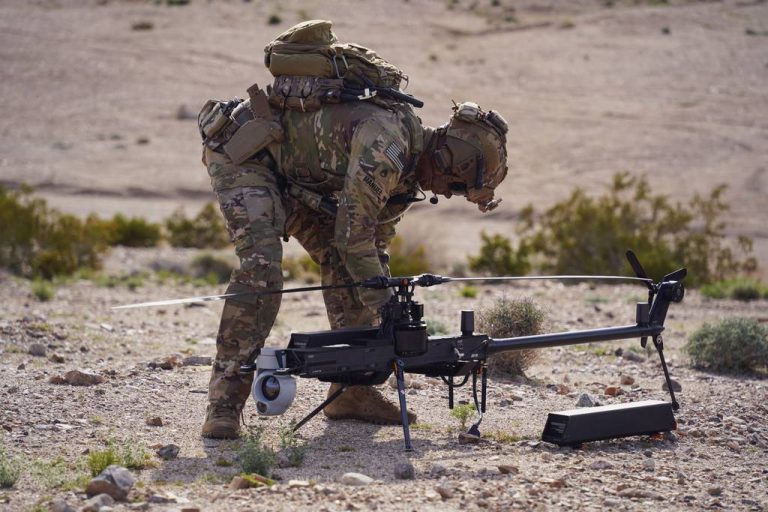
FORT IRWIN, Calif. — Looking like a toy helicopter, a small black drone rose up over a cluster of adobe buildings in a quiet desert village, emitting a faint buzz.

The drone, an Anduril Industries’ Ghost-X, paused and then rose higher, disappearing into the clouds. Another followed.

Seemingly small and unthreatening, the drones were serving as the eyes of an infantry company concealed by the surrounding mountains and readying to reclaim a village held by the enemy.

And those drones were not alone.

All at once, an overwhelming group of air- and ground-based machine fighters burst onto the scene. An “octocopter” lumbered through the sky with precision munitions and other robots attached to its belly, dropping three 60mm mortar rounds on a roof and other small, hand-held, cylindrical “throwbots” on the ground.

Robotic combat vehicles rolled into view, armed with .50-caliber and M240 machine guns, firing on enemy positions and providing cover for troops maneuvering into the village.

Meanwhile, a four-legged dog robot stepped out from a thick cloud of smoke, giving the soldiers monitoring from afar another view.

The scene was the culmination of a U.S. Army effort to understand how it can use human and machines together on the battlefield. Service leaders descended on Fort Irwin, California — home to the National Training Center — in March for a large exercise known as Project Convergence.

The demonstration was a glimpse of the Army’s future, according to top officials. Gen. James Rainey, who leads Army Futures Command, expects the service’s future force to be so integrated with machines that humans will face a much lower risk.

“We will never again trade blood for first contact,” he frequently says, promising to deploy robots instead.

But getting these formations right won’t be easy, leaders acknowledge. For human-machine integration to work, a functional and user-friendly network must underpin it, it requires protection from cyberattacks, and the systems must have the right amount of autonomy.

Leaders also say it’s not technology that will prove the most difficult factor, but rather breaking from antiquated acquisition processes that prevent rapid purchases and slow down deliveries to soldiers.

“The pace of the threat and the pace of technology — the evolution is much faster, and there’s no way that we’re going to succeed if we continue to acquire technology or even choose to develop” it at the usual pace, Joseph Welch, the Army’s C5ISR Center director, said at the March event.

Forward progress

The Project Convergence exercise followed months of effort focused on integrating humans and machines into service formations. It was a chance to see what works and what doesn’t as the Army prepares for a fight against adversaries with advanced capabilities.

The service insists it’s now ready to move forward with human-machine integrated formations.

The fiscal 2025 budget request marks the first time the Army has included funding for these formations, also called H-MIF. It’s seeking $33 million for the first step, which provides an initial human-machine integration capability to infantry and armor formations. The Army was experimenting with both at Project Convergence.

The service wants machines in these new formations to “offload risk” and provide soldiers with “additional information for decision making,” according to the service’s budget documents.

The Army’s Rapid Capabilities and Critical Technologies Office is spearheading the effort for Futures Command. The office is creating prototypes using existing air and ground robotic programs and payloads while incorporating common architecture, communications and network capabilities.

The FY25 funding, the Army has said, will fund the movement of concepts through prototyping as well as enable soldiers to evaluate them in exercises and experiments.

At the Project Convergence event, the Army flooded the battlefield with robots, sensors and other machines meant to help soldiers in complex flights. The experiment included air and ground robots with reconfigurable payloads, tethered drones, counter-drone systems, and a ventriloquist decoy emitter that emulates radio frequency traffic to confuse the enemy.

The service used more than 240 pieces of technology, including capabilities from allied militaries in the U.K., Canada, Australia, France and Japan.

The pressure to transform

The decision to rely more on robots isn’t a choice, according to Alexander Miller, who is now serving as chief technology officer to Army Chief of Staff Gen. Randy George.

George and Miller both watched the experiment in March; Miller carried a cellphone with an app demonstrating the Army’s new Tactical Assault Kit. The app superimposes the location of soldiers and robots as well as enemy positions in real time.

The service knows it has to do this, or “we will fall radically behind,” Miller said of human-machine integration. “There are bad people who are willing to use robotics, and if we don’t figure it out we will be behind the curve, we will put men and women in harm’s way.”

Integrating robots into formations is also accelerating because “there has been a cultural shift,” Miller said. “It’s been 12-18 months where we have stopped treating robots as a one-for-one augmentation for soldiers and started saying: ‘What are the dull, dirty, dangerous, disruptive things that robots can really do that are not just combat power? How do we augment them without taking a single rifleman off or multiple riflemen off the line to control a robot?’ ”

At the March experiment, for instance, the Army sent a ground robot with a mine-clearing line charge to deploy along enemy lines. As it fights the Russian invasion, the Ukrainian military is using these to disarm enemy minefields and trenches, but transporting them in crewed vehicles.

At the experiment, the robot shot the line charge out of a small launcher. The line didn’t explode as intended.

Army leaders said glitches are common and making this work would provide a much safer way for soldiers to clear mine fields.

Also enabling new models for human-machine integration is the progress of commercial technology, according to Welch. “That has accelerated tremendously across many different technical domains,” he said.

Artificial intelligence is getting smarter; sensors are getting smaller, lighter and more versatile; connectivity solutions are more abundant; and air-, ground- and space-based capabilities are easier to use.

Obstacles ahead

Army leaders acknowledge there is plenty of work ahead to integrate robots and soldiers on the battlefield. The experiment itself illustrated “just how complicated it’s going to be … where we really proliferate lower-cost, cheaper options and we clutter the environment intentionally,” Miller said.

At one point during Project Convergence, the Army jammed itself, causing a friendly drone swarm to fall out of the sky. The service fixed the problem by turning on a capability allowing smart routing management for its Wi-Fi, Miller said.

Beyond technical challenges, George said, the Army must convince Congress to alter the procurement process so the service can acquire or adapt capabilities within broader funding lines. The goal, he explained, is to be more responsive to what is working for soldiers and to able to rapidly buy small amounts of that equipment.

He said he’s working with Congress “so that we can move money a little bit.”

“We want and need the oversight, [but] it’s a matter of how we go back to them and tell them, ‘Here’s what we’re going to buy inside that funding line, and here’s how we’re doing it,’ and get feedback,” George added.

Indeed, one focus is on marking sure the Army can change systems without needing reprogramming authorization or new funding.

The technical and operational ways the Army is going to employ human-machine integrated formations today “doesn’t mean that’s how we’re going to employ it two years from now,” said Mark Kitz, the service’s program executive officer for command, control, communications-tactical.

“We don’t historically treat robotics as a software program. It’s really a software program,” Kitz explained. “So how do we use some of our unique acquisition authorities then to build that flexibility upfront?”

Miller said another potential obstacle is ensuring sufficient U.S. production of components.

“We have to have components that are approved and valid and we aren’t scared to employ because they were made by an adversary,” he said. Welch noted the Army is working with U.S. government labs to address some of the component concerns.

The service is also working internally to revamp its approach to finding capabilities.

“There’s a much tighter coupling … not only externally with our industry partners and other key stakeholders, whether it be over on [Capitol] Hill or up in [the Office of the Secretary of Defense], but also internally,” said Lt. Gen. John Morrison, the Army’s deputy chief of staff in charge of command, control, communications, cyber operations and networks. “We’ve got requirements with acquisition, with testers, and they’re all centered around soldiers, getting that direct feedback.”

Benjamin Jensen, a senior fellow at the Center for Strategic and International Studies think tank where he focuses on wargaming, said he’s “optimistic” about human-machine integration but that it may take longer than the service expects.

“Most people overestimate the speed at which you can develop new concepts of employment around even proven engineering,” he said. “It often takes years outside of a major war to build entirely new formations and structures.”

Jen Judson is an award-winning journalist covering land warfare for Defense News. She has also worked for Politico and Inside Defense. She holds a Master of Science degree in journalism from Boston University and a Bachelor of Arts degree from Kenyon College.

Oregon Trail Preparedness Facts

0

In 1834, amidst seemingly unremarkable moments in American history, notable events marked their presence. Pennsylvania witnessed the completion of the first railroad tunnel, while President Jackson faced Senate censure for his actions regarding federal bank deposits.

This year also saw patents for sandpaper, the hard-hat diving suit, and the mechanical reaper. Additionally, Congress established the Indian Territory, later forming Oklahoma, and Abraham Lincoln embarked on his political journey in the Illinois State Legislature.

Amidst these occurrences, Nathaniel Wyeth and Jason Lee led the inaugural migration from Missouri to Oregon, pioneering what would become the Oregon Trail. Despite being the first, their venture paved the way for a mass movement westward.

Over the following decades, half a million pioneers traversed the rugged terrain, sacrificing possessions and risking their lives for a chance at a new beginning, enduring harsh conditions and treacherous landscapes. The journey claimed the lives of many, leading some to dub the trail as the world’s longest cemetery.

Who were these intrepid individuals, and what drove them to pursue the unknown?

Why did they make the journey?

Emigrants chronicling their travels provided various motivations for their migration. Some sought refuge from rampant diseases like malaria and dysentery prevalent in the densely populated Eastern states. Many were descendants of pioneering families who had settled in Indiana, Illinois, and the Michigan territories. These individuals, compelled by diminishing farming opportunities and escalating land competition, pushed further westward. The U.S. Census of 1830 recorded a population of nearly 13 million, which surged to over 17 million by 1840, signaling a significant increase in demand for land.

Approximations drawn from the preserved journals of these travelers indicate that around 70 percent were skilled farmers. Anticipating Congressional land grants in the Western territories, these farmers recognized the urgency in staking their claims early to secure prime agricultural land. Congress indeed allocated land, granting a square mile per married couple in 1850, incentivizing swift migration for advantageous land acquisition.

Additional factors propelled migration waves. The allure of California’s gold fields in 1849 attracted many, dubbed “49ers,” while others sought refuge from the looming Civil War in the 1860s. Despite diverse motivations, nearly every pioneer shared a common belief in Manifest Destiny, viewing America’s expansion as a divine mandate.

The route

Most major Western emigrant trails originated near Independence, Missouri, appropriately dubbed the frontier town. From there or its nearby branches, travelers could opt for multiple routes: southwest via the Santa Fe Trail, westward to Sacramento along the California Trail, or northwest towards Oregon. The Mormon Trail, originating in Nauvoo, Illinois, led to Salt Lake City, intersecting with the Oregon Trail near Fort Laramie, Wyoming, after crossing the Missouri River north of Independence at Council Bluff.

Timing departure from Independence was crucial. Departures before mid-April risked scarcity of grass for livestock, while leaving too late risked encountering autumn snow in the mountains—a June departure could lead to disaster. Spring departures brought challenges such as swollen rivers, fierce prairie storms, and scorching mid-summer desert heat while traversing southern Wyoming, Idaho, and eastern Oregon.

Preparations for the trail

Guidebooks

Prior to embarking on their Western journey, prospective settlers sought out numerous travel guidebooks published shortly after the opening of the Oregon Trail. Among these, “The Emmigrant’s Guide to Oregon and California” by Lansford Hastings emerged as one of the earliest and most popular resources. Despite varying in quality, all guidebooks offered essential details such as travel distances, river crossings, food and equipment costs, hazard warnings, and local insights.

These guidebooks also provided crucial advice on necessary supplies, optimal wagon designs, and preferred draft animals for a successful journey. Seasoned travelers unanimously favored oxen over horses or mules due to their endurance and suitability for harsh conditions. Notably, utilizing oxen offered an additional advantage: in dire circumstances, they could serve as a potential food source, ensuring survival if needed.

Wagons

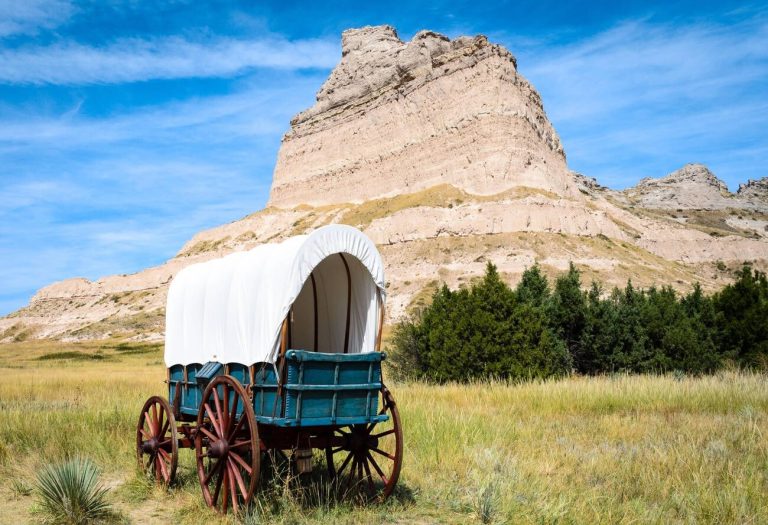
The pioneer families depicted in our childhood Western movies often rode in Conestoga wagons, towering vehicles unsuitable for the Oregon Trail’s challenges. Unlike these cinematic behemoths, the practical choice for pioneers was the “prairie schooner,” measuring four feet wide and ten feet long, featuring lightweight construction and a capacity of up to 2,500 pounds.

Prairie schooners, designed with waterproofed boxes, could double as temporary barges for river crossings. Given their heavy loads, passengers rarely rode inside; instead, families walked alongside, reserving wagon space for the infirm. Although some wagons offered sleeping arrangements, most pioneers relied on tents or slept under the stars, prioritizing storage over living quarters.

Acquiring a complete wagon, three yoke of oxen, provisions, clothing, tools, and firearms required a significant investment, equivalent to $15,000 today. For cash-strapped farmers, funding options included loans, gifts, or selling subscriptions to creditors. Alternatively, destitute individuals could join wealthier pioneers as trail helpers, exchanging labor for sustenance and passage.

TLW banner2

Food provisions for the Oregon Trail

Flour

Alora grabbed the bumpy bag of flour. It felt heavy, reminding her they were low on supplies. Flour back home was light and white, but this trail flour was different. Grumpy Mr. Jebediah at the store offered three choices: coarse flour with bits in it, leftover flour bits, or fancy flour.

The coarse stuff, Jebediah said with a laugh, was barely sifted and had the whole wheat outer layer. It wouldn’t go bad easily, but eating rocks sounded better! Leftovers were the bits left after taking out the good flour. They made the strongest bread, Jebediah said, but wouldn’t rise much. Fancy flour was closest to what Alora knew, but it cost a lot, only for special times.

Baking bread every day was hard. Their small metal oven worked, but finding things to burn was the real problem. Carrying firewood across those endless plains was crazy. Luckily, there were tons of bison everywhere, leaving behind piles of dried poop they called “chips.” It seemed weird at first, watching the kids gather these chips for the fire. But bison poop burned slow and hot, perfect for baking bread or frying their small amount of food. When the chips were scarce, they used sagebrush. It burned good, for sure, and gave their food a funny taste, but it kept them going.

Saleratus

Bakers might wonder why this guide doesn’t mention yeast. Simple answer: no store-bought yeast back then could survive the trip.

Yeast at that time was like cake or goo, mostly from beer makers. It wouldn’t stay good for long, only a few days after it got to the baker. The only way to keep it good longer was to use a super cold box (like a fridge) which wasn’t possible on a hot wagon.

Sourdough starter was another option, but it had problems too. It lasted longer than yeast, but it took a long time to make bread rise. Also, fancy rising breads wouldn’t work in a bumpy wagon, they’d just fall apart.

The answer was something called saleratus, kind of like baking soda we use today. Scientists invented it in the 1700s. When you mix it in dough for bread, it makes bubbles when heated, which makes the bread rise.

At first, travelers got saleratus from scientists, but then they found a natural source near Independence Rock, Wyoming. There were little lakes with no way out for water, so minerals from the mountains built up and made a hard white crust – almost pure saleratus! Because pioneers liked simple names, they called the biggest lake Saleratus Lake, and it’s still called that today.

Bacon

Another super important food for travelers was bacon. You might think they ate all sorts of fancy stuff, but nope, bacon and bread were their go-to meals most of the time.

Just like flour, bacon back then wasn’t like the kind you see at the store today. It was just any salty pork – sides, shoulders, you name it. Every travel guide said to bring bacon, but it rarely lasted the whole trip because it had a lot of fat.

If you were lucky, you could sometimes buy not-so-fresh bacon at forts or from traveling sellers, but it cost a lot more. Unlike other salted meats like pork or beef (which were kept in barrels of salty water), bacon was stored dry in bags or boxes to keep bugs away. In hot weather, they’d even bury the bacon in something called bran, which they thought stopped the fat from melting (or at least soaked it up).

Corn

ot parched corn

Travelers on the Oregon Trail packed all sorts of things to survive the long journey, but one of their favorite foods was simple and smart: parched corn. This wasn’t the sweet, yellow corn you might find on the cob today. Instead, it was regular corn kernels that had all the moisture baked right out of them. They did this by spreading the kernels out in the hot sun for days, or by roasting them in a big oven. The coolest part? This dried-out corn wouldn’t go bad easily, no matter how hot the journey got.

Since it was hard and dry, they couldn’t just eat the corn kernels on their own. So, the pioneers would take a big grinder and turn the parched corn into a coarse flour. This rough flour was then cooked into a mushy porridge. It wasn’t fancy, but it was filling and kept them going. To make it a little tastier, they’d sometimes add milk from the cows they brought along on the trail. This simple mush became a regular sight around campfires, keeping pioneers fueled up for their long trek westward.

Desiccated or dried vegetables

Everyone back then, not just folks heading west on the Oregon Trail, loved dried fruit for snacks. But dried vegetables? Not so much, at least at first. That all changed thanks to a book called “The Prairie Traveler” written by a fella named Randolph Marcy in 1859. In his book, Marcy told travelers about a newfangled food from the Crimean War called “desiccated vegetables.” These were basically fancy words for super dried-out veggies. Some folks loved these dehydrated veggies, saying they tasted pretty good considering they weren’t fresh. But others weren’t so impressed, guess they just weren’t used to the new way of eating vegetables.

Coffee

Coffee wasn’t just a morning pick-me-up for travelers on the Oregon Trail, it was sometimes the only food they had left near the end of the long journey! Unlike the pre-ground stuff you might buy today, they carried their coffee as green, unroasted beans. Roasted or ground coffee wouldn’t last and lost its flavor fast. So, when it was coffee time, pioneers would pull out their skillets and roast the beans right over the campfire. Then, they’d use a handy little grinder everyone seemed to have to turn those roasted beans into something they could brew. It might not have been fancy, but that hot cup of coffee sure helped them keep going on those long days.

Other necessities

TLW2b1Travelers on the Oregon Trail packed the basics to survive, but some folks brought along a few goodies to make the long trip a little tastier. If they had the space, they might pack some dried meats like jerky to munch on. For a sweet treat, there were hard candies or even chocolate, if they could keep it from melting in the hot sun. Cheese was another option, but it had to be a hard kind that wouldn’t spoil easily.

Lucky families who brought a cow along had a real treat: fresh butter! The bumpy wagon ride actually helped churn the cream from the milk into butter every single day. Almost everyone packed lard for cooking, because it lasted a long time and worked well in all sorts of dishes. And for some folks, there was no journey complete without tobacco, whether they chewed it, smoked it, or used it in other ways.

For medicinal purposes

The biggest danger on the Oregon Trail wasn’t wild animals or bad weather, it was sickness. With so many people traveling close together, and not really knowing how to stay clean, poop (from people and animals) and dead creatures often ended up near the water they had to drink. This was a recipe for disaster, especially for a disease called cholera, which spread through dirty water. Cholera caused terrible cramps and made you really dehydrated, and it was the biggest killer on the trail. Other nasty diseases like typhoid (mountain fever back then), diphtheria, dysentery, malaria, and even scurvy all plagued the pioneers. Plus, having a baby on the trail was extra dangerous because of the rough conditions.

Back then, medicine wasn’t nearly as good as it is today. Most folks just had a small first-aid kit with a few things in it, like a weird blue pill that wasn’t really good for anything, some quinine, opium (which makes you sleepy), and medicine to help you go to the bathroom. But there was one “medicine” that was super popular, even though it wasn’t on the official list: strong alcohol like whiskey, brandy, or rum. Almost every wagon had a big jug (or even a whole barrel) of this “medicine” on board, just in case.

Firearms

ot rifle showed by guide

Guns were a common sight on the Oregon Trail, packed in practically every wagon. Movies might make you think settlers were constantly fighting Native Americans, but that wasn’t really the case. A book called “The Plains Across” says way more Native Americans (around 426) died in fights with travelers than settlers (around 362) between 1840 and 1860.

The guns folks carried weren’t fancy, new ones. Most were long muzzle-loaders, like muskets or sometimes rifles. Those newfangled cartridge guns wouldn’t be popular for another ten or so years. Pistols were rare because they were expensive and not very useful for what people mostly needed guns for on the trail: hunting for meat to eat. But even though they weren’t fancy, practically every wagon had gunpowder, tools for making bullets, and lead to melt for them.

Everything else

We could write forever about all the stuff folks brought on the Oregon Trail! Clothes, tents, cooking gear, tools for fixing wagons and shoes – you name it, someone packed it. But the hardest part was deciding what to leave behind. Imagine having to ditch your favorite grandma’s quilt or that fancy lamp you inherited, just to lighten the load for your tired oxen!

Farmers weren’t just packing clothes and food. They brought their plows and precious seeds to start new farms out west. Craftsmen, like blacksmiths or carpenters, sometimes needed extra wagons just for all their hammers, saws, and other tools! That meant hiring extra helpers to drive the oxen and even more mouths to feed.

For entertainment (and maybe to keep track of the journey), people brought books, Bibles, guides about the trail, and even stuff to write with. Only about one out of every 200 travelers kept a diary, but those diaries give us a fascinating glimpse into what life was really like on the Oregon Trail.

The end of the trail

The Oregon Trail wasn’t a solo adventure. Folks mostly left from Independence around the same time, creating a giant wagon train. If something slowed them down, like a flooded river or a landslide, everyone got backed up until they figured it out together.

People camped together for safety and became a sort of traveling community. They traded stuff they brought or hunted together to share food. It wasn’t all sunshine and rainbows though, there were breakups and romances too, just like anywhere else!

Getting stuck on the trail was a bummer, but no one got left behind. The next wagon coming by would always stop and help. Everyone knew they could be next, so they looked out for each other. They celebrated good stuff that happened and comforted each other through the bad times.

Even when they finally reached Oregon or California, the journey wasn’t over. Many folks arrived with nothing left to eat and barely any supplies. Some had a little saved food but were too sick and tired to start fresh right away. Others had spent everything they had just getting there.

That’s where the kindness of strangers (or should we say neighbors?) came in. People who had arrived earlier set up groups to send supplies back down the trail to help those who were struggling to catch up. This support system didn’t stop once they reached their final destination.

Most folks showed up in late fall or winter, which is the worst time to plant crops or build a proper house. But their new neighbors, churches, and community groups all pitched in to help them survive the winter. They basically made sure the newcomers wouldn’t starve until they could get settled and plant some crops. Some folks called it pure kindness, others said it was just common sense – having thousands of starving, armed neighbors wasn’t exactly a recipe for success. Whatever the reason, anyone willing to work got a helping hand, even if they were paid in food instead of money.

banner3 pemmican

Recommended resources for preppers and homesteaders:

How to build an underground cellar for less than $400

Food Storage Plan For The Long Run

How To make an air fountain to obtain water from the air

Survival Foods of the Native Americans

Casting A Bronze Sword Using Sand Casting

0

Casting a bronze sword using sand casting method. This technique is useful for casting other useful objects in Bronze.

Stump Houses: The Original Off Grid Living Structure.

0

Stump houses…an historical study.

Stump Houses: The Original Off Grid Living Structure.

0

Stump houses…an historical study.