Tactical operations involves many facets, including terrain navigation awareness essentials, and air traffic monitoring just to name a couple. Having a mobile computer to use on the move and at a base of operation can be crucial to the success of any mission. This is why I have decided to adopt a very streamlined system to incorporate all of my digital maps and files as well as permit me to utilize the SDR. I am going to begin by listing the equipment and briefly covering the purpose of this setup…
“The TOUGHPAD® FZ-M1 is equipped with the industry’s broadest range of configuration options. Its fully rugged, sealed design is certified to meet MIL-STD-810G and IP65 specifications and withstand drops from up to five feet, water, dust and other elements.” Of course, it is a discontinued item, so a search on the secondhand market will be necessary. I bought a backup battery and a new, larger M.2 hard drive and more RAM, an SDR and antennas with a bluetooth keyboard, and an EMP bag by Mission Darkness. I can route the antenna through the gear as needed and the SDR is kept cool on the outside.
This is looking down as if wearing the MOPC with the admin pack flipped open. It can be quickly closed up again as needed. I also attached some velcro behind the unit to keep it in place. I kept the Win SSD and stored it, and installed a Ubuntu OS on the new SSD. I am still in the process of making it all work right, and some utilities require a bit of learning with the SDR. Also, it’s important to note that I still haven’t found an adequate method of using the SDR for air traffic monitoring without paying a subscription fee. This challenge is still ongoing. I can still use the SDR for a wide range of monitoring radio signals in the meantime.
Purpose: Mostly, I’d like to use this for maps and monitoring air traffic with the SDR, and as a backup for radio signal reception. My mobile operations command gear will be complete once all of this has been thoroughly tested.
All stored inside the kit. I just need to zipper this up and I will be on my way…
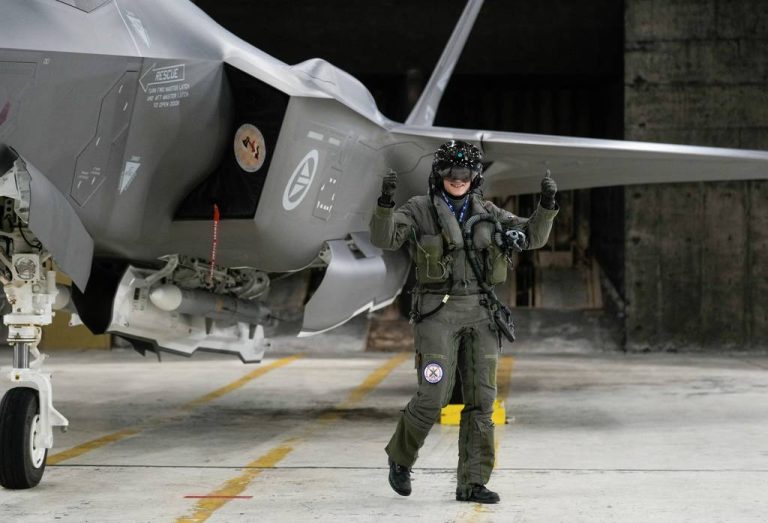
WARSAW, Poland — With fears of slipping F-35 delivery schedules plaguing some European customers of the Lockheed Martin-made warplanes, defense officials in Poland and Italy said they don’t expect their fleets to be affected by the vendor’s technical problems in rolling out a key upgrade for the jets.
In January 2020, Poland signed a contract worth $4.6 billion under which the country is to receive 32 F-35A Lightning II jets from the United States. Warsaw aims to replace the Polish Air Force’s outdated Soviet-designed Sukhoi Su-22 and Mikoyan MiG-29 jets with new fifth-generation jets, adding the aircraft to its fleet of F-16 C/D Block 52+ fighters and FA-50 light attack aircraft.
The nation is poised to become the first user of the Lockheed Martin-made jet in the region, with Romania and the Czech Republic following suit. Deliveries of the F-35s for Poland are scheduled to begin in 2024. The Polish Ministry of National Defence says that the deal is on track.
“The implementation of the contract for the purchase of 32 F-35 fighters is proceeding in line with the schedule. The first six of the ordered F-35A aircraft will be delivered to a U.S. air base in the years 2024 to 2025, and they will be used to train Polish pilots,” a spokesperson for the ministry told Defense News.
“The new fighters will arrive to Poland in 2026, and they will continue to be delivered until 2030 in batches of between four and six units per year,” according to the spokesperson.
RELATED
Meanwhile, as Poland is awaiting the first of its ordered F-35 jets, Warsaw is considering to further expand its combat aircraft fleet with a purchase of 32 additional fighters of a yet undetermined type, as suggested by local defense decision-makers.
Polish Air Force officials have expressed interest in securing air superiority aircraft that could counter Russian Sukhoi Su-34 fighter bombers and Sukhoi Su-35 fighter jets. This suggests that the front runners for a potential order would include the Eurofighter Typhoon, produced by a European consortium jointly operated by Airbus, BAE Systems UK, and Italy’s Leonardo, and the F-15EX Eagle II, manufactured by Boeing.
However, a third option could consist of expanding Poland’s F-35 order and purchasing more jets from Lockheed Martin. Recent statements by local government officials indicate that all options are on the table, but budget constraints will affect the final decision.
“We want to modernize the Polish military, this is our program,” Polish Deputy Defence Minister Paweł Zalewski told local broadcaster Radio Poland in a Feb. 13 interview, vowing to continue the previous government’s thrust.
Asked whether the defense ministry was considering to increase its F-35 order, Zalewski replied that “we will see what will be the offer. For now, we cannot rule out anything, but we would like these aircraft to arrive to Poland as soon as possible.”
As for Italy, the country has received 24 of the 90 fighter jets ordered from the United States. The Italian Air Force already has deployed the F-35s to carry out air-policing missions over the Baltic Sea and the northern Atlantic Ocean.
Rome believes that the issues related to Lockheed’s Technology Refresh 3, or TR-3, which is a batch of hardware and software upgrades to the latest variant of the F-35, will not prevent the country’s military from performing its operations as planned.
“The Italian Air Force is following the TR-3 development and release very closely because of the capabilities it will introduce, which are vital to cope with advanced threats,” a spokesperson for the Italian air service told Defense News.
“However, its delay, if not further extended considerably, does not preclude the Italian Air Force to execute the assigned mission within the operating domains,” the spokesperson said.
Tom Kington reported from Rome.
Jaroslaw Adamowski is the Poland correspondent for Defense News.
Tom Kington is the Italy correspondent for Defense News.
Benefits of Using Exam Dumps Exam dumps offer several advantages to students and professionals preparing for certification exams. Firstly, they provide a comprehensive overview of the exam syllabus, allowing candidates to identify key topics and areas of focus. Additionally, practicing with exam dumps helps improve time management skills and boosts confidence levels ahead of the actual exam.
Criteria for Selecting the Best Exam Dumps Websites Reliability and Authenticity When choosing an exam dumps website, it’s essential to prioritize reliability and authenticity. Opt for platforms that offer verified and up-to-date exam dumps sourced from reputable sources.
Quality of Content The quality of exam dumps is another critical factor to consider. Look for websites that provide accurate and detailed explanations for each question, helping candidates understand the underlying concepts rather than simply memorizing answers.
User Reviews and Ratings Before committing to a particular exam dumps website, take the time to read user reviews and ratings. Platforms with positive feedback from past users are more likely to deliver satisfactory results. FOR LATEST Dumps TRY Now >>>>> Valid IT Dumps
Comparison of Features Pricing While some exam dumps websites offer free access to their resources, others may require a subscription or one-time payment. Compare pricing plans to find the most cost-effective option.
Exam Coverage Consider the range of exams covered by each website, ensuring that they offer dumps for your specific certification or exam.
User Experience Evaluate the usability and interface of each website to ensure a seamless studying experience.
Pros and Cons of Using Exam Dumps Advantages
· Helps familiarize candidates with exam format and content
· Improves time management skills
· Boosts confidence levels
Disadvantages
· Risk of relying too heavily on memorization
· Limited effectiveness for exams with practical components
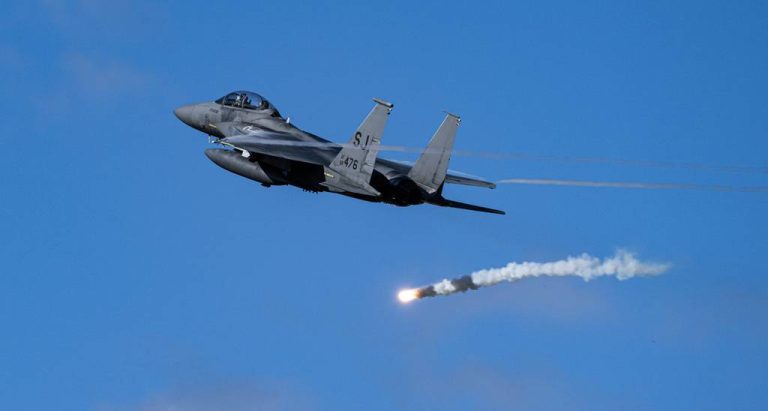
An advanced electronic warfare system for the Air Force’s F-15 fighters successfully completed a key operational testing phase, according to the company that makes it.
The Air Force recently finished the initial operational test and evaluation phase for the Eagle Passive Active Warning Survivability System, or EPAWSS, BAE Systems said Tuesday. BAE builds EPAWSS, which provides electronic warfare capabilities for the F-15E Strike Eagle and F-15EX Eagle II fighters.
EPAWSS is a more advanced electronic warfare system than F-15s have had in the past, and BAE says it will allow fighters to monitor, jam and deceive threats in highly contested environments. It provides radar warning, geolocation, situational awareness and self-defense capabilities, allowing a fighter to maneuver more deeply and freely in enemy territory and counter air defense systems.
“EPAWSS is a leap in technology, improving the lethality and combat capabilities of the F-15E and F-15EX in contested, degraded environments against advanced threats,” Maj. Bryant Baum, the system’s test director at the Air Force Operational Test and Evaluation Center, said in the statement. “EPAWSS has set the baseline for EW within the fighter community.”
BAE said it’s working to help improve EPAWSS, including by using artificial intelligence in an approach known as cognitive electronic warfare.
EPAWSS’ cognitive EW capabilities were tested last May in the Air Force’s Northern Edge 2023 exercise in Alaska. During that exercise, two F-15EXs took part in 70 sorties that tested how quickly EPAWSS’s cognitive EW capaiblities can react to electromagnetic threats it had not previously encountered in a busy, unpredictable environment.
BAE said it updated the EPAWSS mission software during the exercise, which improved the jets’ ability to jam other aircraft and showed how quickly its programming can adapt to a
“Our close collaboration with the U.S. Air Force allows us to mature EPAWSS cognitive processing capabilities,” BAE program director Chip Mosle said in the statement. “By incrementally testing and fielding cognitive EW solutions to proven systems such as EPAWSS, we are enabling tactical spectrum overmatch against advanced threats that are unpredictable, evolving and adaptable.”
Stephen Losey is the air warfare reporter for Defense News. He previously covered leadership and personnel issues at Air Force Times, and the Pentagon, special operations and air warfare at Military.com. He has traveled to the Middle East to cover U.S. Air Force operations.
Cultivating your own herb patch might present a frustrating dilemma when you find yourself swamped with more herbs than you can promptly consume before they begin to wither. So, what steps can you take to utilize these herbs efficiently and avoid wastage?
Although there exist various methods to conserve herbs, such as air-drying or freezing, one expedient and straightforward approach is to preserve them in vinegar. While we each have our preferred herbs that we frequently use to enhance the flavor of soups, salads, and sandwiches, it might be worthwhile to explore other varieties of herbs indigenous to your locality.
Preserving herbs in vinegar serves as an excellent means to retain the fresh essence of a season for later use. Infused with herbs, vinegar can serve as a zesty salad dressing or be combined with diverse flavors in culinary preparations. Discover the art of preserving herbs with vinegar through the following guidelines.
A word about herbs
Before embarking on the journey of herb preservation, it’s advantageous to gain a comprehensive understanding of what defines an herb. Essentially, an herb encompasses a diverse array of vegetation distinguished by their leaves, seeds, or blossoms, which find utility in enhancing flavor profiles, medicinal concoctions, culinary creations, or aromatic blends.
Furthermore, herbs are often characterized by their growth habit, with many belonging to the category of seed-bearing plants that lack woody stems and typically undergo dormancy after flowering. This unique trait sets them apart from other botanical classifications. It’s important to recognize that while herbs contribute immensely to culinary and medicinal realms, they do not include fruits or vegetables within their categorization.
Herbs stand as versatile botanical entities, offering a rich tapestry of flavors, aromas, and therapeutic properties, enriching various facets of human existence. Understanding their nature and versatility sets a solid foundation for exploring their preservation techniques and unlocking their full potential in culinary and wellness pursuits.
Varieties of Vinegar
When it comes to preserving herbs in vinegar, it’s essential to recognize that not all vinegars are created equal. While any vinegar boasting approximately 5% acidity can serve the purpose of herb preservation, certain combinations are particularly recommended for optimal results.
Apple Cider Vinegar
Celebrated for its rich history and myriad health benefits, apple cider vinegar emerges as a versatile elixir in culinary and wellness realms alike. Crafted through the fermentation of apple cider, this vinegar boasts a delicate balance of sweet and tart notes, rendering it a beloved ingredient in various cuisines and home remedies.
While its distinct amber hue may deviate from the clarity of other vinegar varieties, apple cider vinegar’s robust flavor profile makes it an ideal candidate for preserving herbs, especially those with bold and aromatic characteristics. Its acidity, typically around 5%, ensures effective preservation while infusing the preserved herbs with a hint of fruity undertones.
In addition to its culinary prowess, apple cider vinegar is revered for its potential health benefits, including aiding digestion, balancing blood sugar levels, and even promoting weight loss. With its versatile nature and numerous virtues, apple cider vinegar stands as a staple in both the kitchen and the medicine cabinet.
Balsamic Vinegar
Renowned for its unparalleled depth of flavor and syrupy consistency, balsamic vinegar serves as a prized ingredient in dressings, marinades, and culinary creations worldwide. However, its robust and distinctive taste profile may not always align with the delicate flavors of most herbs typically used in preservation methods.
While balsamic vinegar’s intense flavor may overpower the nuances of certain herbs, it remains a coveted choice for elevating dishes with its complex notes of sweetness and acidity. Instead of preserving herbs, balsamic vinegar is often celebrated for its ability to enhance the taste of fresh ingredients and add a gourmet touch to salads, meats, and roasted vegetables.
Despite its limited application in herb preservation, balsamic vinegar continues to reign supreme as a culinary essential, revered for its unparalleled versatility and unparalleled depth of flavor.
Champagne Vinegar
Renowned for its elegance and refined taste, champagne vinegar stands out as a premium option among vinegar varieties. Crafted meticulously from dry white wine, this vinegar undergoes a meticulous fermentation process, resulting in its delicate flavor profile. Its subtle acidity and nuanced sweetness make it an ideal companion for herbs with delicate flavors. Notably, champagne vinegar’s pale golden hue adds a touch of sophistication to culinary creations, making it a favorite among gourmet chefs and home cooks alike.
Malt Vinegar
Characterized by its bold and robust flavor, malt vinegar commands attention in the realm of vinegar. Traditionally derived from barley malt, this vinegar undergoes a fermentation process that imparts its distinctive tang and depth of flavor. Its strong taste profile makes it a preferred choice for pickling vegetables and adding a hearty kick to condiments like mustard. Due to its potency, malt vinegar is best paired with herbs and flavors that can hold their own against its assertive presence, making it a staple in traditional British cuisine and beyond.
Rice Vinegar
Hailing from Asian culinary traditions, rice vinegar offers a subtle yet distinct flavor that sets it apart from other vinegar varieties. Produced through the fermentation of rice wine, this vinegar boasts a milder acidity and delicate sweetness, making it a versatile option for preserving herbs. With variations including red, white, and black varieties, rice vinegar offers a spectrum of flavors to explore. Its gentle nature allows it to complement delicate herbs such as fennel and thyme, preserving their essence while imparting a subtle tang. Rice vinegar’s versatility extends beyond herb preservation, finding application in marinades, dressings, and dipping sauces in cuisines across the globe.
Sherry Vinegar
Exuding sophistication and complexity, sherry vinegar captures the essence of its fortified wine origins. Crafted from sherry wines aged through a meticulous aging process, this vinegar showcases a rich and aromatic profile that elevates culinary creations. With its deep amber hue and nuanced flavor, sherry vinegar lends itself beautifully to dressings, marinades, and herb-infused concoctions. Herbs such as parsley, sage, rosemary, and thyme find their perfect match in the robust character of sherry vinegar, creating a harmonious blend of flavors that tantalize the palate. As a cherished ingredient in Mediterranean cuisine, sherry vinegar adds depth and dimension to dishes, imparting a touch of sophistication to every culinary endeavor.
White Vinegar
Derived from grains, white vinegar reigns as a ubiquitous pantry essential valued for its versatility and affordability. However, its robust flavor profile makes it less suitable for herb preservation, as its strong taste tends to overpower the delicate flavors of herbs. Despite its unsuitability for preserving herbs, white vinegar finds myriad applications in household cleaning, pickling, and culinary endeavors where its tangy acidity adds a distinctive punch.
Wine Vinegar
Embraced by homesteaders and culinary enthusiasts alike, wine vinegar emerges as a favored option for preserving herbs, thanks to its nuanced flavor and aromatic qualities. Crafted from a variety of wines including white, red, or rose, wine vinegar offers a diverse palette of flavors to explore. Its light and fruity taste profile harmonizes beautifully with an array of herbs, enhancing their natural essence without overpowering them. From parsley and thyme to basil, tarragon, dill, and lemon balm, wine vinegar complements a wide range of herb varieties, infusing dishes with depth and complexity. Additionally, its compatibility with stronger flavors such as dill weed, dried red peppers, tarragon, rosemary, thyme, oregano, and sage expands its culinary versatility, making it a cherished ingredient in kitchens around the world.
What You’ll Need For Preserving Herbs In Vinegar
what you’ll need for preserving herbs in vinegar
Ensuring the longevity of your herbs requires only a handful of essential items. Here’s what you’ll need to embark on your preservation journey:
Vinegar: Opt for a gallon of vinegar of your preference. Choose from a variety of options such as those listed above, depending on your flavor preferences and the herbs you intend to preserve.
Canning Jars: Acquire pint-sized canning jars with new lids to securely store your preserved herbs. These jars provide an airtight seal, ensuring the freshness and quality of your herbs for an extended period.
Plastic Wrap: Use plastic wrap to cover the mouth of each canning jar before sealing them with the lids. This additional layer of protection helps maintain the integrity of the herbs and prevents any external contaminants from compromising their quality.
Herbs: Gather 4-5 sprigs or approximately 1 cup of fresh herbs per canning jar. Choose herbs that are vibrant, aromatic, and free from any signs of decay for optimal preservation results.
Optional Spices: Enhance the flavor profile of your preserved herbs by incorporating optional spices such as chili flakes, salt, or garlic. These additional ingredients can impart depth and complexity to your herb-infused vinegar, elevating its culinary versatility and appeal.
With these essential supplies at your disposal, you’ll be well-equipped to embark on the rewarding journey of preserving herbs for future culinary endeavors.
Guidelines for Preserving Herbs in Vinegar:
Preserving herbs in vinegar offers a dual benefit of retaining the freshness of the herbs while crafting a versatile dressing. Follow these steps to embark on your herb preservation journey:
Prepare the Vinegar Solution:
Pour two cups of vinegar of your choice into a clean pint jar.
Gather 3-4 sprigs or approximately one cup of fresh herbs, gently bruising the leaves to release their flavor.
Place the herb sprigs into the jar, and if desired, add optional spices such as ½ teaspoon of chili flakes, a clove of garlic, or a pinch of salt to enhance the infusion.
Seal and Steep:
Cover the jar’s mouth with plastic wrap before securely sealing it with the lid and band.
Set the jar aside in a cool, dark place to allow the herbs to steep and infuse into the vinegar for 1-4 weeks, depending on desired flavor intensity. Longer steeping times result in stronger flavor profiles.
Strain and Customize:
After steeping, strain the vinegar-herb mixture using cheesecloth or a fine-mesh sieve into another jar or bottle to remove herb stems and leaves.
Optionally, add an additional sprig of the herb used to the bottle for identification purposes. Consider incorporating citrus peels, peppercorns, or other spices to further customize the flavor.
Storage Options:
Store the strained vinegar in the refrigerator for immediate use or process the jars for long-term shelf stability.
If canning, process pint jars for 10 minutes in a boiling water bath canner, ensuring a ¼ inch headspace.
Experiment and Enjoy:
Embrace experimentation with different flavor combinations based on personal preferences and intended uses, whether for culinary delights or thoughtful gifts.
Explore the addition of various spices and fruits from your garden to create unique and flavorful infusions.
Remember:
Use glass jars exclusively during the preservation process to avoid any adverse reactions with vinegar.
Employ a protective barrier between the vinegar and metal lids to prevent potential reactions.
When faced with an abundance of garden-fresh herbs, follow these simple steps to preserve their essence in vinegar. Herb-infused vinegars not only enhance meal preparations but also allow you to savor the taste of summer’s bounty year-round.
Concluding
Preserving herbs in vinegar offers a delightful fusion of practicality and culinary creativity. Through the process of preserving herbs in vinegar, we not only safeguard the freshness of our garden harvest but also unlock a myriad of flavor possibilities. Whether infusing delicate herbs with champagne vinegar or accentuating robust flavors with apple cider vinegar, the art of preserving herbs in vinegar allows us to capture the essence of each season and extend its vibrancy into our culinary endeavors.
I encourage you to embrace the versatility and ingenuity of preserving herbs in vinegar, and continue to explore new combinations and savor the unmatched freshness and flavor infusion it brings to our dishes.
NAVAL AIR STATION LEMOORE, Calif. — From the air control tower at the center of the U.S. Navy’s largest jet base, the roar of fighter engines is inescapable.
It’s coming from the rows of F/A-18E/F Super Hornets — and, increasingly, F-35C Joint Strike Fighters — on the flight line, going through routine maintenance before hitting the skies.
It’s also coming from the runway, as jets speed by with chest-rattling force as they return from practicing flight formations over the surrounding farmland.
It’s a reassuring sound to Navy leaders — a sign the squadrons’ maintainers and the depot artisans at Fleet Readiness Center West are turning jets around so pilots can get back in the air for training and deployment preparations.
But as the service’s F-35C fleet expands here in Lemoore, both the Navy and a government oversight group worry the Joint Strike Fighters aren’t available for missions often enough. And to make matters worse for the fleet, it’s costing more than expected to sustain the aircraft.
The Joint Strike Fighter program stands in contrast to most other military aircraft programs: Lockheed Martin plays an outsized role in jet readiness, with the company responsible for maintenance planning and management, distribution of repair parts and supplies, engineering, maintenance training, and more. The government’s F-35 Joint Program Office, or JPO, oversees the global fleet of F-35 jets and manages the facilities and people that support maintenance.
This leaves the services with little control over ensuring their own readiness. But the Joint Strike Fighter Wing in Lemoore, which oversees all Navy F-35Cs, is taking extra steps to directly improve readiness by drawing lessons from the service’s F/A-18E/F Super Hornets.
U.S. Navy sailors perform maintenance on an F/A-18F Super Hornet assigned to a squadron from Naval Air Station Lemoore, Calif., during a weapons system evaluation program at Tyndall Air Force Base, Fla., on March 22, 2023. (Senior Airman Anabel Del Valle/U.S. Air Force)
In 2018, then-Defense Secretary Jim Mattis ordered the military branches to hit an 80% mission-capable rate for all fighters in fiscal 2019. With Super Hornet mission-capable rates barely above 50% for much of 2008 through 2018, the Navy kicked off a data-driven effort to analyze its processes, facilities, supply practices and more, dubbed Naval Sustainment System-Aviation. By the end of FY19, the service surpassed 80% and has sustained that readiness since.
Now, the Joint Strike Fighter Wing is working with its F-18 counterparts to adopt proven practices on operation-level maintenance to boost readiness and lower costs. As part of this effort, the Navy is particularly bolstering its data collection and communication efforts.
Those efforts are yielding results: The Navy’s F-35C community has higher readiness rates and fewer aircraft awaiting supply parts than the rest of the global F-35 fleet’s average, a service leader told Defense News.
That improvement on readiness and cost matters, given the threat of a high-end fight in the Pacific and mushrooming procurement costs.
“From a budget standpoint, it is simple economics: The more it costs to buy and maintain aircraft, the fewer we can procure in a tight fiscal environment and the more onerous it will be to repair them,” Rep. Rob Wittman, R-Va., the vice chairman of the House Armed Services Committee, told Defense News.
“We also cannot go to war, especially against an adversary with advanced [anti-access/area-denial] capabilities, without our most advanced fifth-generation aircraft,” he added.
Slow repair times, lower aircraft readiness
In a September report, the Government Accountability Office detailed the failures in Joint Strike Fighter maintenance and availability of spare parts.
The watchdog’s report noted that in March 2023, 55% of planes were considered mission capable, meaning they were able to fly and conduct at least some warfighting missions. It attributed this low readiness to maintenance challenges at the squadron and depot levels.
The report detailed the unique maintenance setup: Other programs like the Navy’s Super Hornets are repaired through operational-level maintenance by squadrons, intermediate-level work by the Navy’s fleet readiness centers located at the jet bases, and depot-level work at select fleet readiness centers.
But the F-35 program does not include any intermediate-level maintenance; instead squadrons must undertake more work on the flight line with help from contractors, while farming out more work to industry at depot locations and at the original builder’s facilities.
This rate is the percentage of time during which aircraft in the possession of F-35 units are unable to conduct any of their assigned missions because of maintenance. (Eric Parsons/U.S. Navy)
In the case of the Super Hornet, the Navy controls all three levels of maintenance and signs its own contracts for support and parts. In contrast, the F-35 program gives significant responsibility to manufacturer Lockheed Martin and to the Joint Program Office, leaving the services with little ability to change or improve the supply system and contractor-led maintenance.
At the operational level, the GAO report noted, squadrons lack some technical data and training experience needed to efficiently conduct maintenance — a challenge that will only grow if the JPO decides to shift more work from industry to the services by adding intermediate-level maintenance to the plan.
At the depots, it noted the JPO is now 12 years behind schedule in standing up some of its repair capabilities, or “workloads.” As of last spring, 44 of 68 workloads were activated.
“Delays in standing up the F-35 program’s depot repair capacity has had several effects, including slow repair times, a growing backlog of components needing repair, and lower aircraft readiness,” the report found.
GAO projects the total fleet’s mission-capable rate could have been at 65% instead of 55% last spring if not for the lack of depot repair capacity.
The lack of depot capacity is also increasing the cost.
With the depots now facing a backlog of 10,000 components to repair, “the F-35 Joint Program Office has purchased new parts instead of repairing the parts it already has in inventory. According to [Department of Defense] officials, this is a practice that program officials do not believe is a sustainable solution.”
Those officials said the approach keeps the aircraft flying, but it results in “higher sustainment costs because buying new parts generally costs more than repairing existing parts.”
Hard-earned lessons from the F-18
In remote Lemoore — where fighter jet squadrons are based a six-hour drive from the admirals in San Diego and a six-hour flight from the JPO in Arlington, Virginia — the captains are in charge.
Joint Strike Fighter Wing Commodore Capt. Barrett Smith and Strike Fighter Wing Pacific Commodore Capt. Michael Stokes are part of a “council of captains” that work together to manage aircraft readiness, facilities, personnel and families at Lemoore.
Two fleet technicians attach ALR-67 test equipment onto an F/A-18 aircraft at Naval Air Station Lemoore, Calif., on Feb. 14, 2019. (Chief Aviation Machinist’s Mate Alvin Zuilan/U.S. Navy)
Smith and Stokes leveraged this close collaboration to boost the Joint Strike Fighter Wing’s primary contribution to F-35C readiness: operational-level maintenance performed by each squadron.
Stokes said the Navy in 2018 brought in the Boston Consulting Group to make recommendations as part of the effort to get F-18s to an 80% mission-capable rate.
He said one of the most consequential results was the creation of the Maintenance Operations Center, which monitors aircraft status daily. The center uses that data to prioritize distribution of parts, provide technical assistance, and identify potential broader changes to boost readiness or reduce cost.
Smith said the F-35C joined the center in October 2022 as part of its own effort to boost the readiness of its planes.
This data can point to problems in real time — for example, a supply issue that’s holding up several planes in a single squadron that has a major exercise coming up — and can also reveal trends over time that might make a squadron reconsider its workflow or whether maintainers need additional training, Smith said.
Stokes said one seemingly simple change recommended by the Boston Consulting Group was to put a whiteboard by each aircraft undergoing maintenance in the squadron hangar or down the road at Fleet Readiness Center West. Each whiteboard would note “the lead person and all of the outstanding items so you can see it in front of that aircraft,” he said.
The two say these practices are yielding results.
On a Feb. 15 visit by Defense News, the Navy had 347 mission-capable Super Hornets, well above the Navy’s requirement to maintain a monthly average of 333.
This rate refers to the components that are most frequently responsible for preventing aircraft from being capable of carrying out their mission. (Rick Goodfriend/U.S. Air Force)
(The Navy previously had a goal of 341 and then 360 mission-capable Super Hornets, to reflect Mattis’ 80% goal. The inventory of Super Hornets is smaller today, as some squadrons have transitioned to the F-35C. Stokes said the 333-plane goal still equates to an approximately 80% mission-capable rate.)
On the Joint Strike Fighter side, the F-35 JPO wants to see 64% of its planes mission capable, 21% non-mission capable due to waiting on supply parts, and 15% non-mission capable due to waiting on maintainers to do a job. Those numbers will eventually shift to have more planes ready and fewer planes waiting on parts and maintenance work.
Smith’s fleet of Navy F-35Cs is already beating those goals. He told Defense News his wing already surpassed the 64% mission-capable goal. In addition, it’s had a non-mission-capable maintenance rate — the only rate the wing can truly affect on its own — below 15% from January 2023 through March 2024.
‘Ebbs and flows’
Even as Smith and his Joint Strike Fighter Wing do what they can from Lemoore to boost readiness, some things are out of their hands.
Smith is stymied by the same parts challenges outlined in the GAO report.
“Parts availability ebbs and flows,” he said. However, the JPO has a Lightning Sustainment Center with a Navy representative on staff, who Smith can call when there’s a delay in getting a needed part flown to Lemoore.
To increase communication, Smith said that Lightning Sustainment Center representative also sits in on Maintenance Operations Center meetings. He noted cross-community meetings were a big part of the 2018 Naval Sustainment System-Aviation reforms.
Warren Scovell, the director of fleet readiness at the F-35 Joint Program Office, said the organization is closely tracking feedback regarding which parts cause the biggest headaches for the fleet.
A CH-53K carries a non-flying F-35C model during a load certification lift out of Naval Air Station Patuxent River, Md., on Dec. 13, 2022. (Kyra Helwick/U.S. Navy)
The JPO had a top 10 list of readiness degraders, which was later expanded to 20 and then 40. Over the last year, Scovell said, the office eliminated 13 of the top 20 degraders — in many cases, replacing parts with more reliable ones that won’t break as often and therefore won’t be such a drag on the supply system.
Though some parts have remained thornier than others — Defense News reported last year canopies and the electro-optical distributed aperture system were two tough ones that affected all three models of the F-35 jet — Scovell said the fleet can get down to the goal of 21% non-mission capable supply by the end of this year, and then reduce that even further. That rate shows how many planes are down while awaiting supply parts.
Asked if that would drive down cost, he replied: “Absolutely yes.”
“The No. 1 focus is always to keep parts on wing longer. So whenever you can do that, you will absolutely drive down cost,” he added.
Similarly, Smith and the head of Fleet Readiness Center West, Capt. Joseph Hidalgo, agree they’d like the center to perform intermediate maintenance on F-35s instead of outsourcing that to industry. However, that’s up to the JPO.
In the meantime, Smith is trying to apply Naval Sustainment System-Aviation principles to monitoring depot performance data, if only to demonstrate to the JPO what the Navy is experiencing at industry-led depot availabilities and how it affects F-35C readiness.
Scovell said the JPO is working on a new sustainment strategy that would move more work away from industry and to the services. He said that effort is ongoing and declined to provide a timeline for its release, but noted it would allow fleet readiness centers to play a bigger role in F-35 sustainment, including uniformed personnel conducting more maintenance and the services buying their own spare parts.
In a statement, Lockheed Martin said it stands “ready to partner with the government as plans are created for the future of F-35 sustainment.” The company noted it is working with the government to “accelerate depot activations to increase repair capacity” and said that since 2015, the firm has lowered its portion of the F-35′s cost per flight hour by 50%.
Keeping costs low
The naval aviation budget is tight this year and expected to remain that way.
In fiscal 2025, the Navy asked for 13 F-35C jets, down from a recent 19-per-year rate to reflect congressionally imposed spending caps. That number is expected to grow as high as 24 jets a year later this decade — but that comes as aviation procurement needs will balloon by 34%, ship procurement 35%, and weapons procurement 71% in the coming years, according to Navy FY25 budget materials.
It’s unclear if the Navy will be able to secure that kind of funding to grow its fleet. And even if it does, it then has to pay to sustain the new platforms.
In FY25, the Navy asked for 13 F-35C jets, down from a recent 19-per-year rate to reflect congressionally imposed spending caps. (Colin Demarest/Staff)
“The entire naval aviation enterprise is acutely aware of the burgeoning costs required to sustain air operations and remains focused on increasing lethality and readiness through process improvement and driving efficiency at all levels of the organization,” according to a Navy budget document.
When F-35C sustainment overruns its estimates, the Navy has to reconsider the whole portfolio.
“There is not a single bill-payer for higher-than-expected F-35C maintenance costs. The Navy evaluates cost increases through the lens of the larger Navy priorities and balances the budget in accordance with strategic guidance; this can result in reductions in other areas of the budget,” a Navy spokesperson told Defense News.
The spokesperson noted the cost per tail to operate the F-35C has decreased as the aircraft inventory grows, and that both the JPO and naval squadrons are finding ways to improve performance and lower cost.
Stokes and Smith said they are seeking to minimize mishaps: engines sucking up debris that damages them from the inside, crew damaging planes while towing them, canopies being scraped during operations and more. When they can avoid these mishaps, they pay less to repair the damage.
Hidalgo and Smith are closely monitoring F-35C corrosion and looking to take early intervention steps, after corrosion proved to be a costly challenge with the Super Hornets and the legacy Hornets before them.
Scovell said the JPO is about 90% complete in writing a structural repair manual to send to squadrons so they can do more of their own maintenance on the flight line. He said the squadrons doing this work themselves would be faster and cheaper than waiting on contractor maintenance.
Wittman, who also chairs the Tactical Air and Land Forces Subcommittee, said the Navy and Air Force are now turning to unmanned wingmen — also known as collaborative combat aircraft — to achieve “affordable capacity” in tight budgets.
He said the U.S. military cannot afford — monetarily or operationally — to lose out on F-35 readiness.
“The combined force in the Indo-Pacific will rely on F-35s in a near-peer fight: South Korea, Japan and Australia all operate the aircraft,” he noted. “Losing that capability from readiness delays, or not achieving the required aircraft capacity due to cost overruns, will inevitably hamper our ability to respond to threats and aggression in the region.”
Wittman also said he hopes the services learn from the F-35′s cost and readiness challenges when pursuing future programs.
“Contractor-led sustainment of the aircraft will eventually phase out in the coming years as it transitions to service-led governance,” he said. “Although contractor-led sustainment was the primary acquisition strategy initially, we are watching setbacks of that original acquisition sustainment strategy play out in real time.”
Megan Eckstein is the naval warfare reporter at Defense News. She has covered military news since 2009, with a focus on U.S. Navy and Marine Corps operations, acquisition programs and budgets. She has reported from four geographic fleets and is happiest when she’s filing stories from a ship. Megan is a University of Maryland alumna.
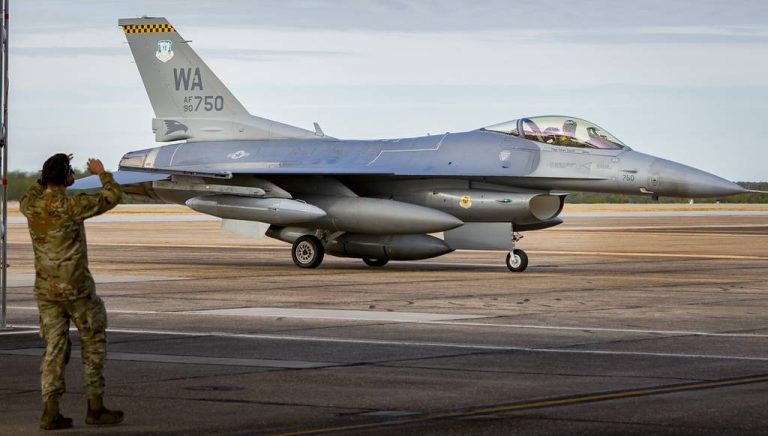
The first three F-16 Fighting Falcons that will be loaded with self-flying technology have arrived at Eglin Air Force Base in Florida, the Air Force said Tuesday.
The arrival of the F-16s marks the service’s biggest step forward yet in standing up the program known as Venom, which stands for Viper Experimentation and Next-gen Operations Model-Autonomy Flying Testbed and aims to speed up the testing of autonomous technology on both crewed and uncrewed aircraft.
The Air Force hopes the autonomous technology tested under Venom could help it more quickly shape plans to create a fleet of self-flying drones that team up with crewed fighters in battle, known as collaborative combat aircraft.
The service is heavily focusing on creating a fleet of at least 1,000 CCAs, which will use autonomous capabilities to fly alongside aircraft such as the F-35 or future Next-Generation Air Dominance family of fighter systems. These drone wingmen would carry missiles or other weapons to strike enemy targets, jam enemy signals through electronic warfare operations or perform reconnaissance missions.
The Air Force is increasingly confident autonomous capabilities have advanced to the point where such aircraft can succeed. But officials say there are still a lot of questions to answer about how the technology will work in action, which led the service to launch Project Venom with a nearly $50 million investment this year.
The service eventually plans to modify six F-16s to serve as test aircraft as part of Venom. It has requested another $7 million for the program in 2025, with the following years’ budgets ranging from $6.1 million to $6.6 million.
Maj. Ross Elder, the program’s developmental test lead, said in an Air Force statement Venom will represent a step toward “a new age of aviation.”
“The Venom program marks a pivotal chapter in the advancement of aerial combat capabilities,” he said.
The 96th Test Wing’s 40th Flight Test Squadron and 53rd Wing’s 85th Test and Evaluation Squadron at Eglin will work together to carry out Venom’s developmental and operational testing.
“Having both [developmental test] and [operational test] pilots working and flying from the same location allows for daily collaboration and reduces the stovepiping of knowledge and lessons learned,” said Lt. Col. Jeremy Castor, who is in charge of Venom’s operational testing.
When Venom’s self-flying F-16s are ready, the Air Force will start testing them with human pilots in the cockpit. Those pilots will take off with the jets and fly them to a testing location, and then allow the autonomous programming to take over in midair. The pilots in the cockpit will keep track of the autonomous software to see whether it works as intended, and make sure all the test objectives are met.
Lt. Col. Joe Gagnon, squadron commander of the 85th, said a human will at all times be ready to start and stop the autonomous algorithms if needed.
“There will never be a time where the Venom aircraft will solely fly by itself without a human component,” he added.
Stephen Losey is the air warfare reporter for Defense News. He previously covered leadership and personnel issues at Air Force Times, and the Pentagon, special operations and air warfare at Military.com. He has traveled to the Middle East to cover U.S. Air Force operations.
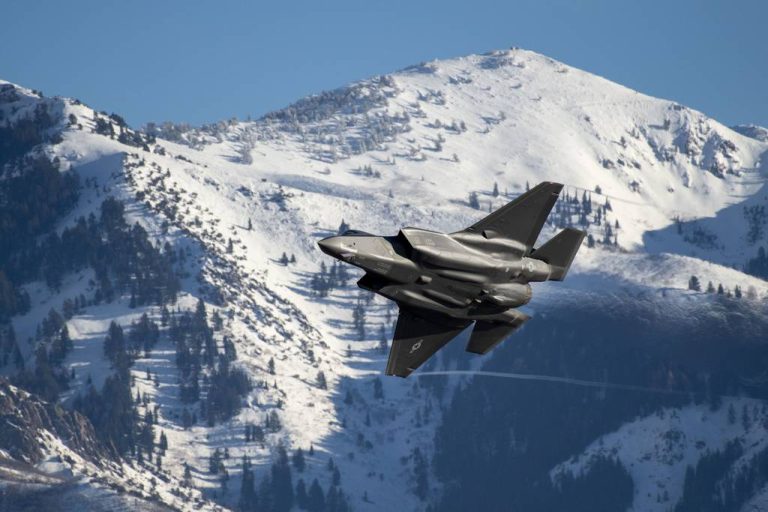
The Air Force’s version of the F-35 Joint Strike Fighter can fly in lightning and thunderstorms again after the service lifted a restriction that had been in place for four years.
The F-35 Joint Program Office confirmed in an email that the 2020 standoff restriction placed on the aircraft, officially called the Lightning II, was lifted on March 19. The news was first reported by Breaking Defense.
The military stopped F-35As from flying within 25 miles of lightning after a problem was discovered with its Onboard Inert Gas Generation System, or OBIGGS, which is meant to keep the jet safe from strikes. OBIGGS pumps nitrogen-enriched gas into the F-35′s fuel tank to render it inert, and keep the fuel tanks from exploding if struck by lightning.
In 2020, maintainers conducting depot maintenance on an F-35A at Hill Air Force Base in Utah found that one of the tubes that distributes the gas to the fuel tank was damaged. Subsequent inspections found problems with tubes in multiple other F-35s, and the military restricted it from flying near lightning until a fix could be developed.
F-35Bs and Cs were not affected by the lightning problem and did not have their flying restricted.
Spokespeople for Lockheed Martin, which makes the F-35, or BAE Systems, which makes OBIGGS, were not immediately available to comment.
The JPO said the fix included “a more robust” design for the fighters’ OBIGGS hardware, as well as updates to its software. The modification was tested both in the lab and in flight. It credited government and industry engineers for finding a solution to the lightning restriction problem. The JPO declined to further detail how the system was fixed, or how many F-35As have been modified, due to operational security concerns.
“The fix restores operational capability, while providing additional safety for the pilots and aircraft,” the JPO said.
Stephen Losey is the air warfare reporter for Defense News. He previously covered leadership and personnel issues at Air Force Times, and the Pentagon, special operations and air warfare at Military.com. He has traveled to the Middle East to cover U.S. Air Force operations.