Air Force to get F-15E jet with fresh electronic warfare tech in summer
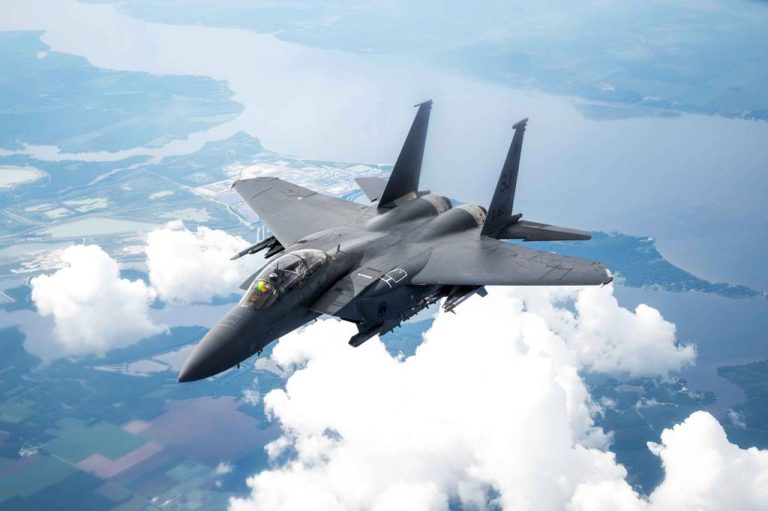
The U.S. Air Force expects to receive its first operational F-15E Strike Eagle upgraded with an advanced electronic warfare system this summer.
In a statement to Defense News on Thursday, Air Force spokesperson Maj. Alli Stormer said eight Boeing-made F-15E jets are undergoing modifications with the Eagle Passive Active Warning Survivability System, or EPAWSS. The work is taking place at the company’s facility in San Antonio, Texas, the service said.
EPAWSS will come standard on F-15EX Eagle II fighters, also made by Boeing, and will be added to some F-15Es. BAE Systems, which makes EPAWSS, said the technology will allow those F-15s to monitor, jam and deceive threats in highly contested environments as well as provide radar warning, geolocation, situational awareness and self-defense capabilities with an array of sensors, electronic countermeasures and algorithms.
The delivery of the first F-15Es with upgraded electronic warfare capabilities would mark a major step forward in the Air Force’s effort to modernize these fourth-generation aircraft and prepare them for a possible war against an advanced adversary, such as China.
Boeing started installing the EPAWSS on operational F-15Es in San Antonio in July 2022, the Air Force said in a previous statement that year. Boeing also awarded BAE a contract in September 2022 to produce the second EPAWSS lot for new F-15EXs and as many as 43 F-15Es there were already operational. The Air Force now has roughly 218 F-15E jets.
BAE said earlier this month that EPAWSS had recently finished its initial operational test and evaluation phase.
In Thursday’s email, the Air Force said the Air Force Operational Test and Evaluation Center and the Pentagon’s Office of the Director, Operational Test and Evaluation will deliver their final reports on that phase of EPAWSS by the end of June.
The Air Force also said EPAWSS’ engineering and manufacturing development phase is nearly finished, and the service expects to have final production-representative hardware modules delivered this fiscal year. The Air Force expects to award a contract for full-rate production on EPAWSS by the end of 2024.
BAE declined to comment and referred queries to the Air Force.
Stephen Losey is the air warfare reporter for Defense News. He previously covered leadership and personnel issues at Air Force Times, and the Pentagon, special operations and air warfare at Military.com. He has traveled to the Middle East to cover U.S. Air Force operations.
Brazilian Air Force, Embraer launch study for surveillance fleet

SANTIAGO, Chile — Brazil’s Air Force and Embraer are beginning a joint study to look into adapting aircraft already in service to carry out intelligence, surveillance and reconnaissance missions, the local firm announced April 10.
The head of the Air Force, Gen. Marcelo Kanitz Damasceno, and the chief executive of Embraer Defense and Security, João Bosco Costa Jr., attended the company’s announcement during the FIDAE air show, which runs April 9-14 in Santiago, Chile.
During the presentation, a backdrop showed a C-390 Millennium transport aircraft, a type in service with Brazil, labelled as a maritime patrol aircraft and carrying anti-ship missiles.
The Air Force has started looking for options to replace its P-3AM Orion maritime patrol aircraft beginning in 2031, a military source in the capital of Brasilia told Defense News.
Already, companies appear keen to win a potential contract. Apart from Embraer’s announcement, the American firm Boeing put out a news release just ahead of the air show that emphasized its history in supplying the region with defense platforms.
At the show itself, Tim Flood, Boeing’s senior regional director for international business development in Europe and the Americas, specifically pointed to Brazil as the first potential customer in the region for the P-8, according to an article from Janes.
French defense firm Airbus also attended the show, promoting its C-295 twin turboprop maritime patrol aircraft. The Air Force already operates 10 of them in a maritime search and rescue role.
“A decision is set to be made by 2026,” the military source told Defense News, speaking on the condition of anonymity due to the sensitivity of the topic. “If the idea of developing a C-390 MPA is favored, there will be no tender, and a contract will be awarded to Embraer soon instead.”
“If not, a tender for bids will run between 2026 and 2027. The target will be to acquire a minimum of six aircraft, spread in two batches, with [the cost] under current estimations — if P-8 or an equivalent is selected and ordered — amounting to $3 billion,” the source added. “Deliveries of the new MPAs would start in 2031, to be completed in 2036.″
Why now?
The exploration and refinement of substantial reserves of oil and natural gas in Brazil’s littoral areas in the late 1990s drove the country to bolster its maritime surveillance capability, with the Navy and Air Force both playing critical roles.
However, the Air Force’s maritime patrol fleet at the time — the small, twin-engine turboprop Embraer P-95 Bandeirante, a version of the Embraer C-95 Bandeirante fitted with a nose-mounted AN/APS-128 radar — lacked the necessary range and endurance, among other capacities.
In the early 2000s, Brazil purchased 12 former U.S. Navy P-3A maritime patrol aircraft. The transaction was followed by a contract award to the Spanish company CASA, a subsidiary of Airbus, to refurbish and upgrade the aircraft. The plan was to modernize eight of them to more closely match the P-3C, with the remaining set of four used as a source of spare parts. They would be known as P-3AM aircraft.
The work led to an increased range and a 16-hour endurance, as well as the fitting of a new mission system built around the Airbus-made Fully Integrated Tactical System. The aircraft also received electro-optical, acoustic and magnetic anomalies sensors. They were also integrated with Boeing’s AGM-84L Harpoon Block II anti-ship missiles.
The P-3AM began entering service in 2011, with the last one delivered in 2014.
But according to the military source, the P-3AM fleet’s maintenance costs have increased substantially in recent years. To keep the P-3AM fleet operating would require “a substantial investment,” the source added, plus they would need upgraded mission systems, driving the cost higher.
Noting “older platforms also have limitations for capability growth,” the source said Brazil decided “to procure a new aircraft with a larger life service span, and also with a wider margin to grow capacities in order to meet future requirements.” This approach, the source added, would be more cost-effective.
“Options are being explored, and the idea to develop an MPA version of C-390 is popular, but it is yet to be seen if it is technically and financially feasible. To bring other nations and firms onboard, as customers and industrial partners, may be necessary,” the military source said.
José Higuera is a Latin America correspondent for Defense News.
The Big Lie: How to Enslave the World

"The Big Lie" or "große Lüge", is not a recent political device, but its earlier exponent in the modern era, Joseph Goebbels employed it enthusiastically….simply because it was effective.
Faraday bag.

Did a search but could not find a post on Faraday bags. Looking for a quality one preferably made in America.
Army pushes more safety training as helicopter crashes spike

The Army has ordered an aviation “safety stand up,” with additional aviation training across the force following a dozen mishaps that have resulted in 10 fatalities in only the first six months of the fiscal year.
By comparison, the Army had 10 mishaps and 14 fatalities for all fiscal 2023. The current number of mishaps is equal to or higher than the total annual mishaps reported each year since fiscal 2016, according to Army Combat Readiness Center data.
“Over the first six months of this fiscal year we’ve seen a troubling trend with our accident rates,” Maj. Gen. Walter Rugen, director of Army aviation said on a call with reporters Wednesday. “And certainly, any loss of life is 100% unacceptable and obviously when we have [an] accident where we lose the aircraft or severely damage the aircraft, we consider that unacceptable too.”
The Army defines a Class A mishap as any that results in the loss of life or the loss of equipment totaling more than $2.5 million. The service tracks the rate of Class A mishaps per 100,000 flight hours. The current rate is 3.22, more than double the highest rate of any entire fiscal year in more than a decade, according to readiness center data.
During the “safety stand up” as opposed to a stand down, Army aviation will continue its normal operations, Rugen said. Commanders have asked for flexibility in providing the training.
“A stand up is more empowering,” he said. “We have ongoing operations that are critical that we complete. We want to empower the force at the lowest level to solve these problems.”
The training will target three broad areas, Rugen said. Decision makers, such as unit commanders, will focus on risk management and mitigation for aviation training and operations. At the operational level, the focus will target power management and spatial disorientation. Maintainers will review maintenance standards for aircraft repairs and safety checks.
“Spatial disorientation has been a trend,” Rugen said. “We get into aspects of flight where the crew must reinforce knowing where you are and where your aircraft is with respect to the ground.”
With the power management aspects, Rugen said aviators will reinforce measures taken regarding flight altitudes, higher temperatures and wind conditions.
Rugen and Brig. Gen. Jonathan Byrom, the readiness center director, did not share more specific information on causes of recent crashes or any training changes.
Aviation experts from Fort Novosel, Alabama, home to the Aviation Center of Excellence and the Army Combat Readiness Center, will visit aviation units across the service to work with units conducting the training.
A March 25 crash involving an AH-64E Apache helicopter at Joint Base Lewis-McChord, Washington was the third Apache mishap in two months. That incident resulted in two soldiers injured.
In February, there were two separate Army National Guard Apache crashes, one in Mississippi resulting in the death of two pilots, the other in Utah, which was not fatal.
That pair of crashes prompted a Guard safety stand down.
In April 2023, the service grounded its entire helicopter fleet following a double Apache crash in Alaska that killed three, a March collision between two Black Hawk helicopters that killed nine in Kentucky and a February Guard Black Hawk crash that killed two in Alabama.
Five of the 12 incidents this fiscal year remain under investigation. Mishaps in which the investigations have concluded will be used in classified briefings in the training.
“The focus is to learn from those, so we don’t repeat any of the problems we had in the past,” Byrom said.
Officials issued the safety order Wednesday morning. Active duty aviators and aviation maintainers will conduct four to six hours of training by May 10. The Guard and Reserve components have 60 days to complete the training.
Todd South has written about crime, courts, government and the military for multiple publications since 2004 and was named a 2014 Pulitzer finalist for a co-written project on witness intimidation. Todd is a Marine veteran of the Iraq War.
Long-Lasting Comfort Foods For Preppers

In times of uncertainty and hardship, having a well-stocked pantry can be a source of reassurance. For preppers, ensuring that their food supplies are not only ample but also long-lasting is a crucial aspect of readiness.
When considering what to stockpile, it’s essential to prioritize foods that offer sustenance, versatility, and, perhaps most importantly, also comfort during challenging times. So, once you covered the basic staples, how about stockpiling some long-lasting comfort foods? Perhaps a selection of hearty, shelf-stable options that provide both nourishment and solace when the need arises.
From timeless classics to lesser-known gems, these foods not only withstand the test of time but also offer a taste of familiarity and warmth in even the most uncertain of situations. So, let’s explore a curated list of enduring comfort foods that every prepper should consider adding to their emergency provisions.
Long-lasting comfort foods for your pantry:
1. Chocolate:
When it comes to chocolate for prepping your pantry, it’s best to opt for dark chocolate with a high cocoa content (70% or more). Dark chocolate tends to have a longer shelf life compared to milk chocolate due to its lower moisture content. Look for individually wrapped bars or pieces to maintain freshness and portion control.
To store chocolate properly, keep it in a cool, dry place away from direct sunlight and strong odors. A pantry or cupboard works well for storage as long as the temperature remains consistent. Avoid storing chocolate in the refrigerator, as it can absorb odors and develop a whitish film known as “bloom.”
Consider stocking up on chocolate bars with nuts or dried fruit for added variety and nutrition. Additionally, chocolate chips or cocoa powder can be versatile additions for baking or making hot chocolate.
Having chocolate on hand can provide a sense of comfort and indulgence during stressful situations. Whether enjoyed as a standalone treat or incorporated into recipes, dark chocolate offers both satisfaction and a boost of energy when needed most.
2. Potato Chips:
When selecting potato chips for prepping, opt for brands that use minimal preservatives and artificial additives. Look for varieties with simple ingredient lists, such as potatoes, oil, and salt, to ensure a healthier option.
Store-bought potato chips typically come in sealed bags or containers, which help maintain their freshness and crispiness. It’s essential to store them in a cool, dry place to prevent them from becoming stale or soggy. Once opened, reseal the bag tightly or transfer the chips to an airtight container to prolong their shelf life.
Consider stocking up on a variety of chip flavors to cater to different preferences. Classic flavors like salted or barbecue are always popular, but you might also want to include options like sour cream and onion or kettle-cooked for added variety.
While potato chips may not be the healthiest snack option, they can provide a sense of comfort and familiarity during stressful times. Enjoy them in moderation as a satisfying treat or alongside other pantry staples for a quick and easy snack.
3. Peanut Butter:
For prepping purposes, choose natural peanut butter without added sugars or hydrogenated oils. Look for varieties made from only peanuts and salt, as they tend to have a longer shelf life and fewer additives. Consider purchasing large jars or bulk containers to ensure you have an ample supply on hand.
Peanut butter can be stored at room temperature before opening, but once opened, it’s best to refrigerate it to prevent spoilage and preserve freshness. However, if you go through peanut butter quickly, storing it in a cool, dark pantry is acceptable. Stir the peanut butter well before each use to redistribute any natural oils that may have separated.
In addition to traditional peanut butter, consider stocking up on alternative nut butters such as almond or cashew butter for variety. These options offer similar nutritional benefits and can be used interchangeably in recipes or enjoyed on their own.
Peanut butter is a versatile and nutritious comfort food that can be enjoyed in various ways. Spread it on crackers or bread for a quick snack, use it as a dip for fruits or vegetables, or incorporate it into savory dishes and desserts for added richness and flavor.
4. Popcorn:
When it comes to popcorn for prepping, consider purchasing unpopped kernels rather than pre-packaged microwave popcorn. Unpopped kernels have a longer shelf life and are more cost-effective in the long run. Look for non-GMO or organic varieties for a healthier option.
Store unpopped popcorn kernels in a cool, dry place in an airtight container or resealable bag to prevent moisture and pests from compromising their quality. Keep them away from heat sources and direct sunlight to maintain freshness.
Investing in a popcorn popper or air popper can be a worthwhile addition to your prepping supplies. These appliances allow you to make popcorn quickly and efficiently without the need for oil or butter, making it a healthier snack option. Alternatively, you can pop popcorn on the stovetop with a bit of oil in a covered pot.
Popcorn is a satisfying and comforting snack that can be enjoyed plain or seasoned with various toppings, such as salt, butter, nutritional yeast, or spices. It’s also a versatile ingredient that can be used in sweet or savory recipes, adding crunch and flavor to your meals.

5. Dried Fruit:
When selecting dried fruit for prepping, opt for varieties without added sugars or preservatives. Look for fruits that are naturally dried and free from sulfites, which can affect taste and shelf life. Common options include raisins, apricots, apples, bananas, and cranberries.
Store dried fruit in airtight containers or resealable bags in a cool, dry place away from sunlight and moisture. Proper storage helps prevent the fruit from drying out further and maintains its flavor and texture.
Consider purchasing dried fruit in bulk to save money and ensure you have a sufficient supply on hand. You can also mix different types of dried fruit to create your own custom blends for snacking or baking.
Dried fruit is a convenient and nutritious snack that provides natural sweetness and a boost of energy. Enjoy it on its own as a quick pick-me-up, add it to trail mix or granola for extra flavor and texture, or use it as a topping for oatmeal, yogurt, or salads.
6. Instant Pudding Mix:
When choosing instant pudding mix for prepping, opt for varieties that require minimal additional ingredients and have a longer shelf life. Look for pudding mixes that only need to be mixed with milk or water, as they are more convenient during emergencies.
Store instant pudding mix in a cool, dry place such as a pantry or cupboard. Ensure that the package is tightly sealed to prevent moisture from entering and spoiling the mix. Check the expiration date regularly and rotate your stock to use the oldest mixes first.
Consider stocking up on a variety of pudding flavors to cater to different preferences. Classic options like chocolate and vanilla are always popular, but you can also explore flavors like butterscotch, banana, or pistachio for added variety.
Instant pudding mix is a quick and easy dessert option that requires minimal preparation. Simply mix the pudding powder with milk or water according to the package instructions, then chill until set. Serve the pudding on its own or use it as a filling for pies, parfaits, or cakes.
During emergencies, instant pudding mix can provide a comforting and indulgent dessert option that requires little effort to prepare. Whether enjoyed as a standalone treat or incorporated into recipes, instant pudding offers a sweet and satisfying end to any meal.
7. Canned Soups and Stews:

When it comes to canned soups and stews for prepping, choose varieties with simple ingredients and minimal additives. Look for options labeled as low-sodium or reduced-fat for healthier choices.
Store canned soups and stews in a cool, dry place such as a pantry or cupboard. Check the expiration dates regularly and rotate your stock to ensure you use the oldest cans first. Consider organizing your cans by type and labeling them for easy access during emergencies.
Stock up on a variety of soup and stew flavors to cater to different tastes and dietary preferences. Classic options like chicken noodle soup or beef stew are always comforting choices, but you can also explore international flavors such as minestrone, lentil, or curry.
Canned soups and stews provide a convenient and comforting meal option during emergencies when fresh ingredients may not be readily available. Simply heat and serve for a quick and satisfying meal that requires minimal preparation.
8. Instant Macaroni and Cheese Mix:
Instant macaroni and cheese mix is a comforting and convenient option for preppers seeking a quick and satisfying meal. These mixes typically come in single-serving pouches or boxes, making them easy to portion and prepare. Look for varieties that include both the pasta and cheese sauce mix for simplicity.
To store instant macaroni and cheese mix, keep it in a cool, dry place such as a pantry or cupboard. Ensure the packaging is tightly sealed to prevent moisture from entering and compromising the quality of the mix. Check the expiration date regularly and rotate your stock to use the oldest mixes first.
During emergencies, instant macaroni and cheese provide a comforting and familiar meal option that appeals to both children and adults. Simply cook the pasta according to the package instructions, stir in the cheese sauce mix, and enjoy a warm and cheesy dish in minutes.
9. Hard Candy:
 Hard candy is a classic comfort food that can provide a sweet treat and a boost of energy during emergencies. Look for varieties such as peppermints, fruit-flavored candies, or butterscotch drops, which have a long shelf life and can withstand fluctuations in temperature.
Store hard candy in a cool, dry place away from direct sunlight and moisture to prevent melting or sticking. Consider transferring the candies to airtight containers or resealable bags for added protection. Check the expiration dates regularly, although hard candy can often last for several years if stored properly.
During emergencies, hard candy can provide a quick and convenient source of comfort and enjoyment. Whether enjoyed as a standalone treat or used to soothe a sore throat, these sweet confections offer a simple yet satisfying indulgence.
10. Instant Noodle Cups:
Instant noodle cups are convenient and comforting options for preppers looking for a quick and filling meal during emergencies. These cups typically contain pre-cooked noodles along with dehydrated vegetables, seasonings, and sometimes protein, such as dehydrated meat or tofu.
Store instant noodle cups in a cool, dry place such as a pantry or cupboard. Ensure the packaging is tightly sealed to prevent moisture from entering and affecting the quality of the noodles and other ingredients. Check the expiration dates regularly to ensure the cups remain fresh and flavorful.
And if you’re interested in storing beverages as well, here are a few ideas for your pantry. Check out this article!
Concluding
Stocking up on a variety of long-lasting comfort foods offers numerous benefits for people preparing for emergencies. These familiar and satisfying options provide not only sustenance but also a sense of comfort and normalcy during challenging times. From indulgent treats like chocolate and hard candy to convenient meal solutions like instant noodles and soup packets, these comfort foods offer versatility, convenience, and nourishment when needed most.
By following proper storage guidelines and regularly checking expiration dates, you can ensure that your comfort food supplies remain fresh and flavorful for extended periods. Whether enjoyed as standalone treats, incorporated into recipes, or used as quick meal solutions, these foods provide reassurance and peace of mind, knowing that comforting and familiar options are readily available during emergencies.
Suggested resources for preppers:
How to find Food in any Environment
The #1 food of Americans during the Great Depression
Survival Foods of the Native Americans
If you see this plant when foraging, don’t touch it!
US Air Force reports lower B-21 costs after negotiations with Northrop

The Air Force is seeing the unit cost of the B-21 Raider, its next stealth bomber, come down after negotiations with manufacturer Northrop Grumman, the service’s secretary said Tuesday.
Frank Kendall told the Senate Appropriations subcommittee on defense the cost decline shows the negotiations are “going in the right direction.”
He declined to discuss upcoming milestones for the B-21 in the hearing on the department’s proposed fiscal 2025 budget, citing the secretive program’s high levels of classification.
When the first B-21 was unveiled to the public in December 2022, the Air Force said it was staying under its inflation-adjusted average procurement unit cost of $692 million. An Air Force spokesperson on Tuesday declined to say what the bomber’s unit costs are now, citing its classification.
The spokesperson said the Air Force’s procurement budget for the B-21 in fiscal 2025 was adjusted to take into account the favorable negotiations on low-rate initial production prices. The service said neither the program’s quantities nor scope were adjusted.
Northrop Grumman did not immediately respond to a request for comment on Kendall’s remarks. The company reported a nearly $1.6 billion charge on the B-21 in the last quarter of 2023, citing rising production costs and macroeconomic disruptions. This came after chief executive Kathy Warden warned investors several times last year Northrop Grumman could lose money at first on the program.
As the B-21′s development continues and moves into low-rate initial production, the Air Force is trying to make sure it plans for all aspects of the program, Kendall said, not just getting the aircraft itself ready. That includes building the facilities needed to operate and maintain it, training the pilots and other airmen who will work on it and setting up simulators.
“I’ve seen programs get into trouble because there was too much focus on the platform and not enough on all the things that are necessary to support it,” Kendall said. “Hopefully, we will have avoided that in the case of the B-21.”
Meanwhile, the recapitalization of another key portion of the United States’ nuclear triad, the LGM-35A Sentinel intercontinental ballistic missile, is not seeing the same cost decline. The expected price tag of the Sentinel program has grown at least 37%, largely due to the massively complex construction projects it will require. It is now expected to cost more than $130 billion.
The Sentinel cost growth has triggered a process known as a critical Nunn-McCurdy breach, and the Defense Department is now reviewing the program to find a way to restructure it and bring its price under control. Air Force Chief of Staff Gen. Dave Allvin said Tuesday the Pentagon’s decision on the Sentinel review will likely come in July.
A Nunn-McCurdy review process can also lead to a program being canceled, but top Air Force officials have repeatedly said the Sentinel — slated to replace the aging, Cold War-era LGM-30G Minuteman III ICBM — is too important to cancel.
Allvin said the service remains committed to recapitalizing its ICBM program. Land-based nuclear missiles allow a quicker response than the military’s nuclear bombers and submarines and have “a great deterrence effect,” he said.
“We’re supporting [the review process] with facts and data,” Allvin said. “Regardless of what the outcome of that committee [is], we will ensure we have a safe and reliable and effective [nuclear] triad in the future.”
The Air Force has taken steps to improve the structure of the Sentinel program, including by putting a two-star general in charge as program executive officer for ICBMs, Allvin said.
And other parts of the Air Force’s modernization efforts — namely its plans for next-generation tankers and transport planes — are likely to take a back seat to its efforts to recapitalize its nuclear bombers and ICBMs, another top official said Tuesday.
If nuclear modernization gets delayed, said Lt. Gen. Richard Moore, deputy chief of staff for plans and programs, that could have ripple effects — potentially including major service life extensions of older mobility aircraft.
“I don’t view it as realistic to see a next-gen tanker or a next-gen airlifter … until after the nuclear bow wave,” Moore said at an Air and Space Forces Association discussion. “And if that nuclear bow wave pushes out, I think there’s a possibility — just from a reality perspective — that it will push recapitalization of the remainder of the mobility fleet out.”
Stephen Losey is the air warfare reporter for Defense News. He previously covered leadership and personnel issues at Air Force Times, and the Pentagon, special operations and air warfare at Military.com. He has traveled to the Middle East to cover U.S. Air Force operations.
AI-operated fighter jet will fly Air Force secretary on test run
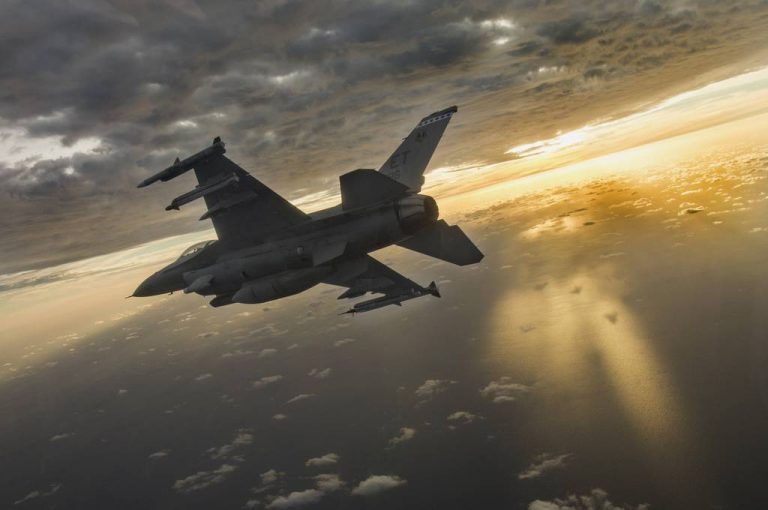
The Air Force is betting a large part of its future air warfare on a fleet more than 1,000 autonomously operated drones, and later this spring its top civilian leader plans to climb into one of those artificial intelligence-operated warplanes and let it take him airborne.
Air Force Secretary Frank Kendall told senators on Tuesday at a hearing on the service’s 2025 budget that he will enter the cockpit of one of the F-16s that the service has converted for drone flight to see for himself how it performs in the air.
“There will be a pilot with me who will just be watching, as I will be, as the autonomous technology works,” Kendall told the Senate Appropriations Committee’s defense panel. “Hopefully neither he or I will be needed to fly the airplane.”
Drone warfare has quickly expanded from the sidelines of combat to one of its primary weapons. Drones are a daily threat in Ukraine and in the Middle East. In Ukraine, everyday citizens are targeted by Russian drones but also are assembling drones to collect video of Russian positions. In the Middle East, Iranian-backed Houthis and militant groups have regularly employed sophisticated air, sea and underwater drones to target U.S. bases and commercial ships in the Red Sea.
The Air Force began planning for its fleet of collaborative combat aircraft, or CCAs, several years ago, and it envisions a scenario in which one piloted jet will be able to quarterback multiple AI-driven, responsive drones, which the service calls “loyal wingmen.”
The service has been tight-lipped on what the fleet of drones will look like in size or platform, whether they will be full-size warplanes or something smaller. Kendall said the converted F-16 test flight will be done for him to observe the technology behind the future fleet.
The fleet is being designed specifically with future warfare, and potentially a conflict with China, in mind. China has rapidly modernized its anti-access capabilities as more sophisticated air defense systems make it risky to send manned crews too close. Drone aircraft could augment the service’s ability to breach those defenses, and they are envisioned to provide support in a variety of future missions such as surveillance or jamming.
“The initial role for the aircraft was going to be counter-air, but it will have the potential to do other things,” Kendall said.
The drone fleet is also expected to be cheaper than developing new manned jets, Kendall said. The current goal is to have each cost about a quarter to a third of what an F-35 fighter costs now, or about $20 million apiece.
Tara Copp is a Pentagon correspondent for the Associated Press. She was previously Pentagon bureau chief for Sightline Media Group.
Bracken: When The Music Stops – How America’s Cities May Explode In Violence

Interesting take on a possible downward spiral of society.
From the article
“In response to recent articles in mainstream military journals discussing the use of the U.S. Army to quell insurrections on American soil, I offer an alternate vision of the future. Instead of a small town in the South as the flash point, picture instead a score of U.S. cities in the thrall of riots greater than those experienced in Los Angeles in 1965 (Watts), multiple cities in 1968 (MLK assassination), and Los Angeles again in 1992 (Rodney King). New Yorkers can imagine the 1977 blackout looting or the 1991 Crown Heights disturbance. In fact, the proximate spark of the next round of major riots in America could be any from a long list cribbed from our history.
We have seen them all before, and we shall see them all again as history rhymes along regardless of the century or the generation of humankind nominally in control of events. But the next time we are visited by widespread, large-scale urban riots, a dangerous new escalation may be triggered by a fresh vulnerability: It’s estimated that the average American home has less than two weeks of food on hand. In poor minority areas, it may be much less. What if a cascading economic crisis, even a temporary one, leads to millions of EBT (electronic benefit transfer) cards flashing nothing but ERROR? This could also be the result of deliberate sabotage by hackers, or other technical system failures. Alternatively, the government might pump endless digits into the cards in a hopeless attempt to outpace future hyperinflation. The government can order the supermarkets to honor the cards, and it can even set price controls, but history’s verdict is clear: If suppliers are paid only with worthless scrip or blinking digits, the food will stop.
STEP ONE: FLASH MOB LOOTING
In my scenario, the initial riots begin spontaneously across affected urban areas, as SNAP (supplemental nutrition assistance program) and other government welfare recipients learn that their EBT cards no longer function. This sudden revelation will cause widespread anger, which will quickly lead to the flash-mob looting of local supermarkets and other businesses. The media will initially portray these “food riots” as at least partly justifiable. Sadly, millions of Americans have been made largely, or even entirely, dependent on government wealth transfer payments to put food on their tables.”…..
Read the entire article here.
Bracken: When The Music Stops – How America’s Cities May Explode In Violence