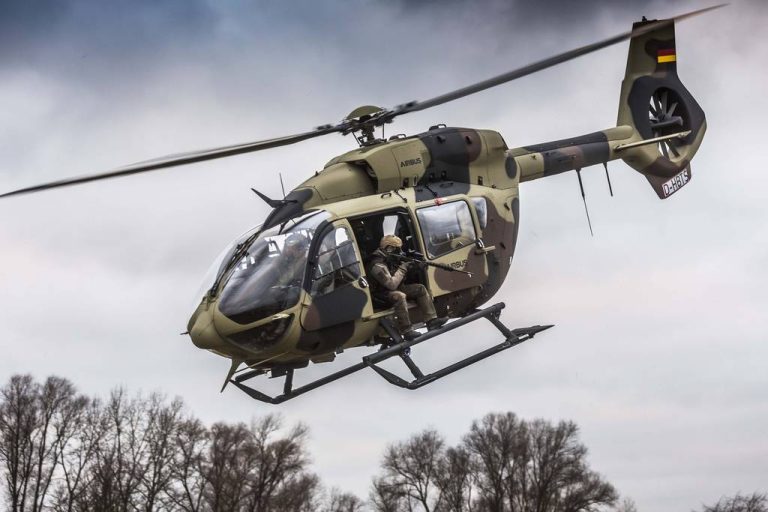
CHRISTCHURCH, New Zealand — Brunei has purchased six H145M helicopters from Airbus Helicopters as the Southeast Asian nation recapitalizes its fleet for close air support, surveillance and other operations.
The order follows a 2011 acquisition under Phase B of Brunei’s Support Helicopter Project for 12 Sikorsky-made S-70i Black Hawk helicopters.
The latest purchase for the Royal Brunei Air Force is part of Phase B. It’s unclear how much the contract is worth.
The Defense Ministry said the contract signing took place April 30 at Bolkiah Garrison, where the ministry’s is based. “All six helicopters will be introduced into service gradually starting from the year 2026 to replace the Bolkow Bo 105 helicopters, which have been retired from service,” the ministry stated.
Airbus Helicopters announced the sale May 2, but neither party mentioned whether the H145Ms would be armed. Still, the platform can carry 12.7mm machine guns, 20mm cannon pods, 70mm rockets, or air-to-ground missiles. The Bo 105 fleet was armed.
Among the H145M’s operational capabilities are medical evacuation and special forces missions. The helicopter might also become part of a manned-unmanned teaming fleet, as a console can be fitted in the rear cabin for controlling drones. Brunei already operates Insitu Integrator reconnaissance drones.
Last month, the U.K. Defence Ministry announced it would buy six H145Ms for use by British forces in Brunei and Cyprus, meaning there will be some commonality between British and Bruneian helicopter operations in the sultanate. Thailand is the only other nation in Southeast Asia to adopt the H145M to date.
Brunei also has a pair of older Bell 206B-3 JetRanger helicopters used for training, though they’re due for replacement.
For the current fiscal year, Brunei allotted 796.3 million Brunei dollars (U.S. $589.3 million) for defense, representing a 31.6% jump over last year’s budget.
Gordon Arthur is an Asia correspondent for Defense News. After a 20-year stint working in Hong Kong, he now resides in New Zealand. He has attended military exercises and defense exhibitions in about 20 countries around the Asia-Pacific region.
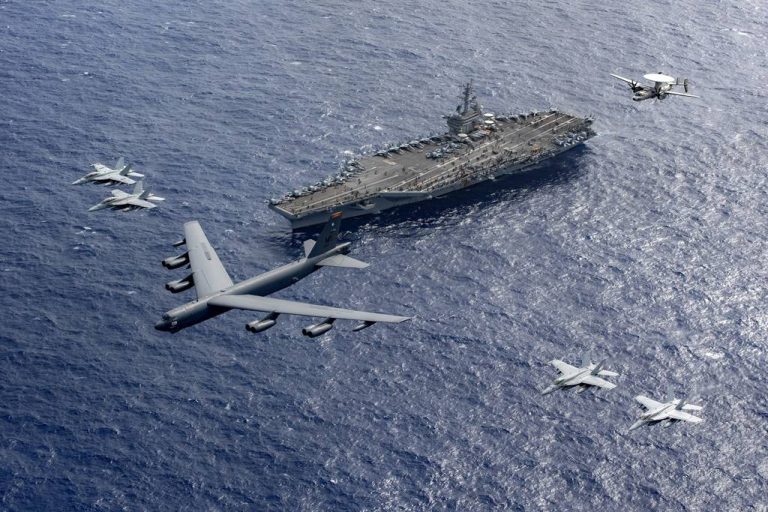
The U.S. Air Force and Navy are each preparing for a potential fight in the Pacific against China, perhaps in the next couple of years, under the guidance of the same National Defense Strategy. But this uncertain timing overlaps uncomfortably with a mountain of modernization priorities for each service.
Add to that budget caps for fiscal 2024 and fiscal 2025, and the two services have responded with very different budget strategies.
On one side, the Air Force’s proposed FY25 budget would trim its procurement account by $1.6 billion from the prior year, while boosting research, development, test and evaluation spending by nearly that amount. In the process, the service expects to reduce its fighter jet purchases by 12.
For its part, the Navy has found itself in a shooting war in the Red Sea while also trying to increase its presence in the Pacific region to deter China. The service has prioritized paying for current operations and personnel in its FY25 spending request. Procurement spending is flat, while research and development drops 5%.
U.S. intelligence officials say Chinese President Xi Jinping has set a goal for the nation’s military to modernize enough to carry out an invasion of Taiwan — which China views as a rogue breakaway province — as early as 2027.
Chinese President Xi Jinping is displayed on a screen as Type 99A2 battle tanks participate in a 2015 parade in Beijing. (Ng Han Guan/AP)
The Air Force says that, while it wrestles with spending caps under the Fiscal Responsibility Act, it leaned toward research and development more than procurement to ensure future capabilities remain on track.
The Navy, in contrast, contends that if it must deter or fight China in this “decade of concern,” it would do so with the fleet it has today, not the one it hopes to develop in the decades to come.
As the services determine their approaches, lawmakers are weighing in on whether the United States will be ready to face China in time.
Rep. Rob Wittman, R-Va., said at a March conference China could try to take Taiwan by force as early as 2027, noting that fielding capabilities at the turn of the decade will be too late.
“Anybody that uses a metric or time frame and says, ‘We’ll get this stuff done by 2030′ — wrong answer,” Wittman said at the McAleese & Associates event. “2027 needs to be the metric. That’s how we will have the opportunity to deter [China].”
A pattern of differing approaches
At least one expert told Defense News it’s normal for the Navy and Air Force to take different approaches on modernization.
In general, the Navy has taken a more strategic, methodical route to accomplishing its aircraft modernization goals, holding back on buying next-generation aircraft until technology matures and prices come down, said Todd Harrison, a senior fellow at the American Enterprise Institute think tank who focuses on defense budgets.
In the meantime, the Navy has bought aircraft already in production to fill out its inventory. For example, over the last decade, the service repeatedly extended its fourth-generation F/A-18E/F Super Hornet production line to avoid a fighter jet shortfall. It introduced its fifth-generation F-35C in 2019, well after the Marine Corps’ F-35B in 2015 and the Air Force’s F-35A in 2016.
Sailors perform maintenance on an F/A-18E Super Hornet from the hanger bay of the U.S. Navy aircraft carrier John C. Stennis. (MCSN Tomas Compian/U.S. Defense Logistics Agency)
“That’s why for about a decade, until just recently, the Navy had a higher aircraft procurement budget than the Air Force,” Harrison said. “The Air Force approach has been more about chasing new technologies and shiny objects that are dangled in front of them.”
The Air Force is now simultaneously trying to buy the F-15EX, a new version of a legacy fighter, and the F-35A, while “getting knee-deep” into developing a sixth-generation fighter program called Next Generation Air Dominance, or NGAD, Harrison said.
“They’re trying to buy three different generations of fighters all at the same time,” he said. “And it looks like they just aren’t sure where they want to place their bets. That’s an unsustainable approach, and it looks like it’s catching up to them. They just don’t have the resources to continue buying three different lines of three different generations of fighters all at once.”
But if China moves to reclaim Taiwan in 2027, Harrison said, the Air Force is “going to come up short. They’re not going to have the future systems like NGAD in time, and they’re not going to have the quantity of fifth-gen and fourth-gen fighters that they would likely need in those scenarios. … They’re destined to fall short on quantities with this approach.”
The Pentagon released footage of a Chinese aircraft approaching a U.S. aircraft over the South China Sea.
The Navy, for its part, acknowledges it would enter a hypothetical 2027 battle with the fleet it has today. So even as its ship and aircraft fleet have shrunk in size in recent years amid the decommissioning of Cold War-era platforms, the service has focused on the readiness of the ships and planes it would take to war.
The Navy has launched several data-driven efforts aimed at quickening maintenance, and it has looked to field software updates and other capabilities that can be rapidly implemented on existing platforms, rather than built into those of the future.
Navy Under Secretary Erik Raven told Defense News all the services are driven “to be ready to execute the [National Defense Strategy] over the near, the medium and the longer term. Each service will come to that with a slightly different view on how to execute that strategy. But we’re fundamentally all aligned to execute that strategy.”
“It’s a risk balance over time,” Kendall said. “If you fixate only on 2027, you’re going to find that in ’29 you’re in big trouble.”
‘We got pinched’
Maj. Gen. Dave Tabor, director of programs for the Air Force’s Office of the Deputy Chief of Staff for Plans and Programs, told Defense News the service must be able to field enough existing capabilities and continue developing the next generation of aircraft to stay on the cutting edge. To do that, he said, the service had to strike a fine balance between R&D and procurement.
And with the Fiscal Responsibility Act’s budgetary caps pushing the Air Force to make tough choices, R&D came out on top.
“At the end of the day, we got pinched by the topline,” Tabor said, and six F-35s and six F-15EXs got cut. “The result is relatively minimal to our overall rollout, but it’s 12 jets [cut] that last year we were thrilled to have.”
The consequences of the FRA’s budgetary caps started to come into focus last summer after the Air Force had drawn up its program objective memorandum, which spells out the service’s spending plans over the next five years, Tabor said.
“We knew that [the FRA] was coming; we didn’t know how it was going to manifest,” he added.
Then-Air Force Chief of Staff Gen. CQ Brown speaks with airmen during a stop at Travis Air Force Base, Calif., on Aug. 4, 2022. (Senior Airman Alexander Merchak/U.S. Air Force)
Top Air Force leaders, including then-Chief of Staff Gen. CQ Brown, current Chief of Staff Gen. David Allvin and Secretary Kendall, convened in June for a high-level meeting called Corona South. A key topic of discussion, Tabor said, was what to put on the chopping block to meet the budget caps. The matter remained unsettled as Corona South wrapped up, he added, and only became more clear after submitting the program objective memorandum at the end of June.
In hindsight, the Air Force would have liked a clearer picture of its budgetary outlook earlier, though service leaders ended up relatively satisfied with the result, Tabor said.
“Building a 90% solution is a whole lot different than building a 100% solution and taking 10% out of it, and the latter is kind of what we ended up with,” he said. “The approach was [preserving capabilities that provide] relative value to the joint fight and what did the least amount of damage to what we had already done.”
If a conflict with China were to erupt, he added, systems now in the works — such as NGAD, the B-21 Raider stealth bomber and artificial intelligence-operated drones known as collaborative combat aircraft — would allow the Air Force to fight in ways it never had before.
NGAD and the collaborative combat aircraft ended up winners in the Air Force’s proposed R&D budget: The former’s funding in 2025 would jump by $815 million to more than $2.7 billion, and CCA spending would increase by $165 million to $557 million.
But Harrison and Heather Penney, a former F-16 pilot and senior resident fellow at the Mitchell Institute for Aerospace Studies, said the Air Force can’t count on having newer capabilities, such as NGAD, fielded in the early 2030s. Such a time frame could be overly optimistic, they agreed, given the advanced technology that must be refined for NGAD and the track record of some nascent aircraft programs failing to stay on schedule.
This concept art shows a concept for the U.S. Air Force’s future fighter, known as Next Generation Air Dominance. (Boeing)
“When was the last time we ever saw an advanced capability show up on time and on budget?” Penney said. The B-21′s apparent success so far is “an exception to how we’ve seen everything else happen. The capabilities [intended for NGAD], in terms of fully operationally capable — that’s not 2030. We’re talking 2035, 2040.”
Tabor said NGAD is “proceeding at pace” and that, even if it falls behind schedule, “we’re prepared with other capabilities to mitigate risk” for a conflict with China.
The Navy reported it has lobbed a billion dollars’ worth of missiles into the skies of the Middle East since October, shooting down drones and missiles launched by the Yemen-based Houthi rebel group. The service hasn’t publicly estimated the cost of its operations there, which include the higher-than-usual tempo of daily operations for ships and planes, the extension of the Gerald R. Ford Carrier Strike Group’s deployment in the fall, and what’s likely to be a greater maintenance bill.
“Where the Department of the Navy really placed its priorities is on our fundamental mission of being forward-deployed around the world so that if a crisis hits, we’re there on the scene,” Raven, the undersecretary, told Defense News days after releasing the FY25 budget. “Readiness and people were the two top priorities that really came through in this budget.”
The Navy asked for $87.6 billion for operations and maintenance, up $3 billion from FY24. It also continued a recent focus on munitions, asking for $6.6 billion to buy weapons and expand the industrial base that builds them.
But it had to then cut procurement and R&D. The Navy asked for six ships, compared to the seven it previously expected to include in its FY25 budget. It also asked for 75 planes, compared to the 94 it previously planned to purchase.
Naval special warfare operators use a submarine exploration diver propulsion vehicle during underwater training in the waters near Virginia Beach, Va., on Jan. 7, 2024. (MC1 Trey Hutcheson/U.S. Navy)
This took a toll on all three of the Navy’s key modernization programs: its own Next Generation Air Dominance, which includes a manned and unmanned family of systems to replace the F/A-18E/F Super Hornet fleet; the SSN(X) next-generation attack submarine that will follow the Virginia class; and the DDG(X) next-generation destroyer that will follow the Arleigh Burke class.
The Navy’s NGAD effort took the biggest financial hit: The service wants $454 million in FY25, compared to $1.5 billion in FY24, for the F/A-XX piloted aircraft portion of the program.
The SSN(X) program faces the most significant delay: The service now says it will begin acquisition in the early 2040s, compared to a previous 2035 start and a 2031 plan before that.
Raven said the Navy had to take risk here, given the FRA budget caps.
“If we’re going to prioritize people and readiness, something has to give, and we saw the best benefit in taking more risk in that longer-term modernization,” he told Defense News. “But budget caps have consequences. There are hard choices being made in this year’s budget.”
Down the line, Raven added, “there may be opportunities to learn from the Air Force as it develops its path to some of these same types of technologies” — such as their separate NGAD programs.
Though lawmakers like Wittman have expressed a preference for prioritizing readiness over future fleet size and capability, one expert warned the Navy is digging itself a hole it will struggle to get out of.
“Given the long lead time to design and build capital assets such as ships and aircraft, the U.S. Navy has entered its version of a ‘doom loop’ where funds for future ships are deferred to pay for today’s readiness — which ensures tomorrow’s readiness will also suffer, as new ships are required to maintain readiness,” Mackenzie Eaglen, a senior fellow at the American Enterprise Institute, told Defense News.
“Readiness and fleet size are inextricably linked,” Eaglen added. “It’s shortsighted to believe they are separate and distinct.”
The Air Force, after decades of deferred modernization, now faces a “massive gap” between its current reality and the vision Kendall crafted for transforming the service through next-generation systems, Penney said. But it can’t achieve that vision without pouring its money into research and development.
“Nobody’s wrong here, and nobody’s right,” she said.
Stephen Losey is the air warfare reporter for Defense News. He previously covered leadership and personnel issues at Air Force Times, and the Pentagon, special operations and air warfare at Military.com. He has traveled to the Middle East to cover U.S. Air Force operations.
Megan Eckstein is the naval warfare reporter at Defense News. She has covered military news since 2009, with a focus on U.S. Navy and Marine Corps operations, acquisition programs and budgets. She has reported from four geographic fleets and is happiest when she’s filing stories from a ship. Megan is a University of Maryland alumna.
U.S. Vice President Kamala Harris Monday announced more than $100 million in funding and resources to support American auto workers and small auto suppliers.
Historic contracts secured by the United Auto Workers with the Big Three Detroit automakers and recent organizing victories ensure that these jobs will provide comparable wages, retirement security and respect at work, the office of the VP said in a statement.
This is the new thread for the Survival Monkey tips and tricks section. We are currently using a xenForo forum, and it has a few features that are not common to other bulletin board systems. It is important to note that advanced users who have been familiarized with forums may not be comfortable with this new software initially. Members who are new to bulletin boards will also find this information very helpful. The official xenForo user guide can be downloaded here in .pdf format. It is not worded well, but it does cover a wide range of features. New users may find this useful.
I have broken this introduction into TWO categories. The first is Navigation, and the second is Conversations (or Messaging).
A note on messaging:
The most significant difference this forum contains is unique messaging, called “conversations”. With most every other BBS, this is known as “private messaging”, and these messages are read like a normal email. Here, on a xenForo powered forum we can instantly chat back and forth with up to five members at a time, much like a real-life conversation. You will receive a red alert in the top right navigation area whenever you have received a conversation invite. I will explain more on conversations after we go over navigation.
NAVIGATION:
There are two important areas you have to keep in mind: (1)top left navigation bar and (2)top right navigation bar.
On the top left navigation bar, the ‘Forums’ link is your best friend. Be certain to click this whenever you are in doubt.
You can click “What’s New” under this menu to read any new forum posts since your last visit. You may also focus on reading only the threads you have chosen to watch by clicking on “Watched Threads”. Here you may also search forums, find help, and look up the member list.
Also in the top left navigation menu you will find “Today’s Posts”. Click this link to view the last (5) days posts:
Clicking on “Forums” will bring you back to the main forum page:
On the top right navigation bar, we have everything needed to customize your own experience here at Survival Monkey:
Clicking on your name will grant you more than you ever asked for, but don’t be afraid –it’s surprisingly easy to navigate. This is my favorite place to update my status, too. You will also find alerts and can easily check any conversations from this top right navigation bar (by clicking on ‘Inbox’).
If you would like to find more features to help customize your experience, click on “preferences” under your user name menu in the top right navigation bar:
Here you will be brought to a preferences page where you can customize your browsing features:
CONVERSATIONS:
You may also choose to start a new conversation here in your browsing preferences, even though it is far easier to click the avatar of any user to do that.
You can click anywhere you see an avatar –I have clicked in Tacmotusn’s avatar in the Shoutbox, for instance. Click “Start a Conversation” to effectively start a new messaging instance (also known as a private message). Remember, to get back to your list of conversations, simply use the top right navigation menu to access the “Alerts” option:
As you can see, by hovering my mouse over alerts, I get a drop down description of my alerts. If i simply CLICK the Alerts function, I will be taken to the alerts page in my control area:
You can also get here by clicking your name, then ‘your alerts’ in the top right navigation bar. Now, you can click “View Conversations” in the left menu to see all your conversations. You can start a new conversation from this point if you want by clicking on the “start conversation” button in the upper right:
…And the rest is pretty much simple. You will find this system to be very useful, and even though it is not quite the same as traditional “PM” messaging, the conversations capability can be profound because it is streamlined and efficient. Let’s remember to leave any conversations you no longer want to be a part of. It’s pretty much the same thing as deleting your messages:
Once you click ‘Leave Conversation’, you will be given the options below:
You may accept future messages for this conversation, thus keeping you in the loop. You may also banish it forever if you choose. Important note -if you add another user to a conversation, they will be able to see the full history of this particular conversation. This means, they won’t be in the dark, and will have full knowledge of all that has been talked about. Try it out, add somebody to a conversation and have fun!
_____________________________
TIPS AND TRICKS: Did you know? You can also start a new conversation by hovering over “Inbox” in the top right navigation menu, then clicking on ‘start a new conversation’ at the bottom?
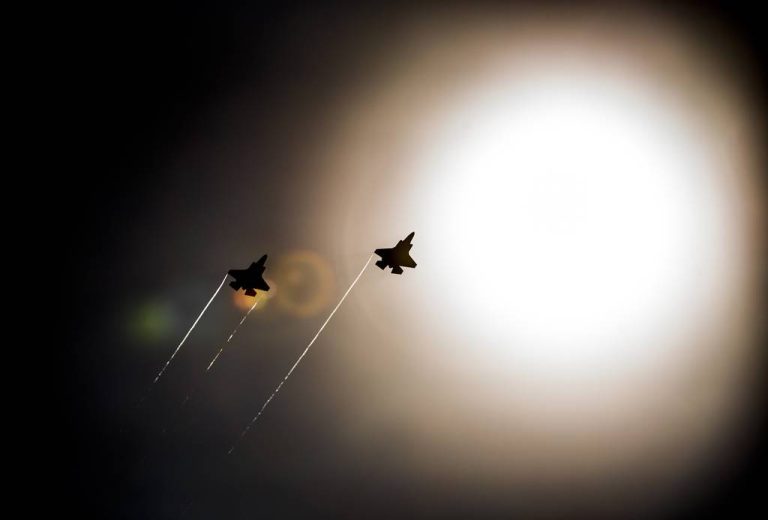
Two of the world’s largest defense contractors said they signed a long-term agreement that will accelerate procurement and delivery of geospatial information considered integral to F-35 pilot training.
Maxar Intelligence and Lockheed Martin announced their growing partnership May 6, saying it will improve the F-35 Full Mission Simulator. The FMS, as it’s known, puts people inside a copycat cockpit with displays and other devices that replicate software, sensors and weapons used on the actual aircraft.
The simulator is a major step in training and is useful for mission rehearsal. More than 1,300 people have been schooled using the FMS, according to Lockheed.
At its core are lifelike visuals and environments that Maxar makes possible. The new agreement standardizes pricing, licensing and other requirements for its products, including Dynamic and Precision3D, which generate high-resolution images and three-dimensional models of the Earth. The joint announcement did not mention a dollar figure.
RELATED
“Maxar’s geospatial products, particularly Precision3D, are critical to the success of this system,” Susanne Hake, general manager for U.S. government at Maxar, said in a statement. “They enable the highly accurate, precise simulated real-world environments that are brought to life in the FMS, creating an immersive experience that helps improve pilot safety and enhance mission success.”
The Department of Defense is increasingly interested in computerized worlds: The Army has mulled the metaverse as a recruiting tool, thinking it may appeal to younger generations, and Navy leaders have advocated for improved virtual testing techniques for information warfare and other sensitive disciplines.
Doing things digitally can save real-world materiel from wear and tear while also boosting the amount of hours one can practice. Hake described the FMS as an “industry gold standard for immersive training and mission readiness support.”
Lockheed is the world’s largest defense contractor when ranked by defense-related revenue, according to Defense News Top 100 analysis. The company earned $63 billion in 2022.
Maxar stood at No. 77, reaping $952 million. The company was tapped earlier this year for additional work on One World Terrain, considered a critical component of the Army’s Synthetic Training Environment.
Colin Demarest is a reporter at C4ISRNET, where he covers military networks, cyber and IT. Colin previously covered the Department of Energy and its National Nuclear Security Administration — namely Cold War cleanup and nuclear weapons development — for a daily newspaper in South Carolina. Colin is also an award-winning photographer.
MILAN — Amid a rush within NATO to rally around next-generation combat aircraft, new alliance member Sweden is taking a pause to assess what’s next for its lineage as a warplane-producing country.
The Nordic state in 2022 suspended its flirtation with one of Europe’s two marquee airpower efforts, the Global Combat Air Programme, an initiative led by the U.K., Italy and Japan that seeks to deliver a sixth-generation fighter capability by 2035.
Fast forward to today, and Sweden’s industrial champion Saab is freshly under contract with the Ministry of Defense’s equipment branch, dubbed FMV, to conduct “conceptual studies” on future fighter systems — military jargon for starting at square one.
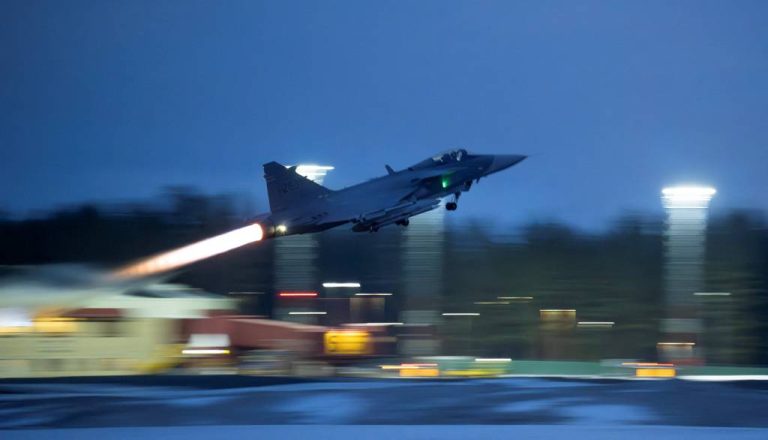
Saab has managed to secure a share of the global warplane market with the Gripen family of aircraft. The decades-long work has spawned an industrial ecosystem in aerospace engineering that political leaders hope to bring to bear in the NATO alliance.
Next-generation air power concepts on both sides of the Atlantic envision a move away from traditional fighter jets steered by humans as the central pillar of future air forces. Instead, nations are fine-tuning ideas for a networked hodgepodge of flying objects at various altitudes that can be synchronized at the push of a button to overwhelm enemy forces.
A key factor in those considerations is forging a multinational industrial base that can make it happen. For Europeans, that means consolidating workshare around critical aviation technologies while trying to preserve enough national know-how as a hedge against crises to come, an issue certain to be on the minds of decision-makers in Stockholm.
“It has been a successful story so far [for Sweden’s jet-manufacturing chain] and we are looking forward to the future,” Maj. Gen. Jonas Wikman, chief of the Swedish Air Force, told Defense News. He referred to the newly contracted warplane studies as a “journey to figure out what the next steps are for us.”
“What the concept studies are allowing us to do is to have the freedom to decide what suits us best and the freedom to invest in capabilities that make sense to us,” Wikman said.
Yet another program?
Sweden’s decision to take a pause to determine its own requirements has brought about a guessing game across the defense industry regarding what the country’s next move might be.
Will Stockholm try to rejoin GCAP through Saab in the future? Could it team up with the rival program, the Future Combat Air System led by France, Germany and Spain? Or will it opt to build and develop its own fighter with other partners? Might it simply acquire an existing fighter when the time comes?
“Nothing has been decided yet and won’t be decided until at the very least the beginning of the next decade,” Wikman said. “No matter the direction we opt to go in, Swedish industry will always be involved.”
In the mix of options, the emergence of yet another fighter program in Europe is unlikely because of the enormous investment involved, Douglas Barrie, a senior fellow for military aerospace at the London-based International Institute for Strategic Studies, told Defense News.
“Saab and the FMV are looking at all possible options, but I wouldn’t put the emergence of a third European crewed combat aircraft project particularly high in terms of outcomes,” he said. Instead, Stockholm could seek to tack onto a collaboration in an effort to spread the research and development costs, he added.
Affordability is a major challenge to programs like FCAS and GCAP, with high-tech ambitions driving the life-cycle costs into the tens of billions of dollars or more.
To put the amounts required into perspective, as of last year, the U.K. pledged to spend around $2.5 billion on GCAP’s initial research and observation stage alone, an amount equivalent to roughly one-fourth of Sweden’s planned 2024 defense budget.
Whichever path leaders in Stockholm decide to take, there is such a thing as a uniquely Swedish approach to combat airplanes that officials will likely want to retain, according to Justin Bronk, a senior research fellow at the London-based RUSI think tank.
“Sweden is likely to stick to its traditional areas of design and technology strength in the combat air design space during any next-gen program,” he said. Its features include “designing comparatively small, and therefore, efficient aerodynamic airframes; electronic warfare suites; rapid software iteration; and ease of maintenance.”
Gripen DNA
Considering the Gripen fighter will be the backbone of the Swedish Air Force for decades to come, with plans to operate the latest variant, the Gripen E, until 2060, some of its design tenets are expected to bleed into any future Swedish fighter ideas.
“The easy upgradability, robustness allowing for disperse operations from highways, and flight hour costs – these are all characteristics that are a great foundation for a starting point when looking into the next fighter system,” Peter Nilsson, head of Saab’s business unit for advanced programs, told Defense News.
Sweden’s national emergency plans dictate fighter aircraft must be able to use roads as makeshift runways in the event of a crisis.
At a media briefing during the Singapore Airshow in February, Saab’s chief marketing officer, Mikael Franzén, said due to the current threat level in Sweden, the country would operate the Gripen C/D variant for longer than anticipated.
“The C/D versions are to be retired between 2035 and 2040, or beyond, so that the Air Force does not have a dip in readiness and retains full capability during this re-armament period,” Franzén told reporters.
There are now more than 21 operational Gripen E models globally, including test models, and 35 aircraft in production, according to the company.
Franzén also said the Swedish company had improved every system in older C/D models under the Gripen E program, including an upgraded electronic warfare suite and the ability to carry three times more armaments.
When it comes to a future fighter system, Sweden does not plan to go it alone.
“We have a long heritage of international collaboration and will continue working in that way — the Gripen is truly an international fighter, but built in Sweden,” said Saab’s Nilsson. “We’ll continue working with partners from other countries.”
At this point, the studies under contract with the defense ministry are meant to illuminate the trade space in which Swedish leaders will make decisions later on. Focus areas include technology analysis, partnership opportunities, logistics and industrial implications, as well as digital and physical testing of capabilities, according Nilsson
Some high-tech areas of interest Saab plans to explore are a mix “between manned and unmanned systems as well as disruptive technologies,” he said.
A unique aspect of Saab’s vision of fighter jets is the company’s specialization on counter-stealth technology, which is the discipline of detecting aerial objects designed to be concealed from radar.
At an air warfare conference organized in March by the RUSI think tank, Jonas Grönberg, Saab’s director of strategy for fighter aircraft, said that given the fast-paced development of software and hardware systems for signals processing, stealth fighters are bound to increasingly be more discoverable by radars.
“Some military trends we’re seeing influence electronic warfare are radar threats regaining importance and the re-emergence of surveillance radars at low-frequency bands,” he added.
Some older radars function at much lower frequency ranges, which means their wavelengths are considerably longer and capable of effectively spotting most stealth aircraft.
An unmanned companion
Sweden, like other countries, is considering the addition of a drone to accompany Gripen fighters even before plans for a next-gen fighter are hatched. The idea is conceptually known among air forces as “loyal wingman,” a reference to an unmanned helper which pilots can task mid-flight to attack targets, collect intelligence or act as a decoy.
In 2022, Saab’s concept for a supersonic loyal wingman broke cover as part of an academic paper presented by a company employee at the International Council of the Aeronautical Sciences in Stockholm.
While little is known regarding the status of the technology today, the document states it was initially developed under Saab’s participation in the U.K.-led program now known as GCAP. The wingman was designed for combat with a low radar signature profile, to fly at high speeds and to conduct long-range air-to-air battles.
Saab, for its part, is readying its workforce for the pivotal next-gen study. For one, the company has equipped the unit tasked with the project to have “full fighter system capability,” and hiring is underway to beef up the engineer ranks, Nilsson said.
Elisabeth Gosselin-Malo is a Europe correspondent for Defense News. She covers a wide range of topics related to military procurement and international security, and specializes in reporting on the aviation sector. She is based in Milan, Italy.
It would seem that in some parts of the world some Christian churches are in a death spiral of diminishing parishioner numbers and active memberships.
Various churches have attempted to ward off the decline by rebranding Christian theology, doctrine, and practice, but the trends are starkly clear. I suspect that, among other factors, 'spiritual, but not religious' is one of the social solvents which are dissolving the glue of community that keeps the…