Making Oil From Seeds and Nuts

0

Plant-based oils, produced from seeds, nuts, and occasionally fruits, have been a staple of the human diet since 6000 BCE. Just like your ancestors, you can implement a small-scale seed and nut oil production at home.

Archaeologists discovered evidence of olive oil production in northern Israel ruins thought to be around 8,000 years old. In North America, Indiana University archaeologists discovered evidence of hickory nut oil extraction in the remains of an ancient kitchen thought to be more than 4,000 years old.

These oils were critical to the producers’ health and well-being. The dietary fats found in seed and nut oils play an important role in the body, assisting with vitamin absorption and essential brain and nerve function.

The use of oils in food, medicine, and religious ceremony hasn’t changed much in the 8,000 years since the first olive was squeezed to release its flavorful, golden essence, but production methods have evolved dramatically.

The “wet extraction method” was the first technique. The seeds or nuts are hulled, crushed, added to water, and then boiled in this method. Oils float to the surface and are skimmed off and saved. This is a time-consuming and low-yielding process.

Around 2000 BCE, India invented the first mechanical press for extracting sesame seed oil. This early machine, known as a ghani, looked like a large mortar and pestle and was usually powered by oxen. Modern motor-powered models are still commercially available and are widely used throughout the Indian subcontinent.

An “expeller press” is a variation of this technology that still relies on applying direct pressure to the oilseed. This machine is made up of a rotating turnscrew housed within a horizontal cylinder that, when turned, gradually increases pressure on the seed or nut. These expeller presses can be operated manually or electrically.

I recommend them for the home-scale oil presser because they are widely available in motorized or manual versions, are simple to use, and are highly efficient.

Why should someone bother pressing their own seed and nut oils when there is a wide variety available at the local grocery store?

The most important reason is flavor.

Because oils are essentially fats, they degrade and become rancid over time. Unlike mechanically extracted oils, most commercial oils are extracted using hexane as a solvent. Although this method of chemical extraction is high-yielding and profitable, the oils are heavily refined, bleached, deodorized, and degummed.

Although the resulting oils have a very long shelf life, they lack flavor, color, and aroma. While refined oils are convenient, they lack the qualities of small-scale, cold-pressed oils.

Growing, foraging, and pressing high-quality oils at home is simple and rewarding with the right equipment. I recommend going with a commercial oil press like the CGOLDENWALL 1500W because it will make the whole process a lot easier, and you will be able to extract every drop of oil from various seeds and nuts.

To get you started, here are some of my favorite oilseed crops.

Sunflower oil

Oilseed sunflowers are an easy-to-grow annual crop with small, black-shelled seeds that yield 24% to 47% oil. These are the same sunflower seeds sold as bird seed.

While there are many hybridized sunflowers on the market today, including those bred specifically for oil production, even the most common varieties will yield a flavorful and useful oil.

They thrive in full sun, as the name implies. They prefer loose, well-drained soil and should be planted after frost danger has passed.

Allow your sunflowers in the field to mature until the foliage turns yellow, and the backs of the flower heads turn brownish-yellow. Toss the heads into a basket after cutting the stalks about 6 inches below the flower.

Remove the seeds easily by rubbing them loose with your hands or over a hardware cloth and allowing the seeds to collect in a container. To remove any debris, sift the seeds through screens or winnow with a box fan. Allow your seeds to dry for 7 to 10 days before pressing or storing them in airtight buckets until pressing time.

Process the seeds in the press whole, in-shell, or crushed.

The finished oil will be a deep golden color with a mild, nutty flavor that is ideal for salad dressings and marinades. It’s also high in vitamin E and can be applied topically, making it useful in skin-care products.

Pumpkin oil

gardenkitb1The common orange field pumpkin is one of many cultivars of the Cucurbita pepo species. This species includes the majority of summer squashes as well as a few winter-type squashes, which, as the name implies, are commonly stored for winter use.

Other domesticated squash species in the cucurbit family include Cucurbita maxima and Cucurbita moschata, and the seeds from any of these species are edible and can be pressed for oil, though some C. pepo varietals have been developed specifically for use as oilseed crops.

People in Central and Eastern Europe were the first to press pumpkins for oil.

A Styrian pumpkin farmer in southeast Austria discovered a random genetic mutation around 1870, which resulted in a crop of pumpkins with hulless seeds. These seeds proved to be ideal for oil extraction, with the resulting oil being praised for its flavor and quality.

Since that time, several hulless seeded pumpkins have been developed, all of which are suitable for roasting, snacking, and oil production. Don’t be concerned if these unique varieties are not available to you. Any pumpkin or squash seed can be pressed with its shell, and butternut squash (Cucurbita moschata) oil is robust and flavorful, especially if the seeds are lightly toasted before pressing.

Collecting a large number of pumpkin seeds from your garden by hand can be time-consuming. Larger-scale farmers use tractor-pulled seed extraction machines. If you intend to extract more than a small amount of pumpkin seed oil, consider renting this equipment.

Before running the seeds through the press, lightly toast them. The oil is a flavorful delicacy with a deep reddish-green hue. Because of its low smoke point, the oil should not be used for high-heat applications, but it is ideal for cold culinary applications such as salad dressings.

Peanut oil

making peanut oil

Peanut cultivation was well established across South America before the arrival of the Spanish. Spaniards brought peanuts back to Europe, where they were well received and quickly spread.

In the mid-to-late 1600s, enslaved Africans brought these legumes to North America, but peanuts remained a small-scale garden crop until the 1930s. Peanuts have become a commercial mainstay around the world thanks to agricultural scientist George Washington Carver, who developed hundreds of uses for the crop.

Peanuts thrive in a long, warm season and mature in 120 to 150 days. They prefer sandy soil and require full sun to produce well.

When the leaves and stems turn yellow and die back, loosen the soil with a garden spade or fork and remove the plants from the ground. Place the plants in a sheltered area to dry. Remove the peanuts from the plants after 2 to 3 weeks, when the hulls are completely dry.

Remove the peanuts from their shells before running them through the oil press. Hand-shelling is appropriate for small batches, but for larger batches, alternative shelling methods may be required.

Simply crush the shells with a rolling pin, food processor, or similar tool, and place the debris in a bucket of cold water. The lighter shell particles will float, while the heavier peanuts will sink. After that, the peanuts can be dried in a low-temperature oven.

If the peanuts are roasted before pressing, the oil will have a deep, nutty flavor and a dark, golden-brown color. Break toasted or raw peanuts into smaller pieces before pressing them to increase yields.

Roasted peanut seed oil is commonly used as a flavoring oil, similar to how toasted sesame oil is used, whereas raw peanut oil is excellent for frying.

Banner 620 273 3

Walnut oil

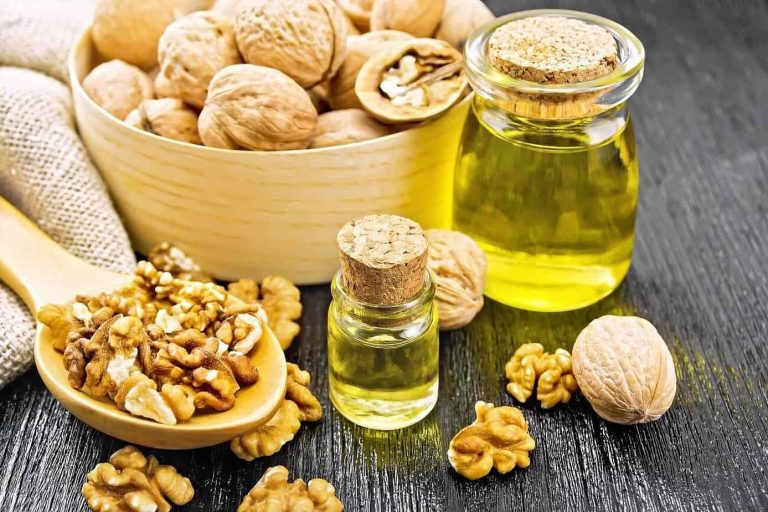
The domesticated English walnut, Juglans regia, is the source of the majority of commercially available walnut oil. English walnuts, which are thought to have originated in Iran, are now grown all over the world.

A number of native walnut species, most notably the black walnut, Juglans nigra, can also be found in North America. Although all walnut species produce an edible kernel, some have thick shells and smaller seeds than others.

Growing walnuts from seed can be a time-consuming process that can take up to ten years from seed to nut harvest. The abundance of wild black walnut trees in North America, as well as already established groves of English walnuts, can supply enough walnuts to meet all oil needs.

Foraging for wild nuts is an option, though the English walnut is the easiest to work with because the hull splits open when mature, as opposed to the black walnut, whose hull remains intact even after ripening and falling from the tree.

The walnuts must then be washed and their shells removed. You can remove a walnut hull in a variety of ways, but I’ve found that a tabletop corn sheller works best.

For English walnuts, a simple nutcracker should suffice. Black walnuts, on the other hand, will need to be hammered before being dropped into a bucket of cold water. The lighter nutmeat will float, while the heavier shells will sink.

The yield of walnuts can be increased by heating them before pressing them. Although roasting the seeds before pressing results in a slightly darker color and deeper flavor, walnut oil has a golden amber hue and a light, nutty flavor. The delicious flavor of walnut oil lends itself well to cold-temperature uses as well as sautéing and stir-frying.

Processing and storage

processing and storing oil

Whatever seed or nut oil you press, the process of filtering, bottling, and storing the oil will be similar. Label your oil with the date it was pressed.

Because of the small bits of seed and shell suspended in the oil, freshly pressed oil will be cloudy. Place the oil in a cool, dark place to settle. The oil will have visibly clarified, and most of the debris will have settled to the bottom of the container within 24 to 48 hours.

Filter the oil through a fine-mesh screen or tightly woven cheesecloth after decanting it, leaving the sediment behind. Filtering will extend the shelf life of the product.

While specific storage temperatures vary depending on the seed, it is always best to keep the oils in a cool, dark place. This can be as simple as putting them in a kitchen cabinet or pantry.

Some oils are more delicate and should be refrigerated. While it isn’t always necessary, cold storage will keep your oils from going rancid for even longer, so if in doubt, put them in the fridge.

The crushed seed that remains after extraction, also known as “seedcake,” is also useful. The leftover seedcake is edible if the oilseed had edible shells, such as hempseed or flax, or if the shell was removed, such as walnut or pecan. Using a food processor, grind the seedcake into a powder and add it to cereals, breads, and other baked goods.

Alternatively, if the seeds were pressed with their inedible shells still attached, such as sunflower seeds, you can still use the seedcake as supplemental feed for your chickens or other livestock. You can also add it to the compost pile to help create lush, rich soil.

Concluding

Reviving lost skills, such as small-scale seed and nut oil pressing, revitalizes our relationship with our food system. This hands-on, small-batch approach to food production connects us to the land and to one another in ways that we could never achieve as consumers.

Suggested resources for preppers:

Harvesting and canning wild greens

The #1 food of Americans during the Great Depression

Recommendations for planting fruit, nut, and shade trees

If you see this plant when foraging, don’t touch it!

Sno-Cat Safety!

0

Bear with me, this news really bothers me!
Actor Jeremy Renner run over by his Sno-Cat while trying to help stranded motorist!
The News is reporting his Pistin Bully Sno-Cat rolled over him while he was trying to climb back in and stop it, which screams all sorts of issues with that Cat, not to mention operator training or lack there of, and I suspect we will learn ether that Cat had several of it's safety interlocks disabled, or was otherwise ill maintained! What really bothers me here, I…

Sno-Cat Safety!

Ideal Survival Rifle | Survival Monkey Forums

0

An AR15.com article
This article is an attempt to select an “ideal rifle”. What this means is that if you were forced to select a single rifle to rely upon for your survival, what would it be. The scenarios could range anywhere from a current day home defense weapon all the way up to global disasters and the aftermath that follows (TEOTWAWKI) and everything in between.

Modern firearms have come a long way. There are thousands of handguns, rifles, and shotguns designed for military and sporting use. You could select a single category such as ‘double-barreled shotguns for hunting ducks’ and get a large number of “ideal” choices. Ask a few people to select their choice, and you’ll likely get about as many different replies.

So how is it possible to select a single “ideal rifle”? And furthermore, why bother selecting a single rifle?

The answer to the latter is easier. Most do not select a single rifle. They have a selection, which they can call upon for the specific task at hand. This is perhaps the ideal condition, but in this article we’re operating under the premise that a single choice needs to be made. A single choice allows for better familiarity, consistent operation, and all resources are focused on a single firearm (ammo, tools, training, parts and accessories). In some situations, you may only be able to carry a single firearm, and thus be forced into the decision. It is not practical to travel by foot carrying multiple long guns, particularly over any period of time.

In modern times, one could argue the dependency for survival on a rifle is not what it may have once been. We have burglar alarms, cellular phones, laws and police forces, a powerful army, and technology has made us safer than ever. At the same time, technology has made us more vulnerable than ever before. A small group has the potential to wipe out millions of people with a single nuclear weapon. The fall of the Soviet Union has loosened the control over its existing nuclear weapons, and third-world countries can have nuclear arsenals. The threats from crime, terrorism, natural disaster, and weapons of mass destruction are real. If something were to happen today, you would need to have made a decision about the rifle you would select and be prepared for such an event.

So the need to select a “survival” rifle is real. Selecting a single “ideal rifle” is not easy. The AR-15 series of rifles comes out ahead when compared to everything else. In the text that follows, this article will attempt to justify that decision, as well as to take it a step further and specify a single configuration of the AR-15 that is “ideal”.

Keep in mind that this is a single opinion in an exercise to select a general-purpose tool for a great number of possible scenarios. This means that while the selected rifle may not be the best choice for a particular scenario, it is the best choice when all those scenarios are viewed as a whole.

Requirements

General

Selecting a single weapon for your survival means that it is going to be called upon to perform a number of different tasks. These can range from hunting to self-defense including CQB and long-range battles. In addition, shooting may require penetration of body armor, cover, or other obstacles and at the same time the selected firearm/ammunition may be called upon to be safe when rounds go astray indoors.

The selected weapon and ammunition will need to be light as travel may be required, and you’ll want to keep them with you at all times. The rifle needs to be reliable, durable, easy to maintain, and parts should be readily available.

Since distances can vary from a few feet to a few hundred yards, selecting a single weapon/cartridge that will handle short to intermediate ranges seems like the best tradeoff. While it is often advantageous to keep as much distance between you and your target, this applies for the most part to offensive tactics; in a survival situation, most encounters will be defensive and thus at shorter ranges. These “defensive” ranges can range from a few feet to 300 yards.

The AR-15

The AR-15 series of rifles are the ideal firearms for the purpose at hand. Having been around for several decades and having seen considerable combat and widespread use, the AR-15 has evolved into a reliable, robust, and accurate weapon. It has managed to function under all types of conditions or been improved to do so. The following describe a few of the areas where the AR-15 excels.

Flexibility

The AR-15 is perhaps the most flexible firearm ever developed; in seconds, a carbine can be switched over to a long-range rifle by swapping upper receivers. With options available for almost every part of the rifle, a rifle can be custom tailored to an individuals specific needs and desires.

Accuracy

Today’s AR-15’s are capable of providing MOA accuracy or better. The AR-15 now dominates service rifle matches.

Reliability

Current AR-15 rifles are extremely reliable and suffer none of the problems experienced at its inception. Through advanced engineering and manufacturing the AR-15 has evolved into a dependable firearm as capable as any other.

Proven Performance

As one of the most widely issued military arms in history, the AR-15 series has proven itself though nearly 4 decades of military service. It has been used by most of the armies in the free world, and is current issue for a large number of these.

Maintenance

The AR-15 quickly disassembles into its major parts without the need for tools. At this point it can be easily cleaned and inspected, and parts replaced.

Parts Availability

The long-term success of the AR-15 means that parts are readily available worldwide and relatively easy to come by. These parts are interchangeable with other rifles. There is no other rifle in existence with more available parts than the AR-15.

Options

Semi or Auto

The only time that full-auto fire offers an advantage is when facing very close adversaries and multiple threats. The advantages of full-auto do not justify the high costs of registered firearms or the liabilities of illegally possessing one. In most cases, semi-automatic fire is not only adequate but also superior to full-auto, and this is especially true in a survival situation where conservation of ammunition is a priority.

Caliber

While there are also options to convert AR’s to a large number of pistol and rifle calibers, the standard .223 (5.56x45mm) is the best solution. (a comparison of calibers is outside the scope of this article) The .223 round is available and manufactured in greater numbers than any other round. In addition, different loads are available to fill a number of needs, from hunting small game up to long-range accuracy, tracers, incendiary and more.

It is perhaps the best round for CQB, surpassing any of the handgun rounds with more stopping power and less chance of over-penetration. It offers a flat trajectory, good penetration when necessary, and destructive effects on targets.

The 5.56mm NATO also offers a light recoil, and small size. This is important because you may need to carry and store a large amount of ammunition, and the light recoil aids in training and use by smaller or younger individuals.

As for loadings, either the U.S. M193 55 grain or the current NATO 62 grain, steel core will do (U.S. SS109). Preference goes to the 62 grain NATO round if it can be found. However, the 55-grain loadings are cheaper and more readily available. There are a number of other weights available, but do not offer any advantages for our general-purpose use.

Barrel

Length

The ideal barrel length is 16″. This length is long enough to extract the necessary performance from the ammunition and to provide the accuracy desired, while remaining short enough to be easily maneuvered in close quarters. The 14.5″ M4-style barrels are very popular, but the legal limitations and higher costs do not justify their selection over a standard 16″. These barrels need to have their flash suppressors permanently attached to bring the overal length to 16″; the standard A2 flashider is not long enough.

Twenty-inch barrels are a bit long, and don’t offer the performance increase over a 16″ barrel to justify their length and additional weight. Anything above 20″ detracts from the rifle’s “all purpose” use, and is for more specialized applications.

Weight

The weight of the barrel will only refer to whether the barrel is a “heavy” one or not. The heavy-barrel (HB) designation means that there is more metal there. Some of these taper at different points, either underneath the handguards or from the front sight on. The HB whose thickness does not vary (i.e. is maintained from back to front) offers the most durable design. The 16″ barrels are available in a lightweight configuration, M4 profile (thin under handguards, thick outside handguards, and with a cutout to allow mounting of M203, and in a heavy barrel. For this rifle, a lightweight or M4 profile offers the most advantages as far as weight and handling.

Fluting

Fluting a barrel will reduce the weight as well as offer improved cooling, but may reduce the strength of the barrel. This is a tradeoff that may go either way- get a heavier fluted barrel, and you’re at least as well off as the non-fluted barrel. Stick with a non-fluted barrel.

Terminating

For a survival rifle, the benefit of a flash suppressor is important. The standard A2 flash hider is very good, but not long enough for those 14.5″ barrels. In that case, a better alternative is to replace it with the Vortex flash hiders that are most effective in their role. Many have argued the post-ban (non-threaded) barrels offer an advantage in accuracy, but the advantage of a flash hider outweighs this in the survival situation. Get a rifle with a flash hider. There are a few alternatives now to the Vortex, and time will tell how well these fare.

Bayonet Lug

A bayonet lug is for the most part never going to be used. However, since the flash-hider is required, the existence of the bayonet lug does not require any additional effort and should be included. It is better to have and not need than to need it and not have it… keep in mind that a bayonet will not fit correctly on a 16″ barrel; it will fit a 14.5″ barrel.

Twist

The barrel’s twist rate refers to the distance a bullet travels in the barrel to complete a full revolution. For instance, a 1/9″ twist means that the bullet will make a complete revolution for each 9 inches traveled in the barrel. Heavier bullets require a faster twist rate to stabilize them correctly, but too fast of a twist rate will potentially cause a bullet to spin apart. For this reason it is important to match a barrel to the bullets being fired. In selecting a single twist rate for the survival AR, either a 1/7″ or a 1/9″ will serve the purpose best. These barrels are designed for bullets from 55 to 62 grains, and these are the weights that will most likely be used in survival. The 1/9 is the better of the two, but the majority of Colts/military barrels are 1/7.

Chrome

A survival rifle should have a chromed bore and chamber. The smooth, hard chrome finish offers increased longevity and facilitates the task of cleaning. It is also more resistant to the effects of oxidation.

Stock

While an argument can be made for the superior sturdiness and reduced complexity of the fixed stocks, the telescoping stock offers advantages in storage and carry, and is strong enough for rugged use. It also offers flexibility in stock length, useful when wearing body armor or thick clothing. While perhaps not as rigid as the standard stocks, the advantages of the telescoping stock make it the “ideal” choice.

The telescoping stocks are available in either an aluminum or plastic construction, both of which are strong enough for the purpose, but the aluminum have a tendency to shatter if hit. They are also offered in 2, 3, or 4 position varieties representing how many positions it locks open in. The 3 or 4 position stocks are desirable to offer the flexible stock lengths necessary when either smaller individuals are using the rifle, or when thick clothing or body armor are used. The best of these is the Colt M4 stock, which is a plastic,4 position stock. Bushmaster’s stock is also pretty good, and I would not recommend on that wasn’t Colt/Bushmaster.

Sights

Iron

The rifle’s iron sights are its primary sighting system. When optical sights, lasers, and other aiming gizmos fail, the iron sights are always there to fall back on. Iron sights are also quicker to acquire and offer a greater field of view than most any other alternative. Do not get a rifle with detachable iron sights that can get lost.

The A2 sights are supposed to be superior to the original A1 style and allow for easy windage and elevation adjustments. In addition, the A2 sights are calibrated for adjusting range; zero your rifle for 300 meters and you can dial in the range up to 800 meters. In reality, a combat rifle should never have the sights adjusted once the rifle is zeroed. All that “adjustability” only introduces the chance that the sights will be knocked out of adjustment. Preference is the simpler A1 sights, but replace the tiny aperture with the A2 aperture for better target aquisition at closer ranges.

The recommended zero is 300 meters, as the bullet’s flat trajectory will require no adjustments from 0-300 meters.

Optical

Optical sights can enhance target acquisition, particularly at longer ranges. While iron sights should be the rifle’s primary sights, a scope can offer some advantages.

It is easier to aim and more precise using a scope. Magnification can vary, but about 4x is ideal for the medium ranges we’re interested in. A key benefit for an optical sight on the survival rifle is in target identification. Although a pair of binoculars or a spotting scope offer a better picture, the rifle mounted scope is always with you, does not require an additional set of hands and eyes, and eliminates the need for movement when switching from target identification to firing.

The current cost and dependency on batteries prevents the current generation of weapon mounted night-sights from being practical. However, a scope with an illuminated reticle can offer some benefits when shooting in low light. Even though such a scope would be dependent on batteries, they are small, last a long time, and are commonly found. Once the supply of batteries is exhausted, you only loose the illumination; scope will function fine (minus illumination) without the batteries.

Receiver

The big question with upper receivers is flattop or carry handle?

The flattop uppers provide a more stable platform for mounting sights as well as a closer to bore line of sight. This allows for a natural cheek-stock hold when sighting. There are a large number of optical as well as fixed and flip-up sights available for these receivers.

However, there are several advantages to the carry-handle uppers that make them a better choice for the “ideal” rifle. The most important of these is the ruggedness of the built-in sights. When selecting a survival rifle, it is important to always have backup iron sights regardless of how good of a scope you mount on your rifle. I prefer the carry handle sights to any “clamp on” option for flat tops.

Another advantage is the ability to use this handle for carry. Anyone that’s carried an AR-15 for any period of time ends up either slinging it or carrying it with four fingers in front of the magazine well underneath the barrel and the thumb through the front of the carry handle; a carry not available without the advantage of the carry handle.

Although flattop receivers have a removable carry handle available, I would not want to need to keep track of add-ons not attached to my rifle. If you intend to keep the handle mounted at all times, then you might as well skip the flattop.

Accessories

The AR-15 can be enhanced with a few accessories, and some are required.

Lights

The advantage of a tactical light may not justify their added weight in most cases, but if any work is done in a dark environment, they can be invaluable. When selecting a light, make sure it is designed for its intended purpose. A weapon-mounted light is subjected to the repeated abuse of recoil, and most bulbs are not designed to withstand that.

It should offer bright light and a it’s pattern should be free of dark spots that may detract from it’s purpose in identifying a target. Also, the light should offer a pressure activated momentary-on switch mounted where it’s operation does not interfere with normal handling of the rifle. Perhaps the best of these is the SureFire Millennium.

Magazines

A good supply of 30-round GI aluminum magazines is a must. The plastic magazines are also usable, but the GI aluminum magazines are more widely available, more reliable, and even cheaper. The 30-round capacity is superior to the 5, 10, or 20 round varieties, and the 40-round magazines are more prone to jamming, less available, and cost significantly more. Many prefer the 20 round magazines as they do not interfere with shooting in the prone postion, or from a bench. Recommendation? Get some of both.

These can be reused, as long as they are well taken care of, indefinitely.

Cleaning Supplies

Rod

Stay away from the multi-sectional cleaning rods whenever possible. The joins on these rods can cause irreparable damage to the barrel.

Solvents

There are a large number of solvents on the market, and most of them do a decent job. While some may take longer than others may, their purpose is to dissolve deposits left on the barrel that may affect accuracy. Some would argue that a chrome-lined barrel doesn’t need a solvent to clean; oil or CLP is enough.

Lubrication and Protection

Lubrication and protection are the most important parts of maintaining your rifle. With proper care, a rifle will last several lifetimes. Light lubrication prevents wear and binding on metal parts, and the same oils are used to protect against oxidation. Just about any oil will do, and while there are very specialized “gun oils” around, plain motor oil will do when it runs out. If available, some of the dry lubricants work better than oils particularly in colder climates where oil can freeze. General purpose CLP is probably the best solution.

Sling

A sling on your rifle is required. It is probably going to be the most used item on that rifle. A sling allows you to carry a weapon while freeing your hands, carry additional rifles, and helps to always keep your rifle with you. I cannot recommend any of the “tactical” slings, as these are too restrictive in a fast moving environment; the standard M16 slings server their pupose as a “carry strap” very well and can be had for less than $5.

Summary

The “ideal rifle” as described above is an AR-15 with a short (14.5 or 16) lightweight or M4-contoured barrel with 1/7 or 1/9 twist (latter preferred), flash hider, M4 collapsible stock, A1 carry handle receiver (with A2 aperture). Options can include illuminated optical sight and a weapon-mounted light. A scope can re-balance a front-heavy rifle (caused by tactical light). This configuration gives the greatest flexibility under a variety of conditions, and performs its duties as well as or better than any alternative.

The need for self defense under unpredictable geography, weather, and conditions is common to every military force. It is also common to police forces and anyone interested in “survival.” A large portion of the world’s armies has adopted the AR-15 in its various forms, and currently police departments throughout the world are making the switch. The U.S. military, perhaps the best equipped Army in the world has recently begun deploying it’s new generation rifle to it’s forces: an AR-15 with a collapsible stock, short barrel, and optical sights where appropriate. Millions of dollars on research and development have been spent to find the “ideal rifle” and the AR-15 has once again risen to the top.


How to stop a truck

0

In situations #1 & 2, you are not going to stop a speeding truck with a rifle or pistol of any size unless you can get off a very, very lucky shot. And heroic dreams of shooting up the engine, or a tire, or the driver, happens in the movies a lot more than it happens in the real world.

In situation #3, the only way to defend a home against a heavy speeding truck is if you plan ahead and put up heavy barriers. But the likelihood of someone ramming your house with a truck is just below being hit by an asteroid. One has to balance the risk with the money, effort, and time required to mitigate the risk. YMMV, but there are a million other things I’m more worried about than a truck crashing through my living room.


hi, from the midwest | Survival Monkey Forums

0

  1. gunsmith, bullet caster, reloader, shooting instructor, handgun-hunter, holster-maker here. Happy New Year everybody.


    stg58 and Dunerunner like this.
  2. Happy New year – and welcome aboard!


  3. Happy New Year Kven and welcome to the Monkey!!


  4. melbo

    melbo
    Hunter Gatherer
    Administrator
    Founding Member


  5. BTPost

    BTPost
    Stumpy Old Fart Snow Monkey
    Moderator

    We welcome new monkeys with joy in our hearts… Pick out a branch and have a look around… Lots of Good Folks here’bouts…


survivalmonkey SSL seal


survivalmonkey.com warrant canary

what items would you want to have for the Naked and Afraid challenge?

0

  1. you get one, your partner gets another and the producers give you your choice of a machete, ferrorod, small cookpot. I’d take the machete. I’d bring a lightweight 20×20 tarp and I’d want my gal to bring a 2 person cotton rope hammock. The hammock gets un-raveled for camp cordage, to make a big pump drill for fire-making and to make netting. The tarp forms a shelter, sleeping-gear, sandals, liner for the stone-boiling pit, water-storage “bag”, canteen, breechclouts, maybe headgear and shoulder-capes vs the sun.


    Kamp Krap and Dunerunner like this.
  2. I’d want a 5th wheel trailer and my partner to have a 1 ton F350!


  3. BTPost

    BTPost
    Stumpy Old Fart Snow Monkey
    Moderator

    I would take my Nepalese Kukuri, and my wife would bring the FerroRod, the rest we can fabricate…. 50 years of living in the Alaskan Bush, teaches one a lot…


  4. Give me a good blade and I can make everything else that might be needed. Two years living in the wilderness after walking in with nothing but shoes, cut offs, a T Shirt and a Sharp Finger. I was not adjusting well to civilian life :) Now days I am with Dunerunner Give me that house on wheels and the truck to pull it!


survivalmonkey SSL seal


survivalmonkey.com warrant canary

That Mr Cool DIY Minisplit heat pump.

0

I ran it through the 100+ degree days of summer, ran it through a week that got as low as -10 and it has kept the food container at 52 degrees and near zero humidity through it all. It did pull a few more amps on the really hot and really cold days but ran just fine. Its the 12k btu one. Easy to install and get up and running and is proving to be very dependable, Well worth the $1700 price tag IMO.

Anyone here follow the Alone TV show?

0

what would be your 10 gear picks?. here’s the list that you get to choose from. No guns, steel traps, very few fishhooks, only a very small amount of netting. No treblehooks, no barbed hooks, no lures but a dry fly, tied on-site. Only certain clothing items can be taken, too. the last man standing, out of 10, wins 1/2 million $ (before taxes and SS which take over 150k, btw)

Alone Season 8: Gear List | HISTORY.com


Can’t remember where I left off…..

0

But here is where I am now with the projects And please I am no longer that other guy……… There is only Kamp Krap and Krappy and the Poo now.
vid2 - Copy.

The Lake is DONE, The Little Pond is DONE and the Big Pond……… Yeah I am going to have to pump it out quite a bit next summer to finish it on the tails.

I went with a terrace on the big pond dam and needed to get a bunch of honeysuckle out of the West Woods tree line so ripped it out with box blade and put it on the back side slope.
DSC03524.JPG

I put eight 25 ton tandem loads of 3″ on the top, water side slope and terrace flat part. The waterline will come up to the Mount Krap Mountain pass terrace. LOL I decided to keep the 30′ tall Mount Krap and use it as my watch tower and deer stand. Best view of the entire property is from up there.
DSC03526.JPG

Built it all with a 6′ box blade and the Still newish 57hp tractor. I did compress every 8inch layer with the old 12k pound Massey and 10 ton sheep foot roller. Pic is from November there is about 8′ more water in it now. Had to make it 30′ wide so my friends biggest combine could cross it. We shall not speak of how many hours it took to build that dam :)
DSC03529.JPG

I cut a spillway in each end of the dam in the virgin clay and stuck a 15″ pipe in either end and put a whole lot of rip rap in it down to the little pond between the lake and the big pond. I am standing in the bed of the little pond to take the pic.
DSC03521.JPG

The big pond will flood about 50 yards into the woods between the big dead tree and the little cedar tree to the left. We finally got rain and the tails there and on the South to keep scraping. Will pump it out next summer and finish it up.
DSC03527.JPG

The little pond ended up only being 1.25 acres but real deep. And kind of a dangerous little pond with very steep banks and shallowest water under the big pond dam being 7′ deep. Zero wind action in the little pond but there will be a pretty good current when the big pond overflows into it. 3″ rock on the slope to the water line and 6″ rip rap below the water line….. Rip Rap was not in at the time of the pic Thick layer from the 3″ down to where the water is in this pic now.
DSC03522.JPG

Tore the old ceiling out of the Kabin and put sistered ceiling joist in on 24″ centers and filled it up with R-30 unfaced rolls, then put 3/4 inch OSB on top

DSC03635.JPG

Changed the stove pipe from through the wall to through the roof with 6″ triple (10″ OD) And filled the roof with R19 faced bats(Not done in the pic)
DSC03636.JPG

Had enough siding left over from the machine shed walls to skin the ceiling of the Kabin. I like it, need to caulk and tighten the seams together but I like it.
DSC03638.JPG

Gave old sparky a long overdue seal job and face lift. and basically remodeled the entire Kabin to boot. Tried a few different things on Sparky to increase his burn time and overall efficiency. He is getting 7 hour burn times now instead of 5 and with insulation improvements the Kabin stays 70+ for 9-10 hours. I will call that a win for old box stove.
Woodstove reborn.

And the finished product done just in time for that extreme cold last week! Well except for the High Temp Dektite Flashing and storm collar. Those arrived yesterday and are installed now.
DSC03590.JPG

Moved on to building the new house. Windows in, concrete slab in, ceiling spray foam on, door in, first floor framing mostly done, stair stringer cut out and put up…… I hate making stair stringers for the record!
DSC03670.JPG

Does not look like a McMansion but it is a nice little 1200sqft on the first floor and another 400 square foot of living space in the center of the loft. And we dropped down to -10 within a few hours of taking that pic. LOL childs play for Northerners, brutal Cold for Southern IL!!!
DSC03612.JPG

Shot 3.5″ Nail into my hand hit perfect and went good and deep into the palm.

DSC03568.JPG

Pulled it out, flushed it out real good with iodine.
DSC03566.JPG

Wrapped it up real good and went back to work :) Never a hint of infection, just hurt like hell for a week!
DSC03570.JPG

Finally broke down and bought New USED very good GN Trailer only 24′ and 14,000gvwr but will handle everything I want to haul going forward.
26147_IMG_1708_1.JPG

Middle finger healed, only have about 2/3s of the tip left after it finished rotting out and the tip bone worked its way out of the hole. Stunk like a rotting pig carcass for a week until doc scraped and boiled all the rotten crap out with super powered peroxide. Totally dead and with out feeling to the second knuckle, but still good for giving people the bird!
DSC03304.JPG

Bought two more containers one to be the tool shed and WIND WALL for the remaining high tunnel. Tired of the 70-90 mph winds for a week or two every spring shredding my high tunnel skin!
DSC03391.JPG

The second is going to house my personal water treatment plant. Drawing from the lake filtered, and UV sterilized in the container and sent to the 5,000 gallon sealed cistern for the house. That is a 2023 project but container prices are not showing signs of getting any cheaper.
DSC03370.JPG

A lot of work done in 2022, a lot left to do in 2023 but life is good and getting better. Mostly Mrs Krap was diagnosed with stage 3 pancreatic cancer a Month ago and we go a good distance for her chemo treatments that are 14 hour day and then repeat the 4 hour round trip 2 days later to get the portable chem pump removed. Every other week for the next 9-12 Months. Found the tumor while removing a gall stone that was not a gall stone but rather the tumor pushing the bile duct shut. Caught it early enough that there is a good chance of treatment and a surgery curing it…… rather than a stage 4 death sentence. But she is in good spirits except for the 3-4 days after the chemo treatments, they are real hard on her :( So a bad week after Chemo and a good Week before the next Treatment. Just gotta keep her spirits and morale up through the bad week and charge he up going into the next bad week. Right now it it just looks like a very long road with very dim light at the end of the tunnel. We are gonna beat this though!


Just a test of new member registration

0

  1. Seems like a ‘must have admin approval’ box had gotten checked in the member registration process. All working as designed again now. I’ll go in and manually approve any in the queue from the last few months.

    -melbo


  2. BTPost

    BTPost
    Stumpy Old Fart Snow Monkey
    Moderator

    Great news… Thanks Melbo…


survivalmonkey SSL seal


survivalmonkey.com warrant canary
