mechstdr submitted a new resource:
Fm 21-60 Visual signals – visual signals-many types,flags,lights,sound,etc.

mechstdr submitted a new resource:
Fm 21-60 Visual signals – visual signals-many types,flags,lights,sound,etc.
As of Sunday night, 3/12, the feds etc said that all deposits in the bank, insured and uninsured would be covered, but the bank stock would become worthless. It is a bail out of the depositors, not the bankers. Sounds good and no “taxes” are going to be used to pay for it. Instead a special fee is going to be charged to the banks on top of the usual fee for the FDIC insurance. This will be a bank expense and as such you and I will pay for it when we do business at the bank. In addition the feds are going to loan money to the banks to cover the loss in value of the treasury bonds and bail out that sector. Basically loan a $100 on a bond with a value of about $85 or so. We will see tomorrow if it will work.
US regulators say SVB customers will be made whole as second bank fails | News Channel 3-12
The feds are raising the interest rates and you and I will pay more for future loans, but the banks will be covered against the policy. Some folks are more equal than others, but at least someone lost money due to bad business decisions. They hope to keep kicking the can down the road for the rest of the banking system. . Move on folks, nothing to see here.
mechstdr submitted a new resource:
Fm 16 Fabric Repair – repair of all types of fabric/cloth, tents-packs-etc.
mechstdr submitted a new resource:
Fm 21-75 care-repair of clothing – all cloth/clothing repairs for packs-fatigues-tents-etc.
…

Thought you might enjoy seeing the torture test vids, that my friends Chris & Heather, from Point Blank CHL (in Texas) made, for the PSA Dagger pistol. The Dagger is a clone of the Glock 19 Gen 3, with a few differences in the parts used…..and $300, versus upwards of $500, for the G19 Gen 3.
I like vids like these, because these two aren’t wanna-be experts. They’re a married couple, with a successful concealed carry & instructor class business, who have been instrumental in giving testimony before the Texas legislature, to help formulate some of the better firearms-related laws that have passed, in recent years. They tested this Dagger pretty much the same way you or I would, and give their honest opinion of what they’ve seen and experienced.
The 1000-round torture test vid:
…and the epic failure of the trigger mechanism, when dealing with extreme conditions!
I’ve asked them if they’d consider dropping a factory G19 Gen 3 trigger group in the Dagger, then re-test it, with the extreme conditions torture test. Would be interesting to see, if you can buy a $300 Dagger, drop a factory trigger group in it from Glock, and end up with something that will perform as well as a G19, at a lower price point.

This is a (9 part) series from the UTOOB channel (NBS Welding) of a pro welder. He takes the time to explain at least part of what he is doing – and why. The guy is a bit gruff in presentation – give him a few minutes and IMO soon you'll come to see it's worth your time to watch.
There are many 'maker' vids, I found this one to be both very down to earth and full of useful "why I do…

Every knife will serve you well if you (1) understand its limitations, (2) use the blade according to its primary strengths, and (3) do not abuse the steel by expecting it to perform exceptional tasks outside its general use. I can explain some of the more common blade profiles and steel types, but not in great detail and only based on my limited knowledge.
These are just BASIC guidelines, and there are exceptions which can be applied to any of them. I only list some of the more common grinds and steel types, so this is by no means an absolute list.
SCANDINAVIAN KNIFE EDGES:
Favored for woodcraft, light to medium duty to include carving and intricate tasks and game preparation, especially fish. A traditional Scandinavian grind is perhaps the sharpest and keenest edge for a knife. The edge is traditionally ground flat from about 1/4″ to zero edge, but many knives of this type also come with a secondary micro-bevel to increase durability. See below on micro-bevels for more information. With feathersticking wood, this blade type is generally the best (without micro-bevel).
CONVEX EDGE (full, feathered, partial):
The first picture below is a partial convex edge to zero point. Below is a picture of a full convex edge, and a feathered convex edge would be a combination of the two. Typically, a convex edge excels in the depth or bite of the blade, and offers very low resistance and can slice very well. It is often a favorite among hunters for quartering game and even in bushcraft as an alternative to a Scandinavian grind edge.

CONVEX EDGE WITH MICRO-BEVEL:
Some micro-bevels cannot be easily seen with the naked eye and require a microscope or some kind of magnification to see. Some knife manufacturers will place a micro-bevel on their blades to increase durability or to lower production costs. The inherent problem with a micro-bevel, is that it does not promote or assist the actual blade geometry, and upon regular use and resharpening, can cause performance issues over time. This is because the blade thickness typically increases higher up the blade, and sharpening a micro-bevel at the same angle will only increase the sharpened blade thickness, requiring more force to cut and altering the edge angle. Some knife users just re-profile their edges to a more natural geometry of about 30 degrees (if Scandi, re-profile to flat Scandi and so on) to escape having to use this micro-bevel. Just to clarify, that’s 15 degrees in each direction, equalling 30 degrees.
TYPICAL BEVEL EDGE:
Many utility blades have a simple edge, and the main portion of the blade can have full flat grind, hollow grind, a variety of convex or chisel grinds. The typical bevel edge could also have a micro-bevel, but it is not very common.
STEEL TYPES: (Heat treat/hardening/tempering variables must be kept in mind)
1075 (carbon steel): Light duty steel, softer than most types. Will tend to roll easily with slim profiles like Scandi and with heavy use on hard woods. This steel will tend to bend and roll long before chipping. Highly prone to rust.
1095 (carbon steel): Similar to 1075, but typically can be hardened to higher rockwell and is very common. This steel is favored among some bushcrafters due to its ability to be used with flint, ferrocium rods and its low cost value. It is regarded as an average to lower average steel in toughness, with very few exceptions. One nice feature of this steel is that it can be easily sharpened in the field. Prone to rust quite easily, often has a coating or surface treatment.
Stainless (440C): Can be heat treated to good rockwell hardness (59HRC) and holds an edge decently. Since it has the potential to border on tool steel wear resistance, it is often viewed as a good budget steel. It does lack in toughness compared to even D2 tool steel, however. 440C has more rust protection than high carbon steels, and is common among most average utility blades and food cutlery. It can be prone to rolling and minor to severe chipping at higher hardnesses.
5160: A carbon-chromium steel alloy, often referred to as “Spring Steel” and it is also used in car springs. It is a common sword steel, especially for European style swords but is also common among survival knives due to its toughness. The composition of 5160 includes: Carbon – Chromium – Manganese – Phosphorus – Silicon – and a very small amount of Sulfur.
CPM154 variant: Another steel type which is in the stainless steel category, and there are several variations. It has excellent edge retention and is not too difficult to sharpen. Generally, 154 steel is a great hunting, general purpose blade metal. The CPM154 is an improvement over 154CM steel, which was popular with knifemakers in the 1980’s. It is widely used and sits on the higher end of the knife steel category. It can take a polish very nicely, which makes for very lovely show pieces, but can be used hard practically as well. It has more toughness and better edge retention than 440C steel. I personally find this steel to be my favorite when considering cost, value, performance and overall wide range of use.
3V (and CPM 3V): A “super steel” as some may call it, it is very tough and difficult to sharpen. You will also find it to be quite expensive. It has a good resilience to rust, and better performance over most tool steels, however in some cases A2 steel will compete very well. It can stain and corrode, which is why S30V was a response to it as some believe.
S30V: Some say it is a step above 3V steel, having exceptionally improved characteristics across the board. Another “super steel” variant, and practically identical to S35VN. It has improved machining and grind characteristics over S30V and 3V steels. These steels are exceedingly expensive, however.
Laminated: A method to increase resilience to environment factors such as rusting and is applied to some high carbon steels.
Foreign Steel:
8CR13MOV – Typical hardness 57-59HRC, low molybdenum content, so this “stainless” variety Chinese steel can rust. It is a similar steel to 440C, but not so much with resistance to rust. Many times you will see a coating for knives made with this steel.
AUS8 – Hardness typically 57-59HRC, and uses nickel and vanadium content and a little molybdenum, so it does have some decent corrosion and rust resistance. It is a somewhat tough steel, along the stainless variety of Japanese origin. Takes a very fine edge, reasonable to sharpen, economically priced.
13C26 – A Scandinavian steel, some chromium content making it corrosion resistant and similar to 440C stainless. Typical HRC 58-60.
12C27 – Called a Norwegian steel, it is similar to 13C26 and 440C in some ways, slightly less tough but economical.
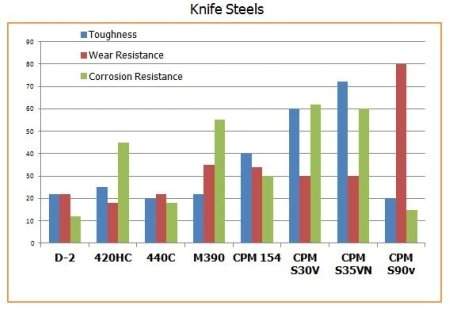
TOOL STEEL: See chart below for comparison. These are generally tougher steels.
Tool steels have chromium content to a varying extent and other metals sometimes including molybdenum, silicon, tungsten and manganese. All tool steels can be quench hardened to well above 60 rockwell. Can your tool steel be used to baton wood and come out unscathed? With some softer woods, yes. However, every tool steel can receive minor and even moderate rolling or chipping with heavy and rough baton use on hard woods. There is no perfect tool steel, just correct tool steels for the perfect application.
O1 Tool steel – It’s a good tool steel, on the lower end with higher carbon content, but tougher than average, high carbon steels. Highly prone to rust.
A2 Tool steel – Tougher than O1 steel, and is harder to sharpen. Holds edge longer than O1 steel on average. Regarded generally as an exceptional all purpose steel and solid, upper middle ground tool steel. Can be tempered to 60+ rockwell. A2 steel has a higher toughness than D2 steel, but slightly less wear resistance. Also prone to rust, but not highly.
D2 Tool steel – Regarded as the ‘typical’ tool steel. Has a higher chromium content, and is used typically for high wear steel tools. It is similar to A2 in most regards, but more closely resembling stainless steels in its characteristics and can be relatively difficult, but not terrible at sharpening. It will also hold and edge well, but at higher rockwell (60+) it can chip if used hard. This steel is prone to rust.
TO SUMMARIZE – There is no “best steel” for knives, as far as I know. With harder steels also comes the increased possibility of them being brittle in nature. Some steel treatments can extend the rust-proof nature of a steel, like stone washing, bead blasting, adding a natural forced patina, and sprayed treatments like powder coating. To find an acceptable balance for a blade, you MUST factor in the traits of the steel and consider the job you wish to use it for. Do not expect one steel and one blade to do everything exceptionally. At best, some knives will do many tasks well, some extremely well, and others not well at all. You just have to understand the limitations of your steel. Now that you have a general knowledge, with a little practice you can hold a knife, know the steel type and its limitations, understand the grind and make alterations if necessary in order to maximize its potential.

I used to be proud that Benchmade was a local company. I’ve driven past their HQ and domestic manufacturing countless times over the years. Then this happened yesterday:
b
The Facebook post was quickly taken down by the OCPD as soon as the discussion turned critical of the Police for destroying what could have been auctioned (like all other government assets) and WTF was Benchmade involved?
The OCPD then made a deceptive post about having to destroy firearms that citizens turned in and had requested they be destroyed as well as firearms that were used in the commission of a crime and the judge had requested by destroyed. They did not clearly state that ALL the firearms destroyed were in these categories and have stillnot responded to questions about such.
Back to Benchmade… While the OCPD may have been required to destroy some firearms, Benchmade did not have to take their business. For a company that claims to be a strong supporter of the Second Amendment this is quite perplexing.
Now let’s take a closer look at something else – let’s peek in on what politicians they support:
Senate Ron Wyden (D-OR) $12,900
House Kurt Schrader (D-OR) $11,900
Senate Mark Udall (D-CO) $5,200
Senate Martin Heinrich (D-NM) $2,700
Senate Scott Brown (R-MA) $1,000
House Robert Cornilles (R-OR) $1,000
House Greg Walden (R-OR) $1,000
House Scott Bruun (R-OR) $500
Senate Jeff Merkley (D-OR) $500
Not a single Republican in the last 4 years,but we do see several Democrats bought and paid for by Bloomberg .
How Benchmade Knives Betrayed American Gun Owners – Prepper.org

blade I made for my brother 10 1/2 ", 6" blade, 1095 and 15n20, brass guard and iron wood scales.
Hello. I was in survivalistforums long ago till right before it was sold. Need someplace to interact that doesn't require jumping through hoops with a mask on.
God Bless You All