Making a chopper from a leaf spring…
Air Force’s ‘WiFi in the sky’ provides a backbone for Gaza airdrops
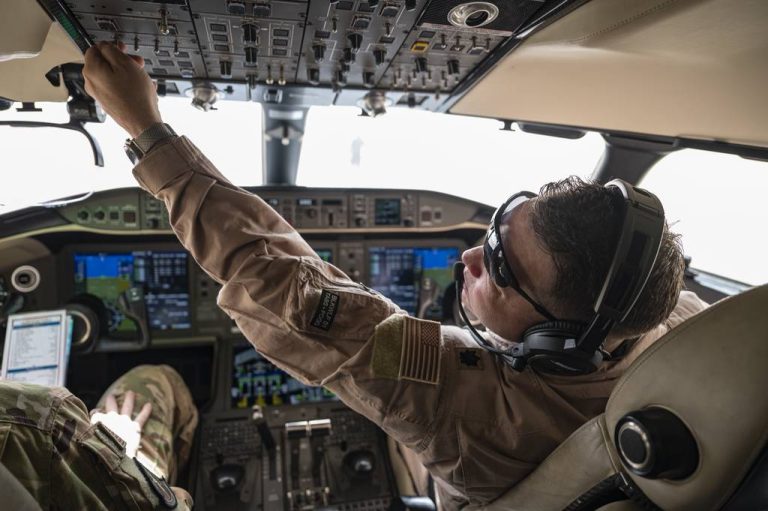
The Air Force’s E-11A airborne communications relay planes have been referred to as “WiFi in the sky” for their ability to share battlefield data with faraway aircraft as well as troops on the ground, including across the mountainous terrain of Afghanistan for which they were developed.
The aircraft, a modified Bombardier business jet outfitted with Northrop Grumman’s Battlefield Airborne Communications Node payload, or BACN, is lesser known than the Air Force’s stalwart fleet of bombers, fighters and cargo jets. Now, with U.S. troops out of Afghanistan, the E-11 has taken on a new behind-the-scenes role supporting the multinational mission to deliver humanitarian aid to Gaza.
Since March, the 430th Expeditionary Electronic Combat Squadron, the only unit in the Air Force to fly the aircraft, has supported more than 30 of the service’s airdrops in Gaza while operating out of an undisclosed location in U.S. Central Command. Pilots with the squadron who spoke with Air Force Times in an interview declined to discuss specific missions, but offered brief insights into their work in the region.
The Air Force has participated in 40 airdrops alongside coalition partners since March. Those missions were paused for more than a month as Israel’s invasion of the city of Rafah began in early May. The U.S. flew its most recent airdrop June 9.
“The BACN mission provides the Air Force, as well as joint and international partners, line-of-sight and beyond-line-of-sight interoperability, and that’s between dissimilar platforms with varying electronic capabilities,” 430th EECS Commander Lt. Col. R. Clayton “Vector” McCart said. “We capture, translate, combine and, ultimately, relay and extend legacy and modern comms and data links.”
That means flagging potential threats to the cargo aircraft ferrying shipments of food, any course corrections or other important details from mission planners and other troops around the area.
In a region as large as CENTCOM, airdrops can be derailed by a number of variables, from weather to other flight safety issues. The BACN aircraft, which carries two pilots, can quickly relay real-time changes coming from the Combined Air Operations Center in Qatar to mission partners on the front lines.
“We can monitor progress in a way that other platforms may not be able to see … as far as locations of the assets, the weather calls, etc. Weather plays a big factor in the airdrops off the coast of Gaza,” Capt. Britton “Rad” Ellington, an E-11A pilot who previously flew the service’s now-retired E-8C Joint Surveillance Target Attack Radar System, or JSTARS, aircraft, said.
With a range of more than 6,900 miles and a typical sortie time of around 10 hours, the aircraft can take over where satellite phones fail, and interpret transmissions between the military’s myriad communications systems that can’t otherwise connect. While AFCENT declined to say how many of the service’s seven E-11As are operating in theater, the 430th acts as a data lilypad for more than 1,000 hours every two weeks.
“We’re just not relegated to an airdrop. For instance, we could do that as a part of a larger expectation from CENTCOM leadership, and just move around the battlespace. … We’re not really tethered to any one location,” McCart said.
The E-11A is in the process of establishing its new home at Robins Air Force Base, Georgia, within the 18th Airborne Command and Control Squadron. It’s one of four missions replacing JSTARS planes at Robins over the next several years; the squadron is expected to become fully operational by 2027.
The 430th EECS, which currently deploys out of Prince Sultan Air Base, Saudi Arabia, and doubles as a training unit, will shift its training mission to Robins.
“Every sortie is a training sortie, in the sense that we learn every day that we fly,” McCart said.
Courtney Mabeus-Brown is the senior reporter at Air Force Times. She is an award-winning journalist who previously covered the military for Navy Times and The Virginian-Pilot in Norfolk, Va., where she first set foot on an aircraft carrier. Her work has also appeared in The New York Times, The Washington Post, Foreign Policy and more.
Louisiana the 28th state to enact constitutional carry

As of tomorrow, SB 1 will officially take effect, making Louisiana the 28th state to enact constitutional carry legislation!
Air Force Ospreys in Japan resume flight ops
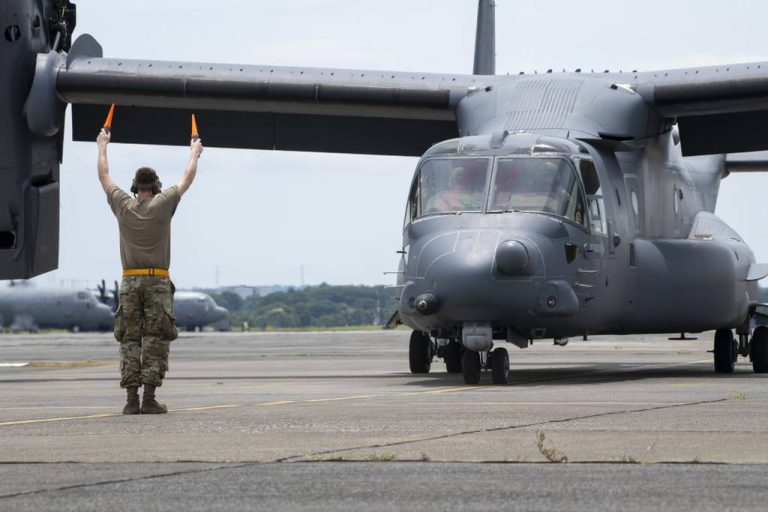
U.S. Air Force crews from the Japan-based 353rd Special Operations Wing started flying the CV-22 Osprey once again Tuesday, seven months after one of the aircraft crashed during a training mission, killing all eight airmen on board.
The return to flying followed a “multi-phased” approach to ensure the readiness of crews and follows a “meticulous and data-driven approach” that includes the development of added safety controls, the Air Force said in a news release.
RELATED
“We remain steadfast in our commitment to ensuring the safety of the men and women who operate our aircraft and the safety of our community both on base and in Japan,” 21st Special Operations Squadron Commander Lt. Col. Matthew Davis said in a statement. “These safety mitigation measures have been taken seriously, and we would not fly this aircraft without full confidence in the measures, the maintenance professionals implementing them, and the skilled professionals who fly it.”
The U.S. military has said it doesn’t expect its fleet of more than 400 tiltrotor Osprey aircraft to return to full flying operations until at least mid-2025. Naval Air Systems Command, which leads the joint program office overseeing the aircraft, began allowing the Osprey to fly again in March after a three-month grounding was lifted but with added restrictions.
Ospreys can be flown like an airplane and take off and land like a helicopter. Its vertical take offs and landings make it useful for carrier landings as well as for special operators operating in austere environments. The controversial aircraft has suffered a string of fatal crashes since being introduced into special operations more than two decades ago with four mishaps responsible for the deaths of 20 service members in the last two years.
RELATED

The military grounded the Ospreys in 2022 and again in 2023, after a series of “hard clutch engagements” that occurred when the input quill assembly, which attaches the Osprey’s engine to its proprotor gear box, wore out earlier than expected. A redesigned clutch is expected to begin testing with fielding anticipated mid-2025. Testing is also underway on a vibration sensing system upgrade to identify complements that need to replaced and a proprotor gearbox pinion bearing redesign is awaiting production and installation.
The military has said the Nov. 29 crash of GUNDAM 22 was the result of a material failure that hadn’t been seen before on the Osprey. An investigation into that crash is nearing completion.
The Marine Corps, which operates hundreds of the aircraft, used them in Sweden as part of Exercise Baltic Operations with the 24th Marine Expeditionary Unit, which last week conducted flight operations with the Osprey from the amphibious assault ship USS Wasp in the Mediterranean Sea. The Navy, which owns about 30 of the aircraft, is sidelined from using them in its carrier support mission and remains barred from flying them more than 30 minutes from an airfield where they could land in an emergency.
The Air Force owns about 50 Ospreys. While the 353rd resumes flying, crews from the 27th Special Operations Wing, based at Cannon Air Force Base, New Mexico, have also resumed limited flying operations based on aircraft availability after spending months keeping up their proficiency in simulator training, something Japan-based crews have also done while preparing to return to the air. That includes putting pilots and flight engineers through a specific return-to-flight simulator syllabus, Capt. Paul Danielson, a flight commander and Osprey pilot with the Cannon-based 20th Special Operations Squadron, told Air Force Times.
Cannon-based maintainers continued sustainment necessary on the CV-22s during the stand down and were trained on maintenance protocols directed by NAVAIR to return to fly, 20th Special Operations Maintenance Squadron Commander Maj. Shelby Olivera said, adding that they’re also completing rigorous inspections. Squadrons are progressing through those protocols based on aircraft maintenance needs and personnel experience levels, she said.
As the 20th Special Operations Squadron focuses on reaching basic proficiency, the unit is first focusing on getting flight instructors back in the air. Pilots and maintainers look are looking forward to getting Ospreys flying once again, Danielson and Olivera said.
“The morale of the squadron, I think, has gone up just seeing people fly,” Danielson said. “There’s also a good balance of understanding from the the crews that aren’t flying, understanding that the leadership is doing what is best just ensure safety moving forward.”
Courtney Mabeus-Brown is the senior reporter at Air Force Times. She is an award-winning journalist who previously covered the military for Navy Times and The Virginian-Pilot in Norfolk, Va., where she first set foot on an aircraft carrier. Her work has also appeared in The New York Times, The Washington Post, Foreign Policy and more.
The first Internet Saint – no joke

Late teen Carlo Acutis approved to become first millennial saint : NPR
captioned –
A teen tech whiz nicknamed 'God's influencer' will become the first millennial saint
The article claims a pair of miracles attributed to the kid. As a former catholic, I can only shake my head.
Kratos’ Erinyes test vehicle logs hypersonic speeds on first flight

A hypersonic test bed built by Kratos took its first flight last month, launching experiments for the Missile Defense Agency and hitting speeds above Mach 5.
MDA announced the successful flight of its first Hypersonic Testbed, HTB-1, June 14, which took off from Wallops Island in Virginia. Not only did it provide a high-speed test platform for the agency, but it allowed its two missile tracking satellites — launched in February and designed to detect advanced threats — to catch their first tracks of a hypersonic vehicle.
While MDA did not provide details about which company built the system, Kratos confirmed last week that its Erinyes vehicle — named after the Greek goddess of vengeance — flew the mission.
The company developed Erinyes in three years for under $15 million with a mix of internal investment and congressional funding. According to Josh Peterson, senior vice president for space and missile defense systems at Kratos, the company built the system largely in response to concerns within the Defense Department that its existing hypersonic test infrastructure was overtaxed and not well positioned to meet demand.
Now, Erinyes is drawing significant attention from other potential customers within the Defense Department, Peterson and Dave Carter, president of Kratos’ defense and rocket support systems division, told C4ISRNET in a July 2 interview.
“There’s been a lot of interest from numerous parties,” Carter said.
Those possible customers include the Pentagon Test Resource Management Center’s Multi-Service Advanced Capability Hypersonic Test Bed, or MACH-TB. The program relies on vehicles like Rocket Lab’s HASTE and Stratolaunch’s Talon-A to test components and subsystems in a realistic flight environment that mimics the conditions these systems might face as they fly and maneuver at Mach 5 and higher speeds.
Kratos is already involved with MACH-TB as a subcontractor, providing sounding rockets to the program’s prime contractor Leidos. Carter highlighted the vehicle’s affordability — a single Erinyes costs around $5 million, not including the rocket motor that powers it or any other customer-specific requirements — and said he expects it to play a key role in the program moving forward, potentially flying MACH-TB experiments in 2025 or 2026.
In the meantime, the company is eyeing its second flight for MDA, which is slated for later this year.
Beyond Erinyes, Kratos’ hypersonic development work includes a range of services for commercial, DOD and classified national security customers. The company started out using its sounding rocket technology to provide targeting capabilities to MDA and the Naval Surface Warfare Center in support of its Aegis Ballistic Missile Defense System.
It has since supported various hypersonic experiments and is now on contract with the Air Force Research Laboratory for its Mayhem program, which is developing a hypersonic ISR and strike platform.
Kratos is also developing a line of rocket motors called Zeus, designed to provide greater thrust and range at a lower cost. The company sees the system as a response to a need within the defense and commercial markets for affordable launch vehicle propulsion.
Zeus will fly this year on an undisclosed mission, Carter said, and will eventually be a propulsion option for Erinyes.
“We think it will provide some additional capabilities for both our target missions and probably even more capability for our Erinyes vehicle,” he said. “It’ll give it the additional horsepower to do more sophisticated things.”
Courtney Albon is C4ISRNET’s space and emerging technology reporter. She has covered the U.S. military since 2012, with a focus on the Air Force and Space Force. She has reported on some of the Defense Department’s most significant acquisition, budget and policy challenges.
How To Defend A Bug Out Location

The main difficulty in holding a position is the availability of resources, particularly trained personnel, firearms, and ammunition. Having a large arsenal is less useful if there are not enough people to operate the weapons, as a person can only handle one weapon at a time. This makes manpower critical, unless there is an expectation of reinforcements.
Ammunition, however, is a key factor. It’s common for people to have sufficient ammunition to get into a conflict but not enough to get out. Prolonged firefights consume vast amounts of ammunition, so it’s crucial to avoid using all your supplies in one battle. Therefore, it is important to steer clear of unnecessary engagements whenever possible.
Planning for bugging out
Firstly, always be ready to swiftly relocate from your current shelter to a secondary position. This requires having an alternative site prepared in advance. Options like spider holes, foxholes, and camouflaged blinds can serve as effective backup locations. These alternative positions must be chosen carefully to ensure you can’t be cornered within them. Keep in mind that cover protects you from bullets, while concealment hides you from enemy observation.
It’s crucial to avoid getting trapped inside your shelter. You could be flushed out with fire, overwhelmed by superior weaponry, have doors broken down, or even have grenades and other explosives dropped through openings. If you are defending with only one or two others, you cannot effectively guard all directions, including the roof, making entrapment a serious risk.
Additionally, ensure these alternative locations are within a reasonable distance to allow for a quick escape, and regularly check and maintain them to ensure they remain viable options. It’s also wise to have a communication plan in place to coordinate movements and ensure everyone knows where to regroup if forced to evacuate.
Finally, always keep a stockpile of essential supplies at these alternative sites, including ammunition, food, water, and medical supplies, to sustain you during prolonged engagements.
Ideal scenarios
Position your shelter at the center of a circle on a piece of paper, marked like a compass with north, south, east, and west. Suppose your front door faces south, which means the back door faces north. Measure 1,000 yards from each direction to establish your perimeter, then divide this distance into 100-yard zones to create fire sectors.
These measurements are just examples; you need to determine your actual perimeter size based on your property and geographical features. Ideally, you would set up listening posts for nighttime and observation posts for daytime at the 1,000-yard mark at all compass points to alert those in the shelter of any intruders. Once an alert is issued, defenders would move to their assigned shooting positions, each knowing their designated 100-yard sectors. Prepare and leave range cards at each position.
Range cards should indicate distances from key points like the front door, windows, or notable landmarks, ensuring shooters know their fields of fire and avoid firing randomly. Overlapping firing positions are essential to prevent exploitable dead spots. Make sure all weapons are zeroed for their respective ranges, with snipers set for up to 1,000 yards.
This setup is ideal and assumes you have enough personnel for guard duty, trained shooters, and coverage for all firing positions. Recognize that this might not always be feasible, so always have a backup plan. Additionally, ensure you have communication systems in place for coordination, maintain supplies at key points, and conduct regular drills to keep everyone prepared.
The most likely scenarios
If you and your spouse or partner, along with your children, face threats from marauders or looters, guerrilla tactics become essential. You must leave the shelter to avoid being trapped. Outside, you need positions to fire from, hide, and provide cover for non-combatants in your group.
In extreme cases, abandoning your shelter might be necessary to save your lives. Therefore, you need supply caches in the area to survive until the looters leave or you can reclaim your shelter. Supplies inside the shelter might be stolen or damaged, making external caches crucial. You must also consider the possibility of never returning to your shelter or land, so these caches should be sufficient to help you establish a new location.
To prevent a prolonged firefight, an early warning system is vital, especially with limited trained personnel. If you have electricity, use exterior lighting, particularly motion-activated lights, and motion-activated sensors around the perimeter. Cameras, either wireless or hardwired, can also be useful. Guard dogs are another option.
No system is perfect, so you also need a plan to protect non-combatants if you can’t escape before shooting starts. Safe places like a root cellar, basement, or any location that offers protection from gunfire are essential. Establish clear procedures for quickly moving everyone to these safe zones and keep essential supplies there for their safety and well-being. Regular drills and clear communication plans will help ensure everyone knows what to do in an emergency.
Recommended tactics

Fortification
Reinforcing Entrances: Doors and windows are the most vulnerable points of entry. To strengthen doors, consider using solid-core doors with heavy-duty deadbolts. Reinforce the door frames with metal plates and add a security bar or barricade brace that can withstand force. Windows should be secured with bars or grilles, and you can apply security film to make the glass more resistant to breaking. Shutters or storm panels can provide additional protection and concealment.
Barricades: Inside your shelter, position heavy furniture or specially built barricades to block doors and windows. This can slow down or deter intruders. Bookcases, heavy tables, or specially designed barriers can serve this purpose. Make sure these items are easily movable by you but not by attackers from outside. If possible, create secondary barriers within your shelter to provide a fallback point if the outer defenses are breached.
Sandbags: Use sandbags to create defensive positions both inside and outside your shelter. Sandbags can absorb bullets and shrapnel, providing effective cover. Place them around windows and doors to protect against gunfire. You can also build sandbag walls to create safe zones inside your shelter. Ensure that these walls are high and thick enough to provide adequate protection.
Surveillance and Early Warning Systems
Cameras: Install security cameras at key points around your property, such as entrances, pathways, and other potential approaches. Use both visible and hidden cameras to deter intruders and monitor their movements. Cameras with night vision capabilities are essential for 24-hour surveillance. Connect the cameras to a central monitoring system inside your shelter, allowing you to keep an eye on your surroundings without exposing yourself.
Tripwires and Alarms: Set up tripwires around the perimeter of your shelter. These can be connected to various noise-making devices, such as bells, cans, or electronic alarms, to alert you of any intrusions. Position these tripwires in areas where intruders are most likely to pass, but make sure they are not easily visible. The sudden noise can startle intruders and give you an early warning of their approach.
Motion Sensors: Install motion-activated lights and sensors around your property. These devices can detect movement and trigger lights or alarms. Motion-activated lights can illuminate intruders, making it difficult for them to approach unnoticed and potentially scaring them away. Pair these lights with audible alarms to alert you and your neighbors. Wireless motion sensors can be placed in strategic locations and linked to a central alert system inside your shelter.
Concealment and Deception
 Camouflage: Use natural or artificial materials to blend your shelter into the surrounding environment. Paint your shelter in colors that match the local terrain and use netting, foliage, or other materials to break up its outline. Consider creating a false front that disguises your shelter as an unimportant structure. This can make it less attractive to potential attackers.
Deception: Create decoy shelters or supply caches to mislead intruders. These decoys should be placed in areas where intruders are likely to find them before discovering your actual shelter. Make the decoys appear valuable, with visible but non-essential supplies, to divert attention. Setting up fake trails, signs, or markers can also confuse attackers and lead them away from your true location.
Safe Zones: Establish hidden safe zones within your property where you can retreat if your primary shelter is compromised. These can be concealed bunkers, hidden rooms, or even natural features like caves. Stock these safe zones with basic supplies and ensure they are well camouflaged. Having multiple layers of defense and fallback points increases your chances of survival.
Consider this
Those seeking to steal your supplies are unlikely to burn you out right away, as they want your supplies intact. However, criminals may act irrationally and attempt to burn you out after a few hours of exchanging gunfire.
In a total societal collapse, self-appointed groups or government-appointed entities might try to redistribute supplies. Such groups will also want your supplies undamaged and may opt for a prolonged siege. They could cut off your electricity or water supply and use other harassment techniques to force you out of your shelter and surrender your stockpile.
Defending your bug-out location or safe haven during a crisis is uncharted territory for most people. Without specific training in defense or offensive tactics, you risk losing your supplies or even your life if you attempt to barricade yourself inside and fight.
It’s crucial to have an escape plan when faced with armed individuals or groups. This plan should ensure you can leave your shelter safely, allowing you to survive and continue your preparations for another day. Make sure you have multiple escape routes and know the surrounding area well. Additionally, maintain caches of essential supplies at various locations outside your primary shelter to sustain you if you need to flee. Regularly practice your escape plan with your group to ensure everyone knows what to do in an emergency.
Suggested resources for preppers:
A few unusual fire starters to get a campfire going
The #1 food of Americans during the Great Depression
Tips for starting a fire in any conditions
If you see this plant when foraging, don’t touch it!
Anderson Manufacturing AR-15 Stripped Lower Receiver 29.99
On sale again I have built on them they are good basic receivers.
https://www.primaryarms.com/anderso…V285IUFV4&trk_link=16SKEPILN4PKFA9DQLNQHOMOQ8


