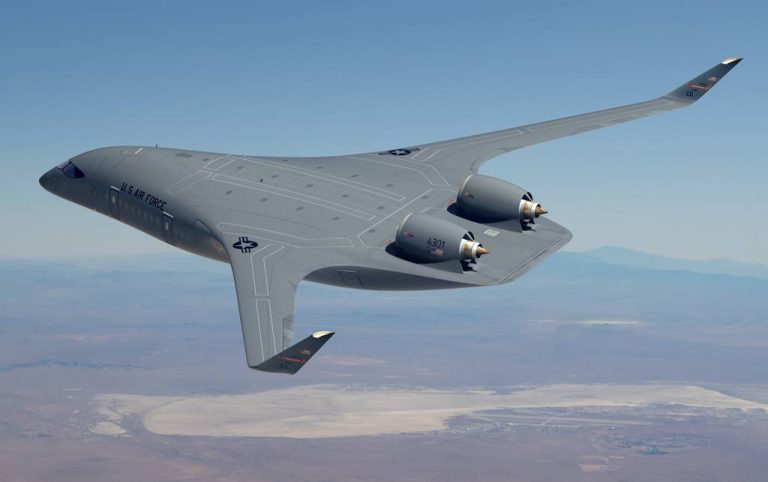
JetZero, an aerospace startup focused on fuel-efficient jets, will build and fly a sleek new prototype aircraft that could one day join the Air Force’s mobility fleet, the service announced Wednesday.
The Z-5 airframe — a blended wing body design with an oblong fuselage and long, skinny wings that looks more like a B-2 Spirit bomber than it does a Boeing 747 — was chosen over one other competitor in a yearlong contest led by the Pentagon’s Defense Innovation Unit. JetZero will ready a full-scale prototype for its first flight in 2027.
The decision marks a new milestone in aircraft design and offers a glimpse into a more capable, greener future for the Air Force inventory. Service officials praised the offering as a key development that will position the U.S. military to outpace Chinese technology and outmaneuver its forces in a potential conflict.
“We’re going into this new area where it’s all about bringing capabilities … to the Air Force, the warfighter [and] the commercial space,” JetZero Chief Executive Officer Tom O’Leary said at an Air and Space Forces Association event to unveil the plan.
The Pentagon’s renewed focus on the Pacific as its top priority has placed a premium on assets that can travel farther and faster without breaking the bank. Cargo and tanker aircraft are expected to fly into harm’s way more often, spurring the military and defense industry to reimagine the large, slow platforms for contested areas.
And the sooner that mobility assets can reach their destination, the more flexibility it gives the rest of the joint force on the battlefield.
“Greater range increases lethality. Fuel efficiency conserves our energy resources and allows us to generate more sorties,” said Ravi Chaudhary, the Air Force’s assistant secretary for energy, installations and environment. “In an era in which installations will no longer be the sanctuary they were in previous conflicts, this capability is going to be critical.”
The service last summer described blended wing body design as “one of the single most impactful technology opportunities for future U.S. Air Force aircraft.”
That approach flattens a traditional tube fuselage into a more aerodynamic, somewhat triangular shape to carry payloads where the wing meets the body and be less visible on radar.
The comparatively lighter design could be around 50% more efficient than a traditional mobility aircraft and able to travel twice as far — a goal that, if achieved, could substantially shrink one of the Air Force’s significant annual expenses as well as its environmental footprint. Air Force aircraft and bases guzzle around 2 billion gallons of fuel, costing many billions of dollars, each year.
JetZero’s joint venture with Northrop Grumman on the Z-5 has received $40 million in government funds in fiscal 2023, Chaudhary said. The military will put $235 million toward the initiative through 2026, plus more from private investors.
If flight tests are successful, Air Force officials may consider a version of the JetZero aircraft to replace the C-5 and C-17 transport aircraft or to follow the KC-46 tanker.
Chaudhary said the Air Force will simultaneously build up the supply chain and other logistics it needs to transition the prototype to a full-fledged program, if the service taps it to make the jump into real-world operations.
But Maj. Gen. Albert Miller, Air Mobility Command’s director for strategy and plans, cautioned against viewing the jet as the sole solution for the Air Force’s next-generation airlift and air refueling programs.
At the least, it could offer a new perspective on the fuel efficiency and stealth qualities that workhorse aircraft will need in the future, he said.
The Air Force said in a press release the same day that “several military transport configurations are possible” using blended wing body aircraft. Officials also hailed its potential applications for commercial air travel as well.
“This project is a win-win for the commercial industry as well as for the DoD,” Air Force Secretary Frank Kendall said. “This is going to be a pathfinder project that’s going to make a big difference.”
Rachel Cohen joined Air Force Times as senior reporter in March 2021. Her work has appeared in Air Force Magazine, Inside Defense, Inside Health Policy, the Frederick News-Post (Md.), the Washington Post, and others.
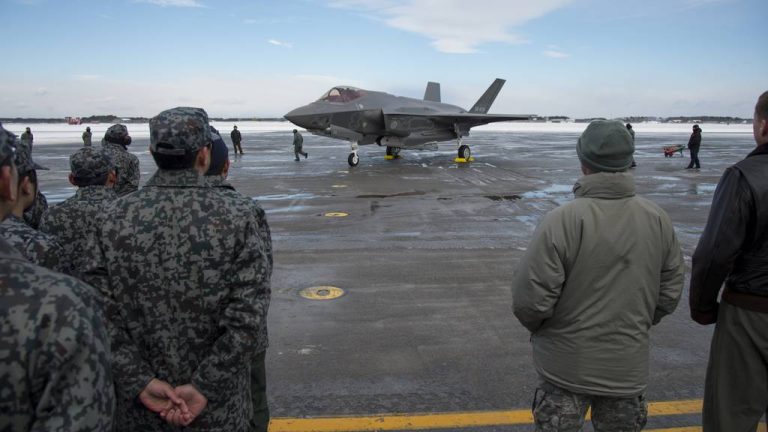
MELBOURNE, Australia — Japan will send its fifth-generation F-35 stealth fighters overseas for the first time later this month to take part in exercises in northern Australia.
The Japan Air Self-Defense Force, or JASDF, said in a release Monday that four Lockheed-Martin F-35A Lightning II Joint Strike Fighters from the 3rd Air Wing at Misawa will undertake a two-week deployment.
According to the release, the deployment will see the jets take part in exercises flying via Andersen Air Force Base on the U.S. territory of Guam to Darwin and Tindal in Australia’s Northern Territory.
A JASDF Boeing KC-767 tanker, a Lockheed-Martin C-130 Hercules and two Kawasaki C-2 airlifters will support the F-35s for the exercises beginning Aug. 21 and concluding Sept. 2.
This will mark the first time Japan has sent its F-35s overseas for training and follows the deployment of five Mitsubishi F-2 fighters to Australia for the first time in 2022 when the JASDF took part in the multinational Pitch Black air combat exercise.
Royal Australian Air Force F-35As will deploy to Japan in early September for Exercise Bushido Guardian, a joint air combat training activity between the two countries, according to a joint announcement by Australia’s defense and foreign ministers.
Australia will also participate in Exercise Yama Sakura as a full participant for the first time with more than 150 personnel travelling to Japan in December for the land warfare exercise.
The announcement of the exercises comes as the Reciprocal Access Agreement, or RAA, between both countries comes into effect. The agreement provides the legal framework for greater cooperation between the defense forces of both countries.
This is the first visiting forces agreement Japan has struck with any country outside the United States and is expected to “streamline more effective force cooperation and enable each country to increase the sophistication and regularity of training, exercises and other cooperative activities,” according to the announcement.
Mike Yeo is the Asia correspondent for Defense News.
This is an EXTREMELY important video from RFK Jr. which explains the TRUE history of WWII, Russia and Ukraine.
EVERYONE should listen to this video. Americans do not understand why Ukraine is so important to Russia. This is the gateway through which the Nazis invaded Russia in WWII, and they will not stand to leave it unprotected. VERY IMPORTANT video with RFK Jr. and Tucker Carlson.
You can skip the part about the Secret Service protection in the beginning, and jump to the Ukraine explanation about 18 minutes in.
I wonder if there is material about replacement of factory medicine to herbal,this because there is ever more shortages,and most base material en medicines come from china,and some (me to) depend for there life on them. I realize its a impossible task to substitute one on one as the % active in the herbs is never constant,and no doubt more side efects,but its needed to be around a bit longer
And i know bad me, to start thinking after a little poo has hit the fan.
The Big Pond being hidden, does not get much wind action and has….HAD a low Oxygen, High CO2 and Ammonia problem that was creating a algae and duck weed problem. Like the pond was starting to look pretty scummy and not very appealing to step foot into. People kept suggesting paddle wheels, skimmers, and multi head bubblers.. Diffusers. All viable solutions and cost more than I wanted to spend on it, when there is a much simpler and more cost effective solution to removing Algae/Duck Weed and balancing the water chemistry out at the same time and it is effective in 95% of ponds less than 5 acres.
I bought two 4500GPH Submersible Pumps at harbor freight for $130 per pump. LOL the same company that makes the high end expensive ornamental pond pumps I used to install when I had the landscape company ($320 per 4500gph pump back in 2000-2007) Make the Harbor Freight Pumps. They are literally identical in parts and quality. Where they went cheap was the pump outer housing and removable screen intake end. The plastic is about 2/3s thinner than the higher end pumps. Not a big deal as they sit underwater on some cinder blocks and should not be moving around and breaking the casing
Not knocking the other methods they work, the skimmers are pretty limited though. A skimmer simply takes the surface algae off and does not correct the water chemistry part of the problem. Pond dye also helps but I just don’t like my ponds and and lakes looking like chem toilet water. The kids also enjoy playing in the fountains the pumps shoot pretty high up if they are set up to make a geyser.
Here is the video right after I dropped the pumps in and turned them on. You can see in this one how scummy the water was getting. https://youtu.be/KpIBLrTYtkI
What was the insurrection all about? Why have federal actors in the crowed encouraging and directing bad behaviors? Read on for a very well presented explanation for many questions surrounding that particular day in American history. Take the time to read the comments at the link for the article.
August 12, 2023 | Sundance | 499 Comments Tucker Carlson interviews Capitol Hill Police Chief Steven Sund about the events that took place in Washington DC on January 6, 2021. {Direct Rumble Link}
Within the interview former Chief Sund notes there was extensive “chatter” intelligence gathered by Dept of Homeland Security (DHS), the Federal Bureau of Investigation (FBI), and even the Defense Dept (DoD) about the potential for disturbance and possible violence on Capitol Hill. However, not a single briefing was ever conducted, and not a shred of documentation was created about the warnings to share with the Capitol Police.
Was the “chatter” real or was it self-created by political leadership in federal agencies, DHS, DoD and FBI, who were intent on using chaos to facilitate the goals and objectives of House Speaker Nancy Pelosi. We have previously outlined the Pelosi motive and expand again below. The Tucker Carlson interview with Police Chief Sund puts those motives and outcomes into a new context. WATCH:
Within the questions: the FBI and government apparatus had advanced knowledge of the scale of the J6 mall assembly yet doing nothing? Why were the Capitol Hill police never informed of the FBI concerns? Why didn’t House Speaker Nancy Pelosi secure the Capitol Hill complex, and why did she deny the request by President Trump to call up the national guard for security support? Why did the FBI have agent provocateurs in the crowd, seemingly stimulating rage within a peaceful crowd to enter the Capitol building? There have always been these nagging questions around ‘why’?
Long time CTH reader “Regitiger” has spent a great deal of time reviewing the entire process, looking at the granular timeline and then overlaying the bigger picture of the constitutional and parliamentary process itself. What follows below is a brilliant analysis of the federal government motive to create a J6 crisis that permitted House Speaker Nancy Pelosi to trigger an emergency session and avoid the 2020 election certification challenges.
Those congressional floor challenges, known and anticipated well in advance of the morning of January 6, 2021, would have formed a legal and constitutional basis for ‘standing’ in judicial challenges that would have eventually reached the Supreme Court. The certification during “emergency session” eliminated the problem for Washington DC.
I think most, not all, but a large number of people, are totally missing what happened; and why this happened on Jan 6th. I am going to try my best to outline the events that day, blast past the commonly held assumptions and get right down to the core corruption.
I will present this as a series of questions and answers.
♦ Q1: How do you prevent congress from delaying the certification of state electoral votes?
A: It requires a crisis. A crisis that creates an “emergency” …An “emergency” that invokes special house rules.
FACTS: Remember carefully, focus please. Just moments, literally 3 minutes before two representatives issued a vote for motions to suspend the certification, the House members were “informed” by capitol police and other “agents” that a protest was about to breach the chambers. It was at this time that key people: Pence, Pelosi, Schumer, Mcconnell can be seen being walked out and escorted from the chamber. This effectively halted the Entire Chamber Process.
♦ Q2: Why was it necessary to halt the chamber process?
A: The crisis was created to eliminate the motion challenges to halt the certification and to begin voting to look into voting irregularities and fraud
FACTS: The two motions were completely legal and constitutional under at least two constitutionally recognized procedures… procedures that would REQUIRE the house to pause the certification and then vote to determine whether the motions of suspend could move forward.
♦ Q3: What was so important to refuse this motion and the subsequent votes to suspend the electoral certification?
A: It was important to remove that process entirely and continue the fraud and certify the fraud with no detractors on record. This effectively gives no standing for a SCOTUS ruling appeal! Understand this. If those two motions, even just one had successfully been voted EVEN IF THE MOTIONS were DENIED IN VOTE, this gives those who presented them with STANDING FOR A CONSTITUTIONAL LEGAL ARGUMENT BEFORE SCOTUS.
♦ Q4: Could this have been done some other way other than creating a crisis/protest?
A: Unlikely. In order to prevent those two motions, requires that speaker of the house, minority leaders, and the president of the congress (vice president of the United States: Pence), to NOT BE PRESENT IN THE CHAMBERS.
Once the capitol police and other “law enforcements agents” informed the speaker and these three other individuals, Pelosi UNILATERALLY UNDER EMERGENCY RULES, suspended the business of the congress. This protest was necessary. The crisis was created because there is no other way to suspend the business of certification UNILATERALLY. By creating a crisis invokes emergency procedures. No other circumstances other than war or mass simultaneous explosive diarrhea can create such unilateral speaker delivered suspension of the certification.
♦ Q5: Why did the motions, once that the speaker RECONVENED congress, move forward back again to the floor for votes? Why were members disallowed to even consider putting forward ANY motions to the floor in when the chamber business was reopened?
A: The Speaker initiated the NEW sessions under special emergency rules. These rules abandon and make it clear that the ONLY purpose of the new session was to EXPEDITE the certification and dismiss all prior regular session procedural rules. This is why those two motions to table votes to consider a debate and pause to the certifications of state vote electors never happened later that evening when the house business was reconvened!
♦ Q6: Other than new rules, emergency rules, what other peculiar things occurred when the speaker reconvened?
A: Members were allowed to “vote” in proxy, remotely, not being present. You can use your imagination about what conditions were placed on ALL members during this time to prevent anyone from “getting out of line”.
Also clearly, it was at THIS NEW SESSION that VP Pence, President of Congress, would also have no ability to even consider pausing the electoral certification, because there were no motions of disagreements on the matter. So, in a technical legal claim, he is correct that he had no constitutional authority to address any issues of fraud or doubts about electoral irregularities. But this completely dismisses the FACT that congress created rules in this crisis/emergency that never allowed them to be floored!
Understand what happened in Jan 6, 2021. Don’t get hung up on Viking impostors, stolen Pelosi computers, podium heists, and complicit capitol police. Understand the process and what happened and what WAS NOT ALLOWED TO HAPPEN.
This was a coup….it was a very organized and carefully planned coup. VP Pence without a doubt as well as most members of the house were quite aware of how the certification was going to be MANAGED. It would require new rules to prevent the debate clause from occurring! New rules that ONLY AN EMERGENCY CRISIS COULD CREATE! So, they created an emergency.
•NOTED: I understand why many people have great interest in debunking the j6 event. I get that. I think it is important to dissect and examine the events of that day but please, step back and understand WHY these things happened. Examine the chain of events in congress. Why those two motions that would have at least paused the certification THAT WOULD GIVE VP PENCE THE CONSTITUTIONALLY RECOGNIZED POWER TO MOVE TO SUSPEND THE ELECTORAL CERTIFICATION AND THEN EXAMINE THE IRREGULARITIES AND CLAIMS OF FRAUD!
At the very center of this coup stands Mike Pence, the same individual who also spoiled President Trump’s first opportunities in the earlies hours of his Presidency just 4 years prior, when he created and facilitated the removal of Lt General Michael Flynn. I will not spend much time on this thread explaining why Lt Gen Flynn was so important to President Trump and why the IC was so afraid he would have advisory power to the President. That I will leave for another day, another time. But understand this clearly: MIKE PENCE WAS AND IS WORKING FOR THE MOST CORRUPT CRIMINAL TREASONOUS PEOPLE IN GOVERNMENT.
•PRO TIP: If you really want to get a true understanding of this matter videos of protesters walking in the capitol is not going to address them. Actual video and timeline records of events and the specific actions taken by the speaker just moments before TWO MAJOR ELECTORAL ALTERING MOTIONS WERE ABOUT TO BE FLOORED.
This crisis was developed just in time with a precise coordination to prevent those two motions to be entered into the chamber record. The two motions do not exist. The emergency powers established in the new session made sure they never could be entered. The emergency powers could never happen without a crisis.
NOTE: “Under this scenario, the J6 pipe bombs were the insurance policy, in the event the feds couldn’t get the crowd to comply with the FBI provocations. If no one stormed the Capitol, the finding of the two pipe bombs would have then been the emergency needed to stop the process.” Which explains why the FBI has no interest in the DC pipe bomb suspects. ~ Sundance
Note from Author: “I started this effort years ago. To date, no one and I mean no one has replied. It’s as if everyone that can expose it that has a larger platform is either disinterested, or suspiciously withdrawn from the issue. I made several comments about this over the years right here at CTH, on article threads that are relevant to the topic.
I was watching the certification live that day. I recorded it ALL on every channel. I was doing this because no matter what happened that day, I KNEW IT WOULD BE A PROFOUND AND SIGNIFICANT EVENT TO REMEMBER. I never in my wildest imagination (and I have a pretty vivid imagination, always have), expected to see the unmistakable perfectly timed “coincidences” that occurred.
One member raises a motion (with another in waiting for his turn) those two motions were well known and advertised. These were motions to vote for a pause in the certification to examine electoral vote fraud and irregularities. I can’t speak to the veracity and substance of those motions. They were never allowed to even be floored. it was at that exact moment that the house chambers were suspended and 4 of the key members, Pence, Pelosi, Schumer and McConnell were escorted OUT right after initiating the end of the session.
Effectively, this resulted in that motion never being floored at all. Then, when reconvened under special emergency rules, inexplicably those two motions (and perhaps more – we will never know – or will we?) were not even attempted to be motioned. That was not just peculiar to me.
It all started to make more sense when I did some study on constitutional law AND THE HISTORY of specific special authorities given to president of the congress, Pence in this case. Not only did he have the authority and power to suspend the certification, but the duty to address the motion in the same sense that it becomes vital to the debate clause.
There really is no higher significance of weight given to the debate clause than the certification of the votes. This was more than odd to me the way that the media and pence framed their narrative: Pence would not have the constitutional power to suspend certification. Then it hit me, like the obvious clue that was there all the time. He was right. But the reason he is right, is because there WAS NO MOTION ON THE FLOOR TO CAUSE HIM TO SUSPEND!
Understanding this, happened for me about 4 or 5 months after this Jan 6 day. I took me this long to examine the facts, look at the video again, compare it to the arguments made by several leading constitutional academics, and again, inexplicably even some that I respect seemed to dodge that central reality. The motions were never allowed to be floored in the re-convened house rules later that evening. Most would not even venture to address the exotically coincidence that the moment those two members would stand to place the motion before the house, that the House Speaker Pelosi AND Pence ended the session, effectively blocking the motions from being heard in normal house rules.
It’s been a journey for me. A journey that was initiated because I am just a simple but curious person. Perhaps even to a point where I get obsessive in those efforts. Many days and nights combing over the details. praying and trying to make sense of what makes little sense. With over 6 states having serious well known and obvious defects in the voting process, some more credible to believe – some less, but one would not expect the house would be so deliberate in marching past the motions that were definitely going to be present to slow this process down and take the time to get it right. Even IF the claims never reached an intersection that would change the outcome.
There are two possibilities: Millions of people, against all the odds, hitting all-time records even past Obama and Clinton, voted for a naval gazing ambulatory pathological racist moron. And chose Joe Malarkey as their leader. Or this was a coup, a conspiracy, and a treasonous manipulation regime change because President Trump could not be controlled by the deep state and globalists who OWN AND OPERATE WASHINGTON DC.
BOTH POSSIBILITIES ARE TERRIFYING.
The only way for THE PEOPLE to gain power in this country is to force the transfer of it. If truth isn’t the fuel and vehicle, we will just be replacing deck chairs and hitting the next series of expected ice bergs.
Knowing the truth is not enough; however, it is truth that makes it a righteous cause.
Julie Kelly – […] Just as the first wave of protesters breached the building shortly after 2 p.m., congressional Republicans were poised to present evidence of rampant voting fraud in the 2020 presidential election. Ten incumbent and four newly-elected Republican senators planned to work with their House colleagues to demand the formation of an audit commission to investigate election “irregularities” in the 2020 election. Absent an audit, the group of senators, including Ted Cruz (R-Texas) and Ron Johnson (R-Wis.) pledged to reject the Electoral College results from the disputed states.
The Hail Mary effort was doomed to fail; yet the American people would have heard hours of debate related to provable election fraud over the course of the day.
And no one opposed the effort more than ex-Senate Majority Leader Mitch McConnell (R-Ky.).
During a conference call on December 31, 2020, McConnell urged his Republican Senate colleagues to abandon plans to object to the certification, insisting his vote to certify the 2020 election results would be “the most consequential I have ever cast” in his 36-year Senate career.
From the Senate floor on the afternoon of January 6, McConnell gave a dramatic speech warning of the dire consequences to the country should Republicans succeed in delaying the vote. He downplayed examples of voting fraud and even mocked the fact that Trump-appointed judges rejected election lawsuits.
“The voters, the courts, and the States have all spoken,” McConnell insisted. “If we overrule them, it would damage our Republic forever. If this election were overturned by mere allegations from the losing side, our democracy would enter a death spiral.”
Roughly six hours later, McConnell got his way. Cowed by the crowd of largely peaceful Americans allowed into the building by Capitol police, most Republican senators backed off the audit proposal. McConnell, echoing hyperbolic talking points about an “insurrection” seeded earlier in the day by Democratic lawmakers and the news media, gloated. “They tried to disrupt our democracy,” he declared on the Senate floor after Congress reconvened around 8 p.m. “This failed attempt to obstruct Congress, this failed insurrection, only underscores how crucial the task before us is for our Republic.”
Congress officially certified the Electoral College results early the next day. (read more)
OVER THE MARIANA ISLANDS — The airmen have five seconds.
Poised next to nearly three tons of cargo — plastic barrels of water — these loadmasters aboard a C-17 airlifter know the stakes. If they airdrop the precious supplies too early, the cargo ends up in the Pacific Ocean. Too late? Same result.
When the countdown hits zero, the barrels zip down the open ramp and dip off the edge. White parachutes unfurl and the cargo sails to its destination: a dirt strip on the edge of Tinian, thetinyisland outpost 100 miles north of Guam.
New Zealand Army Pvt. Alexander Lam Sam and Staff Sgt. Geoffrey Troughton inspect and clean pallets on July 11 to prepare for a coalition airdrop near Andersen Air Force Base, Guam. The airdrop, part of Mobility Guardian 23, showed how the U.S. and its allies are capable of resupplying remote areas. (Staff Sgt. Bailee Ann Darbasie/Air Force)
This practice run is part of a bigger test, a race with higher stakes: How quickly could the Air Force respond to a Chinese attack on Taiwan?
“We stand united with our partners and allies for a free and open Indo-Pacific,” said Gen. Mike Minihan, the Air Force’s top mobility officer. “We’re ready, we’re integrated … and we can handle any mission set that our civilian leaders choose for us to accomplish.”
The Pentagon views China as America’s top competitor in military strength, technology development and global influence. Defense leaders are also wary of Beijing’s growing aggression toward Taiwan, the democratically self-governed island that maintains military and trade ties with the United States but is claimed by China.
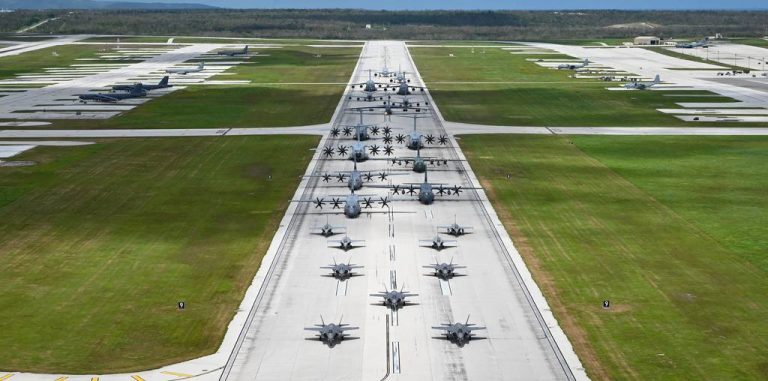
That’s why, for the first time, the U.S. Air Force’s massive biennial training exercise for airlift and aerial refueling brought together around 3,000 troops and 70 mobility aircraft, such as the C-130 and A400 airlifters and the KC-46 tanker, from the United States and six allies to the Pacific.
For two weeks in July, the training, known as Mobility Guardian, helped solidify the use of the so-called “Second Island Chain” — the string of archipelagos from Japan to the Mariana Islands to Indonesia — as a key logistics hub for the U.S. and its allies in a future war.
It was a test of several crucial questions: How quickly can the Air Force get there? What and who does it need to bring? And can the airmen do it all themselves?
The answers began more than 8,000 miles away in Charleston, South Carolina.
Royal Australian Air Force Cpl. Charlotte Roe, left, and U.S. Air Force Master Sgt. Jason Livingston, both C-17 loadmasters, watch other C-17s fly over the Commonwealth of the Northern Mariana Islands July 12 during Exercise Mobility Guardian 23. (Tech. Sgt. Sean Carnes/Air Force)
‘Back to the future’
On a scorching, muggy morning at Joint Base Charleston July 3, Air Force Times began an exclusive 10-day trip with Air Mobility Command to Andersen Air Force Base in Guam.
Airmen milled around the Installation Deployment Readiness Center, a one-stop shop for last-minute paperwork checks, briefings and vaccinations before shipping overseas.
They were preparing to deploy as the 437th Air Expeditionary Wing, the unit that would lead Mobility Guardian from a makeshift headquarters at Andersen. Their goal was to bring to life the Air Force’s vision of a speedier, more holistic approach to combat tours.
It marks a fundamental shift in how the Air Force thinks about fighting in the Pacific.
For the past two decades, the war on terrorism has relied on a stream of airmen who cycle through well-established bases around the world. Sometimes that requires deploying an entire squadron for one mission; other times, airmen are tapped piecemeal from different squadrons or bases to fill open jobs overseas.
Now airmen who work under the same wing at home will deploy together as one team, with a built-in air staff to manage missions and morale. Along with more predictable schedules and ample training, the Air Force hopes the new approach will lead to more capable expeditionary units that can function away from brick-and-mortar bases.
“[U.S. Central Command], quite frankly, has created some bad habits with how we employ our assets,” said Lt. Col. Jake Parker, Mobility Guardian’s lead planner. “We have a very robust infrastructure, and we got so reliant on that, that now we don’t have the ability to pivot from one place to the next.”
For 437th Operations Group commander Col. Carlos Berdecía, Mobility Guardian was a chance to tackle new challenges after the U.S. military’s tumultuous 2021 withdrawal from Afghanistan.
“Joint Base Charleston had a hangover from [Operation Allies Refuge], because we did so well. We were the last ones on the ground,” said Berdecía, a career C-17 Globemaster III pilot who served as expeditionary wing commander for the exercise. “There had to be something to say, ‘I need to focus on what’s next.’ ”
U.S. Air Force Col. Carlos Berdecía, who served as 437th Air Expeditionary Wing commander during the Mobility Guardian exercise, poses in front of the flightline at Andersen Air Force Base, Guam, July 18. (Airman 1st Class Caleb Parker/Air Force)
Revamping how the Air Force goes to war means reviving practices like deployment lines that fell by the wayside during the war on terrorism — and before today’s youngest airmen were born.
“It’s almost back to the future,” Berdecía said. “There’s some knowledge that hasn’t been retained. Breaking open [regulations] that haven’t been looked at, making sure we’re doing things by the book, is really important. That muscle memory isn’t necessarily there, so we’re trying to build that right now.”
Outside the deployment center, tan and olive luggage bound for Guam and Australia lined the parking lot and piled up on trucks; a staffer handed out first-aid supplies in the lobby.
Airmen filed inside for briefings on what lay ahead. Mobility Guardian is an opportunity to show the world what the U.S. and its allies can do, they were told, so take it seriously. Be respectful to locals as Guam recovers from Typhoon Mawar, the strongest storm to hit the U.S. territory since 2002.
And they were warned: Guam is a popular destination for Chinese intelligence officers, so be wary of strangers in bars and the questions they ask. For added protection, troops were told to turn off geolocation services on their devices for the duration of the exercise.
Then airmen headed down the hallway to a counter where administrators ensured their paperwork was in order, from survival training certificates to medical documents, and picked up printed deployment orders and dog tags.
Master Sgt. Justin Braden, a combat communications specialist, said it was a chance to interact with the airmen, soldiers and Marines who would rely on that equipment for their own training around the region.
“We’re supposed to go with generators and nothing, and set up initial comms,” Braden said aboard a C-17 Globemaster III as it prepared to leave Charleston for Australia. “We’re getting to do more of what we’re supposed to be doing … when you go on deployment.”
Airmen from Joint Base Charleston, S.C., work in a trailer at Andersen Air Force Base, Guam, July 18 as part of the 437th Air Expeditionary Wing’s air staff for the Mobility Guardian exercise. (Staff Sgt. Bailee Darbasie/Air Force)
Getting there
The exercise formally kicked off July 5 with one of its toughest challenges: rushing dozens of planes and thousands of airmen to the Pacific in record time.
Air Force leaders have said that deploying in a matter of hours or days by air, rather than weeks or months by sea, can deter Chinese and North Korean aggression in the region. It also gives commanders more options to respond if a crisis erupts.
“No one wants a conflict. We’re doing this to show our adversary that we want peace in [U.S. Indo-Pacific Command] and we can all exist here together,” said Lt. Col. Jason Walker, 61st Expeditionary Airlift Squadron commander. “But this is the line. … Do not cross it.”
The 8,100-mile trek from South Carolina to Guam starts with a 10-hour flight to Honolulu, plus another seven hours to the southernmost point in the North Pacific. Getting to Japan or Australia takes even longer.
For comparison, the journey is farther than Afghanistan, and the Pacific lacks the network of large, U.S.-run bases across Europe and the Middle East where airmen are used to stopping for sleep and equipment. And though Air Mobility Command regularly travels around the Pacific, those flights are scheduled farther in advance and with fewer planes at once.
The 628th Air Base Wing and 437th Airlift Wing from Joint Base Charleston, S.C., prepare to depart for Guam on a C-5 Galaxy July 5 as part of the Mobility Guardian exercise. (Tech. Sgt. James Cason/Air Force)
Walker said his airmen flew from Arkansas to Guam in 38 hours, and to the Philippines in 42 hours — a first for Little Rock Air Force Base’s C-130s, which fly lower and slower than larger cargo jets. One British airman boasted that the Royal Air Force was able to reach the Pacific in under 21 hours.
It was made possible by maintainers who stretched their limits and tackled last-minute problems; schedulers who navigated the puzzle of aircraft and crew availability, cargo and passengers, destinations and timing; and pilots who worked in shifts between naps in the back of the aircraft.
Still, crews faced plenty of hiccups. Some were turned away from Australia due to bureaucratic complications; others were slowed by weather, broken jets, disconnects when new crews weren’t ready to go, or small gas tanks that required frequent refueling.
C-17 maintainers from Travis AFB in California were stuck in Hawaii when their jet broke en route to Guam, said Master Sgt. David Moser, a Globemaster III maintenance superintendent. Another jet did reach Andersen, but airmen couldn’t offload their equipment or personal belongings because of confusion over biosecurity inspections. Then the team fell several hours behind schedule because jet fuel trucks were slow to arrive and carried less gas than those at Travis.
“It’s what Gen. Minihan wants … to see,” Moser said. “How do you work when you’re … stressed out?”
“We need to see how we fail when it fails, so that way, when real-world situations do arise … we can be more proactive,” he said.
For Mobility Guardian, the command allowed its crews to take stimulants like Modafinil or sleeping pills to control their circadian rhythm. “Go” and “no-go” pills are commonly used in the combat and intelligence communities but have remained off-limits for mobility pilots.
“A lot of the crews reported feeling better than expected when we got here,” said Walker, who said he opted for sleep and caffeine rather than drugs. “I wouldn’t do it again tomorrow. … But it definitely wasn’t as bad as we thought it would be.”
In the fight
On the ground in Guam, another experiment was unfolding.
The Air Force has long relied on the rest of the U.S. military to set up its bases of operations around the world. Now Air Mobility Command wants to become the service’s own “maneuver force” that opens airfields and launches flight operations.
For Mobility Guardian, that job fell to the 621st Contingency Response Group. The Air Force’s in-house rapid-reaction teams specialize in clearing the way for air operations and directing forces in austere locations.
A team of 88 contingency response airmen began arriving in Guam on July 3, where they marshaled themselves into the airfield and got to work building the exercise’s deployed headquarters on the far edge of the flightline at Andersen AFB.
Over the course of six days, the exercise’s footprint in Guam grew from 25 people and one aircraft to 1,100 people and 27 aircraft from seven countries.
First came satellite communications, so the contingency response team could talk to the aircraft that began arriving within hours. Then came a logistical hub where airmen could unload planes and prepare them for their next flights out.
The 437th Air Expeditionary Wing operated out of a makeshift camp of trailers, known as Forward Operating Base LFG, during the Mobility Guardian 2023 exercise at Andersen Air Force Base, Guam. (Tech. Sgt. James Cason/Air Force)
The site became known as Forward Operating Base LFG (“let’s f***ing go”) — a camp of about a dozen air-conditioned, generator-powered trailers arrayed around a small hangar filled with aeromedical evacuation supplies, airdrop cargo and towering stacks of water bottles. A black flag bearing a skull and crossbones fluttered overhead.
Contingency response handed off control of the base to the air expeditionary wing staff at noon on July 10 — 54 hours after Berdecía’s team landed in Guam.
That put the wing’s air staff in charge of ensuring life in the field ran smoothly: Procuring more than 650 roast beef sandwiches for boxed lunches. Ensuring dozens of port-a-potties were regularly serviced. Figuring out who, exactly, owned the fleet of 53 rental cars.
It was a smaller, more austere footprint than the Air Force had envisioned. Because of Typhoon Mawar, the Category 4 storm that hit Guam May 24, the Federal Emergency Management Agency had taken over an area at Guam’s international airport that the Air Force had planned to use. That brought more jets and airmen to Andersen, where leaders worried that the influx of people would strain already-struggling resources.
“It’s a very congested operation … a ballet of those elephants out there,” 621st Contingency Response Group commander Col. Daniel Mollis said.
Troops from Australia, Canada, France, Japan, New Zealand and the U.S. conduct mission planning during Mobility Guardian 23 at Andersen Air Force Base, Guam, July 9. Portions of this image were blurred for security reasons. (Tech. Sgt. Joseph Pick/Air Force)
Airmen charted each day’s planned missions on large whiteboards and handed out paper copies of their flight profiles — a way to navigate differences in each country’s security clearances and software that wouldn’t list non-U.S. flights.
Leaders tasked airmen with moving troops and equipment in support of other U.S. and allied exercises around the Pacific, like the U.S. Air Force’s Northern Edge. When not on real-world missions, they practiced skills like aeromedical evacuation.
Island-hopping in the Pacific offered the chance to practice refueling aircraft with gas pumps on the ground, and with engines running, to reduce reliance on tanker jets. The Air Force found there’s a greater demand for those operations across the joint force than expected, a spokesperson said after the exercise.
Airmen also practiced launching and landing airlifters at steep angles on unlit, short runways. Those “assault landings” can protect aircraft from incoming fire, and prevent them from damaging the plane by overshooting smaller-than-usual airstrips.
Pilots and crews flew missions on jets from other countries to learn from their foreign counterparts, and maintainers swapped tips on how to repair the airframes they have in common with their allies.
Airman 1st Class Trenton McGregor, a C-17 maintenance crew chief, said the exercise pushed his team to anticipate a jet’s needs before it returned to base, and to work more efficiently with fewer people and tools.
“You have to learn to adapt and … spread out between different people,” he said. “Guys that normally don’t do my job are having to do my job, and I’m having to go out and help these guys that I don’t know too much about. We’re all learning on the fly.”
A U.S. airman, left, and a U.S. Marine unload a UH-1Y helicopter from a C-5 Galaxy at Royal Australian Air Force Base Darwin July 13. The C-5 transported two Venom helicopters for Marine Rotational Force Darwin and Exercise Talisman Sabre, which Mobility Guardian participants helped receive and unload. (Airman 1st Class Stassney Davis/Air Force)
Unexpected emergencies tested the coalition, too.
On July 10, the U.S. Coast Guard called for help to save 11 people whose 21-foot boat was in danger of capsizing in rough waters off the coast of Rota in the Northern Mariana Islands, the U.S. Air Force said. Planners at Andersen dispatched French A400 and Canadian CC-130J airlifters to find and maintain contact with the boat until U.S. Navy rescue forces arrived.
Mobility Guardian participants also rescued a hiker who fell down a cliff, and transported a 10-day-old newborn with an enlarged heart from Yokota Air Base in Japan to the United States for emergency medical care.
Capt. Mike Thomas, who guided the exercise’s daily operations as the agnostic “white cell,” said the coalition planning cell did far better than expected at navigating the daily grind.
“The scariest thing that you can see as a mission commander or an air planner is if you walk into a mission planning cell and it’s quiet, because that means that nobody’s talking, nobody’s actually highlighting problems,” he said. “When we walked into the coalition mission planning cell, it was just humming.”
Coalition participants praised the chance to work through problems unlike those they faced with the U.S. in Afghanistan and Iraq.
“It’s funny when you’re working on each side of the [International Date Line], because sometimes we are [on] the 14th, but some guys are still [on] the 13th, and even when you’re trying to discuss in Zulu time, it’s Zulu on which day?” said Col. Franck Bottero, who led France’s delegation to the exercise. “We are using the same procedures, but considering the size and different spokes, I think it’s quite new for us.”
Airmen from multiple countries noted that the American penchant for process meant the U.S. planned missions more cautiously than others, forcing foreign airmen to move slower as well.
“The U.S. has a lot of very well-established systems and processes, which is very required for the large scale that the U.S. forces have. In Australia … some things can be more agile,” said Flight Lt. Peter Spearman, who led Royal Australian Air Force C-17 operations at Mobility Guardian. “That sometimes is useful, especially being able to change regulation when it is limiting us.”
Maj. Michael Bakke, with the 621st Mobility Support Operations Squadron, Joint Base McGuire-Dix-Lakehurst, N.J., prepares as a Japanese C-130 Hercules lands at Baker Landing Zone on Tinian, U.S. Commonwealth of the Northern Marianas, July 12 during Mobility Guardian. (Airman 1st Class Kadielle Shaw/Air Force)
In the coming months, the coalition will try to turn lessons learned into future fixes.
Mobility Guardian highlighted the need to work in smaller teams with enough tools to do the job if others take longer to arrive, to remove the red tape that keeps cargo on jets too long, to ensure all airmen are communicating using the same apps, and to invest in equipment like secure radios and the militarized version of SpaceX’s Starlink.
It has illustrated the frustrations of trying to navigate the Pacific’s many airfields and finicky weather, and the opportunities that arise from sharing airmen and jets.
And it showed airmen that even with a fraction of their team on the ground, demand for air mobility assets never lets up. Berdecía said the exercise proved the difficulty of starting from scratch, even with support from contingency response and the local base.
“We have proven that this concept works,” he said. “We will continue gathering lessons learned, as small as they can be all the way to as large as they can be, and adjust for the next Mobility Guardian and/or real contingency that would call for this type of structure.”
There’s plenty that isn’t ready for primetime yet. But Mobility Guardian showcased what could be: A more self-reliant, swift-moving international air coalition in even the remotest places.
A U.S. Army cavalry squadron, freshly arrived from Hawaii, loitered at the edge of camp on July 13. An airman nodded in their direction.
“The Army’s here now,” he told Berdecía.
Berdecía smiled back. “And look who got them here.”
Rachel Cohen joined Air Force Times as senior reporter in March 2021. Her work has appeared in Air Force Magazine, Inside Defense, Inside Health Policy, the Frederick News-Post (Md.), the Washington Post, and others.