Ukrainian pilots will learn to fly F-16s at US Air Force’s 162nd Wing

0

WASHINGTON — The U.S. will begin training Ukrainian F-16 pilots within two months, Pentagon Press Secretary Brig. Gen. Pat Ryder said in a briefing Thursday.

While he didn’t give specific numbers, he said there would be “several” pilots and “dozens” of maintainers trained. This follows comments earlier in the week that the U.S. would participate in the process only if the Netherlands and Denmark — who are leading the transfer of planes — reached capacity.

“We know that as the Danes and the Dutch prepare to train those pilots that at a certain point in time in the future, capacity will be reached,” Ryder said.

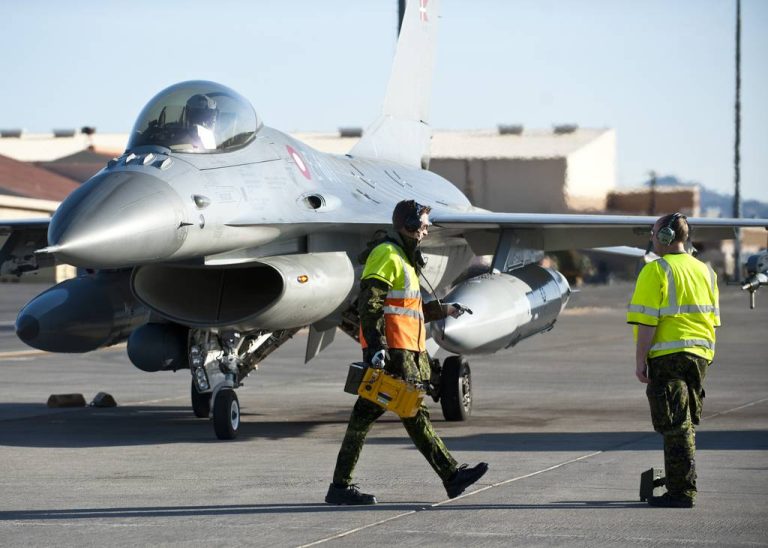
The training will begin in October at Morris Air National Guard Base in Tucson, Arizona, and will be conducted by the Air National Guard’s 162nd Wing, Ryder said. In September, the pilots will first receive English language training tailored to the training at Lackland Air Force Base in San Antonio, Texas.

Details on the curriculum, including its speed and the kind of training that will be offered, are still uncertain, Ryder said. They partially will depend on the experience level of the Ukrainian pilots.

The 162nd Wing carries out international F-16 pilot training and has trained pilots from 25 countries to fly the fourth-generation fighter, the Air Force said in a fact sheet. Morris Air National Guard Base sits next to the Tucson International Airport and uses some of the airport’s facilities such as its runway.

The wing has three squadrons that fly its F-16 Fighting Falcons, as well as maintenance squadrons to keep the fighters in the air and other units.

An Air Force official said in a Thursday email that pilots without prior flight experience could learn to fly the F-16 in about eight months, as part of the service’s standard F-16 basic qualification course.

Pilots who have previous experience flying other fighters can learn to fly the F-16 in about five months under the Air Force’s transition qualification track, the official said.

The F-16, versions of which have been flown by the Air Force for more than 40 years, can carry weapons such as the AIM-9 Sidewinder air-to-air missile and AIM-120 advanced medium range air-to-air missile, or AMRAAM. It can fly of speeds up to Mach 2, and has a total range of about 2,000 miles, according to the Air Force’s website.

In total, up to 61 Dutch and Danish F-16s could eventually be transferred to Ukraine. The Netherlands have 42 available, according to Prime Minister Mark Rutte.

Denmark said Aug. 20 it would send 19 F-16s to Ukraine. Because the planes are an American system, they first need to be approved by the State Department — a process Secretary of State Antony Blinken said would be expedited.

The Danish military announced Aug. 20 that it had started training eight Ukrainian pilots to fly F-16s as part of this effort, and that another 65 service members will be trained to maintain the fighters and provide other support. Those Ukrainians have already arrived at Skrydstrup Air Base in Denmark, the nation said.

Other countries in Europe, including Greece and Norway, will also contribute, either training pilots or donating fighters.

“Our F-16 coalition is proving its efficiency,” Zelenskyy wrote on X, formerly Twitter, on Monday.

Today’s announcement is the latest milemarker in the effort to deliver the fighters to Ukraine, which has been asking for them for more than a year. Initially, the administration declined. Yet, as with so many other systems eventually sent to Kyiv during the war, that stance eventually changed.

“We could certainly have started earlier, but there were much higher priorities,” Air Force Secretary Frank Kendall said in May.

The fighters may be a symbolic victory for Ukraine. But they won’t aid its slogging counteroffensive, which has so far failed to puncture dug-in Russian defensive lines. The fighters aren’t expected to arrive until mid-to-late 2024, and air defenses on both sides of the war still threaten anything flying.

Instead, the aircraft are part of a long game to improve Ukraine’s self-defense. The focus now is on supplying the planes and training personnel, but Kyiv will also need improved airfields and ground equipment to keep operating them once delivered, Ryder said.

“We’re talking months, not weeks, obviously. And as we said from the very beginning in May, this is about the long term support to Ukraine,” Ryder said.

Noah Robertson is the Pentagon reporter at Defense News. He previously covered national security for the Christian Science Monitor. He holds a bachelor’s degree in English and government from the College of William & Mary in his hometown of Williamsburg, Virginia.

Stephen Losey is the air warfare reporter for Defense News. He previously covered leadership and personnel issues at Air Force Times, and the Pentagon, special operations and air warfare at Military.com. He has traveled to the Middle East to cover U.S. Air Force operations.

Fishing on Lake of the Woods when he hooked a wallet.

0

With all the crap going on it is great to see an incredibly great person.
This is what makes America Great.

BTW, if you ever have a chance to fish Lake Of The Woods, take it :5s:
……………………………………………………..
He also gave Connor a compliment worth more than the money found at the bottom of the lake.

“I would take Connor for a grandson any day and I would fight for him any day,” he said.
Check out the video..
14-year-old hooks wallet holding $2,000 while fishing

Days away from the beginning of his freshman year at Moorhead High School, 14-year old Connor Halsa had the best summer vacation that ended with the discovery of a treasure while fishing.
He was fishing with his family on Lake of the Woods when he hooked a wallet.
“I thought I had a big fish, and I set the hook really hard,” he said.
Inside the billfold was money.
“My cousin Brandon, he opened the wallet up and he … said some words that you probably shouldn’t say and then he said there was some money in it and he showed everyone and then we took the money out and placed it all on the dashboard to let it dry off,” Connor said.
There was a total of $2,000 inside the wallet.

“My dad said we should give it to the person, so I told him we should, too,” Connor said.


Vivek Ramaswamy for POTUS!

0

Have you Monkey's been watching this guy? I don't know if he can win, but BOY, if he does, things are going to turn around BIG TIME! I don't think the Neocons will allow him to win, but then Trump won, so there might be hope!
If you haven't seen this guy, you really should give him a listen and make up your own mind!

And my Guy, Sean Ryan!

I wish Sean would take a little more time to prepare his questions and ask them in…

Vivek Ramaswamy for POTUS!

The Boy Who Died Hugging His Dog – Maui Fire

0

I. AM. PISSED!!

Biden Cares About Maui, Tell That to the Boy Who Died Hugging His Dog

Biden Cares About Maui, Tell That to the Boy Who Died Hugging His Dog
By
M Dowling
–
August 21, 2023
10

Lahaina destroyed by fire and incompetence.

Joe Biden took some time off for his vacations with billionaires like climate extremist Tom Steyer to visit Maui.

The disaster in Maui was made worse by the incompetence of Hawaiian officials. Even worse was Joe Biden’s uncaring response to it. Over 114 people have died, and much of the history of Maui was destroyed. Four museums were lost.

Biden Really Cares
The Biden administration wants us to believe they have been with people in Maui since Day One. It’s sickening to constantly hear how Joe cares about America as he turns his back on us.

THE MEDIA FINALLY COVERS THE DEATHS

The media is finally covering the deaths. They have tried to cover it up to protect Biden and Hawaiian Democrats.

More than 100 people were killed in the Lahaina wildfire, and hundreds more remain missing – and it’s “possible” that many of the victims are children who were at home while schools were closed, Hawaii Gov. Josh Green told “Face the Nation” on Sunday.

Hawaii officials said on Monday that 850 people are still missing on Maui in the wake of wildfires that destroyed historic Lahaina and other areas. So far, just 27 of the 114 confirmed victims have been identified.

School was out and people fear many of the deceased are children.

The boy who dies hugging his dead dog
Stories have started pouring in of children who were lost in the flames.

Teenager Keyiro Fuentes was enjoying his last day of summer vacation hanging out at his Lahaina home when the fire swept through. His adoptive mother, Luz Vargas, was working five miles away.

She and her husband tried to get home to Fuentes as soon as they learned of the fire, but got stuck in traffic. When she got out of the car to run to the house, she faced a police barricade. Later, after running past officers, first responders told her the area had been cleared and no one was there.

When they were finally allowed to go to their house two days later, they found the body of their 14-year-old son, hugging the family’s dead dog. He was just days away from celebrating his 15th birthday.

I’m sorry, but this is criminal.

As we said, the incompetence is horrifying.

[​IMG]
Coast Guard Station August 8 2023
If it wasn’t for the intense pressure on him, it’s doubtful Biden would have gone to Maui.

He asked for another forty billion dollars for Ukraine, and in the way of comparison, he will give $700 to each Maui resident.

The residents want help, not Joe Biden.

Residents of Maui don’t believe it. [Biden doesn’t care about anything or anyone.]

You’re Too Late, Joe

Related
Joe Heads for Lake Tahoe and Help for Maui Is Still Not on the WayAugust 18, 2023In “Home”

The Maui Fires That Aren’t Caused by Climate ChangeAugust 12, 2023In “Home”

Biden’s at the Beach and Maui Can’t Get Enough HelpAugust 14, 2023In “Home”

Previous articleMitt Romney Might Not Run Again But Mitch Wants Him to run
Next articleOh, Look, Insurrectionist Yevgeny Prigozhin Is Alive and Well

5
Article Rating

Subscribe

[​IMG]

10 Comments

Newest
[​IMG]
Guest
miguel
1 day ago

Diaper will soon know what fire, heat and a lost soul feels like. He’s gonna burn for all of eternity.

2
Reply

[​IMG]
Guest
ALfromNY
1 day ago

Aside from FakePresidentRealCrook SenileJoeBiden’s belated visit, one must take note of the incompetence of the local officials, who were elected by the citizens of this very blue state, not for their brilliance, but because of their ‘diversity.’ Well, when ‘diversity’ Trumps competence, there are real consequences!

9
Reply

[​IMG]
Guest
Vigil
1 day ago

Joe Biden comes to Maui only to remind all Hawaiians to be sorrowful for the death of his son Beau Biden who Joe thinks died due to a burn pit in Iraq.

14
Reply

[​IMG]
Guest
morton
1 day ago

Reply to Vigil
I’m surprised Diaper doesn’t bring with him a cardboard cutout of Beau. After all, Beau is nothing more than a prop for this pos.

2
Reply

[​IMG]
Guest
Mike S
1 day ago

President Biden’s response, or lack of, is shameful. President Obama is also AWOL.

15
Reply

[​IMG]
Guest
MICHAEL DAY
1 day ago

BOTH POOLITCAL BANDITS are in FOOL CON-TROLL
and can steal any election any where they can call a State of democracy in any state of the old republic
MOB RULE until
THE SHEEP GROW A TEETH
And THE DOGS OF WAR
WTFU

10
Reply

[​IMG]
Guest
8675310
1 day ago

This is not incompetence. Watch the first video.
JUST IN: Unbelievable videos out of Hawaii… and drone footage that is IMPOSSIBLE in a fire…. no? – Whatfinger News Summary

3
Reply

[​IMG]
Guest
M Aurelius
1 day ago

Criminal grifter Pedo Joe is protected by the fully corrupt criminal Deep State.
When you can steal elections, you don’t have to concern yourself with
the little people of Maui. Besides, you can’t launder $billions through Hawaii.
FJB.

9
Reply

[​IMG]
Guest
Dave Huff
1 day ago

Fuck Joe Biden!

13
Reply

[​IMG]
Guest
lalasayswhat
1 day ago

They will still vote for Biden next election. That’s the liberal way. Disasters happen to other people and they don’t care until it happens to them. Then they get outraged. By next election they will all be back in lock step and vote democrat.

11
Reply

[​IMG]

[​IMG]Fast clip: 14 Year Old Girl HUMILIATES WOKE Liberal School Board….
[​IMG]Vivek SHUTS DOWN Jim Acosta during heated exchange!!…
[​IMG]Bongino Goes Dark Mode After Biden’s Grotesque Hawaii Speech…
[​IMG]News Junkie Paradise – Whatfinger – More news daily than any other site! BAM!
Trending Posts

Comments
We have a multi-language translator on the top left. If you don’t see your language, email [email protected] – we will add it.

Periodically, we must employ comment moderation due to an influx of spammers. It’s only temporary and has nothing to do with the content of the comments.

Whatfinger


Who likes crab?

0

I still help to take care of my mom (101) a few days a week. Made her crab omelette with fruit on the side. This was mine. Hers was smaller, only one egg.

Brazil to double air fleet as part of $10.6 billion investment

0

SAO PAULO — Brazil plans to invest 52.8 billion reals (U.S. $10.6 billion) for research, development and equipment acquisition efforts for its military, including nearly doubling the size of its Gripen fighter fleet and financing projects by local aircraft manufacturer Embraer for aerial refueling planes, the government announced earlier this month.

The measure, revealed Aug. 11, is part of the government’s Growth Acceleration Program, or PAC, established by President Luiz Inácio Lula da Silva. PAC guided programs during his first two terms in office, which lasted from 2002 to 2010, and there are now plans for the overarching initiative to spend 1.7 trillion reals, with defense a key area of focus.

“Equipping the Armed Forces with cutting-edge technologies, enhancing national defense capability, and border monitoring are some of the guidelines of the New PAC,” according to a government website.

The government intends to invest 27.8 billion reals by 2026, and an additional 25 billion reals after that period, without a specific deadline.

The PAC does not require the legislature’s approval, as it is a federal investment program funded by government resources, state contributions and the private sector through concessions.

However, there are some obstacles, such as bureaucratic processes and legal uncertainties for public works. Regarding defense, which will rely almost exclusively on public funds, the government might face financial challenges, according to Cristiano Noronha, the vice president of Arko Advice, a consultancy firm in Brazil’s capital Brasília focused on intelligence and political analysis.

“The executive [branch] has often made budget cuts over the years. The investments will depend on the government’s fiscal capacity, spending control and economic growth,” he told Defense News, adding that the program could be seen as an “expression of intent.”

For the Brazilian Air Force, the plan involves the production and acquisition of 34 F-39 Gripen fighters, which would almost double the country’s fleet. Brazil signed a $5.04 billion contract with Swedish manufacturer Saab in 2014 for the purchase of 36 Gripen fighters, for delivery by 2027. In 2022, the signatories added four more fighters to the contract.

Of the 40 now on order, Brazil has received six, with four in operation. The contract stipulated that assembly for 15 F-39E Gripens would take place at Embraer’s factory in Gavião Peixoto in the state of São Paulo. The deal also included a technology sharing agreement between Brazilian engineers and Saab. The fighter production line was inaugurated in May 2023.

“The renewal of the fighter aviation [fleet] is one of the main projects of the Brazilian Air Force covered in the new PAC, and is being realized through the acquisition of the Gripen fighter,” Defense Minister José Mucio Monteiro Filho told Defense News. “It is the most modern combat aircraft in Latin America, enabling Brazil to significantly enhance its air defense capability in line with the country’s continental dimensions.”

The minister also pointed to another program under PAC: the purchase of nine C-390 Millennium planes — initially known as KC-390 — produced by Embraer, along with the development of a refueling version of the model.

“Besides its military role, the KC-390 can be used in national and international humanitarian aid actions, such as supporting public emergencies and firefighting,” he said.

The government website also mentioned plans to convert two Airbus A330 aircraft into aeromedical and aerial refueling planes.

Pedro Pligher is a Latin America correspondent for Defense News. He has reported on politics, economics and the Brazilian small arms industry.

Lockheed, Pratt win $1 billion in Navy deals for F-35 parts, equipment

0

WASHINGTON — The Navy this week awarded Lockheed Martin and Pratt & Whitney more than $1 billion in contracts to buy parts and equipment for the F-35 Joint Strike Fighter.

On Monday, the Pentagon announced Lockheed received a $347 million firm fixed price modification to a previously awarded contract to procure F-35 helmet mounted display systems for the Navy, Marine Corps and Air Force.

And on Tuesday, the Navy awarded Lockheed another modification to a previously awarded contract, worth up to $607 million, to buy long-lead time materials, parts and components to build 173 F-35s for foreign military sales customers and non-U.S. Defense Department participants.

The Pentagon on Monday also announced Pratt & Whitney, a subsidiary of RTX — which was formerly known as Raytheon — had received a more than $59 million contract modification to procure advanced long-lead time hardware for the F-35′s F135 engines. This contract will support all U.S. services flying the F-35, as well as FMS customers and non-U.S. DoD participants.

The Pentagon’s announcement on the helmet contract said Lockheed will carry out the work in Fort Worth, Texas, where Lockheed runs its main F-35 factory, and is expected to be done by December 2026.

Most of Lockheed’s work on the long-lead items for the F-35, or 59%, will also be carried out in Fort Worth, the Pentagon said. Other work will be performed in El Segundo, California; Warton, United Kingdom; Cameri, Italy; and other locations. Work on these long-lead items is expected to be done in January 2028.

And Pratt will conduct its work on the F135 engine parts in East Hartford, Connecticut; Indianapolis, Indiana; Minneapolis, Minnesota, and other locations. More than a quarter of the work will be performed at various locations outside the continental U.S.

Lockheed’s long-lead item contract includes nearly $330 million from FMS customer funds, and more than $277 million in non-U.S. DoD participant funds.

Naval Air Systems Command in Patuxent River, Maryland, is the contracting authority for all three deals.

Stephen Losey is the air warfare reporter for Defense News. He previously covered leadership and personnel issues at Air Force Times, and the Pentagon, special operations and air warfare at Military.com. He has traveled to the Middle East to cover U.S. Air Force operations.

Indonesia to buy Boeing’s F-15 jets, Lockheed’s Black Hawk helicopters

0

MELBOURNE, Australia — Indonesia has committed to buying Boeing-made F-15 Eagle fighter jets and Sikorsky-made Black hawk helicopters.

Air Vice Marshal Yusuf Jauhari, who leads the Defense Facilities Agency within Indonesia’s Defense Ministry, and Mark Sears, who serves as Boeing’s vice president and program manager for fighters, signed a memorandum of understanding on Aug. 21 confirming plans to purchase 24 F-15s. The event took place at Boeing’s St. Louis, Missouri, during a visit by Indonesian Defense Minister Prabowo Subianto.

Indonesia’s F-15s will be known as the F-15IDN jets and will be a version of the F-15EX, currently on order by the U.S. Air Force. Boeing touts the F-15EX as the most advanced version of the F-15 ever built, with digital fly-by-wire flight controls, a new electronic warfare system, an all-glass digital cockpit, and the latest mission systems and software capabilities.

“We are pleased to announce our commitment to procure the critical F-15EX fighter capability for Indonesia,” Subianto said in a statement on Boeing’s website. “This state-of-the-art fighter will protect and secure our nation with its advanced capabilities.”

The memorandum does not serve as a finalized contract, and the sale is still subject to U.S. government approval.

Meanwhile, Indonesia’s Defense Ministry announced Aug. 23 that the state-owned aerospace company PT Dirgantara Indonesia and the American firm Lockheed Martin signed an agreement related to the S-70M Black Hawk transport helicopter. Sikorsky is a subsidiary of Lockheed.

The agreement will see Indonesia acquire 24 S-70Ms, and PT Dirgantara Indonesia undertake the sustainment and manufacturing of helicopter components.

Indonesia has an ongoing need for new combat aircraft as it seeks to better defend the airspace of its estimated 18,000 islands that stretch from the west of Singapore to the western half of New Guinea. Indonesia already has a contract to buy 24 French-made Dassault Rafale fighters, and is seeking 18 more. The Air Force also cut a deal to acquire 12 Dassault Mirage 2000-5 jets from Qatar as a stopgap measure.

The service is currently operating 33 Lockheed-made F-16s alongside 16 Russian Sukhoi Su-27/30 Flankers as its primary combat fleet, making up 3 different squadrons. This is far short of the Air Force’s minimum essential force of 10 fighter squadrons originally planned for 2024.

Mike Yeo is the Asia correspondent for Defense News.

How Wood Selection Impacts The Success Of Your Campfire

0

Fire, often hailed as one of humanity’s most significant breakthroughs, likely came into the awareness of ancient people through natural events like brushfires or nearby lightning strikes. The art of creating and controlling fire marked a pivotal moment in human history, ushering in a host of advantages that greatly improved early human existence.

With the newfound ability to manage fire, our ancestors gained the power to cook their meals, offering protection against the dangers of food-borne parasites and harmful bacteria. It also extended their days by providing light in their camps, effectively deterring potential threats from lurking predators. Moreover, fire became a crucial ally in facing the challenges of harsh winter climates, offering essential warmth for survival.

Remarkably, these age-old benefits have endured for millennia, as today’s humans still gather around the gentle flicker of firelight. They use it to prepare food and ensure their comfort and safety, underscoring the enduring legacy of this timeless discovery.

Understanding fire essentials

Fire, despite its immense power and its timeless appeal for human comfort, is fundamentally uncomplicated. Our ancient ancestors made a profound discovery: you only need three elements to ignite a fire – fuel, air, and heat.

Oxygen and a heat source are readily available. The air surrounds us, always at the ready. Any prepared individual should be equipped to start a fire; whether it’s with lighters, matches, or even a parabolic mirror, there are numerous methods to generate that crucial spark. It’s wise never to be without at least two of these tools.

However, the key to a successful fire ultimately hinges on the quality of your fuel. The better the fuel, the more impressive the fire. In dire situations, you can burn almost anything, but there’s something primal about a roaring wood-burning fire that connects you with your cave-dwelling ancestors, invoking a deep, instinctual connection to our past.

The science behind wood burning

Wood, harvested from trees, holds a top spot as a fuel source for several compelling reasons. It’s abundant in nature, budget-friendly in our civilized world (especially when compared to liquid or gas fuels), and it allows for easy fire control. But have you ever wondered why wood burns?

In reality, wood doesn’t directly burn; rather, it undergoes an indirect combustion process. When wood is exposed to heat, it releases gases. These gases are what actually ignite when they react with oxygen. This straightforward reaction is why wood is such a dependable fuel source.

To break it down, a wood fire is essentially a chemical reaction. When a piece of wood encounters a heat source while in the presence of oxygen, its molecular structure undergoes oxidation. This chemical reaction is exothermic, meaning it releases energy in the form of heat and light. It’s akin to a spark igniting a fuel source, causing the molecules within the wood to heat up and disperse, forming a gas. These gas molecules then merge with oxygen from the air, commencing the burning process. This sequence of chemical reactions is what we commonly refer to as fire.

As time passes, the gaseous fuel gets consumed, leaving behind charred wood. While charred wood can still burn, it doesn’t produce flames. Instead, it transforms into a glowing, red region, gradually turning the wood into a layer of white ash. But here’s the interesting part: this ash layer, when it thickens, obstructs the flow of oxygen essential for the fire to thrive. When this happens, poking at the wood or using a fan can be quite effective.

These actions disrupt the ash barrier, allowing fresh air to reach the burning wood’s surface. This influx of oxygen revives the flames by heating up new sections of wood, which in turn release more gas and restart the fiery spectacle.

How wood reacts to heat

Understanding how wood responds to heat is key to building a successful fire. Here are the important factors at play:

  1. Moisture Content: Wet wood is challenging to ignite because it acts like a heat sink. When heated, the water within the wood absorbs and consumes heat energy, particularly during the vaporization process. Additionally, moisture increases the material’s thermal inertia, making ignition more difficult.
  2. Thickness: The thickness of the wood plays a role in its ignition. Thin pieces of wood ignite more quickly than thick logs. When heat is applied to one side of a thin piece, the opposite side heats up rapidly, approaching the temperature of the first side by the time ignition occurs. Conversely, with thick wood, the opposite side remains at ambient temperature when the wood ignites.
  3. Heat Intensity and Form: External factors like the intensity of heat exposure and its form of effect, such as the distance of flames from the wood surface, influence ignition. The closer the flames are to the wood, the quicker it may ignite.

What wood burns best?

The ideal wood for burning varies from person to person and depends on individual circumstances, including location and expected weather or conditions. Here are some considerations:

  1. Hardwood vs. Softwood: Hardwood, characterized by denser wood fibers, tends to be heavier than softwood, which has fibers that are more spaced out. Softwoods like pine and birch ignite more easily, while hardwoods like teak and walnut burn hotter and for a longer duration.
  2. Seasoned Wood: When in a survival situation, opt for dry sticks and logs that have been lying on the ground for a while. Seasoned wood typically appears gray and lacks moisture, making it easier to ignite and resulting in a cleaner burn.

Ultimately, the best wood choice depends on your specific needs and conditions, so it’s essential to assess your situation carefully.

banner 728x901lw

Different types of wood and how they burn

When it comes to wood for your fire, the type you choose can greatly impact your experience. Here’s a breakdown of various wood types and their burning characteristics:

American Beech: Found east of the Mississippi, American Beech is dense and perfect for chilly nights. It burns hot and clean with minimal sparks.

American Elm: This tree ranges across the eastern United States and, often due to Dutch elm disease, you can find dead elm trees for firewood. Ensure it’s dry before burning as it produces a medium-hot fire.

Apple: Apple wood, known for its density, burns slowly, making it a long-lasting choice. It also adds a delightful fragrance to your fire.

Ash: White ash, found in eastern and central North America, burns well when seasoned and can even burn when green. It provides a steady, reliable fire and is a popular choice due to its ease of splitting.

Birch: As a softwood, birch ignites quickly but burns rapidly, meaning you’ll need more of it in the long run. It’s found in temperate or boreal climates in northern North America, but it needs time to season and should be burned in smaller pieces.

Black Locust: Native to the southeastern U.S., black locust is dense and burns for a long time, but it can be challenging to find.

Cedar: Various types of cedar grow across the United States. They produce low heat but burn easily and work well for kindling. Beware, though, as cedar wood tends to pop and spark.

Cherry: Common in the central and eastern United States, cherry hardwood burns slowly and produces a pleasant aroma. However, it can spark when burning.

Cottonwood: Eastern cottonwood grows on the East Coast, and the Fremont cottonwood is popular in the Southwest. Cottonwood fires provide low heat, but the wood burns quickly when dry.

Eucalyptus: Mainly found on the West Coast since its arrival from Australia, eucalyptus wood produces an extremely hot fire. However, dry eucalyptus can be challenging to split.

Hickory: A popular choice in the United States, hickory is dense and heavy, making it an excellent option for a long-lasting fire, although it can be difficult to light.

Ironwood: Known for its density and heat production, ironwood is found in the American Southwest. It may burn too hot for smaller spaces.

Maple: Found throughout North America, maple is a dense and durable hardwood that burns hot and long, making it a practical and readily available choice.

Oak: Oak trees are abundant across North America, but the wood must be well-seasoned before burning. They offer great heat and a long-burning experience.

Pine: Pine is an excellent fire starter due to its softwood nature, making it easy to ignite. It also adds a pleasant aroma to your fire.

Walnut: Walnut, particularly black walnut, is native to eastern North America. This dense hardwood burns slowly, emits minimal smoke, and requires less frequent replenishing.

Yew: Found on the West Coast from Alaska to California, yew is an excellent option for firewood, offering high heat and an extended burn time. Plus, it has a pleasant scent.

Choosing the right wood for your fire can enhance your outdoor experience, so consider your options based on your needs and what’s available in your area.

Why Does Fire Produce Smoke?

why does fire produce smoke

Fire and smoke are intricately linked. When we burn solid fuels like wood and natural materials, achieving the perfect balance of fuel, oxygen, and heat can be challenging, often resulting in the production of smoke. Here’s why:

  1. Insufficient Oxygen: In some cases, like campfires built directly on the ground, it’s tough for the fire to receive enough oxygen for complete combustion. This deficiency causes the wood to burn incompletely, leaving unburned fuel.
  2. Air Movement: Even the movement of air over the fire can disrupt the conditions needed for a strong, smoke-free flame. Such disturbances can reduce the necessary heat and oxygen supply, leading to the generation of smoke.
  3. Ash Formation: As the fire progresses, coals can ash over, further choking the fire and adding to the smoke production.

This combination of unburned fuel, particulates, ash, carbon monoxide, and nitrogen oxides constitutes the components of smoke.

Gathering wood for your campfire

When building a campfire, it’s crucial to gather the right types of wood to ensure your fire burns efficiently. These woods fall into four main categories:

Tinder: This is the initial fuel, often soft, light, and easy to ignite. It includes materials like cotton balls, dry grass, pine needles, cattail fluff, and birch tree bark.

Kindling: Kindling consists of small twigs, usually thinner than the diameter of a pencil. It keeps the fire going after the tinder has ignited. Cedar bark, dry leaves, and small twigs are excellent examples.

Sticks: These are slightly larger limbs, about the diameter of your thumb (approximately an inch). They sustain the fire once the tinder and kindling have burned off.

Firewood: To maintain a robust and long-lasting fire, you’ll need larger pieces of wood, typically around 3 or 4 inches in diameter.

Building a campfire

Starting a fire involves the gradual use of each fuel group. Begin with tinder and kindling, then move up in size to sticks and finally firewood. It’s essential not to overload the fire with too much fuel all at once. Fires require oxygen to burn, so ensure there’s enough airflow by leaving spaces between the wood. Balancing fuel, heat, and air is crucial; an excess or lack of any of these elements can extinguish the fire.

Campfire construction

bannerlost4

Different campfires serve various purposes – from warmth to cooking to providing light or signaling. Specific fire lays or arrangements are designed for each situation:

Dakota Hole Fire:

Purpose: Concealed and low-visibility fire.

Construction: A small fire sits below ground level with a secondary hole connecting to the main fire via a tunnel, funneling air to the base.

Lean-To Fire:

Purpose: Provides a sustained source of light and heat.

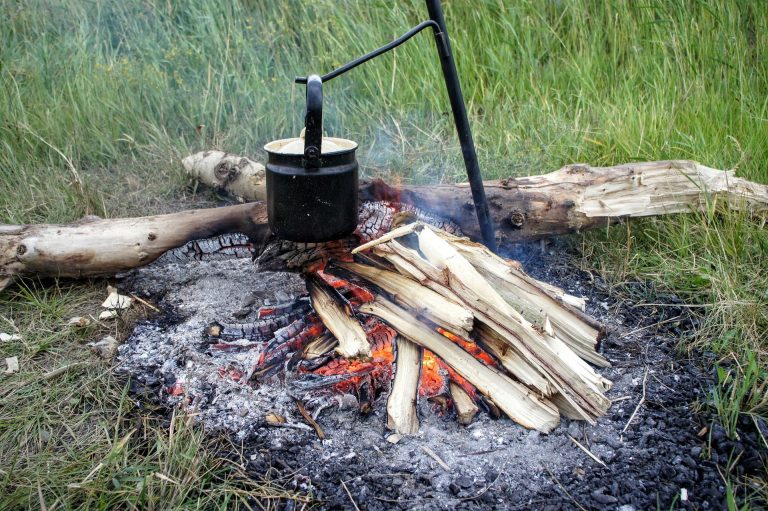
Construction: Place a long, thick log or a row of large logs horizontally on the ground as the “backbone” of your fire. Lean smaller pieces of firewood at an angle against this backbone, forming a lean-to structure. Start your fire at the open end, and it will burn gradually along the structure, providing a long-lasting flame.

Teepee Fire:

Purpose: Ideal for quick warmth and cooking.

Construction: Arrange kindling and smaller sticks in a teepee-like shape, leaving an opening on one side for air to flow in. Place your tinder in the center. As the fire starts, the teepee structure collapses inward, feeding the fire with larger sticks and logs. This layout encourages good airflow and a fast, intense fire.

Star Fire:

Purpose: Great for providing light in all directions.

Construction: Arrange larger logs or rocks in a star or wheel shape, leaving a central space. Place your tinder and kindling in the center. As the fire burns, it radiates heat and light in multiple directions, making it suitable for group settings.

Pyramid Fire:

Purpose: Effective for cooking or boiling water.

Construction: Stack logs or large sticks in a pyramid shape, leaving an opening at the top. Start your fire within this central chamber. The flames converge upward, focusing heat for cooking purposes.

Suggested resources for preppers:

A few unusual fire starters to get a campfire going

The #1 food of Americans during the Great Depression

Tips for starting a fire in any conditions

If you see this plant when foraging, don’t touch it!