To avoid chaos in an emergency, plan ahead of time for potential scenarios so you can make an informed and realistic decision about your destination. This is obviously a serious decision, and it is dependent on a number of factors.
Anyone of us may be forced to bug out
The scenarios below demonstrate this point.
Hurricane Ian was expected to hit the community where close friends of ours, Andrew and his wife Johana, lived within the next 48 hours. They had packed suitcases with clothing, money, food, and medication in case they needed to evacuate.
What they hadn’t anticipated were their two teenage nieces who were spending time with them since their parents were overseas. If they had to evacuate, their small car couldn’t handle four people, plus their bug-out supplies. If necessary, they would have to shelter in place unless they could get a larger vehicle before they had to leave.
Civil unrest, which my brother-in-law had feared, had become a reality in the city he’d called home for 17 years. The combination of racial tension, political unrest, and looters exploiting daily protests and confrontations had turned the streets into chaos.
The worst part was that this was happening in urban areas all along the Northeastern seaboard, so going to a hotel or a friend’s house in another city was out of the question. He’d have to relocate to a more rural area or even to the wilderness area where he hunted every year.
Why location is important
Choosing where to bug out is not something you do right before fleeing a dangerous situation. You should have thought about it long before you had to make that decision, and you should consider all of the possible outcomes.
Typical scenarios include the following:
Natural disasters, such as earthquakes, storms, hurricanes, or fires, can render your home uninhabitable or disrupt the availability of resources such as food and fuel.
Loss of infrastructure, such as power plants, rails, roads, and air travel, can have an impact on businesses and resource availability.
Nuclear disasters can endanger entire regions. Terrorist activities cause panic, and civil unrest makes going out or working dangerous.
You may have a single bug-out location that you use for all of these situations, but you can reduce the risks and inconvenience of bugging out by selecting different locations based on the type of danger you’re facing.
There are numerous options for bug-out locations, such as purchasing land and constructing a fortified backcountry retreat or investing in a disaster condo. Some more realistic options are as follows:
Staying with relatives in the area or a few states away.
A motel or hotel in or out of state, depending on the size of the disaster area.
Local governments established refugee shelters.
 A vacation home, if you have one, or renting a vacation home in a secure location.
A retreat in the country or camping in a state or national forest or park.
Consider the following questions when deciding where your bug-out location would be for each of the scenarios you believe you might face.
What type of emergency are you facing?
Who is involved, and how many people you have to take with you?
How much time do you have before you need to leave?
How long will you be away?
How far from the danger do you need to go?
Can you cover the distance to reach your bug-out location with your current means of transportation?
Is it safe to bug out, or should you stay?
Also, remember that bugging out does not automatically make you a refugee or a survivalist, and your daily activity doesn’t need to stop. You can still go to work if your job is located in a safe region, and you can get there from whatever bug-out location you choose.
If your bug-out location is close to the resources you require, such as food and fuel, you can still shop for what you require while away from home rather than relying on the supplies you brought with you.
Always have a plan

Once you’ve decided on your bug-out location (or locations), you must consider how you’ll get there.
Because each location will have its own set of challenges and strengths, your plan should, at the very least, address the following questions:
What type of transportation will you use to get there? What will you do if your primary choice is unavailable?
How will you get everyone together if you’re traveling with others? Will everyone congregate in one place? Will you pick them up at various locations? How are you going to inform everyone that you’re bugging out?
What do you have to bring for each scenario? Is it just clothing, or do you also require food, water, and medical supplies? The length of time and resources available at your bug-out location will tell you what to take.
What route do you need to follow to get to your bug-out location? You must be prepared for delays or roadblocks along your primary route; therefore, when and where can you exit your primary route and take a secondary route?
How will you learn about potential roadblocks? Do you have an emergency radio, a police scanner for traffic monitoring, or a smartphone that can display traffic congestion?
Does anyone that comes along have special needs, such as medication, wheelchair use, or the inability to walk or stand for more than an hour or two? All these factors will influence what you need to bring along but also how much it takes to reach your destination.
You must consider these factors for each scenario and location and then write them down somewhere accessible. I recommend writing it all down in a note on your phone or in your wallet, so you have it with you at all times.
Once you’ve decided what to do, you can pack your bug-out bag, gather any additional equipment for needs such as communication or vehicle repairs, and practice. Few people do, but everyone should rehearse or practice their plan.
It accomplishes three major goals: It teaches everyone involved what to do if you need to bug out, builds confidence, reduces fear and panic, and shows you which parts of your plan will work and which will need to be changed.

Keep this in mind when putting together a bug-out bag
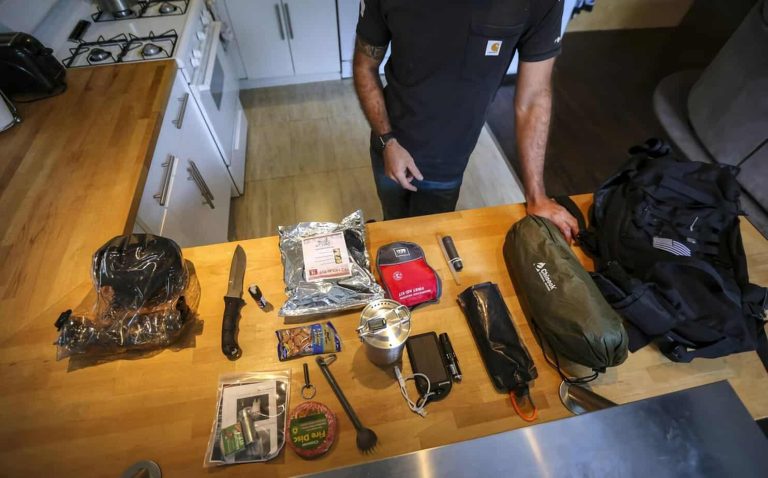
Your bug-out bag (BOB) may contain items that are heavier than you can safely and realistically carry.
Follow these pieces of advice to keep it at a manageable weight:
Your BOB should not be heavier than 25% of your body weight.
Avoid purchasing a pre-packaged BOB. They usually have items that the vendor wants to sell rather than items that you actually need; for example, you don’t need four different knives and a 500-piece first-aid kit.
Think about how much you can realistically carry. Can you walk 10 miles or five hours with your BOB?
Learn from ultralight backpackers: Keep your contents to a bare minimum and use the lightest equipment you can find and afford.
Above all, get some practice in with your BOB. Take it with you on weekend hikes and use the contents. You don’t want to try to start a fire or treat an injury for the first time while on a true bug-out journey.
Deciding to bug out

Bugging out is a serious challenge. You’ve decided to leave a relatively safe and well-supplied location and travel to another location that you hope to reach without incident.
The first decision you must make is whether it is worthwhile to leave where you are. In some cases, heading towards a bug-out location should be your last resort. You should only make the move if staying put will endanger you or those with you and if your bug-out location is significantly safer.
Choose your bug-out location based on the scenario you’re facing, the current situation and activity along each route, the number of people who must accompany you, the weather, each person’s level of fitness, and the time you need to get there.
Many scenarios require special considerations, such as roadblocks between you and your primary bug-out location, a chemical spill or nuclear accident upwind of where you want to go, or rioting along your planned route.
All of these factors influence your decision-making and will determine your success or failure.
One final consideration is to ensure that your expectations are reasonable. If it’s snowing, don’t expect to arrive in the same amount of time as you would on a sunny summer day. If you’re walking, keep in mind that you’ll be moving at the pace of your slowest member.
Also, unless you’ve recently retired from the special forces, don’t expect to be able to walk 10 miles or more each day while carrying a 50-pound bug-out bag.
Be adaptable
It is a risky endeavor to leave a relatively safe and familiar location for one that may be hours or days away. You must not only plan how you will do it, but you must also anticipate and plan for events that may occur along the way.
Your bug-out vehicle may fail. The original route you chose may be congested or unavailable. Perhaps, you or someone in your group could become ill or injured. Your bug-out location may no longer be available or reachable.
You must have a backup plan, a plan B, and a plan C, and you must be willing to change all of your plans and recognize when a change is truly necessary. Stubbornly adhering to a plan that is no longer viable is both counterproductive and dangerous.
Concluding
Obviously, bugging out is a serious business that should not be underestimated.
To make a good decision about whether you need to bug out, which bug-out location makes the most sense for the danger you’re facing, what to bring with you, and how to get there, you must weigh the various factors.
You should also remember to be flexible because we all know that the perfect plan is only perfect until it is put into action.
So, put in the time and effort now to plan ahead of time, think things through, and prepare your bug-out vehicle and bags, so you’ll be ready if you need to leave the safety of your home.
 Other Useful Resources:
Bugging Out Without Leaving A Trail
Find Out What’s the Closest Nuclear Bunker to Your Home
Learn How To Customize Your Bug-Out Vehicle
Learn how to Safeguard your Home against Looters