Pocket Defense Options Worth Having

0

A firearm is usually your best option if you find yourself in a critical situation and need to defend yourself against an attack. However, carrying a firearm is not always an option, and it’s worth looking into other pocket defense options.

A handgun is a potent weapon that allows you to be effective while keeping a safe distance from the aggressor. It also does not necessitate a high level of strength or dexterity to be effective.

However, there are several reasons why someone may be unable to carry a firearm. Perhaps they live or work in a location where it is prohibited. Perhaps they are unable to obtain the necessary permit or license due to a youthful blunder.

In any case, other defensive options are available. They may not have the range or punch of a handgun, but they can still be effective.

Be prepared to handle a conflict

Prior to engaging in any type of conflict, it is critical to clarify what you may need to do in order to win. Violent encounters do not occur in real life as they are depicted on television or in movies.

They are fast-paced, at times confusing, and frequently brutal affairs. There is no time for doubt or hesitation. You must be ready to act quickly and decisively.

One disadvantage of not using firearms is that you will have to get up close and personal with the attacker. You’re obviously close enough for them to grab you if you’re close enough to use a knife or other weapon. The defensive tactics you employ must be aimed at disabling the attacker as soon as possible before they gain the upper hand.

No such thing as a fair fight exists. The only rule you need to keep in mind is that there are no rules to follow: do whatever it takes to win. The ultimate goal is to be present when the sun rises the next morning.

Inflicting intentional harm on another human being does not come naturally to many of us. It’s normal to feel uneasy at the prospect of striking an attacker in the face with a slingshot or severing an artery or tendon with a sharp blade. But make peace with the fact that such actions may be required to protect yourself and your loved ones.

Prepper spray

Capsaicin, the active ingredient in pepper spray, is the same stuff that makes you crave buttermilk after ingesting your fifth ghost pepper.

Pepper spray is occasionally marketed as OC spray. The abbreviation “OC” stands for oleoresin capsaicin. Without getting too technical, oleoresin refers to an extract obtained through the use of evaporated solvents rather than steam distillation.

Pepper spray causes the eyes to close and tear, the skin to burn, and breathing becomes difficult. These effects typically last 30 to 45 minutes, giving you enough time to take additional action, such as fleeing. Some sprays also contain dye, which makes it easier to identify the attacker later on.

Various measurements are supposed to indicate how effective the spray will be. The “Capsaicin and Related Capsaicinoids” (CRC) measurement is the only one that truly matters. This indicates how much of the OC is capsaicin. Look for a CRC of at least 1%.

The delivery system is another factor to consider when using pepper spray. A stream is far superior to spray or fog. It is simpler to aim and less likely to blow back at you. Learn the effective range of your pepper spray product and how to accurately estimate that distance. If the range is 12 feet, go outside with a partner and measure it so you can get a sense of it.

Self defense

Electroshock guns and devices

Here’s a fun activity. Search YouTube for “police training Taser” videos. The yelling you hear is genuine.

Electroshock weapons work by using an electric current to cause debilitating pain and temporary paralysis. Stun guns come in a variety of shapes and sizes, ranging from basic black boxes to lipstick tubes.

They are all equipped with two metal prods that protrude from one end. The prods make contact with your attacker, and you activate the current by pressing a button. The circuit is completed by their body. Stun guns can also penetrate clothing.

The disadvantage here is that you must be within arm’s reach to use a stun gun effectively. While the current will not travel back to you if they grab you, they could still cause some damage if they don’t go down right away. If you’re close enough to touch them, they should be able to touch you, right?

Tasers, on the other hand, provide a bit of range. A Taser discharges a pair of hooked metal probes connected by thin wires. The probes attach to the skin or clothing and conduct a current through the body. The advantage is that a Taser will illuminate them like a Christmas tree.

The disadvantage?

The Taser is ineffective if one of the probes misses or is yanked free. Tasers also employ single-use cartridges that must be replaced after use. Some of them include a stun gun feature as well, giving you that option if necessary.

If you want to consider this option, I recommend getting the Taser Pulse Self-Defense Tool since it’s one of the best Tasers I have come across. It has a laser sight, which is a significant advantage in a high-stress situation. It has a 15-foot range, allowing you to reach out and touch someone before they reach for your arm. The charge lasts 30 seconds, giving you enough time to plan your next move.

Knives

pocket knife as pocket defense option

The geometry of the blade is one of the most important factors to consider when selecting a self-defense blade.A thick blade with a short grind will not perform as well in a fight as a thinner blade designed for slicing.

Here’s a good example: Carve a chicken or steak with your battle knife at the dinner table. If it works well in that capacity, it will also work well on an attacker.

It should also have a sharp point that allows the knife to sink deep into the attacker when stabbed. Unlike what Hollywood would have you believe, the knife does not have to be a foot long.

A three-inch-long blade can penetrate deeply enough to strike something vital. Remember, too, that the more stabbing and slicing you do, the more likely you are to hit tendons and large blood vessels, which will slow down or stop your attacker completely.

Another thing to consider is the shape and design of the knife’s handle. You’ll need something to keep your hand from sliding up onto the blade, such as a guard or finger groove.

The handle should be long enough to allow you to grip it comfortably and securely. The handle material should be textured to ensure a firm grip even when wet. The idea here is to keep the knife in your hand throughout the fight.

Spikes

These are typically made of steel, though plastic versions are available. They only serve one purpose: to pierce your attacker.

The spike is sometimes triangular in shape, allowing for fast and deep penetration while still providing a powerful weapon. To use, make a fist with the spike and stab it into your attacker’s face or body.

Multiple strikes increase the weapon’s effectiveness. It will take practice to be able to quickly stab into a target, pull the spike out, and stab again.

Tactical pens

Blackoutusa B4These have grown in popularity in recent years. The basic idea came from the kubotan, which was released in the 1970s. The weapon is a solid cylinder that can be held in one’s hand and used in a variety of ways, including striking and gouging. In this case, the weapon can also assist you in writing your police report describing the altercation.

One of the most fundamental techniques is to use an icepick grip on the pen and stab or strike your opponent. It’s worth noting that if the pen is large enough, it can protrude from both sides of your fist, allowing you to strike from multiple angles without having to reposition the weapon.

The eyes, neck, and genitals are prime targets for the pen. If you can’t swing your arm, try pushing and grinding the pen into your attacker.

While any weapon is preferable to none, don’t expect a disposable plastic pen to withstand such abuse. Tactical pens are frequently made of aircraft-grade aluminum and have knurled bodies for a secure grip.

I personally recommend the CRKT Williams Tactical Pen 2 when it comes to tactical pens. Both my wife and I have one of these, and they are great. They are made of aircraft-grade aluminum and are of high quality both inside and out. When used correctly, this weapon can be very effective while remaining low-profile enough to go unnoticed by almost everyone.

Flashlights

Many pocket-sized flashlights are now designed to double as a self-defense weapon. They frequently have crenulated heads and are intended to be used as an impact weapon, much like a tactical pen.

With recent advancements in LED technology, the lights are frequently bright enough to truly dazzle the aggressor for a moment, giving you time to either further your own attack or beat feet.

Slungshots

monkey fist as pocket defense option

A slungshot, as opposed to a slingshot, which uses elastic to launch a projectile, consists of a weight held at the end of a flexible material such as cordage. The weight is swung at the attacker, aiming for the face or groin.

A popular type of slungshot is a monkey-fist keychain. When used correctly, the slungshot is not spun around several times before striking. Instead, you simply grasp the loose end of the cordage and swing the weight forward, exerting some effort as if swinging a hammer.

Concluding

Self-defense is glorified in movies and on television. Any physical altercation is brutal and ugly in reality. It will require you to do things that you may find offensive otherwise.

But keep in mind that your family and other loved ones are counting on you to do whatever it takes to be there for them the next day. Take no chances and stack the odds in your favor by arming yourself to your fullest potential.

Suggested resources for survivalists:

Pocket Survival Recommendations And Tactics

Find Out What’s the Closest Nuclear Bunker to Your Home

10 Reliable Pocket Pistols For Your EDC

The latest innovation in solar pannels – 3D technology

The Word Association Game | Survival Monkey Forums

0

Words of Wisdom

0

I get these quotes in one of the many newsletters I get each day.
I thought it would be fun to start a thread where we can post any good quotes we come across.

3 Best Ways To Finance A Startup Business

0

In these difficult times, everyone is trying to make a living while working harder than before. Some will decide to start their own business after getting tired of working for someone else. If you are one of these people, than this article could provide some insights on what you need to do to finance your business.

There are more ways apart from personal investment to finance a start-up business. More than half of small business use some type of outside financing, including bank loans, online loans, business credit cards, etc. There is a wide variety of lending options available for a startup business, but they all come with their own advantages and disadvantages, as well as varying terms and conditions. In the article below you will find 3 commonly used ways to finance a new business.

Loans for small businesses

Obtaining a small business loan or a microloan is one of the most popular ways to finance a startup business. Business loans come in a wide variety of shapes and forms, including traditional bank loans, online loans, union loans and many other overdraft alternatives.

All of them ask for different requirements, so regardless of what your credit rating is, you still will be able to get a loan. Some loans have short repayment terms, usually ranging from 6 to 24 months, while others have long terms of up to 30 years. The repayment term usually depends of the amount of cash you will need. The amount of money for small business loans can range from $13,000 to $1.2 million, with average interest rates between 7.75% to 10.25% .

The process from application to funding can range between a couple of hours to a couple of weeks, depending on the type of lender you choose. Small business loans are can be a fast and convenient way to get the money you need for a startup business.

Crowdfunding

Crowdfunding is another additional choice for small businesses to get the funds they need. It refers to the practice of raising money from a large number of people. Crowdfunding is also known as grassroots financing, which is used not only by businesses but also politicians who are running for office and taking donations to finance their campaigns.

For a new entrepreneur, this type of financing is particularly convenient if you are ineligible for a small business loan. Anyone who is interested in investing or making a donation can do so by viewing your startup business or project on a crowdfunding website. Crowdfunding websites work by asking a large number of people to donate money, usually in small amounts, during a specific period of time. Some websites ask you to give contributors a gift in return, such early access to the goods.

Startup Grants

Applying for a small business grant, which offers money you do not have to pay back, may be a good idea if securing a small business loan does not  appeal to you. One thing about business grants is that everyone wants them. Therefore this method is the least promising out of all the three ways to finance a startup business. Since competition is often tight , you will need to think of creative ways to distinguish your company when applying.

Startup grants usually ask for high requirements and have rigorous criteria. The application process is more complicated than the other traditional ways of financing. Startup grants can come from a variety of sources and can be used for different business-related purposes that help the business. The amount you can get from startup grants, as well as the time interval in which you get  the funds, varies depending on the grant type.

Final words

With all the available options today, you do not have to wait to make your dream come true. However, even though there are many small business lending options to choose from, that does not necessarily mean that they all are going to be available for you. Or that they are a good choice for your business. So, before you apply for any type of loan or any other financing option, make sure it is exactly what you need to pursue your goals.

“December 7, 2008” – a short story circa 2006

0

Fictional story passed onto me by TN_Andy
Very interesting read

The original link to the story where published was here. It no longer worked. No matter, below is the short fictional story exactly as written.

December 7, 2008
Terrorism
by Raymond S. Kraft. October 24, 2006

December 7, 2008, began inauspiciously. At 0753 at Pearl Harbor in Hawaii, the attack that had triggered America’s entry into World War II, sixty-seven years before, was ceremoniously commemorated, an honor guard, taps, a 21-gun salute, the bugle’s notes and the rifles’ crack drifting across the bay to the USS Arizona memorial, where Admiral Arthur Peterson, USN Ret., laid a wreath in memory of the sailors sleeping below, one of whom was his own grandfather.

On the West coast it was 1053, and in Washington D.C. it was one fifty-three in the afternoon, 1353 military time. In 2006 America, tired of War in Iraq, had elected Democrats to modest majorities in both houses of Congress. Representative Nancy Pelosi became Speaker of the House, third in line for the presidency. In the spring of 2007, on a narrow, party-line vote, Congress, led by Senators John Kerry and Ted Kennedy and Barbara Boxer refused to authorize spending to continue the war in Iraq, and set September 30, 2007, as the deadline for complete withdrawal of American troops.

President Bush spoke to the country, to the American forces in Iraq, to those who had been there, and to the Iraqi people, to apologize for the short-sightedness and irresponsibility of the American congress and the tragedy he believed would follow after leaving task of nurturing a representative and stable government in Iraq half done, his voice choked, tears running down his stoic face, a betrayal of emotion for which he was resoundingly criticized and denounced in much of America’s media.

The level of violence across Iraq immediately subsided, as the Americans began preparations to redeploy back to the States. Mahmoud Ahmadinejad praised the new Congress for its clear vision and sound judgment. America’s Democrats rejoiced and congratulated themselves for bringing peace with honor and ending the illegal war based on lies that George Bush had begun only to enrich his friends in the military-industrial complex, and promised to retake the Presidency in 2008.

At 1000 on September 30, 2007, precisely on schedule, the last C-5A Galaxy carrying the last company of American combat troops in Iraq had roared down the Baghdad runway and lifted into the air. Only a few hundred American technical and military advisers and political liaisons remained in-country. The Galaxy’s wheels had scarcely retracted when Iraq erupted in the real civil war many had feared and foreseen, and which many others had predicted would not happen if only the American imperialists left Iraq. Sunni militias, Shia militias, and Al Qaeda militias ravaged and savaged the country, killing hundreds of thousands of Iraqis known or suspected to have collaborated with the Americans, killing Shias for being Shias, Sunnis for being Sunnis, Americans for being Americans, and anyone else who happened to be in the wrong place at the wrong time. By noon, not one of the American advisers and liaisons left behind remained alive. Many had been beheaded as they screamed. Most of their bodies were dumped in the river and never seen again. In the next thirty days more than a million Iraqis died. The General Assembly of the United Nations voted to condemn the violence, and recessed for lunch and martinis.

In America, there was no political will to redeploy back to Iraq. And after a few months of rabid bloodletting, the situation in Iraq calmed to a tense simmer of sporadic violence and political jockeying, punctuated by the occasional assassination, while several million refugees fled the country. Only Kurdistan, in the north, which had thrown up a line of its Peshmurga fighters to keep the southern violence away, remained stable and at relative peace.

In the spring of 2008 America began its quadrennial circus of a national election, and in November elected a Democrat, the Junior Senator from New York, Hillary Rodham Clinton, as it next president, to the surprise of few. Her running mate, to the surprise of many, was San Francisco Mayor Gavin Newsom, whose intelligence, charisma, and reputation as an indefatigable campaigner for gay marriage and the homeless of San Francisco helped solidify Clinton’s support among liberal Democrats who only grudgingly forgave her for not openly opposing the Iraq war sooner, and the Clinton-Newsom ticket went to the top with a narrow 50.2% lead over Republican John McCain’s 49.8% of the popular vote, despite, or perhaps because of, Clinton’s and Newsom’s lack of foreign policy and military experience.

America, or a slim voting majority of it, felt it had had all the war it ever wanted to see, and Hillary had led her party to a glorious (if narrow) victory with the unambiguous slogan: “Clinton & Newsom: No More War.” Crowds at every whistle stop had cheered and chanted, No more war! No more war! No more war! At victory parties George Bush, Dick Cheney, Karl Rove, Donald Rumsfeld and Condoleezza Rice were hung and sometimes burned in effigy, enthusiastic crowds chanted “No more war!” many times more, and local bands cranked up the theme from the first Clinton electoral victory, “Don’t stop thinking about tomorrow . . . yesterday’s gone, yesterday’s gone . . .,” and indeed, it was.

President Bush had been a very lame duck since the 2006 election, and with a Democratic Congress could do little but veto most of the bills it sent him. The Democrats couldn’t override his vetoes, so for nearly two years almost nothing important had been accomplished by anyone on the Hill or in the White House. After the 2008 election it was transition time, flocks and herds of thoroughly demoralized Republican staff began leaving Washington in search of greener pastures, Congress adjourned for the Holidays, Democrats came house hunting, and Clinton and Newsom began the briefings they would get from a fully cooperative Bush administration on the state of the nation and the state of the world they would inherit and have to cope with for the next four years, or eight, and in those last weeks of November both Hillary and Gavin seemed to age rather quickly. The exhilaration of the campaign was over, and the weight of a tumultuous world began to settle on their shoulders.

Back in early October, 2006, North Korean President (for life) Kim Jong Il had announced the detonation of a nuclear bomb deep in a tunnel in the stony mountains of North Korea. The seismic signature had been small, and American intelligence at first doubted whether it had been a nuclear explosion at all. Traces of radioactive emissions were detected a few days later, and the intelligence estimate revised to conclude that it had been a failed test that produced perhaps only 10% or less of the expected yield, only 0.5 to 1.5 kilotons, not the 20 kilotons, at least, that Western intelligence had anticipated.

Kim Jong Il gloated. The deception had worked. The Americans were thinking in terms of long range intercontinental ballistic missiles with huge warheads that they could shoot out of the sky with their sophisticated billion-dollar anti-missile defense systems. He was thinking in terms of small warheads carried by small, medium range cruise missiles that could be launched from many places, and infiltrated close enough to slip in under the radar and hit America’s coastal cities.

On the evening of December 6, 2008, a junior analyst in the National Security Agency was going over routine satellite photo production of ship movements in the Atlantic and Pacific within a thousand miles of the US coasts. Late in the shift he thought he saw something through a haze of fatigue and caffeine, and called a supervisor over to talk. “Look,” he said, photos up on several computer screens, more printed out and spread across his desk, “See? These boats, not big ships, fishing boats, yachts, they’ve been moving in along shipping lanes for several days, across from the South Pacific toward the West coast, up from the South Atlantic toward the east. Nothing very unusual, they’re all small and slow, and scattered up and down the oceans, it seems, but if you look at the times and courses . . .” and he pulled out a chart he had plotted, “They’re approaching so they will all arrive at about the same time, or all be about the same distance off the coast at about the same time . . ,” he trailed off. The supervisor looked a bit quizzical. “Coincidence? Probably. You need more sleep. Too much fun in the night, eh? Let me know if you see something we can do something with.” And walked away.

At 0723 Hawaii time on the 67th Anniversary of the Pearl Harbor attack three old fishing trawlers, about 100 miles apart, and each about 300 miles off the east coast, launched six small cruise missiles from launch tubes that could be dismantled and stored in the holds under ice, or fish, and set up in less than an hour. The missiles were launched at precisely one minute intervals. As soon as each boat had launched its pair, the skeleton crew began to abandon ship into a fast rubber inflatable. The captain was last off, and just before going overboard started the timer on the scuttling charges. Fifteen minutes later and ten miles away, each crew was going up the nets into a small freighter or tanker of Moroccan or Liberian registry, where each man was issued new identification as ship’s crew. The rubber inflatables were shot and sunk, and just about then charges in the bilges of each of the three trawlers blew the hulls out, and they sank with no one on board and no distress signals in less than two minutes.

The missiles had been built in a joint operation by North Korea and Iran, and tested in Iran, so they would not have to overfly any other country. The small nuclear warheads had only been tested deep underground. The GPS guidance and detonating systems had worked perfectly, after a few corrections. They flew fifty feet above sea level, and 500 feet above ground level on the last leg of the trip, using computers and terrain data modified from open market technology and flight directors, autopilots, adapted from commercial aviation units. They would adjust speed to arrive on target at specific times and altitudes, and detonate upon reaching the programmed GPS coordinates. They were not as adaptable and intelligent as American cruise missiles, but they did not need to be. Not for this mission.

They were small, less than twenty feet long, and only 18 inches in diameter, powered by small, quiet, fuel-efficient, high-bypass turbofans, and painted in a mottled light blue and light gray ghost camouflage. Cruising at 600 knots, just below the speed of sound, they were nearly impossible to see or hear. They came in under the radar until they reached the coast. After that they were lost in the ground clutter. Nobody saw it coming. At precisely 0753, Hawaii time, 1353 in the District of Columbia, sixty-seven years to the minute after the Pearl Harbor attack began, the first of six missiles to hit the Washington area exploded in a huge white burst of nuclear fire just 500 feet above the White House, which disappeared in a mist of powdered plaster and stone, concrete and steel. President Bush and President-Elect Clinton had been meeting with Condoleezza Rice and Mrs. Clinton’s national security adviser, reviewing the latest National Security Estimate, when they instantaneously turned into a plasma of the atomic elements that had once been human beings. No trace remained. Alarms immediately began going off all over Washington, and precisely one minute later the second missile exploded just as it struck the Capital dome, instantly turning thousands of tons of granite that had one moment before been the nation’s center of government into thousands of tons of granite shrapnel that shredded several square miles of Washington like a leviathan Claymore mine. At precisely one minute intervals, four more 3 kiloton nuclear weapons exploded at an altitude of 500 feet AGL above the Pentagon, the CIA headquarters, the NSA headquarters, the FBI headquarters, all of which were fully staffed in the middle of the day. In five minutes, the government of the United States of America was decapitated, and a quarter million of the people who made the place run were dead, or dying, or had simply disappeared.

Also at 1353 Eastern time, a missile had blown off just above the New York Stock Exchange, in New York City, and thousands of years of collective financial knowledge and experience evaporated in the nuclear flame. In one minute intervals, others had hit the financial centers of Boston and Baltimore, and the Naval base at Norfolk, Virginia. Simultaneously, within the same 10-minute window of hell, nuclear tipped cruise missiles devastated the largest intermodel shipping facility on the West coast at San Pedro harbor, exploded just above the Library Tower in central Los Angeles, and short circuited the computer technology ghetto of Silicon Valley in Santa Clara County, big time. One exploded ten feet away from the top of the Bank of America Building in San Francisco and set much of the east slope of the city ablaze. Another giant fireball flared among the phalanx of office towers along the Capitol Mall in Sacramento, instantly obliterating Arnold Schwarzenegger and the state government of California, the largest state economy in the US, the seventh largest economy in the world. Two ripped open the heart of Portland, Oregon, one shattered the financial district of Seattle, and the last one turned the Microsoft campus into a pillar of fire and smoke, wiping from the face of history, in a second, the IT giant that had revolutionized global communications.

It was 0803, Hawaii time. Ten minutes. Three million Americans dead. And not a trace of the assault fleet remained on the surface of any ocean. Vice-President Elect Gavin Newsom was in his bedroom at home in Pacific Heights, his window overlooking the Golden Gate and the Marin bluffs. He thought he heard an oddly loud crack of thunder and saw a flash reflected on the hills across the inlet, but it was a clear day and nothing else seemed out of place. He continued packing for the return trip to Washington, his second since the election, to continue his transition briefings and begin organizing his staff. His nomination as Hillary’s running mate had come as a huge surprise, and he was elated. Someone rapped on the door, loudly, twice, and without waiting for a reply the senior Secret Service officer on his detail opened it and stepped quickly in. “Come with me, now,” he said. Gavin was startled. “I need to finish packing,” he replied. “No time, sir. Something has happened. Very big. I fear. No details yet. We have to get you out of here, NOW! RIGHT NOW! GO! GO! GO!” He grabbed Newsom’s arm, swung him around, and pushed him out the door, where two other Secret Service agents flanked him down the stairs and out to a running black Suburban waiting in the garage. They pushed him into the back seat, jumped in, and the driver gunned the engine, out the drive, down the street, tires squealing.

Nobody spoke until they were headed over the Bridge, northbound at seventy-five miles an hour, weaving through the traffic which wasn’t yet the gridlock it would soon become. “What the hell’s going on?” he finally demanded. “Okay. This is what I know,” the officer said. “The US has apparently sustained multiple nuclear attacks in the last fifteen minutes, including Washington D.C. and San Francisco. Financial district. We’re not sure how many, at least ten, maybe twenty. Lots of dead. Got the White House, the Capital, the Pentagon. Our job is to get you on an airplane at the nearest functioning airport, that’ll be Novato, and get you to a safe place. Prestissimo.”

“Where?” Newsom asked. Things were moving way too fast now. “Don’t know yet. We’ll get orders.” The Air Force Learjet had been airborne for two minutes when a cell phone buzzed, and the Secret Service captain answered it and handed it off to the Vice President Elect. “It’s Mr. Cheney, sir,” he said. “Gavin?” Dick Cheney asked. “Yes, sir,” Newsom replied, subdued, for the events of the last hour had sobered up his elated mood considerably. “Okay, Gavin. I don’t know what you know, so I’ll tell you what I can. There have been approximately 20 nuclear strikes on government and financial targets in the US, about an hour ago. No real damage estimate yet, except that it’s awful. A hundred times 9/11, maybe a thousand times. I happened to be at the Air Force Academy in Colorado Springs, and have moved into Cheyenne Mountain to set up a temporary HQ, until we get things sorted out. As you know Cheyenne was vacated by NORAD a few years ago, so we have plenty of space. You will be flown here, nonstop.”

“I know you haven’t a lot of national and international experience.” Cheney had thought of saying that Newsom had none, but Newsom would be too painfully aware of that. He didn’t need reminding. “The President is missing and presumed dead. So is Mrs. Clinton. So you may become the next president, in about six weeks. I don’t know. The Constitution says the Vice President succeeds a president who is dead or disabled, but it doesn’t say what happens if the President Elect dies before being inaugurated. I suppose the Court will have to answer that, if we can cobble one together by then. In the meantime, I will assume you will be inaugurated. You’ll have a steep learning curve, a real steep curve. All presidents do, under the best of circumstances, and these are not the best of circumstances.”

The next day a hard winter storm roared down the West coast from Alaska, pelting rescue workers in bombed out city centers with hard, cold rain, that did not let up for a week. People alive but injured or trapped in the wreckage died of hypothermia before they were found. Two days later, a cold front out of Canada brought heavy snow to the Northeast. Millions were already without electricity, and in a week of subzero weather hundreds of thousands more died. More than four million, altogether. More than one of every one hundred Americans. Al Qaeda had picked December 7 because it was the anniversary of the attack on Pearl Harbor, and because, just before Christmas, the Infidel holiday, it would destroy the Christmas shopping season so important to so many retailers, driving another nail into the national economy of the Great Satan. And it would destroy the festive spirit of the season for millions of Americans, perhaps for all. The perfect psyop. Psychological warfare. And the weather forecasters had predicted severe winter storms on both coasts during the week immediately after disaster.

Al Qaeda leaders had calculated, correctly, that by turning up the violence in Iraq during the weeks before the 2006 election it could achieve an anti-war Democratic Congress that would vote to end America’s wars in the Middle East, and then by turning down the violence in Iraq after the election of an anti-war Democratic Congress, it could lull America into a false sense of safety and security in anticipation of the “peace in our time” that America’s new ruling party had promised would follow from what Al Qaeda perceived, correctly, as America’s retreat before the unstoppable determination of the Islamic Resistance Movement, the Jihad.

America did not call it that, of course. The Americans thought they were just ending a bad and illegal war ginned up by George W. Bush to depose Saddam Hussein who had proven not to have WMDs after all, the ones the Americans had never found, the ones buried in Syria. Al Qaeda saw more clearly. It was a capitulation, a de facto surrender of the Middle East to the coming Islamic Caliphate that would someday rule the world. The martyrs of Islam had beaten the Great Satan to its knees. In time they would cut off its head.

By Christmas, the American economy had imploded. Inflation soared, unemployment soared, businesses closed, cities that had suffered direct hits became ghost towns. Tax revenues evaporated, leaving state governments without funds to pay unemployment benefits or teachers’ salaries. With the New York Stock Exchange gone, stock trading ended, and values plummeted. Retirement assets and pension funds disappeared in a wink. Nobody knew what to expect. Real estate crashed, and major banks filed for bankruptcy. With the collapse of the American economy, the largest on earth, the most productive country on earth, with just 5% of the global population producing one third of the global economic output, the rest of the global economy fell into chaos. Oil shipments stopped, food shipments stopped, and in that winter millions of people in third world countries starved to death.

The America era was over.
******
“In the spring of 1941, Nazi Germany was poised to dominate the earth. France, the low countries, Norway, Denmark, Austria, Czechoslovakia, Yugoslavia, Greece, and much of Poland had been overrun by the Germans. All of Europe, save neutral Sweden and Switzerland, was in the hands of Hitler’s friends and allies: dictators or monarchs who ruled fascist Italy, Vichy France, Franco’s Spain, Portugal, the Balkan countries, Finland, and above all the Soviet Union.” “A single German division under General Erwin Rommel, sent to rescue beleaguered Italians in Libya, drove Britain’s Middle Eastern armies flying and threatened the Suez lifeline; while in Iraq a coup d’etat by the pro-German Rashid Ali cut the land road to India. In Asia, Germany’s ally, Japan, was coiled to strike, ready to take Southeast Asia and invade India. No need to involve the United States; by seizing the Indies, Japan could break the American embargo and obtain all the oil needed for the Axis Powers to pursue their war aims.
“Hitler should have sent the bulk of his armies to serve under Rommel, who would have done what Alexander did and Bonaparte failed to do: He would have taken the Middle East and led his armies to India. There he would have linked up with the Japanese. Europe, Asia, and Africa, would have belonged to the coalition of dictators and militarists.” “The Nazi-Soviet-Japanese alliance commanded armed forces and resources that utterly dwarfed the military resources that the holdouts, Britain (with its empire), and the United States, could field. The English-speaking countries would have been isolated in a hostile world and would have had no realistic option but to make their peace with the enemy, retaining some autonomy for a time, perhaps, but doomed ultimately to succumb. Nazi Germany, as leader of the coalition, would have ruled the world.” “Only Hitler’s astonishing blunder in betraying and invading his Soviet ally kept it from happening.” – David Frompkin, Professor of International Relations and History, Boston University, writing in What If: Eminent Historians Imagine What Might Have Been (Putnam 1999) pp. 308, 309.

History is made, wars are won and lost, cultures and nations and civilizations come and go, rise and fall, as much by blunders as by victories. The failure of many Americans, including many of the leading Democrats in Congress, and some Republicans, to fully appreciate the persistent, long-term threat posed to America’s liberties and survival, and to the future of Liberal Democracies everywhere, by an Islamic Resistance Movement that envisions a world dominated and defined by an Islamic Caliphate of religious totalitarianism, and which will fight any war, make any sacrifice, suffer any hardship, and pay any price to achieve it, may prove to be the kind of blunder upon which the fate of America turns, and falls.

Raymond S. Kraft is an attorney and writer in northern California.
 

Why I need a new gun (Caution: This thread contains sensitive material)

0

If your wife is mad at you, buy a new gun.

She will still be mad at you but, you will have a new gun!

The Most Common Survival Foods You Should Learn How To Prepare

0

Modern survival foods include MREs and emergency ration bars. These bug-out-friendly items can be stored for extended periods of time and provide sustaining nutrition, which are two critical requirements for survival food.

While there are many emergency meals and snacks on the market today, they are not the first foods of their kind. Look back in time, and you’ll find many hearty foods that our forefathers used for traveling or emergency sustenance.

Today’s survival food is toughly packaged and can last for years, but you can’t make your own MREs in a cave. After the last meal, you’ll need to be able to make your own “survival food” to replenish your supplies.

Thankfully, our forefathers experimented with subsistence foods and left us with the recipes that worked. They discovered how to prepare foods with nutrition and longevity using simple ingredients, and they were even able to do so without electricity. Tough times call for tough foods, and these are some of the most rugged recipes from history.

Hardtack

This brick-like cracker has its origins in ancient Egypt, but the form we know today bears the most resemblance to a food item made during the American Civil War.

Baked months in advance, these soldiers’ rations were rock hard right out of the oven and even worse when they arrived at the troops.

Soldiers soaked their hardtack in water or coffee to make it more chewable (especially for those with bad Civil War teeth). As an added bonus, any insect larvae in the hardtack would float to the top of the liquid for easy identification and removal.

Ingredients

The hardtack recipe is straightforward. You could add other ingredients, but then you’d be making bread rather than hardtack.

5 cups wheat flour (600 g)

2 quarts of water

three teaspoons of salt

Recipe

In a large mixing bowl, combine the wet and dry ingredients.

When the flour, salt, and water have formed a dry bread dough, roll it out flat with a fat stick (or rolling pin), or pat it out by hand. If the dough has any sticky spots, add more flour.

Make a 12-inch-thick dough sheet, cut it into 3×3-inch squares, and poke holes in both sides of each dough square.

Bake for 30 minutes per side at 375 degrees F for a total of one hour of baking time on an ungreased cookie sheet.

Storage

As with most foods, keep your hardtack in a cool, dry, dark place away from pests, if you have one.

Benefits

Hardtack, once thoroughly dried, will last for years if kept dry and away from pests.

To eat it, simply soak it in your preferred liquid. Because it is completely dehydrated “bread,” hardtack is lightweight and travel-friendly. It contains a lot of nutrients in a small package.

Pemmican

how to make pemmican 121

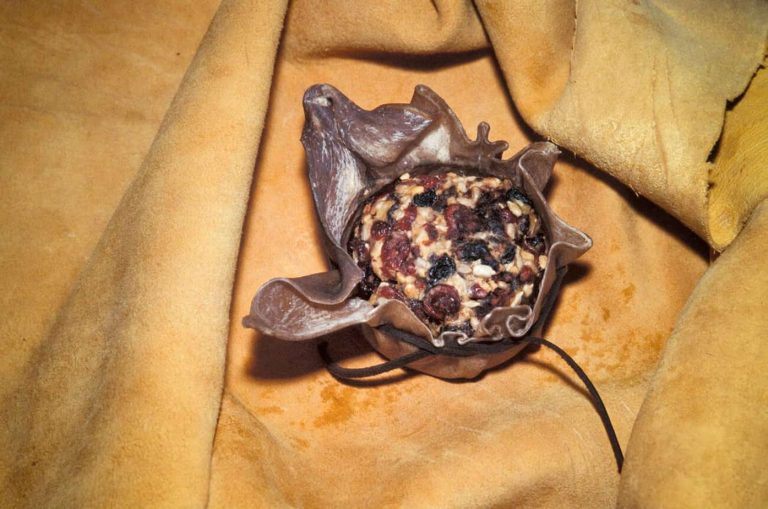
This strange “survival” food is best described as the weirdest meatball you’ve ever eaten. Pemmican is an ancient forerunner to modern survival rations, made from dried meat and rendered fat, among other ingredients.

While different cultures around the world have made their own versions of this calorie-laden concoction, Native Americans are credited with putting it on the map. Pemmican, which is traditionally rolled into serving-size balls, can also be pressed into other shapes.

Although it can be eaten on its own, some cultures have used it as a greasy “bouillon cube” to make a base for soups and stews.

Ingredients

The traditional pemmican recipe consists of two or three main ingredients.

The first is dried jerky that has been ground into slivers or dust. This gives the finished product protein and bulk. This jerky can be salted meat or dried meat with little or no salt. Just keep in mind that salted meat will keep the pemmican fresher for longer.

The second ingredient is rendered animal fat, which provides this food with a lot of calories. The fat also serves as a glue, holding everything together.

As an added source of carbohydrates, vitamins, and fiber, dried fruit or berries are an optional third ingredient. You could buy these ingredients at your local grocery store and make a test batch at home, or you could make a batch in the field from dried game meat and rendered fat. It’s entirely up to you.

lostrecipeb5Here’s an example of an ingredient list.

8 ounces of lard

8 ounces packed powdered jerky (chopped in a blender)

8 ounces dried fruit (any dried fruit will do, but berries are ideal)

Recipe

The recipe is extremely simple. The only difficult part is actually blending the pemmican ingredients.

You’ll need to keep an eye on the temperature. If your animal fat is cold, it will not easily blend with the rest of your ingredients. And if you overheat the fat, the hot melted lard will cook your raw ingredients, which must remain raw to avoid spoilage.

Warm the lard in a pot to a soft pasty texture (below 100 degrees F) while stirring.

Stir your “dry ingredients” into the softened fat until thoroughly combined (about two minutes of stirring).

Some daring explorers have added small amounts of flour or other starch sources for added carbohydrates or spices for added flavor.

Scoop out the pemmican by hand, with or without the additions, and compress it into round balls or flat cakes.

Allow for cooling before storing.

Storage

Instead of using rawhide containers, wrap the pemmican pieces in wax paper (not too tightly). This food can last for months if the weather or your storage area is cold. However, as the weather warms, eat it before the fat begins to smell rancid.

Benefits

Pemmican has the most calories per ounce in this article. A 2-ounce ball of pemmican contains 336 calories (mostly from fat), 57 mg of cholesterol, 17 grams of protein, 770 mg of sodium, and 20% of your daily iron requirement.

Parched corn

how to make parched corn

Parched corn is a distinct Native American cuisine that is essentially a coarse form of popcorn.

Parched corn, like pemmican, was once a popular Native American food. This food was quickly adopted as a snack and as a lightweight trail food by colonists, trappers, hunters, and pioneers.

To make corn soup, parched corn can be ground into coarse meal and simmered in water.

Ingredients

This food can be made in small or large batches and is simple to prepare.

To coat the bottom of a skillet or pan, you’ll need some fat. Bacon fat is preferred, but any edible oil will suffice.

You will also require dried sweet corn. Other types of corn can be used, but sweet corn is the best option. If you can’t find it, you can buy frozen sweet corn and thoroughly dehydrate it.

Your final seasoning ingredient is a pinch of salt or sugar. It tastes like popcorn with salt but more like kettle corn with sugar.

Recipe

Warm your pan over medium heat after greasing it with oil (you can do so on the stove or over a fire).

Start stirring after adding a handful of dried corn. You only need enough corn to cover the bottom of the pan, not an entire pan.

After a few minutes, the corn will start to swell and pop. Continue to stir until all of the kernels are browned. Remove from the pan and season with salt or other seasonings while it’s still hot.

Enjoy it after draining the excess oil!

Storage

Parched corn should be kept in a ventilated container. Cloth bags and leather pouches were traditionally used to keep the corn from sweating.

In the event of rain, place the parched corn bag in a jar, metal tin, or plastic bag to prevent moisture absorption from the air. When the weather permits, remove it from the waterproof covering.

Benefits

Parched corn can be stored for months if kept dry and cool (until the fat goes rancid).

This popcorn predecessor contains 120 calories, 46 mg of sodium, 5 grams of fat, 120 mg of potassium, 20 grams of carbohydrates, 2 grams of fiber, and 3 grams of protein in just 1 ounce.

Trench cake

trenchcake ww1

While the term “fruitcake” and the concept of it date back to the Middle Ages, baked goods like this date back to Roman times.

For centuries, people have carried sustaining cakes made of flour, honey, spices, and fruit, from old-world hunters to soldiers in the Crusades.

Fruitcake became extremely popular throughout the British Empire in the late 1800s.

Later, during World War I, English families sent “trench cakes” to their brave relatives fighting in the trenches of continental Europe.

Ingredients

4 cups mixed dried fruit (2 to 3 cups golden raisins for a classic flavor)

1 cup all-purpose flour

1 can (400 g) sweetened condensed milk

12 cups of water

1 egg

1 teaspoon rum or brandy (optional)

pocketfarm1Recipe

Bring the fruit and water to a boil in a pot. Simmer for two minutes, uncovered. Cover and allow to cool to room temperature.

While the fruit cools, line a deep square or round baking tin with baking parchment paper, bringing the paper 12 inches above the tin’s edge.

Preheat the oven to 300 degrees Fahrenheit.

Stir in the condensed milk, egg, and flour to the fruit pot (and liquor, if using). Mix the batter thoroughly.

Place it in the prepared baking dish and bake for two hours (or until a toothpick comes out clean after being inserted into the cake)

Storage

There is only one way to store fruitcake properly: wrap it in a cloth that has been soaked in liquor. To keep the cloth from drying out, wrap the fruit cake in plastic wrap or, more historically correct, in a metal tin. Fruitcakes embalmed in this manner can last for many months in a cool location, possibly even a year.

Benefits

If you like fruitcake, this could be the most delicious survival food on our list. Even if you don’t like these fruit bread bricks, they contain a lot of nutrients.

A 4-ounce slab of typical fruitcake contains 369 calories, 20 grams of fat, 46 grams of carbohydrates, 4.3 grams of protein, 68 milligrams of cholesterol, and 102 milligrams of sodium.

Concluding

While some heritage foods have persisted because they were delicious, others have persisted because they have proven to be a good way of storing nutrients.

Remember that old does not always imply outdated or obsolete!

We hope that one or more of these historic survival foods inspires you to try something new and that you end up making them because you want to rather than because you have to.

Recommended resources:

Making Old Pioneer Sourdough for Traditional Baking

The best DIY Projects for your household to become self-sufficient

How To Make Bannock or Indian Bread, the food of the mountain men

The vital self-sufficiency lessons our great grand-fathers left us

NWR or a New World Religion questions and opinions please

0

I am reminded of an old SciFi book by Robert Hienlien….(as Anson MacDonald)

Sixth Column, also known under the title The Day After Tomorrow, is a science fiction novel by American writer Robert A. Heinlein, based on a story by editor John W. Campbell, and set in a United States that has been conquered by the PanAsians, who are asserted to be neither Japanese nor Chinese. Originally published as a serial in Astounding Science Fiction (January, February, March 1941, using the pen name Anson MacDonald) it was published in hardcover in 1949. It is most known for its race-based premise.

Sixth Column – Wikipedia
the Wiki is a fair layout of the story and portrayal of racism – on both sides.
The remains of the US Army use a new ‘religion’ as cover for their clandestine war against the PanAsian conquerors of the West.

1941 was a point in history where the “Yellow Menace” was a real hot topic for the propaganda machines of the Western world, much as Germans had been pilloried by the (execrable) W Wilson back in the day..

My point – many things can hide inside of a “religion” – we’ve seen a lot here in the US – from Moonies, to the likes of the Branch Dravidians, splinter “Mormon” groups and the infamous (and murderous) cult of Louis Farrakhan….

Many would describe the whole of the “econuts” (Greenies, Global warmists/alarmists, and “Gaia” worshipers) as a kind of new religion. These folks make Wiccans look pretty mainstream.
I would be hard pressed to argue otherwise, except for the lack of an umbrella 501(c)3 infrastructure and ‘services’, outside of the odd riot, sabotage or splashy media event.

Given the current trend in stats, much, but not all, old school “organized religion” in the US is suffering from shrinking attendance, aging population base, loss of social credibility and in many cases is folding in a major way..

Hard to say of the Left is looking at – other than controlling every aspect of ‘your’ life to fit their idea of what is ‘right’.- something I don’t see as ending well, for anyone.


Tactical Baby Carrier

0

For the young preppers and just outdoors folks. This baby carrier was well thought out and the design is approved for the baby's comfort. Plus men will look cool with the little one strapped on. It is more expensive than a BabyBjorn but the looks and design are very sturdy. This company has a whole line of tactical baby products and they do not skim on the Mole webbing.

Tactical Baby…

Tactical Baby Carrier