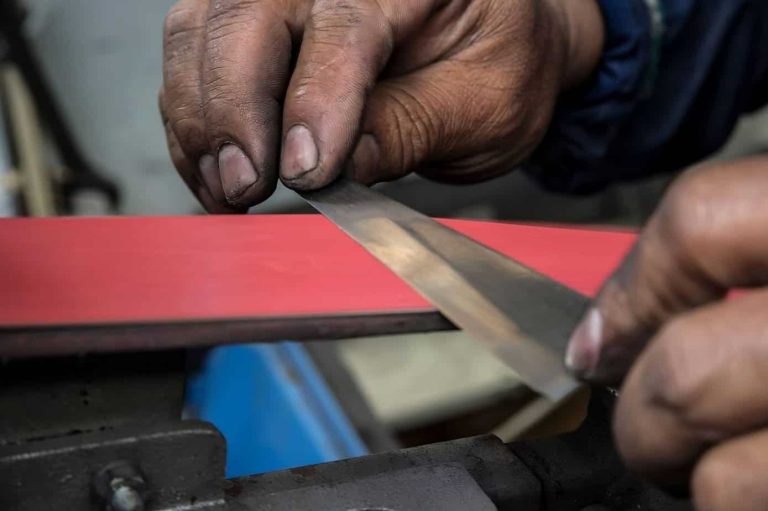
Knowing Your Blade Grinds Can Make Or Break Your Survival Knife

0

Have you ever tried shopping for a new knife and found yourself struggling to understand the marketing jargon? Knife manufacturers tend to use fancy terms like flat grinds, chisel grinds, Scandi grinds, zero bevels, mid-tech, forged, stock removal, textured G-10, S30V, Damascus, and pattern-welded, which can be confusing. However, understanding these terms can help you choose the best knife for your needs.

Fortunately, these terms are not too difficult to comprehend once you familiarize yourself with them. Most knife-makers use these terms in a straightforward manner, but it may still take some experimentation to determine which grind, edge, pattern, or profile works best for the task at hand.

To provide you with the most comprehensive knowledge on survival, we have put together a tutorial on knife grinds and blade profiles to help you understand each one and pick the best tool for your needs. The grind, or how the cutting edge is formed, is the heart of the blade and determines how well it can cut and retain its sharpness. There are many types of blade grinds available, but we’ll focus on the most common ones.

Blade Grinds:

Flat Grind

The flat-ground or “V ground” edge is a simple and common blade style. The blade tapers at a consistent angle from the spine to the cutting edge on both sides. It is commonly used in kitchen knives and blades made by Spyderco and Strider Knives. Flat grinds are easy to maintain and sharpen.

Hollow Grind

The hollow-ground blade originated in the 19th century for straight razors and gained popularity in hunting and sporting in the 1950s. The edge has a distinctive concave grind, with both sides bowing inward until they meet at a thin, sharp edge. While this edge is very sharp, it requires frequent maintenance through stropping or sharpening. This edge is found in Buck hunting knives, straight razors, and custom knives.

Scandinavian Grind

Also known as Scandi grind, this edge begins below the midpoint and lacks a secondary bevel on the edge. It is ideal for whittling, woodworking, and bushcraft because of the high bevel which allows the user to keep an eye on the wood grain while carving. The Scandi grind requires frequent stropping to maintain sharpness and using any other type of sharpener will change the grind by adding a secondary bevel.

Convex Grind

The convex edge is very durable and sharp but challenging to sharpen. Both sides of the blade feature a slightly rounded (convex) bevel that tapers to form the edge. Convex grinds are used on heavy-duty chopping tools like axes and machetes as the rounded shape of the edge prevents it from binding in wood and helps to split it.

Chisel Grind

The chisel grind is a blade design originating from Asia that resembles the grind of woodworking chisels. It features a single ground side, with the opposite side left flat. This grind was initially popular on expensive Japanese kitchen knives and was introduced to the US by Phill Hartsfield in the 1960s. Hartsfield incorporated it into his combat knives, which became popular with Navy SEALs and Army Special Forces. Ernest Emerson later obtained permission to use the chisel grind on his tactical folding knives in the mid-1980s, and it eventually became prevalent on all kinds of tactical knives.

Compound bevel

The compound bevel, or double bevel, is a common grind found on many modern knives. It consists of one of the previously mentioned grinds with a secondary bevel added for increased durability and ease of maintenance.

Asymmetrical Grind

The asymmetrical grind is a combination of two of the aforementioned designs, utilizing two distinct bevel angles for each side of the blade. This is done to create a more durable edge by combining the benefits of each grind. Some makers opt to grind different portions of the blade, such as using a flat grind on the front half and a hollow grind on the rear half.

User profile

By examining the different grinds, a user can determine what they require in a blade. For instance, a hunter or trapper may favor a hollow grind for skinning and dressing game, while a Navy SEAL may opt for a chisel grind with a secondary bevel on a folder for its ease of sharpening or cutting ability. However, they might choose a machete with a convex grind for clearing brush.

The next consideration is determining the ideal profile for a particular knife. If the edge is the heart of a blade, then the profile is its soul, conveying much of the overall appearance of the knife and defining its function.

Drop point

drop point knife

The drop point is now one of the most commonly used blade styles, but this wasn’t always the case. In the 1950s, Bob Loveless popularized this style by grinding the blade in such a manner that the spine has the same thickness and strength from hilt to tip. It is one of the most practical profiles for a daily use knife, with a lowered tip that provides extra control when cutting with the edge while still retaining piercing power. This versatility makes it suitable for hunting, skinning, caping, woodworking, self-defense, and other activities.

Clip point

The clip point blade was once the dominant blade style worldwide. Originally, it was a result of the forging process, as the tip of the blade naturally curved upward due to heat and hammering. As machine-ground blades replaced forged ones, the style remained due to familiarity and perhaps as homage to the Bowie knife of the 19th century. The back of the blade closest to the tip is clipped in a straight or concave fashion, giving it its name.

Common on pocket knives, the clip is intended to safely house the blade within the handle when closed and may feature a false edge to aid in penetration. This profile is suitable for general use, hunting, skinning, caping, woodworking, and self-defense.

Originally intended for trimming the hooves of sheep and goats, the sheepsfoot blade features a straight edge, a straight and dull back, and a rounded tip that curves to the edge. Its unique design allows for precise control when held close to the edge. Today, it’s commonly used on rescue knives and for skinning, woodworking, and self-defense.

Whamcliffe

Similar to the sheepsfoot, the Wharncliffe blade has a more gradual curve on the back edge, and is typically thicker than knives of a similar size. It was originally designed for mariners on sailing ships, with a flat blade that made for predictable cutting action, and an excellent tip for fine work. Today, it’s commonly found on box cutters, and used for rescue, skinning, woodworking, and self-defense.

Hawkbill

Similar to the previous two profiles, the Hawkbill blade has a pointed tip to aid in penetration when used for striking and cutting, making it a potent self-defense tool when used correctly.

Gut hook

The gut-hook is a specialized blade feature with a blunt edge and a beveled, sharpened single serration usually cut in the top plane of the blade. Originally intended for aiding in the skinning of animals, the blunt tip prevents damage to the hide or intestines while dressing it out. Gut hooks are commonly found on hunting knives, as well as rescue and military knives, allowing for easy cutting of seatbelts and cordage without risking injury from an exposed knife tip.

Medical banner

Tanto

The unique tanto blade is easily recognizable. It was introduced to the United States by custom knife maker Bob Lum and gained popularity in the 1980s when companies like Cold Steel began producing them. Tanto designs exploded in the 1990s, especially with tactical knives from makers like Bob Terzuola, Allen Elishewitz, and Emerson.

These modern U.S. blades have a flat spine but typically feature an obtuse angle at the tip. Some variations have the spine angled towards the tip, creating a triangular shape. Tanto blades are great for penetration, but are less versatile than drop-points due to the obtuse angles near the tip. They can be found on tactical knives, everyday-carry (EDC) blades, and sometimes hunting knives.

Persian

The Persian blade is usually the opposite of the previous three types, as it curves upward with a pointed tip. This profile excels at filleting, but can also be found on certain combat and general-use knives.

Recurve

the kukri an example of recurve knife

The recurve blade is a modern design that gained popularity at the turn of the millennium. Its “belly” bows out from the edge before the point, giving more surface area for cutting. Recurve blades are commonly found on hunting knives, skinning blades, self-defense tools, and some EDC models.

Dagger

The dagger blade has had a single purpose for centuries: combat. This ancient profile is steeped in symbolism and has been the base design of many art knives. Originally a scaled-down version of a double-edged sword, the dagger features two symmetrical sharpened edges. Some modern makers prefer to make the top edge unsharpened to avoid weapon laws and to create a more utilitarian blade. Its strength is in stabbing, as the double edge or top false edge aids in penetration.

However, carrying a dagger is heavily restricted or prohibited in most jurisdictions. In response to this, some makers have refined the design into what is commonly known as a spear-point blade or a bull-nose profile, which maintains the symmetrical shape but with only one sharpened edge.

Reverse S

The Reverse S profile was made famous by Spyderco and is a common feature on many of their knife designs, including the Cricket, Dodo, Matriarch, and Civilian. The sweeping curve of the blade provides a larger cutting surface area than a straight edge or even a recurve, resulting in a cutting performance similar to a larger blade, even if the blade length is at the legal limit in most jurisdictions.

What combo works best?

After acquiring a plethora of knowledge about knives, you may be wondering, “Which knife should I purchase?” As with any survival gear, the best knife is one that caters to your needs and budget. If you rarely venture outdoors, investing in a gut-hook skinner would be a waste of money. On the other hand, if you spend most of your time in the wilderness, a double-edged dagger would be a poor choice for bushcraft activities. Perhaps you’re searching for a multipurpose survival blade for your go-bag. In that case, a sheepsfoot with a hollow grind may not be the best option.

Every design has its strengths and weaknesses. Sometimes, personal preference and aesthetics may influence your decision. However, it’s essential to be practical and remember that a knife that looks impressive may not necessarily be the most practical.

power eff banner 200

Recommended resources for preppers and survialists:

Things To Know When Carrying A Knife

Do you know what happens when you take expired medicine?

Tomahawk And Knife Throwing Tips

How to build an underground cellar for less than $400

Hopefully I can grow something this year

0

Last couple of years I have had health issues and what I did plant I wasn't able to take care of. I'm going to be light this year to see how I feel.

Survive, Evade, Resist and Escape

0

The small voice in your mind always feared this day’s arrival, and now it’s here. As you look back at the burning city skyline, you hear gunshots, blood-curdling screams, and shattering glass. Anxious thoughts race through your mind as you wonder if your family is safe. You are leaving this dying city with all the gear and food you’ve stockpiled and all the time you’ve spent training. You are now miles away from your hometown and family on a business trip with strangers.

You pass an abandoned police car, glancing painfully at the empty rifle rack. Gunfire grows nearer, and your group quickens their pace. People are becoming feral, primitive. The armed men you saw earlier are finished with their current victims and are now hunting those in tailored suits and expensive shoes, who appear completely defenseless: you and your colleagues.

Although this scenario is fictional, it’s not unrealistic. Civil unrest, terrorist attacks, invading armies, or natural disasters can cause society to collapse rapidly. That’s why I jumped at the chance to participate in a SERE (survive, evade, resist, and escape) course held by an elite training organization that teaches civilians, law enforcement, and military personnel survival techniques, including women’s self-defense, concealed weapon carrying, bushcraft, and tactical medicine. The two-day course made me confident that we could survive and make it home safely if we ever found ourselves in a similar situation.

From the loads of information, tactics, and experience gained from the SERE course, I have distilled the top five lessons learned. Keep reading to discover them.

SERE Lesson 1 –  You Are Only as Strong as Your Team

Within the corporate realm, leaders can either be competent or incompetent. During a crisis or in its aftermath, the latter can lead to fatal consequences, be it through negligence or sheer incompetence. It is, therefore, essential to select the right person for the role.

Avoid individuals who are overly eager to take the reins and instead choose someone who is already universally respected. This individual will be tasked with keeping everyone on track, delegating responsibilities and tasks, and holding each member accountable for their actions.

That’s why the assigning of leaders is one of the initial tasks given to participants in the SERE class, as it sets the tone for the rest of the training. The decision to appoint an alpha dog falls on the group, but this doesn’t mean the leader must be a tyrant.

If a leader’s approach is too heavy-handed, group members might revolt or splinter off. Instead, decisions and plans can be made collectively in an open forum, where everyone contributes to the subject. This approach makes everyone feel appreciated and part of the team, leading to a more robust and unified plan. Ultimately, the designated leader should assign tasks and have the final say, as they are accountable for their actions, just like the rest of the group.

In the military or certain sports, it’s all about the team. The team becomes a microculture with a unique set of evolving values and customs. It is said that our values are shaped by our environment, and exposure to a new environment changes our values to match that setting.

If your world of Priuses and Frappuccinos has transformed into a post-apocalyptic wasteland, expect your perspective to change to align with your group’s, or you’ll be left behind. Group absolution is a fundamental aspect of human nature, so don’t be surprised by how primitive things may become.

SERE Lesson 2 –  Sleep will get you killed, it’s a luxury you can’t always afford

You won’t be sleeping, and if you do, it could cost you your life. This is a lesson that soldiers know well, and it’s a critical one that runs throughout the SERE program. In a survival scenario, you’re likely to be on foot, as driving yourself out of danger may not be an option. The energy expended hiking all day will leave you exhausted, but that doesn’t mean you get to clock out when the sun sets.

Throughout history, armies have attacked at night or at dawn, and some of America’s top commandos still use this tactic to gain an edge. To stay safe, your group will need to post a rotating night watch, as maintaining security at all times is crucial. While a big tent and a cozy sleeping bag may seem appealing, kicking off your boots and climbing into bed is an easy way to get killed in your sleep. If there are people actively hunting you, why would you let down your guard as darkness falls? You simply can’t, and if your lookout falls asleep on duty, it could be a death sentence for everyone.

The SERE course teaches students how to build simple and effective shelters that can be set up and taken down in minutes. Using tarp shelters provides a lightweight, adaptable, and effective way to make camp. In an emergency, they can be cut down and quickly stowed or abandoned altogether.

SERE Lesson 3 – Even good guys get hurt

While it may be tempting to seek revenge and punish the wrongdoers, it’s best to avoid conflict altogether. Engaging with mixed groups of looters, marauders, and violent gangs will put your group members in danger. In a world without ambulances, hospitals, or doctors, injuries sustained during fights for resources or self-defense can prove fatal. Even with the knowledge and supplies for primitive medicine, it’s best to avoid Civil-War-era medicine at all costs. Having a medical kit and knowing how to use it is just as important as having a firearm.

It’s important to acknowledge that accidents can happen to anyone and to be prepared for them. A simple mistake with a knife or a fall down a ravine can be life-threatening. The medical aspect of the SERE course is a critical lesson for students. Along with the firearms portion of the class, it provides valuable exposure to administering care under fire and handling triage.

BORJun18v2

SERE Lesson 4 – A good plan today is better than perfect planning tomorrow

Inaction, bickering, or wavering can paralyze you and your team when swift action is needed. Talking about procuring food won’t satisfy your hunger, but disregarding a comprehensive plan that ensures all members comprehend it is unwise. While hasty decisions can prove fatal, so can avoiding any risks. Every action you take or fail to take could result in death.

However, by making deliberate and well-informed decisions, you can significantly reduce the risk. This is where exceptional leaders excel, and individual expertise shines through. (Refer to lesson 1.)

Remember that each of your teammates brings a unique set of skills and experiences to the group, which can provide a significant advantage. If you have a mechanical engineer in your team, let them take charge of building a sturdy structure or rope bridge. If there is an ER nurse, they will have valuable insights for devising a medical plan that others may not. And, just because a team member’s current occupation involves hanging drywall, it doesn’t mean that they have forgotten everything they learned during their deployment to Afghanistan in the National Guard.

Consider all of this, share your perspectives, and create good, simple, and executable plans. Assign your subject-matter experts as “project managers” for their specialties. Utilize their knowledge and experience to the fullest and incorporate them into all your plans. Remember that collective wisdom will go a long way in ensuring your group’s survival.

SERE Lesson 5 – Plan for failure

plan for failure

When it comes to survival, having a plan is crucial. However, it’s equally important to understand that plans can change or even fail altogether. In a world where structure and routine are vital to our sense of security, it can be hard to accept the uncertainty that comes with survival situations. But as history has shown us, humans are incredibly adaptable and capable of thinking on their feet.

To prepare for the unexpected, it’s essential to have a plan in place. This plan should outline your team’s objectives and the steps needed to achieve them. But remember, the plan is just a starting point. You must be willing to adjust your strategy as new challenges arise. Flexibility is key. If a team member is kidnapped, you must be ready to adapt and come up with a new plan of action, even if it means trading supplies with the captors or launching a surprise raid.

To survive, you must be as fluid as water and as hard as rock. This means being open to change and willing to act decisively when the situation demands it. It also means having the mental and physical toughness to endure hardship and persevere through adversity. By embracing uncertainty and learning to think on your feet, you can increase your chances of survival and thrive in even the most challenging environments. Remember, a plan is just a list of things that aren’t going to happen, but with the right mindset, you can overcome any obstacle that comes your way.

Concluding

SVMDv22The most valuable asset you can equip yourself with during a crisis is knowledge, and the SERE course offers just that. This knowledge is gained through a range of challenging missions and tasks that are designed to test you both mentally and physically. Because these skills are acquired through adversity, they are more likely to remain with you for a long time.

Unlike real-life scenarios, attending courses like this provides you with the opportunity to learn important skills in a relatively safe environment. From bushcraft and rope work to small-unit tactics and team building, the SERE course offers a comprehensive learning experience that could help you survive in times of crisis. It’s also not uncommon to forge lifelong friendships while attending the course. The sense of empowerment you feel when accomplishing things you never thought possible, while becoming a part of a cohesive team of trusted friends, is truly remarkable.

In a crisis, people do not rise to the occasion; they fall back to their level of training and preparedness. Similarly, a crisis does not turn people into heroes or cowards; it simply reveals their true character. Therefore, the more a person hones their character and skills beforehand, the greater their chances of survival in a crisis.

Suggested resources for survivalists:

Pocket Survival Recommendations And Tactics

Find Out What’s the Closest Nuclear Bunker to Your Home

10 Reliable Pocket Pistols For Your EDC

The latest innovation in solar pannels – 3D technology

Fm 125 Rigging Techniques, Procedures, and Applications.pdf

0

mechstdr submitted a new resource:

Fm 125 Rigging Techniques, Procedures, and Applications.pdf – Move heavy stuff by hand

Read…

Fm 125 Rigging Techniques, Procedures, and Applications.pdf

Fm 20-22 Vehicle Recovery.pdf

0

mechstdr submitted a new resource:

Fm 20-22 Vehicle Recovery.pdf – Got stuck? This book will help you get unstuck!

Fm 20-22 Vehicle Recovery.pdf

Fm 23-10 US Rifle caliber .30 M1903

0

mechstdr submitted a new resource:

Fm 23-10 US Rifle caliber .30 M1903 – field manual for the Springfield M1903 rifle

Read more about this…

Fm 23-10 US Rifle caliber .30 M1903

Tm 9-270 M1903 a4 rifle

0

mechstdr submitted a new resource:

Tm 9-270 M1903 a4 rifle – technical manual for the Springfield M1903 rifle

Read more about this resource…

Tm 9-867 Hand Tools

0

mechstdr submitted a new resource:

Tm 9-867 Hand Tools – title says it all, hammers-wrenches-pliers-etc. proper use and care

Read more about this resource…

U.S. Army arm & hand signals

0

mechstdr submitted a new resource:

U.S. Army arm & hand signals – title says it all, for silent communications

…

U.S. Army arm & hand signals

Military Manuals – Tm 9-242 Machine tools

0

mechstdr submitted a new resource:

Tm 9-242 Machine tools – Manual on the use, care, and repair of power/machine tools, something for both novice & pro

Read more about this resource…