Wolf-like creature shot in Montana

0

First I am thinking this is a cross between a wolf and a large breed of dog but, it shows when you step off the side of the road your not in Kansas anymore –unless your in Kansas and that is not going to save you butt if your not armed,

‘Wolf-like’ creature puzzles US experts

I have been very aware at least 3 times that I was being stalked by something and it was eerie. Animals have a different nervous system and muscle / energy relation, they can go from dead still or asleep to high speed in an instant. A humans reflexes are not as fast and if fear kicks in then your unable to process al the incoming data and be able to get off a shot even with your firearm at the ready. A bear can make 60 yards so fast that they can overtake a horse as well as an alligator two different species different leg lengths and metabolism and people are so arrogant to think they can wander in green spaces because it is close to civilization. The black bear population has exploded in some states to where people in suburbs are afraid to go out after dark.

Some years ago a n acquaintance killed an animal about half this size similar but more like a coyote longer snout but weird. I do not care what people say there are black panthers I have seen 2 in my life. Once when I was driving I saw a dead puma against a concrete barrier on the highway killed by a vehicle it was large at minimum a 100 pounds and that is larger than the normal size in my area. Thinking that what you have seen is all there is or the largest they get is pure stupidity. thinking your safe because your in town is dumber still because there are 2 legged predators, there is not a night that goes by that vehicle robberies of opportunity happen that means that someone was prowling in someones driveway.

you must train like your life is on the line, because it is people go missing or are found dead all the time what ticks me off is that they must not have fought hard because there is so little evidence other than the injury by the predator human or other.thousands of people go missing every year and those are real missing people not those that just want to get out of a situation. Professional investigators can find no reason for these types of events to happen. if your not aware or teach your children to be just a bit paranoid and teach or allow them to be taught to defend themselves your doing them a disservice and yourself that nagging question, “what more could I have done”,

Safety in numbers is not always safe if, one of your group is addle minded or preoccupied with B.S. or motor mouthed point or drag is where people get mauled killed or just disappear never be a laggert or not keep pace with the group and in sight. there are thing that do not take lightly to their space being evaded or just plain hostile keep your head on a swivel.,


Which one 6m, 10mSSB, 12W SSB CB?

0

I've got 2m, 440, GMRS HTs and 4W CB. I'm considering adding one more option in lower frequency / longer wavelength: either 6m, 10mSSB or 12W SSB-CB. This is for simplex use when repeaters aren't available. I can't find much info to compare these because most HAMs aren't interested in this until they have no other choice. If you've actually used one or more of these (in simplex mode) and have useful input, particularly regarding range compared to 2m or CB, then I'd appreciate it. I'm…

Which one 6m, 10mSSB, 12W SSB CB?

Small Scale Hogs Production For Food Independence And Extra Income

0

When envisioning a self-sufficient lifestyle, the inclusion of raising hogs is a common theme. Whether picturing the mountain dwellers of the West or the hill folk of Appalachia, smoked bacon, home-cured hams, homegrown corn, and utilizing leftover scraps all contribute to this image.

Since the establishment of Jamestown and Plymouth, producing pork has played a vital role in the personal autonomy of rural Americans for both consumption and trade. Hogs possess a remarkable ability to survive in challenging environments and convert nearly any edible waste into high-quality meat.

Without hogs, many southern residents, regardless of race, would have struggled to endure the lean years after the Civil War. Additionally, prior to the Cherokee peoples‘ relocation, they maintained their independence and increased their wealth by raising small swine herds for home consumption and trade.

Advantages of a small-scale operation

You may have seen the large, modern swine production facilities that churn out thousands of identical market hogs each year. Competing with such operations may seem daunting, but it’s important to recognize that these owners are beholden to market forces and creditors. Any increase in feed costs, drop in market price, or minor disease outbreak can wipe out years of profits and force them into bankruptcy, costing them their entire farm.

Conversely, small-scale pork producers with 100-500 hogs per year may have an advantage. Selling approximately 110 hogs at a 90% profit can bring in the same amount of spendable dollars as selling 1000 hogs at the typical 10% profit of a factory farm. Raising a single good boar and five quality sows to an optimal weight of 200 pounds per animal and selling at average market price can result in a nice annual profit.

However, small-scale swine production requires preparation and research before diving in. While potentially lucrative, it’s not a venture to be pursued hastily.

Types of hogs

To begin raising hogs on your country property, the first step is to assess your own temperament and abilities as well as the physical aspects of your land. Next, you should choose the type of hog that is best suited for you and your property. There are many breeds and varieties, but they can be divided into two major categories.

The first category includes “confinement” type hogs such as the Duroc, Hampshire, and Yorkshire. These hogs do well in crowded conditions and can breed, bear, and fatten nicely in a relatively small area. However, they require daily care, feeding, and water. These hogs are ideal for smaller farms or homesteads as they don’t require much acreage to produce a reliable and steady income.

The second category includes breeds such as the Tamworth and Holstein (yes, there are Holstein hogs too). These hogs are capable of producing just as well as the confinement breeds but are better suited for large fenced pastures or woodlots. They require minimal care and can thrive on foraged grasses, acorns, and roots. Successful production with these breeds requires a larger homestead acreage.

It’s important to note that confinement breeds do not thrive under forage-type conditions, and vice versa. Therefore, you should make a decision on the type of hog you want to raise before setting up your operation.

Hogs’ accommodation

The next step is to determine the facilities you will require, including shelter, fencing, farrowing huts, and so on. This decision will depend on the type of hog you choose to raise. However, keep in mind that any structure, regardless of the type of hog, must be sturdy and secure.

Adult hogs are incredibly strong animals that can easily break through poorly maintained fences or weak housing. Additionally, young pigs and shoats take pleasure in wriggling out through the smallest break in any fencing or farrowing house.

Therefore, whether you choose wire field fencing or some form of wooden fence, and whatever type of shelter is suitable for your situation, ensure that your initial installation is robust and secure, and then ensure that it remains so.

Feeding the hogs

The advantage of the smaller producer over the factory farmer is evident in hog feeding. The high cost of commercial feed is what drives these pork factories to operate on a high-volume, low-profit margin system. Although these expensive rations typically fatten hogs faster, they require producing ten market animals to match the profit of a single marketable porker from low-volume breeders due to the cost of feed.

Many small-scale producers of forage-type hogs prefer moving their herd three times annually. Their hogs spend spring and early summer on mixed grass pasture, late summer, fall, and sometimes early winter in the woodlot, and the majority of the winter in a corn, bean, sorghum, or beet field that was planted for them and left unharvested.

With our confinement hogs, and our small operation, we have devised a feeding system that works perfectly for us. We plant a mixture of corn, beans, and sorghum together, and harvest the entire plant for feed. During the summer, we feed fresh-mown hay or grass, reserving the last cutting for winter hay. Moreover, we give the hogs any garden waste, potato peels, damaged or spoiled tomatoes, wormy or bad apples, and thoroughly cooked fish scraps and butchering wastes.

To supplement the feed we produce, we found a bakery outlet store that sells us a pickup load of stale bread, doughnuts, and other outdated bakery items once a week or so for next to nothing. It is a worthwhile and super-inexpensive addition for us, and they are happy to receive even a token payment rather than pay to dump it.

Establishing mutually beneficial arrangements with restaurants, doughnut shops, produce wholesalers, supermarkets, farmer’s markets, and other businesses can be very useful for small-scale breeders of confinement-type hogs. Owners of these businesses are sometimes happy to save their leftovers, damaged and imperfect produce, etc., for token payment. Such arrangements can be the determining factor in deciding the number of hogs that your enterprise can support.

LostWayscastiron
LostWayscastiron

Buying the hogs

When it comes to raising hogs, there are a number of factors to consider. From the facilities needed to the type of feed required, every decision can impact the success of your operation. One of the most important decisions you’ll need to make is what breed of hog to raise. With so many breeds available, the choice may seem overwhelming, but it ultimately comes down to personal preference and the demand in your area.

If there are other swine producers in your area, it may be wise to stick with the breeds that are most popular. This will ensure that there is always a demand for quality breeding stock. You’ll want to select your own original breeding stock as carefully as possible, checking into the records of the producers you purchase your stock from.

Factors such as litter size and survival rates, early weaning abilities, number of days to marketable weight, feed conversion rates, and other related factors are all extremely important to consider. While you may pay more for stock with a high production background, it’s well worth the extra cost.

Once you’ve settled on the breed of hog you want to raise, it’s time to consider the facilities you’ll need. This will depend largely on the type of hog you decide to raise. Whether you choose to raise confinement-type or forage-type hogs, you’ll need to ensure that any structure you use is both strong and tight.

An adult hog is a powerful animal, capable of breaking through poorly maintained fences or collapsing weak housing. Even young pigs and shoats can squirm out through small breaks in fencing or farrowing houses. Whether you opt for wire field fencing or some type of wooden fence, make sure that your original installation is both strong and tight, and then make certain that it stays that way.

When it comes to feeding hogs, smaller producers have an edge over factory farmers. The high cost of commercial feed forces pork factories to work on a high-volume, low-profit margin system. While high-dollar rations will bring hogs to market weight much faster than less expensive feeds, due to the cost of feed, factories usually need to produce ten market animals to match the profit realized by lower-volume breeders with a single marketable porker.

Many small-scale producers of forage-type hogs find that moving their herd three times a year works out best for them. Hogs spend the spring and early summer on mixed grass pasture, the late summer, fall, and sometimes early winter in the woodlot, and the largest share of winter in the corn, bean, sorghum, or beet field that was planted for them and left unharvested.

For confinement-type hogs, there are many different feed options available. At our own operation, we’ve found that a feed system consisting of a mixture of corn, beans, and sorghum works well. We harvest the entire plant, including the stalks, for feed. During the summer, we also feed a lot of fresh-mown hay or grass, saving the last cutting for winter hay.

Additionally, we feed them thoroughly cooked fish scraps and butchering wastes. To supplement the feed we produce ourselves, we’ve found a bakery outlet store that will sell us a pickup load of stale bread, doughnuts, and other outdated bakery products once a week or so, for next to nothing. Such mutually beneficial arrangements are well worth taking the time to find.

Finally, when it comes to the care of your hogs, it’s important to handle them in a way that will make it easier to manage them in unexpected situations. Starting out with just a few young shoats allows you to become familiar with their care while they are still small and easily managed. Hand-raising them like family pets can result in calm, easily managed adult breeders.

This method of hand-raising our hogs also allows us to closely monitor their health and well-being. We can quickly identify any issues and provide the necessary care before they become serious problems. By giving them individual attention, we can ensure that they are receiving the proper nutrition and that their physical and emotional needs are met. This not only results in healthier and happier hogs but also translates into better quality pork.

In addition to hand-raising our hogs, we also prioritize maintaining a clean and sanitary environment for them. We regularly clean their shelters and provide them with fresh bedding to prevent the buildup of harmful bacteria and parasites. This not only benefits the hogs but also reduces the risk of disease transmission to other livestock and humans.

Overall, selecting the right breed of hog, carefully choosing breeding stock, and providing individualized care and attention are crucial factors in the success of a small-scale hog operation. It may require more time and effort than a large-scale factory farm, but the benefits of producing high-quality pork and fostering a personal connection with your animals are well worth it.

Moreover, as consumers become increasingly concerned with the ethical and environmental impact of their food choices, small-scale hog operations that prioritize animal welfare and sustainability are likely to become more popular. By focusing on quality over quantity, small producers can carve out a niche market for themselves and create a more sustainable and responsible food system.

Taking care of your hogs

taking care of your hogs

In order to care for newborn piglets, it’s important to nip off their razor-sharp needle teeth to prevent them from injuring their mother while suckling. Although some may skip this step for piglets they plan to keep as breeders, it’s not recommended as the mothers often find the teeth too painful.

However, leaving the tusks intact may prove useful in areas where feralized dogs attack livestock. Castrating male shoats that won’t be kept or sold as breeders is also important, and can be done with a finely-honed sheepsfoot pocket knife blade. It’s recommended to watch someone else perform the procedure before attempting it yourself.

Apart from these specific tasks, hogs also have other needs. Access to fresh drinking water is the most important part of their diet, as water helps keep them hydrated and healthy. Additionally, providing some way for the hogs to keep cool in the summer is essential.

This can be accomplished through various means, such as shade, mud wallows, sprinklers, creeks, or electric fans. Hogs are sensitive to heat, and too much of it can cause serious health problems or even death.

Winter brings different challenges, as drafts can kill hogs when they sleep. Even forage-type hogs need a place to curl up out of the wind, and any hog shelter for winter use should have a dirt floor or be furnished with a plentiful supply of dry bedding. While forage-type sows can generally care for their offspring through weaning, confinement breeds require more attention.

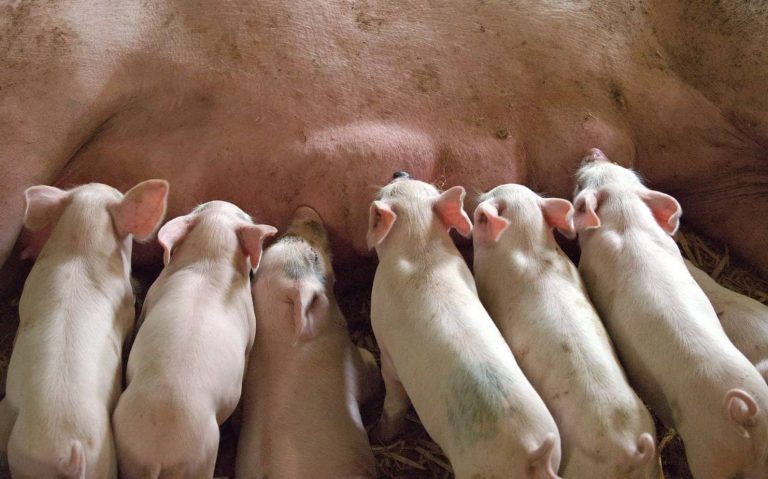
The adult sow can handle cold temperatures, but not heat, so she’s constantly moving around to stay cool. This can be problematic for her offspring, who need to be kept warm at all times. To solve this, a heat lamp can be hung over one corner of the farrowing pen or hut to provide a steady source of warmth for the piglets. The piglets tend to congregate under the heat lamp while their mother avoids the added heat, reducing the risk of her crushing them accidentally.

Selling pork

selfsb b4As you gain more experience, you’ll be able to estimate when your hogs have reached the ideal market weight just by looking at them. Loading these reluctant animals onto a truck or trailer for transportation to the market is often a challenging task. There are many methods to achieve this, but I have found that the most efficient way to load my hogs into my truck is by using a sturdy ramp with fenced sides and a hard-working dog.

While it may seem like a lot of hard work, raising pigs for profit is not a quick and easy solution to making money. However, it can be a reliable source of income for those living in rural areas who are willing to commit to the daily care and maintenance that is required. Take a moment to assess your own situation and see if raising pigs could be a viable option for you.

In addition to earning income, there is the added benefit of having your own fresh pork products, such as succulent pork roasts and smoked hams, essentially for free. This was a significant factor for us when we first considered raising pigs for profit, and we feel that the delicious results alone have made the effort worthwhile.

Recommended resources:

Raising Livestock For Self-sufficiency

How To Build The Invisible Root Cellar

Butcher Basics For The New Homesteader

The #1 food of Americans during the Great Depression

Correct wheel and tire for day to day survival

0

I converted to19.5 12ply commercial tires with a pretty aggressive tread and yes the Thunder Chicken has lift blocks I regularly put 6000#s (3 Tons) of feed in the bed 2 tons in bulk bags on pallets and 1 ton in small bags around the bulk bags. Get almost no tire compression with those load which = much less wear on the tires and have around 70,000 miles on this set now. Drawback is those are a $3800 set of tires counting the two spares.

DSC00524.JPG

Biggest upsides they get decent MPG and pull that trailer (12,000#) and those 3 ton feed loads through my road without breaking a sweat or traction.

DSC00747.JPG

Personally I could care less about tire diameter in the grand scheme of things for me a much wider tire, with a good gripping tread and 12+ Ply is what I look for. That mud ain’t very forgiving so I want tires that don’t feel the need to ask for forgiveness :)

Something else to consider is the compound yer tires are made of. In todays tire technology there are much softer consumer tires and much harder rubber rubber compounds for the commercial and heavy duty tires. Friend works at Continental Tire and tried explaining it to me and all I got was something to do with more silica and heat go into the commercial grade tires as well as more steel. so by the time a 19.5 12ply shoots out the butt end of the plant it is a very tough tire with a lot more structural durability than a standard tire. I am older so I am stuck in ply ratings LOL modern ratings are based on load range and letter stamped on the tire B through F B=4ply c=6Ply D=8 ply E=10ply and F=12 ply 6 Ply or C load rated tires seem to be most common now days and are typically rated at 2750# at 50PSI. You can have 20+ Diameter tire and it only be a C or D load rated tire. Which in my world is not a very substantial tire. Can by the same toke have a 14″ tire rated at F which is a very substantial tire. Those oddball size mobile home tires are a great example of a small tire that is F/12ply rated. Something the rating don’t figure is impacts with road debris but a F rated tire has A LOT less give than even a E rated tire It would take a hell of a rock at a high speed to compress one of my tires enough to blow the back of a rim out :)

I live, work and regularly drive in some rugged ass terrain so I want the toughest tires my money can buy, that can hold heavy loads and pull those loads through 1′ -2′ deep mud. Tires are like preps there is no one package that is right for everyone. For most people my tires are overkill for others my tires are light weights. But the one thing everyone always seems to get hung up on is the tire diameter (Inside not overall diameter) and neglects load ratings, width and tread. When you are looking at $600-$1,000 per tire for a top shelf set that is a intimidating price tag. Thus the much lower cost C, D, and E rated tires are what is in the budget. LOL won’t even get into my 17.5 16 ply trailer tires that cost more than my truck tires………. What tire is best really comes down to yer region, your terrain and how badly you abuses yer tires on average :)


Supply chain issues impede mass production of new Chinese engine

0

MELBOURNE, Australia — China has completed the development of its next generation of indigenous military aircraft engines and will start mass production once supply chain issues with advanced alloys are resolved, according to a senior official from a local aerospace materials research facility.

Speaking at an aviation investment summit in Tianjin, China, on March 17, Zhang Yong, a project leader at the Beijing Institute of Aeronautical Materials, told the audience that developmental bottlenecks for the WS-19 and WS-20 turbofans as well as an unidentified next-generation engine have been surmounted.

However, he added, material supply chain issues for the manufacture and delivery of the advanced alloys that will be used in the engines’ production still need to be ironed out. The official did not specify the supply chain problems.

The WS-19 afterburning turbofan is under development to power the Shenyang J-35, a next-generation fighter jet meant to operate from aircraft carriers for China’s People’s Liberation Army Navy. The WS-20 is a high-bypass turbofan engine that will power the Xi’an Y-20 airlifters operated by the People’s Liberation Army Air Force.

The Y-20 is currently powered by the Russian D-30KP low-bypass turbofan, which is also used by the Xi’an H-6J/K/N bombers of both armed services.

Zhang also confirmed that the WS-15 afterburning turbofan is ready for mass production. The engine will be used for later variants of the Chengdu J-20 stealth fighters of the PLAAF.

The WS-15, rated at 181 kilonewtons, is expected to provide a supercruise capability for the J-20, enabling it to attain supersonic cruise speeds without the use of its afterburner, which reduces fuel consumption.

Zhang also said at his presentation that China managed to achieve “98% localization” for WS-10C engine, which is powering the J-20s currently being delivered to the PLAAF. Other variants of the WS-10 equip China’s Chengdu J-10, Shenyang J-11B and J-16 fighter fleets.

He did not provide details on the remaining 2% input, although it’s likely related to components or materials China still sources from foreign providers.

Mike Yeo is the Asia correspondent for Defense News.

PayPal Working with ADL to Financially Blacklist and Spy on ‘Extremists’

0

No it is not, through out history, anyone who disagrees with you is an extremist, we just had a couple short periods in our system that allowed one to say what they wished. Of course the powers that be want to end that. Not that long ago that wise men were burned at the stake for translating the Bible into the local language so that the church no longer controlled it and in our favorite “stan” people are being beheaded for having “western ideas” as we read this.

The real “leaders” in this country don’t want wealth , other than as a system of gaining real power, and it is hard not to wear a tinfoil hat at the present time. It seems that every day more and more of our worst nightmares tend to actually under rate the real changes going on in our culture.

Of course the real true believers know that any of us reactionaries that resist the one true system must be punished and either be destroyed or rendered impotent.

Stay gray, be debt free, stay out of crowds, and have a lot of caches. Numbers don’t lie, in the small town I live in, the long term food supply that would keep my wife and I alive for 10 years, would feed the whole town for one day. It would seem that sharing, either on your own or under the force of law or the gun, really isn’t an option.


required readin | Survival Monkey Forums

0

Original Work – The Firelighters (A Learning Experience Stand-Alone)

0

Chapter One

The city was devastated.

Captain Riley Richardson kept his eyes open as the team passed through the first checkpoint, their forged paperwork – and a small bribe – more than enough to get them through without the kind of checks that would reveal their identity. The guards were jumpy, their eyes flickering from side to side as if they couldn’t decide if they were more scared of the rebel factions or their own leaders. Iran had been convulsed by civil war for the last five years, the fighting surging back and forth in a manner that was reminiscent of the First World War, and any hope of a peaceful settlement had been lost long ago. Riley was all too sure that when – if – the rebels broke through the network of trenches, antitank traps and fortified buildings, there would be a bloody slaughter. The defenders would be lucky if they managed to escape the city in time.

He remained wary as they drove down the street. The first bloody uprising had shattered the city. The rebel bombings – and terrorist raids – had only made it worse, inflicting horrendous misery on the population for little or no tactical purpose. The city’s masters were the worst of all, conscripting every able-bodied man into the defence forces and forcing them to work hard, keeping them from thinking about overthrowing their masters and trying to surrender to the advancing rebels. A handful of corpses dangled from ropes, left to rot, as a grim reminder of just what would happen to anyone fool enough to raise a hand to the government’s officials. Riley had seen some horrible sights in his time – he’d been a soldier for nearly fifty years – and yet, there was something about the city that chilled him to the bone. It felt dead.

“No women on the streets,” Sarah Wilde subvocalised. She was dressed as a local man, like the rest of the team. No one had bothered to check closely and even if they had, they wouldn’t notice anything odd about the team unless they had access to GalTech scanners. “No children either.”

Riley nodded. No women on the streets was almost always a bad sign. Civil wars – and war of religion – were always harder on the women, who were left to try to feed their children and pray for their menfolk to return safety from the front. The local government wasn’t even trying to help them, as far as he could tell, although there was little they could practically do. The rebel lines had isolated the city, making it impossible to bring in food from the countryside. It was only a matter of time until the city starved to death – or was forced to surrender. He shuddered to think about how many people would die in the next few months.

“They’re still jamming us,” Charles Isabel put in. “They know we’re coming.”

“They know we’d do something,” Riley agreed. “Do they want a fight?”

He felt his expression darken as they made their way towards the centre of the city. The Solar Union had made it very clear, time and time again, that anyone who wanted to immigrate was welcome – and any terrestrial government that tried to stop them would be severely punished. It was astonishing how reasonable some governments had become when they’d realised their most productive citizens would leave, if they weren’t well-treated; it was astonishing, too, that other governments thought they could get away with keeping their people from emigrating. Riley couldn’t blame anyone in the city for wanting out, even if it meant leaving the old world behind and flying into outer space. Hell, the local government should have been delighted. There would have been fewer mouths to feed.

“Maybe they want a heroic death,” Charles suggested. “Or they think the jamming will keep us from intervening.”

Riley shrugged. The jamming would prevent the Solar Union from teleporting the emigrants out of the city, along with the assholes keeping them prisoner, but it hardly kept his fellows from dropping a team of armoured soldiers into the city from orbit or simply sneaking through the trenches and into the city itself. Perhaps they thought they could use the would-be emigrants as human shields, although that would be foolish. If there was one thing Riley and his peers had learnt, in their careers, it was that allowing human shields to deter them would merely ensure all their enemies took and used human shields. He was quite happy to take risks to capture the terrorists, just to make sure they were hanged for breaking the rules of war. They couldn’t break the rules openly, then try to claim their protection.

“Deploy the drones,” he ordered.

“On it,” Sally said. “Interlinking relay systems coming online … now.”

“Good,” Riley said. The enemy jamming was alarmingly good, for something that had been patched together from pre-Contact tech, but the microscopic drones were designed to serve as tiny relay stations as well as sensor platforms. Their images were patchy, and some parts of the city were worryingly opaque, yet it was far better than nothing. Combined with the drones orbiting high overhead, it was unlikely anything could sneak up on them. “Let me know the moment you find the hostages.”

He took a breath and checked the live feed from the drones as they rounded a corner and headed towards the government complex. The enemy hadn’t realised it – he assumed – but their jamming was so powerful it was easy to pick out the source. It would be easy, too, to drop a KEW on it from orbit, although that would take out the entire complex and most of its inhabitants. He’d considered using a smart missile, but even that would put the hostages lives at risk. Besides, it would be a great deal more satisfying to breeze through the front gate and lay waste to the complex.

Don’t get cocky, he reminded himself, firmly. Just because their tech is primitive doesn’t mean they’re dumb.

“We won’t get through the gate,” Charles said, curtly. “The guards are being too careful.”

Riley watched the guards for a long moment, then nodded in agreement. The guards looked like irregulars, or terrorists, but they were checking papers and searching everyone who wanted to enter the complex with a professionalism he would have admired if they hadn’t been on the wrong side. He wouldn’t have been surprised to discover they had a list of authorised visitors too, like high security sites in the west. Anyone not on the list would be – at best – detained. Here, with the city bracing itself for rebel attack, it was likely that anyone they caught would be hanged without trial. They didn’t have the time for interrogation.

“You know the plan,” he said, his implants updating as more and more data flowed in from the drones. “When I give the word, click your forcefields on and charge.”

Charles snickered. “Perhaps we shouldn’t bother with the jamming,” he said. “We can do the mission ourselves.”

Riley smiled, then shook his head. “They’ll bring in reinforcements the moment they realise they’re under attack,” he said dryly, although he knew perfectly well the team already knew it. They hadn’t had much time to plan the operation, but they were experienced professionals. “We’ll need reinforcements ourselves.”

He braced himself as they drove up to the gatehouse. It was admirably secure. The compound walls had been enhanced with Hesco bastions, protecting the defenders from IEDs and VBIEDs; the bunkers, set further into the complex, covered the gatehouse with enough firepower to deter any local attacker. The complex itself was studded with murder holes – he couldn’t help thinking that whoever had cut them had done it entirely at random – and the roof covered with antiaircraft weapons, including one he was sure dated back to the Second World War. It wasn’t as laughable as it looked. The guns had been surprisingly good at killing tanks, back in their day, and rebel technicals had even less armour than early tanks and armoured cars. They might just be more useful than anyone thought.

“Five seconds,” he subvocalised. Microbursts flickered between the team, designating targets. The defenders wouldn’t have a chance to realise they were under attack before it was too late. He smiled, tightly, as the guards approached them. “Go!”

He drew his pistol, his enhanced arm moving inhumanly fast, and started to fire, cutting down the guards before they could react. The rest of the team fired at the same moment, Charles and Sally pouring superhot plasma into the bunkers while Terry and Josh opened fire on the rooftop defences. Something exploded, pieces of debris crashing down … Riley smirked as he jumped out of the jeep, activated his force shield and ran towards the jamming equipment, Sally right behind him. A defender appeared out of nowhere, pointed his AK-47 in Riley’s direction and opened fire. The bullets hit the force shield and harmlessly bounced off, ricocheting in all directions. Riley shot the man and kept going, even as the defenders rushed to the murder holes and opened fire. It felt as if they were panicking.

Long may they stay that way, Riley thought, darkly. He kept a wary eye on the live feed from the drones as they closed on the walls. The force shields were good, but an enemy that refused to panic could slow the team, even hit them hard enough to break the shields – directly or indirectly – and kill them. We have to move fast, without being slowed down.

The ground heaved. He glanced back, just in time to see a pair of fireballs rising in the distance. The orbiting drones, watching for enemy movements, had hit targets … hopefully, that would slow the enemy reaction long enough for the team to complete its mission and withdraw. He turned back to the wall, shoved a molecular disintegrator against it, and hit the switch. The wall disintegrated. The men inside spun around, too late. He switched his weapon to stun and opened fire, the defenders twitching painfully as they fell. They’d have headaches later, but at least they’d be alive.

“This way,” Sally said. The jamming was so strong it was interfering with the microscope drones. “I think …”

She kicked a door with enhanced strength. It shattered, revealing a hodgepodge of outdated computer and communications technology and a young man who gaped at them in horror, then threw up his hands. Riley stunned him anyway, just to be sure. The young man – he was barely out of his teens – looked like a tech nerd, but that didn’t mean he couldn’t be dangerous. Too many terrorists had taken to modern social media like ducks to water, openly broadcasting their vile deeds to the world while sneakily passing messages from cell to cell in codes that defied the algorithms. Riley designated the young man for pick-up – if he had been conscripted, he would be grateful – and stepped back to watch the door as Sally went to work. She was an expert at dealing with hybrid tech.

“Someone’s been telling tales,” Sally commented, curtly. “Lots of layered shit here …”

Riley nodded. Governments the world over had been working, desperately, to come up with ways to block teleport signals and, to be fair, they’d largely succeeded. He wondered, idly, who’d shared the tech with the locals, although the basic concept was simple enough anyone could put it into practice. Teleport signals were incredibly complex and there were limits to how far teleport systems could compensate before the signal was too badly corrupted to be reconstituted. Teleporting was normally perfectly safe, but using teleporters in a combat zone was asking for trouble.

“Too primitive to infiltrate,” Sally added, after a moment. “Lucky, we can just cut the wires.”

Riley grinned. “Do it.”

He checked in with the rest of the team as the jamming faded away. The enemy was trying to get organised, local forces storming the walls with the clear intention of trapping the team inside the complex. They didn’t seem to care about the fact they’d also be trapping their leadership, unless someone on the outside was hoping to take advantage of the chaos to launch a coup. It would be a poisoned chalice, if they succeeded, but the lure of absolute power – even over a besieged city – was hard to resist. The ground heaved as the drones rained death on the surrounding streets, clearing the way for the reinforcements. New icons flashed up in front of his eyes as the first marines started to teleport into the city.

“They won’t be able to get the jammers up again in a hurry,” Sally said. She’d done more than just pull the plug. Once the power was off, she’d activated her lancers and melted half the outdated junk. “Let’s go.”

Riley nodded and led the way out of the room at a brisk clip. The live feed from the drones was updating rapidly, now the jamming was gone, turning the fog of war into a distant memory. The surviving defenders were scattered, a handful running for their lives … straight into the armoured marines taking position outside the complex. The remainder were heading for the prisoner barracks. Riley gritted his teeth as he picked up speed, barely noticing an armed man coming at him. He stunned the man on automatic and darted past him before the unconscious body hit the ground. The stairs would have made a pretty good chokepoint, if the defenders had been thinking clearly, but they hadn’t even tried to make a stand. He threw a stun grenade down the stairs anyway, just to be sure, and followed, gritting his teeth as blue light flared below him. His hair threatened to stand on end. He’d felt the edge of the detonation even through the shield.

“In there,” Sally said, as the ground heaved again. Dust fell from the roof. “Quickly.”

Riley crashed through the door, ready for anything. The prisoners stared at him in numb shock. Women, children … he hoped the grown men had been conscripted, rather than simply hanged, but he feared the worst. The oldest boy he could see looked to be about twelve, if that. His teeth clenched. It wasn’t the first time someone had conscripted child soldiers, but it never failed to shock him. It was an atrocity if ever there was one.

“Hold still,” he snapped. “Don’t move!”

He triggered the teleport scanner. The system ran a series of checks, making sure the local jamming remained down, then linked into the drones and activated the orbiting teleporter. The prisoners froze, their eyes wide with horror as their bodies dissolved into white light. They’d be reconstituted on the orbital platform, where medics would tend to their wounds and provide what reassurance they could. He felt a flicker of sympathy. Religious authorities all over the world were still trying to decide if teleporting was no better than suicide, killing the original person and then creating a duplicate that thought it was the original. The Galactics had proof the teleporter didn’t do anything of the sort – and apparently teleport duplicates were the stuff of science-fantasy – but the explanation was too complex for anyone who didn’t have a degree in quantum physics. Privately, there were times Riley wondered if the Galactics hadn’t simply cooked up a tissue of lies to keep the younger races from thinking about it.

“Sir,” Charles said. “We have the leaders.”

“Teleport them into custody,” Riley ordered. The city’s masters would stand trial for their crimes. If they were found guilty, and he couldn’t imagine any other outcome, they’d either be sent to a detention asteroid or executed. They probably weren’t the sort of criminals who could pay their debt to society through indentured labour or military service. “Josh?”

“We swept the lower levels,” Josh reported. “Got a handful of prisoners and a shitload of records.”

“Take them all,” Riley said. The records might be useful. Who knew? If nothing else, they’d be informative when historians came to write the history of the civil war. He put the thought aside as another explosion shook the ground. The live feed from the drones revealed the rebel forces, advancing against the trenches as they scented weakness. “I think we’ve outstayed our welcome.”

“Looks like it,” Charles agreed. “I don’t want to say we’re surrounded, but we’re being fired on from all sides.”

Riley nodded. “We’re done here,” he said, keying his communicator. “Bring us home.”

He closed his eyes, his skin itching as the teleporter took hold of him. The techs swore blind he was imagining it, but his imagination had always been very powerful. His body staggered, slightly, his eyes snapping open as the teleporter let go. It had been fifteen years since he’d joined the Solar Navy, fifteen years since he’d first used a teleporter, yet he’d never got used to it. The sensation was too disorientating, even for him.

“Sir,” Captain Yu said. “The remainder of the team and reinforcements are being pulled out now.”

“Very good.” Riley sighed inwardly as the adrenaline started to wear off. There would be paperwork. Lots and lots of paperwork. The Solar Union had less than the United States Navy, but … he shook his head. There had to be at least some organisation or the results would be absolute chaos. “We came, we saw, we kicked ass.”

And it was a walkover because they weren’t prepared for us, he reminded himself, sharply. The locals hadn’t understood the full potential of GalTech. The Galactics did. Everyone knew it was just a matter of time before the Solar Union and the Galactics came to blows and then … The next engagement will be harder.

“Yes, sir,” Yu agreed. “You have a message from Command. You have one day’s planetside leave, if you wish it, then you are ordered to return to base. I think they have something in mind for you.”

“No shit, Sherlock,” Riley said. He hadn’t expected any leave. The fact they were being given a day off, with full access to the teleporters, was worrying. It suggested they were being tapped for something very dangerous … he snorted at himself. If he’d wanted a nice risk-free life, he would have become an accountant or a doctor or something – anything – other than a soldier. “I’ll pass the word to the team, then go planetside.”

Yu made a face. “I wouldn’t go down there on a bet,” he said. “It isn’t the world we grew up in. Not anymore.”

“No,” Riley agreed. The younger generation had broken all ties to their homeworld. He was too old to cut the links completely. “But I have family down there.”


Brand new here…Howdy! | Survival Monkey Forums

0

  1. How’s it going, monkeys? I’m a former Californian turned Iowan that was lucky enough to stumble upon a nice house with a decent amount of land. I’m accompanied by my new wife and our two bearded-dragons, Goober and Booger. I spent 6 years in the Air Force reserves with 2 deployments, but have no pretenses of being any kind of veteran badass. I’m mostly looking for any guidance as a prospective homesteader and survival prepper. I’d appreciate any words of wisdom, or direction towards tools that you find helpful. Glad to be here!


survivalmonkey.com warrant canary