One reddit dip shit is telling his other dip shit follwers "Christian extremists live in small towns", they don't have any police", they're defenseless", "they have volunteer fire fighters".
Live stream that please.

One reddit dip shit is telling his other dip shit follwers "Christian extremists live in small towns", they don't have any police", they're defenseless", "they have volunteer fire fighters".
Live stream that please.

The news Just recently came out that NASA is preparing to send a probe out to take a close look at a metal asteroid orbiting between Mars and Jupiter.
In what they call (reasonably enough) the Asteroid belt.
The probe was originally scheduled to launch in 2023, but NASA is bumping the launch date up to 2022–just ‘cuz they really, really want to.
SO–crinkle down your tinfoil hats, my fellow unindicted co-conspirators, and tuck those Aluminum bibs into your collars–because I have something really tasty for you!
The name of the asteroid is 16 Psyche. It’s diameter and mass are well know.
As a result, it’s density is also well known.
16 Psyche is about 124 miles long, about 95% metal, and it’s been calculated to weigh in at a porky 2.72±0.75×10^19 kg.
I think that’s 272,000,000,000,000,000 metric tons. Or 272 quadrillion, if I haven’t lost count of the zeros. (I only have thirteen toes.)
Now, for those of us that can only count to 30 because that’s how many bullets will fit into an illegal high-capacity magazine in Commiefornia, let me simplify that a bit.
It comes out to a density of 4,500 g/cm³.
I confess, I didn’t have a clue how much that was at first because none of my fingers and toes are metric.
But we all know (and love) GOLD!!!!
Which only weighs 19.32 g/cm³.
And there you have it: Whatever 16 Psyche is made out of, it’s 232.919 times as dense as gold.
Considering that Osmium is the heaviest metal on Earth, and at a diminutive 22.59 g/cm3 is only a smidge denser than gold, that means that 16 Psyche is made out of pure Unobtainium.
Folks, there isn’t supposed to be ANYTHING outside the core of a neutron star that’s more than 213 times as dense as gold.
And if it that “Unobtanium” came out of the core of a neutron star, its release from the unimaginable pressure therein should have blown it into individual pieces of individual atoms.
So now you see why NASA is interested in 16 Psyche–VERY interested.
That material will have characteristics we can’t even imagine right now. It may be the ultimate room temperature superconductor, or a source of energy that makes Uranium look positively pale, stale, frail & feeble.
And all they need to grab up is a teaspoon of it (48.89881 lbs.) to start finding out what it’s good for.
And to start an asteroid “gold rush” that will make rushing for mere gold an utterly chump-change enterprise.
Of course, if we get there first, we can stake our claim and own the whole Asteroid.
Even if we have to fight a few wars to keep it.
But the Big Question is: Will the Space Aliens let us have it?
And it they won’t, and we try to take it anyway, will they let us have it?
NASA Is Sending a Spacecraft to a Metal Asteroid | VIDEO
In the wilderness, where nature’s raw beauty captivates the senses, lies a realm teeming with adventure and exploration, we are always vulnerable and we need to take care of ourselves. Amidst the untamed landscapes of sprawling forests and rugged mountains, a hidden danger lurks—one that may not be as apparent as the towering trees or rushing rivers.
It is the realm of common skin conditions, afflictions that can beset even the most intrepid souls.
As we venture into the great outdoors, our skin becomes a steadfast guardian, shielding us from the sun’s scorching rays, the biting cold, and the relentless wind. Yet, it is also exposed to the challenges that arise from prolonged immersion in nature’s embrace. Rashes and blisters, bites and stings—these unwelcome visitors can swiftly transform an enchanting escapade into a worrisome ordeal if left unattended.
Imagine, as you traverse a dense forest, the insidious itch of poison ivy creeping upon your skin. Or perhaps, in the depths of a mosquito-infested marshland, the incessant buzzing is matched only by the tormenting itch of their bites. In the wilderness, encounters with nettles, thorny bushes, poisonous plants, and venomous creatures are not uncommon, leaving their mark on our skin.
Understanding how to handle these skin problems becomes paramount for those who seek solace in the wild. Knowledge and preparedness become trusted companions on the journey. Armed with awareness of common irritants, preventive measures, and effective treatments, one can mitigate discomfort and potential complications.
By recognizing the telltale signs of each ailment, adventurers can discern harmless irritations from serious infections, taking swift action when necessary. Equipped with protective clothing, insect repellents, and sunscreen, they shield their skin from the perils nature presents. A well-stocked first-aid kit becomes their ally, filled with remedies tailored to wilderness-related skin conditions, ready to provide relief and promote healing.
In the following discussion, we embark on a journey through the wilderness of skin conditions, unveiling the most common afflictions encountered and exploring practical steps to manage them effectively.
Skin rashes are a common issue encountered in outdoor settings. Sometimes, a rash can provide valuable clues for diagnosing certain diseases. If a patient is running a fever or appears visibly ill, it is important to consider conditions such as Lyme disease, Rocky Mountain spotted fever, typhoid fever, syphilis, meningococcal meningitis, strep throat, measles, and mononucleosis.
Many rash-causing infections are viral and do not respond to antibiotics. However, in the wilderness where professional medical assistance may be unavailable, if a rash is accompanied by symptoms of illness, particularly fever and body aches, it is advisable to empirically treat it with an antibiotic like doxycycline. A dosage of 100 mg twice daily should be continued for at least 2 days beyond the subsiding of fever.
Certain infections may require longer antibiotic treatment, so it is important to follow the prescribed course if there is a likelihood of dealing with such conditions.
Localized rashes without fever are often caused by superficial skin infections, fungal infections, or allergic reactions. Itching can be alleviated with antihistamines or over-the-counter pain medications. Diphenhydramine, available in the Non-Rx Oral Medication Module, is an effective antihistamine. Taking one capsule every 6 hours (or two in severe cases) can provide relief from itch caused by various factors.
As itch and pain travel along the same nerves, any pain medication can also help alleviate itching. It is generally advised to avoid warm soaks as they can exacerbate itch and rashes unless there are signs of deep infection.
Diphenhydramine is a highly effective oral antihistamine, but it’s worth noting that Atarax (found in the Rx Oral/Topical Module) and its injectable form, Vistaril (found in the Rx Injectable Module), also possess antihistamine properties and can be used to relieve itch. Applying a piece of Spenco 2nd Skin from the Topical Bandaging Module can provide soothing relief to non-weeping or blistered and weeping rashes. Cool compresses can also help soothe a rash.
For moist, weeping lesions, wet soaks using diluted Epsom salts, boric acid, or even table salt can help dry out the affected area (this includes rashes from poison ivy, poison oak, and poison sumac). If the rash is dry and scaly, ointments are generally more effective than gels, lotions, or creams. In the case of blistered rashes, creams, lotions, or gels are the preferred choices. Specific types of rashes may require specific topical medications, so it’s important to use the appropriate treatment accordingly.

Fungal infections are commonly encountered in areas such as the groin, armpits, skin folds, scrotum, under a woman’s breasts, and around the rectum. Rashes associated with fungal infections can vary in color from bright red to almost colorless, but they typically appear as a dull red shade. Often, small satellite spots can be observed near the main rash area, forming a confluent pattern.
Fungal infections tend to spread slowly, with the lesions gradually increasing in size over weeks or even months. It’s important to exercise caution and differentiate fungal rashes from other conditions like Lyme Disease.
Treatment for fungal rashes involves the use of specific antifungal medications. Clotrimazole 2% cream, available in the Non-Rx Topical Bandaging Module, is an effective choice. Apply a thin coat of the cream twice daily. Significant improvement should be noticeable within 2 weeks for conditions like “jock itch,” although it may take up to 4 weeks for athlete’s foot and body ringworm.
Treatment should be continued until all signs of the rash have disappeared, and then an additional 3 weeks of daily treatment is recommended. If there is no improvement, it is possible that the initial diagnosis was incorrect or the fungus is resistant to the chosen medication.
For more severe or extensive body surface fungal infections, Diflucan (fluconazole) is an option from the Rx Oral Medication Module. A dosage of 150 mg per day is usually effective, but it should be noted that this medication is primarily included in limited quantities for the treatment of vaginitis.
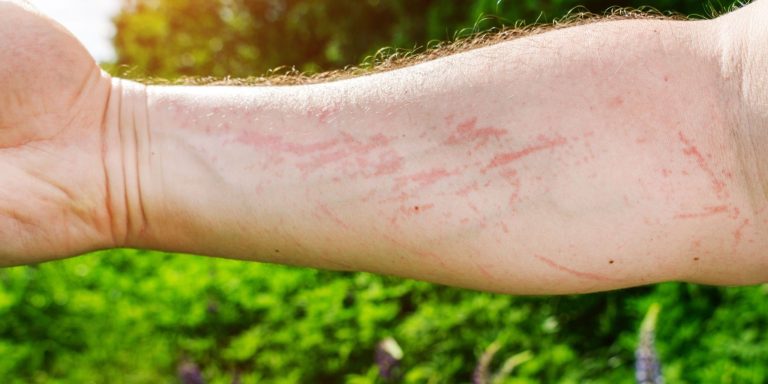
Allergic dermatitis is characterized by the presence of vesicles or small blisters on red, swollen, and intensely itchy skin. The definitive sign of allergic or contact dermatitis is the appearance of a line of these blisters.
Common causes of allergic dermatitis include contact with poison ivy, poison sumac, and poison oak. Additionally, contact with caterpillars, millipedes, and various plants, including seemingly harmless evergreens, can trigger allergic or toxic skin reactions.
When dealing with a toxic reaction caused by exposure to a harmful substance like certain insects or plants, the treatment approach is similar to that of allergic dermatitis. Begin by thoroughly cleansing the affected area with soap and water. Subsequently, administer diphenhydramine at a dosage of 25 mg every 6 hours from the Non-Rx Oral Medication Module. Additionally, apply hydrocortisone cream 1% from the Topical Bandaging Unit twice daily.
For weeping lesions, wet soaks, as mentioned previously, can be employed as part of the treatment. Using an occlusive plastic dressing can enhance the effectiveness of the relatively mild 1% hydrocortisone cream.
Within the Rx Oral/Topical Medication Module, two highly effective medications are available to address this issue. Continue using diphenhydramine, but also introduce Decadron (4 mg tablets) at a dosage of one tablet daily for a period of 5 to 7 days.
Additionally, replace the hydrocortisone cream with Topicort 0.25% ointment. Apply a thin coat of the ointment twice daily without using an occlusive plastic dressing. This combination should yield rapid results in alleviating the symptoms.
Impetigo is a common bacterial infection that affects the superficial layers of the skin, resulting in a rash. The typical presentation of impetigo involves reddish areas surrounding pus-filled blisters, often accompanied by crusty and scabbed skin. These lesions tend to spread rapidly over the course of several days. Unlike other infections, the skin beneath the lesions is generally not swollen.
Impetigo commonly starts around the nose and buttocks, but can quickly spread to other areas of the body due to scratching. In the early stages, the lesions appear as small pimples, which develop crusts within 12 to 24 hours.
Proper management of impetigo involves cleansing the affected area with surgical soap or hydrogen peroxide. After cleaning, apply a triple antibiotic ointment to the lesions. It is advisable to avoid placing bandages on the affected areas, as this can potentially facilitate the spread of germs beneath the tape.
Bacterial skin infections typically require treatment with prescription antibiotics. In the case of impetigo, Levaquin (500 mg once daily) from the Rx Oral/Topical Medication Module is a suitable option. Alternatively, the Rx Injectable Medication Module contains Rocephin, which is well-suited for treating this condition. Administering 500 mg of Rocephin via intramuscular injection once daily would be an appropriate approach.

Seabather’s eruption refers to the sudden onset of an intensely itchy rash that occurs after swimming in certain waters.
In regions like south Florida and the Caribbean, this condition is caused by the larvae of the thimble jellyfish (Linuche unguiculata) or the larvae of the sea anemone (Edwardsiella lineata). In fact, the latter has been identified as the cause of numerous cases on Long Island, New York. With the impact of global warming, it is likely that this condition will become a concern in regions much farther north than its current range.
Within 24 hours of exposure to ocean water, individuals affected by seabather’s eruption may experience the emergence of hives (urticaria) or develop a fine red or pimply rash. Typically, the rash appears in areas covered by bathing suits, as the tiny larvae become trapped against the skin and release nematocysts, triggering the onset of the disease.
Additional symptoms often associated with this condition include fever, chills, weakness, and headache, as the larvae penetrate the skin and cause illness.
In south Florida, occurrences of seabather’s eruption are most common from March to August, with a peak in outbreaks during May. In Long Island waters, outbreaks typically occur from mid-August until the end of the swimming season in early September. These outbreaks are sporadic, with only a few cases reported in some years, while other years may see thousands of cases during peak periods.
Treatment for seabather’s eruption involves the use of topical corticosteroids. Options include applying 1% hydrocortisone cream from the Non-Rx Topical Bandaging Module four times daily or using 0.25% Topicort ointment from the Rx Oral/Topical Module twice daily.
Additionally, taking an antihistamine such as diphenhydramine (25 mg) from the Non-Rx Oral Medication Module four times a day can help alleviate symptoms. It is advisable for swimmers to remove their bathing suits and promptly shower after leaving the water. It is important to note that swimming at a nude beach does not provide protection against seabather’s eruption solely because a bathing suit is not being worn.
 When venturing into the wilderness or engaging in outdoor activities, it is essential to be aware of common skin conditions that can be encountered. From rashes associated with diseases to fungal infections, allergic dermatitis, and bacterial skin infections, understanding how to handle these skin problems becomes crucial in such situations.
It is important to note that the provided information serves as a general guide, and seeking professional medical advice or following the instructions in relevant medication modules is essential for accurate diagnosis and appropriate treatment.
By being knowledgeable about these common skin conditions and equipped with the right information and resources, individuals can effectively handle skin problems encountered in the wilderness, ensuring a safer and more enjoyable outdoor experience.
his article has been written by James H. Redford MD for Prepper’s Will.
You may also want to check this:
Learning to recognize and treating dangerous Heat Disorders
Surviving drought – How to obtain water from air!
A few survival foods everyone should learn how to make
Survival Hydration – Surviving with a minimum amount of water

I did not explain that the SOG Flash II and other knifes have a safety as far as for me I disabled it with some of that stringy glue comes in your mail and a tiny piece of aluminum foil locked it in place. I have never had a problem with this coming open. It may be due to the models requirement that it open over an inch before the assisted spring pressure engages an opens the knife.
A knife is the second layer of defense and mostly for all the things that need to be done like opening a feed sack that has crappy sewing cut insulation off wire open boxes and I cut the heads off a few snakes most every year in my pens mpstly rat snakes and copperheads or finish off a large wood rat the trap did not break their neck.
Knife fighting is for the young and agile, the old saying states that colt made all men equal not Ginsu (kitchen knives) that said a knife attack is faster than a response with a holstered pistol or the ability to do anything but throw off your attacker and try not to get tangled up cornered or not expect there are more than one attacker. I count on my awareness first to keep me out of trouble. Having made my living in places where knife attacks or menacing to rob you is normal M.O; or blunt instrument, You watch and have a defense mine was a rolled up newspaper and a length chain with a “D” ring or a soda pop bottle and some skills training.
Most places do not allow foreigners to have anything remotely sharp or a firearm. In this country even if your allowed police courts and juries are horrified if the assailant is cut to pieces even if they had a blade if your not harmed look for a hostile jury. America is not there quite yet but when it flies apart knives will become more encountered and the people will not run and may well attack as a group you see this in recent attacks on Trump associates and supporters more than one so if something happens they can back up each others lies. we area tick away from murders, allowing someone within your personal space gives them 100% success to do whatever they intend including 2 hold you and one beat you to death. This is a stupid thing to allow, it sets a precedent that your suppose to maintain the high ground and you ignore your defensive response and you get murdered ? People that do these things are mentally ill dangerous and we see from all the unrest to be violent and the police stand down and many times no one is arrested and they have started using home made bombs made from fireworks, Where is the FBI ? Bombs are terrorism why were not all the rioters arrested and questioned to identify and track them ? In my opinion because the local leaders want a civil war or fear retaliation from law suits either way it’s bad for all of us.
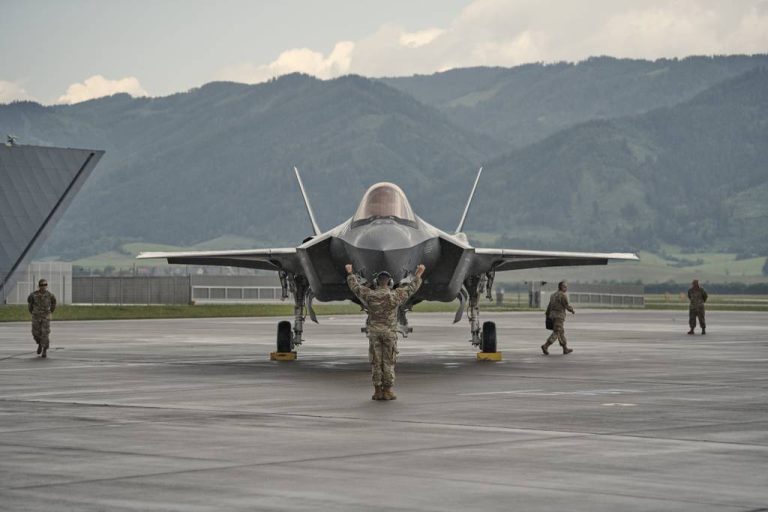
Moody Air Force Base, Georgia, is the service’s top pick to become the next active duty home of the F-35A Lightning II fighter.
The Air Force said Monday it plans to bring two F-35 squadrons to the Valdosta base starting in fiscal 2029, when it hopes to complete phasing out its fleet of A-10C Thunderbolt II attack planes.
The service must first study the proposed move’s environmental impact on the surrounding area before formally green-lighting the project. That review is slated to finish in fall 2025.
Switching missions at Moody isn’t expected to create any new jobs on base, the Air Force said, although it had previously announced that the U.S.’s most advanced fighter jet would bring in another 500 or so workers.
It’s unclear what other bases were considered as part of the process.
Winding down much of America’s combat operations overseas has prompted a significant shift in Moody’s missions at home. For almost two decades, the base’s A-10s watched over ground troops and strafed enemy forces with the Warthog’s iconic, armor-piercing 30mm gun.
Moody airmen also flew search-and-rescue missions in Afghanistan since the early days of the U.S. invasion and trained Afghan pilots on the A-29 Super Tucano ground attack aircraft to build the country’s fledgling air force.
The Air Force’s plan to swap A-10s for F-35s at Moody is emblematic of the Pentagon’s pivot from its longtime War on Terror to instead focus on military competition with China.
The service argues that the Warthog fleet must be retired because it is ill-equipped to face off against advanced air defenses, stealth jets and the vast distances of the Pacific. Critics say the A-10 can perform the close air support mission far better than the F-35, which was designed as the high-tech “quarterback” of the battlefield rather than to hunt convoys.
Georgia lawmakers hailed the decision as a long-term investment in the region’s military community as the country’s priorities change.
“This is a major step forward in our ongoing effort to strengthen and sustain Moody Air Force Base for decades to come,” Sen. Jon Ossoff, D-Georgia, said in a release Monday. “I will continue to champion Moody AFB and its future as a home for U.S. Air Force tactical aviation.”
“For decades Moody AFB has been key for our nation’s defense,” Republican Rep. Austin Scott, who represents the base’s district, said on Twitter. “I am pleased that Secretary Kendall has selected Moody as the preferred location for the F-35 Joint Strike Fighter. Moody is proud to maintain a fighter mission, carrying its strong legacy long into the 21st century.”
Active duty F-35 units already handle test, training and combat operations from Edwards Air Force Base in California, Nellis AFB in Nevada, Luke AFB in Arizona, Hill AFB in Utah, Eglin AFB in Florida, Eielson AFB in Alaska and RAF Lakenheath in England. Three more squadrons will start arriving at Tyndall AFB, Florida, this summer.
In May, the service announced that the Oregon National Guard will likely host the Air Force’s third F-35A training squadron at Kingsley Field, pending an environmental study. The decision would bring 20 jets but no new jobs to the installation.
“The Air Force needs F-35 squadrons available and fully mission-capable to prevail against peer adversaries,” the Oregon Air National Guard’s 173rd Fighter Wing said in a release. “That means they require more F-35 pilots. Team Kingsley’s adaptability and excellence allows us to fill this Air Force need.”
The U.S. plans to purchase 2,470 F-35s overall, more than 1,700 of which will be flown by the Air Force. The jets remain the Pentagon’s most expensive weapons program, at more than $1.7 trillion to buy, operate and maintain, the Government Accountability Office said last year.
Rachel Cohen joined Air Force Times as senior reporter in March 2021. Her work has appeared in Air Force Magazine, Inside Defense, Inside Health Policy, the Frederick News-Post (Md.), the Washington Post, and others.

The Air Force’s new T-7 Red Hawk training jet flew for the first time Wednesday in St. Louis, Missouri, the company said in a release.
Its flight marks the beginning of the T-7′s final development phase before Boeing starts producing military-ready jets. Red Hawks will replace the Air Force’s six-decade-old T-38 Talon trainers as the main platform that prepares American and foreign pilots to fly fighter and bomber aircraft.
Over the course of the hour-long trip from St. Louis Lambert International Airport, Maj. Bryce Turner, a test pilot with the 416th Test Squadron at Edwards Air Force Base in California, and Steve Schmidt, Boeing’s chief T-7 test pilot, gauged how smoothly the plane maneuvered and tested secondary systems like the auxiliary power supply, Boeing spokesperson Randy Jackson said.
The pair vetted how well the plane handled positive and negative g forces, as a pilot experiences when accelerating or flying upside down, and practiced in high-altitude airspace, Jackson said.
“The stable performance of the aircraft and its advanced cockpit and systems are game-changers for U.S. Air Force student pilots and instructors alike,” Turner said in the release.
As the first Air Force training jet designed in the 21st century, the T-7 offers students a digital cockpit, more realistic simulators and software that can be updated as real-world threats evolve.
The airframe that flew Wednesday is one of five test aircraft that will be delivered to the Air Force before it starts receiving fully finished jets at its schoolhouses. The Air Force plans to buy 351 Red Hawks starting in December 2025 under a $9.2 billion contract awarded in 2018.
But design problems with the escape system and ejection seat have set the production timeline back by multiple years.
Air Force officials now plan to decide in early 2025 whether to begin building operational jets, meaning the service would start receiving aircraft two years later than originally intended.
Some problems stem from an effort to make the jet more accessible to pilots of any race or sex. Earlier airframes were primarily designed to accommodate men based on body measurements from decades-old military studies. That means many women’s torsos or arms are too short to safely operate the jets or to eject.
The Air Force has said that testing showed T-7 pilots could be at high risk for concussions, unsafely speeding up when their parachutes open, or losing their visor. Further tests earlier this year aimed to resolve those concerns.
Jackson said a successful high-speed test in February laid the groundwork for future rounds to ensure the escape system is safe, but did not say whether specific issues remain.
Boeing claimed in the release that the T-7′s cockpit egress system is the “safest of any trainer.”
“This first flight with the Air Force represents our team’s commitment to delivering a new level of safety and training for fighter and bomber pilots,” said Evelyn Moore, Boeing’s T-7 program manager, in the release. “We remain focused on engineering ways to better prepare warfighters for changing mission demands and emerging threats.”
Meanwhile, T-38 maintenance issues have slowed the training pipeline amid a longstanding fighter pilot shortage.
Air Force Times reported in March that a private contractor’s delays in restoring the T-38′s J85 engines threatened to slow pilot production for at least another six months. The engine enterprise may not fully recover until April 2024, despite improvements in the supply of spare parts and repair rates, the service said.
“It’s an old engine. … There’s a lot of moving parts,” Air Education and Training Command boss Lt. Gen. Brian Robinson said Feb. 16. “But as a customer, I just want to produce pilots.”
Rachel Cohen joined Air Force Times as senior reporter in March 2021. Her work has appeared in Air Force Magazine, Inside Defense, Inside Health Policy, the Frederick News-Post (Md.), the Washington Post, and others.
Does anyone have any knowledge why the hell ammo prices are still so damn high?
I went to purchase a new firearm (Tavor X95), one that I have given a lot of thought and research and even sold my favorite AR to obtain approval from the Finance Ministry for the purchase. I had green lights across the board, everything was a “Go” then I thought, “I’ll pick up a thousand rounds (5.56) so I am ready for new rifle” as I didn’t want to touch my ammo stash, which is around 8000 rounds of M193 and a couple thousand of M855. The cheapest I could find, on the internet was 40 cents a round, not including shipping! WTH?
Anyway, I was shocked as thought things were back to normal. Most of my ammo was purchased at a maximum of 30 cents a round and I expected to see something at least close to that but no…nowhere close. So, I am extremely pissed as no sense in purchasing a new rifle if ammo is too expensive to shoot, especially when just shooting holes in paper. Yeah, I could shoot my stores/preps but…I don’t like that idea give the daily insanity in which we live.
What the hell is going on? Anyone got any information or even an idea why ammo hasn’t come down? Is it still a supply and demand thing and will remain this way until Biden leaves office (hopefully on a rail, tarred and feathered)? What do you think? Ideas/Info?

Not to bad here, 40 miles South not much at all 40 miles North a whole lot thicker than here. Thought the neighbors had a bale get hot and start smouldering when I walked out and saw it. They line their round bales up over there. I do a bit of consulting work on the side in the small farm bio security, general security and plant and animal problem trouble shooting. And had a consultation up around Salem this morning and another over by Fairfield. The Smoke from Canada was real thick around Fairfield. Salem was somewhere between what we had here and Fairfield. Finally found a reason to wear my Covid Mask in the truck, it was thick enough to be irritating in the throat. Then shot down to a Doc Appointment in Marion and almost nothing of the Smoke past Johnston City.
The Consults were very similar in nature “MT GARDEN IS DYING AND I CAN’T FIGURE OUT WHY!” I figured it was one of two things before even setting out, Herbicide Drift from bean fields being sprayed or The Heat/Drought and them not watering enough. After arriving at both it was obviously Herbicide Drift. 99% certain both got hit by Dicamba Drift. I cut a bag of samples from both and dropped them off at the lab on my way to the Doc appointment, will know for certain tomorrow or day after what herbicide gave their gardens a lethal dose. Both have Large bean field NW and West of them that were sprayed in the last 2-3 days and the Winds have been out of the West NW the last several days. And Dicamba 2-4D anytime is highly volatile in this heat and the decent breeze it is even more volatile. I am not a lawyer so I don’t get involved in the compensation or give any kind of legal advice. I just root out the cause of the malfunction and give advice on how to correct it. There is a mechanism to get some compensation for drift but you have to conclusively prove that the farmer that sprayed misused the ‘cide and caused the damage. A taller hill to climb than it sounds like. In most cases any compensation recovered would be a fraction of what hiring a lawyer to recover it would cost.
So I can’t help those folks beyond confirming what I pretty much already know via the lab results. I can dispense some advice to folks that are planning on buying their dream homestead/farmstead. This is a factor almost never considered when shopping land. If you buy one of these 1-20 acres tracts of land carved out of a larger farm with fields all around your island. You are going to get Herbicide and Pesticide Drift when the fields are sprayed. Some sprays are more volatile and worse than others and the volatile the greater the drift will be. Xtend and Enlist Soybeans that are genetically engineered to be Dicamba 2-4D tolerant arrived in 2016 and 2019 creating a whole new herbicide drift issue. It is simply best to avoid the problem of drift in careful land selection. Like putting a mile or more between your prospective land and row crop fields. If you plan on keeping bees insecticide drift will be a major concern and the bees gathering pollen from insecticide sprayed crops will be a major issue. I have seen drift wipe out folks bee hives and despite the farmer being required to advise prior to spraying very few actually will and do so.
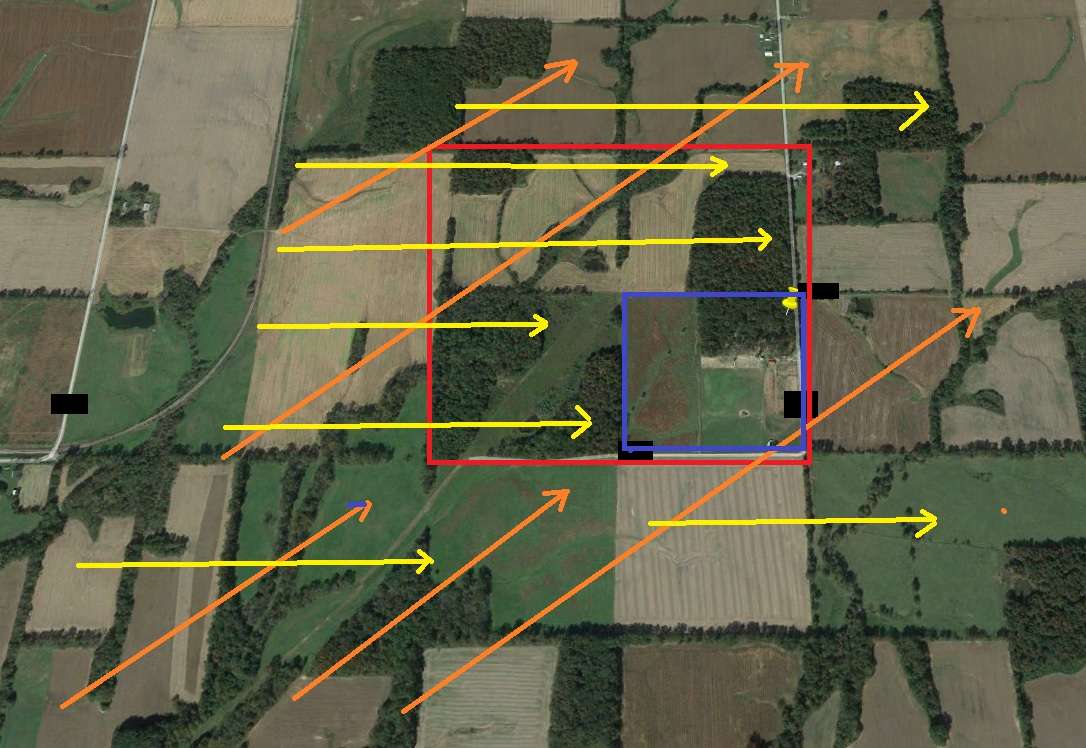
I will use myself as a bad example as usual  The Yellow arrows are West wind drift patterns and the Orange Arrows are the prevailing SW wind drift patterns The Red Box if the entire property, the blue box is the Original 40 acre tract. Drift and prevailing winds were one of the major factors I looked at when shopping for the larger piece of land in 2007/2008 The original 40 gets almost no ‘cide drift. My North Fields are NEVER sprayed with Volatile or Persistent anything and the water run off from them and the fields North of them flows through the West 40 acre tract, not a drop of run off comes through the Original SE 40. The only run off water flowing into the lake and ponds on the SE 40 is from the SE40. Basically theOriginal 40 has a drift buffer W, NW and North and the prevailing winds prevent any drift on my home 40 other than the very South East most corner and my neighbor to the SW is another buffer only using his SW 80 acres as pasture and hay land.
If you plan on being self sufficient and not occasionally or regularly having your fruits, vegetables and honey bees wiped out by drift you should be looking for something very similar to my home 40 acres. You really don’t want to be calling someone like me mid growing season and asking “Why is my garden turning yellow and dying?” Or “Why do I have piles of dead bees around my hives?”
And DO YOU REALLY WANT TO have those drift chemicals in your lungs and clinging to your body? There is no magic shield or dome to prevent drift and you have little to no control over what adjacent property owners do in their fields. The cost of recovering damages is typically far greater than anything you will recover. So it is far better to avoid buying land that is subject to drift.
Drift was a very important factor to me. I produce around 95-97 percent of what we consume on that SE 40 acres. Drift wiping out my food crops, orchard, vineyard, bees, and poisoning us and the livestock was just not a option. I also want to be on at least decent terms with the adjacent property owners and not in constant conflict with them.
LOL and yes my property is Deer and Turkey Heaven and a Deer and Turkey Refuge I occasionally need to thin the numbers down and allow a couple of people to thin the herd down as well as taking a couple myself. Some very impressive Bucks and very large Does have been harvested here over the years. I am more into my rabbit, quail, dove and tree rat hunting than the Deer and Turkey. Hard to beat a pair roasted quail on the plate……….. but I digress as usual
The main factors I look at when selecting land to purchase are Water, water flow, fertility, the right mix of woods, crop, pasture/hay, my personal quirk of it must be at the end of a dead end dirt or gravel road, at least 5 miles away from a small town with some basic services, 20 miles away from a larger town 5000-7000 population and 35-45 miles away from a couple of 15,000-30,000 population towns and the Drift patterns. Some say I am in the middle of nowhere, quite the opposite I am in the middle of Everywhere in Southern IL. and within striking distance of 3 of the larger population towns, 8 Smaller 3500-7000 pop towns and a lot of the little 100-500 population towns but at least 6 miles from the closest small town with a couple of gas stations, restaurants and a small independent grocery store.
It took me all of 2007 and half of 2006 and 2008 to find this place, with sub divisions boxing me me in and squeezing me at the first small 6 acre farm 4 miles North of Springfield. I do not do well surrounded by houses owned by pricks constantly complaining about roosters crowing, and cows having sex outside their picture windows and developers constantly pestering me to sellout my little 6 acre patch. If that is your thang GO FOR IT. Over 5 years my property tax there went from $1800 per year to $13,780 per year. Being in the middle of 4 high end sub divisions with 6 acres and 3800 square foot nice brick house on a hill with a swimming pool just kept getting the accessed property value increases massively every year. I was either smart or lucky and sold out prior to housing bubble popping for $38,000 per acres on the 6 acres and a whole lot more for the house on 3/4 of a acre and retained the Cell Tower lease rights and payments from the tower on the 6 acres for duration of the 30 year lease. LOL I love Cell tower leases if you have not noticed A 70’x70′ piece of land in a out of the way corner or oddball piece of land pays a lot of money And you can negotiate some free phones and regular phone upgrades, Really Unlimited Data and totally free now 5G Wireless internet into the leases.
I paid $140,000 for that property and sold out for a whole lot more. I avoided the capital gains taxes by buying the 160 acres here and reinvesting it all into the farm here… On paper anyway. Can sell one farm and buy another without taking a capital gains hit. Can’t sell a residential property and buy a farm and avoid capital gains unless the house and residence is a part of the the farm being sold. Stuff like that is why I have a very good Real Estate, Estate and business lawyer and a equally good accountant. Between the two of them they know all of the loop holes that apply to legally avoid taxes and save me a whole lot more than they charge. if not for them keeping my tax burden VERY LOW i would have fled Illinois long ago. When I considered relocating one last time to MO or TN back in 2020 in looking at it objectively I would have gained nothing and saved nothing it would have been a financially break even deal. So why relocate at all and go through the hassle of long moving round trips and getting reestablished.
My point in all of this is that it is not really so simple to just find a rural piece of land and plop down and call it a farmstead/homestead. Well you can just do that but it is not wise. A wise person looks at every factor from every angle and avoids as many problems and future headaches as possible. Given how expensive quality rural land is now days it is critical to be wise in selection before making that very large investment in your future.
I would add this. The more land you own the more self sufficient you can be. To be around 70% self sufficient you will need around 20 fertile acres with at least 5-10 acres of it being wooded. To get into the level of self sufficiency I am at you can do it with 30-40 acres. IF it is the right mix of land. 100+ acres of good mixed wooded, field, pasture, and water you have it made not easy……. because it takes a massive amount of labor to provide for your self and scratch a living out of it. Just my own opinion but you are not truly self sufficient if you are working 40 hours + per week working for someone else making them rich. No disrespect intended for those that have to work for someone else. But in my opinion there is nothing more free and fulfilling than working for yourself and living or dying by your own hand and choices. And I make a really terrible employee Oh I will run a planter, combine or grain truck or wash dishes or cook at my friends Restaurant when he needs some extra help for a fair days wage for a fair days work or more often for nothing just to get me off the farm for a week or two here and there while helping folks out that are always happy to help me out. While generally try to keep most locals at arms length and out of my business it is wise to build friendships with some where there is mutual benefit. LOL I will only sell and do business in the towns 30+ miles away and keep the general myth alive locally that a psycho pervert lives at the end of that dead end road alive and circulating
LOL when you know a vehicle is coming down the road at night and you go out and stand beside the road on your property in your boots and underwear with a toilet plunger for a hat, a galil in one hand and a chainsaw in the other smiling and waving the chainsaw at the vehicle….. said vehicle beats it back up the road and word gets around
I climbed into the tree back in September 2016 and have been a regular visitor ever since . Sometimes I just lurk and sometimes I contribute. But not many days that I don’t pop in. Every visit I learn something and usually find some humor and entertainment. I have made some friends along the way and generally enjoy the banter. I was on a lot of the prepper/survivalist type sites even saw some of you on those other sites and forums. I believe it was Brokor that mentioned Survival Monkey on one of them that brought me here.
Every other site and forum always annoyed me as they are mostly populated by full blown Idiots, or the Garden Variety prepper super survivalist that always seems to a cob stuck sideways in their bung. The Monkey as I call this place is a wholly different environment with only a handful of usually passing through idiots and a few with the Cob in the Bung issue Most here seem to understand things can be taken seriously but still be taken in stride with some humor and levity. We have a good community here with a lot of folks that actually live and know what they speak of. We don’t have many if any pretend super soldier Rambo types constantly talking about shit that just never happened. We don’t have the I AM A EXPERT because I watched some youtube videos and a read a book and never actually really ever done anything types. We don’t have to sift through layers of troll and scam post to find real and accurate topics and info. And for the most part everyone even in disagreement are civil with each other and there is not a lot of useless drama here, but occasionally a little to spice things up a little.
So just a little Thank You to the Founding Members, the staff and the Monkey Community as a whole for creating and keeping this tree alive and well.

WASHINGTON — The U.S. Air Force is experimenting with a mix of drones, artificial intelligence and cloud collaboration to find ways to slash the time it takes to inspect aircraft for wear and tear.
In trials backed by aircraft manufacturer Boeing and Near Earth Autonomy, a developer of drone operating systems, service technicians at Joint Base Pearl Harbor-Hickam in Hawaii are launching autonomous uncrewed aerial systems with mounted cameras to catalog the condition of Boeing C-17 cargo planes that transport heavy weapons and passengers.
The goal is to reduce the complexity of aircraft checkups while also improving the accuracy and reliability of information. Whereas traditional exterior examinations can take hours and still miss tiny details, the drone-centric approach, fueled by pattern recognition and 3D models, is far quicker and feeds verified observations to a secure repository, officials said.
“A preflight inspection right now can take up to four hours. We can do it in 30 minutes. That is a significant time savings for airmen and making sure that the aircraft is available, ready to go,” Alli Locher, with Near Earth Autonomy, told reporters June 27 at an event in Virginia. “Eventually, you’ll be able to just pull up a tail number, click anywhere on that 3D model of that aircraft and be able to see a history of images of that exact part you clicked on, from anywhere in the world over the life of the aircraft.”
As the U.S. Department of Defense prepares for potential fights in the Indo-Pacific or Europe, the Air Force is pursuing a concept known as agile combat employment. ACE, as it’s referred to, envisions a hub-and-spoke layout of bases: some larger and fixed, some smaller and mobile.
Such an approach will spread out manpower and know-how — resources already in high demand. So having a reliable, centralized means of collecting and evaluating aircraft status will be all the more important, according to Scott Belanger, a Boeing Global Services executive. Boeing is the third largest defense contractor in the world when ranked by revenue.
“The pictures are, literally, instantaneously live, sent to a cloud environment, where they can be analyzed by Near Earth Autonomy software and our automated damage detection software,” he said. “We’re not trying to replace the human inspection. We’re trying to inform it. We’re trying to upskill that human inspection so when they do go on the tail, they’re not guessing. They know exactly what to bring, they know exactly what to expect.”
In testing, the drones and associated routines have detected “up to 76%, 78% damage,” according to Belanger. While that’s a “high C,” he said, it beats out the human-only metric of 50%.
Moving forward, Boeing and Near Earth Autonomy are eyeing more payloads for the drones, to potentially catch subsurface damage, as well as adding more aircraft to the inspection roster. Lockheed Martin’s C-5 plane was most recently programmed, according to Locher. Boeing’s KC-135 and KC-46 could be next.
“Our secret sauce here, that we use, is we have an autonomy backend on this drone that always knows where it is relative to the aircraft, not the environment around it,” Locher said. “With that, you can pretty much run any sensor and get a map of that sensor.”
Colin Demarest is a reporter at C4ISRNET, where he covers military networks, cyber and IT. Colin previously covered the Department of Energy and its National Nuclear Security Administration — namely Cold War cleanup and nuclear weapons development — for a daily newspaper in South Carolina. Colin is also an award-winning photographer.