Do not obey your television- Buying Gold

0

Gold has been on a daily decline for the last 2 weeks now.
At 1250 an ounce now. Oddly enough no advertisements screaming at you to buy gold now because it could go to 1,800 an ounce. Yeah and I could be crowned queen of England.
$1,800 an ounce signals a sense of impeding market doom, like Obama getting elected.
$1,250 an ounce is a weak buy trigger for me. It’s not a bad time to buy but it’s not a great time to buy. For the regular buyer who picks up 10 to 20 gm at a time sure go for it, but if you want to change your big fat income tax return for gold, hold off.
I’m in it for the long haul, the money from APMEX just hit my account a few days ago and I have no problem sitting on it for 4 to 12 month. I want gold to get as low as possible before I buy. My buy in is as definitely under $1,200 and close to $1,100 an ounce as I can get it. If gold doesnt stop and just keeps marching past $1,100 and down closer to $1,000 I’ll take that too.

IMO sell to APMEX, they will pay the most and from the time you lock in your sale and mail off your goods it takes about 5 to 7 business days before the money is in your account.
This is only the 3rd time i have sold to them, same result each time.
If you insist on a check give them a few more days to cut and then snail mail a paper check to you.
Local gold shops just don’t pay as much but do deal in cash and don’t leave a paper trail.


Everything You Need to Know About Pay Someone to Do My Online Class

0

Online learning is a great thing but sometimes it can be hard to manage. Between family, work, and other obligations, it can be difficult to keep up with all of your homework and assignments. Luckily, there are companies out there that can help pay someone to do my online class is a service that many students utilize. Here’s everything you need to know before making the decision to pay for a professional to take your class for you. Hiring someone to do your online class for you can be a risky and expensive proposition. You’re basically putting your whole education in the hands of another person, and there’s no guarantee that they will do their job well or even turn in good work. Not to mention, you’ll have to pay them a lot of money upfront, and it can be hard to get your money back if they decide not to complete the class or do a poor job.

If you’re looking to hire someone to take your online course for you, make sure to read reviews first. Look for testimonials from actual customers, and try to find one that has a few good ones. This will give you an idea of what to expect from the company and will make it easier to evaluate their services. It’s also a good idea to check out the company’s website and find out what kind of reputation they have. Some of the companies offering this service offer “turnkey” class taking, which means they will actually take your entire class for you. This is a great option nhs fpx 4000 assessment 2 applying library research skills if you’re not smart enough to pass the class on your own, or if the professor’s requirements are too high. In most cases, you’ll need to post the details of your course on an online forum or marketplace and then ask for bids from different people who are willing to do the work for you.

Once you’ve gotten several quotes, compare them and choose the best one. You may also want to try to negotiate with the provider to get a lower price. Another important consideration when hiring someone to take your online class is the amount of time they can dedicate to the class. Some classes have a lot of busy work, which takes up more time than other courses. You’ll also want to consider how long the class is – longer courses will usually cost more, as they take more time to complete. Finally, you should make sure that the person you hire will be able to submit all of their assignments and quizzes within the deadlines set by your teacher. If they can’t do this, you should probably reconsider hiring them.

Click to expand…

Cider vinegar shots! | Survival Monkey Forums

0

I like mine in a 8 oz glass of raw apple cider ( or cherry juice) with honey, cinnamon, and pulverized mint leaf, turmeric, and a shot of thick black strap Bermuda Rum!

Another blend is Apple Cider Vinegar, life water, a spoon full of baking soda, a half spoon of 3% hydrogen peroxide, and a 1/4 spoon of iodized salt, and a bunch of crushed mint and honey! Mix in a 8oz or larger class and slam it!

Lemon iced sweet tea ( made with life water), apple cider vinagar, honey and mint! Actually quite refreshing!


Analyzing a Current Health Care Problem Or Issue

0

Throughout your nursing career, you will face many problems that demand a solution. Using your research skills, you will examine the ramifications of these issues and explore possible solutions. This assessment allows you to practice these skills by analyzing a current health care problem or issue and proposing a solution.

Medication Errors

Medication errors are a common problem in the medical field and can cause serious harm to patients. These errors are often due to a lack of knowledge, fatigue, and other factors. Nurses have an obligation to uphold their oath to “do no harm” and should always take the time to review pay someone to take my online class the right dose and administration instructions before administering medications to patients. The healthcare industry needs to work together to eliminate these mistakes.

Nursing and Medicine

The nurses and physicians of the future will need to be team players in a collaborative environment. They must be able to communicate with each other and break down intangible barriers that can hinder communication. They must also be able to collaborate with interdisciplinary teams to provide patients with the best possible care. This is challenging, but there are tools that can help nurses and doctors improve communication. These tools include online collaboration tools and mobile apps that allow them to connect with colleagues across the world. One of the most important tasks for a medical professional is clinical documentation. This includes keeping track of a patient’s clinical history, treatment plan, and longterm progress. This helps doctors and nurses make informed decisions about nhs fpx 4000 assessment 4 analyzing a current health care problem or issue the best course of action for a patient’s care. Unfortunately, a lot of this documentation is lost because of paper clutter, inadequate training, and other factors. To address this problem, the healthcare industry should implement electronic systems to manage and organize clinical documents.

Identifying a Health Needs Assessment

Identifying the need for a particular health care service or procedure is a complex task that requires the use of a variety of methodologies. These methodologies may involve collecting and interpreting information about the community’s health needs or conducting studies on specific population groups to determine their needs. This information can then be used to design and evaluate a health services program. The scholarly literature on the topic of your choice should explain a health care problem or issue and identify populations affected by the problem. The article should also discuss potential solutions and describe nurs fpx 4050 assessment 1 preliminary care coordination plan what would be required to implement these solutions. In addition, you should analyze the ethical implications of your proposed solution. This will require you to consider the principles of autonomy, justice, non-maleficence, and beneficence. In your analysis, you must explain how your proposed solution meets these ethical requirements. This is a critical step in the process of creating an effective health care plan.


Air Force’s JSTARS flies last intel mission after 3 decades in service

0

The stalwart E-8C Joint Surveillance Target Attack Radar System plane flew its last operational mission Sept. 21, capping a three-decade career as a military “eye in the sky” in conflicts from Operation Desert Storm to the war in Ukraine.

The sortie is a stepping stone on the airframe’s journey into retirement, as the Air Force reshapes its inventory for the demands of modern combat.

“It’s bittersweet,” 116th Air Control Wing boss Col. Christopher Dunlap said in a release Monday. “I’ve been flying this mission on this aircraft since the spring of 2003. There’s been a lot of changes over the years.”

JSTARS is a modified Boeing 707 that uses a long sensor on the belly of the jet to track the movement of ground forces around a region and share that information with other aircraft and troops below. Combat units rely on the fleet to highlight potential targets and stop friendly forces from veering into harm’s way.

Its final mission departed from Ramstein Air Base in Germany, a hub for U.S. military operations across Europe and points farther south. The Air Force declined to answer where the sortie took place or what it entailed.

“The aircraft’s sensors provided invaluable intelligence, guiding strategic decisions on the ground and enhancing operational effectiveness,” the service said in the release.

The fleet’s exit from military operations signals the end of an era in battlefield intelligence.

E-8Cs have flown in military operations from Desert Storm in 1991 to Iraq and Afghanistan a decade later, to the surveillance of Russian troops amassed at Ukraine’s border. They have also assisted in noncombat missions like transnational drug busts.

The fleet withdrew from U.S. Central Command in 2019 after an 18-year deployment supporting counterterror operations.

“The E-8C JSTARS has played a vital role in countless operations, supporting troops and safeguarding nations,” the Air Force said on Facebook.

The fleet, which initially included 16 jets, has been managed by two Air Force units: the active duty 461st Air Control Wing and the Georgia Air National Guard’s 116th ACW, both at Robins Air Force Base.

Together, they have flown more than 14,000 sorties since 2002, when they merged as the service’s first “blended” wing, the service said. The 461st ACW logged its last operational sortie in June.

Plans to sunset the JSTARS fleet have gradually come to fruition over the past several years.

The Air Force briefly launched an effort to solicit another aircraft to replace JSTARS but abandoned that program in fiscal 2019. After sparring with Congress over the fate of the fleet, the service began retiring E-8Cs in February 2022.

Instead of maintaining a vast inventory of jets that are purpose-built for highly specialized missions, the Air Force now wants to use a network of satellites, aircraft sensors and ground radars to collect the same targeting and tracking data.

The service hopes that approach will make it more resilient against potential attacks on its command-and-control enterprise, save money on aircraft maintenance and use its airmen more effectively.

Two of the original 16 aircraft remain at Robins, according to the Air Force release. The last JSTARS is slated to depart for the Air Force’s graveyard of retired aircraft at Davis-Monthan AFB, Arizona, during the first week of November.

Airmen may still use the jet for flight proficiency training until it is formally retired, Air Force spokesperson Capt. Dustin Cole said.

As its centerpiece fleet dwindles, Robins has started taking on new missions that the Air Force views as more relevant in future wars.

Nine E-11A airborne communications relay planes will be based at the central Georgia installation, as well as a command-and-control squadron, a group focused on electromagnetic spectrum warfare, and an office to handle the Air Force’s acquisition of future communications technologies known as the Advanced Battle Management System.

Some airmen are already working to open those units, while others are in training to staff them.

“You can’t expect a wing who has a long history of excellence to sit around and do nothing when there is plenty of work left to do,” Dunlap said in an emailed statement. “It is not in our DNA.”

Rachel Cohen joined Air Force Times as senior reporter in March 2021. Her work has appeared in Air Force Magazine, Inside Defense, Inside Health Policy, the Frederick News-Post (Md.), the Washington Post, and others.

new 'airborne' mRNA – get Vaxxxed without your knowledge or permission

0

New 'air vax' delivers mRNA right to your lungs, raising serious bioethical concerns – LifeSite (lifesitenews.com)
Money quote: "Researchers say this new 'air vax' method could 'radically change the way people are vaccinated,' but it could also be used to rapidly vaccinate the masses without their knowledge or consent."

Don't know about you, to me this sounds…

new 'airborne' mRNA – get Vaxxxed without your knowledge or permission

Tactical Driving To Survive The Road Ahead

0

Security checkpoints have been established just outside the town, and the national guard is conducting thorough searches of homes within the quarantined zones. The principles of democracy have gradually eroded, giving way to martial law in the urban areas.

The optimal time to depart was a couple of days ago. It’s time to load up your car, make sure your tires are properly inflated, and fasten your seatbelt securely. Escaping won’t be a walk in the park, and you’ll need to employ some skillful driving techniques if you hope to reach the countryside and your designated safe haven.

As you navigate the streets, you might find yourself being pursued by military police just two blocks away. What’s your next move? It’s time for some tactical driving.

While car chases are a staple of action-adventure movies, it’s important not to assume that it’s all just cinematic Hollywood stunt work. Across the globe, individuals of considerable wealth and political influence acquire the skills you’ve witnessed on the silver screen and more.

The reason is straightforward: when someone is targeting the person in the back seat, the driver becomes not only a liability but a potential threat. The first shots are typically aimed at the driver, emphasizing the need to swiftly remove both themselves and the vehicle from harm’s way.

Depending on the specific circumstances and location, drivers are trained not only in evasive and tactical driving techniques but also in situational awareness and advanced firearms handling.

Mastering Tactical Driving: It’s All in the Mind

When it comes to mastering the art of tactical driving, experienced individuals are well aware that the lion’s share of training is not just about handling a vehicle but requires a keen mental approach.

Delving into this multifaceted domain, it’s evident that there’s a wealth of knowledge to absorb. The very foundation of tactical driving instruction begins with cultivating acute situational awareness, a skill that extends beyond the mere mechanics of driving.

It encompasses understanding how to navigate your vehicle while maintaining a mere six-inch buffer zone between your car and three others closely tailing you. Furthermore, communication takes center stage, whether it’s through the use of a radio or the interface of a laptop computer.

But that’s just the tip of the iceberg. The essence of tactical driving goes beyond these fundamental elements. It involves a deep comprehension of the roles each vehicle plays within a convoy.

What’s the mission of the lead car?

What responsibilities fall upon the principal vehicle?

And, importantly, what tasks are assigned to the rear vehicle?

As we delve deeper into the world of tactical driving, it becomes abundantly clear that success hinges not only on physical dexterity but also on a meticulous mental grasp of the intricacies involved.

Tactical driving is as much a cerebral exercise as it is a hands-on skill, demanding constant vigilance and a proactive mindset to ensure the safety and success of the mission.

Strategic Readiness: The Crucial Element

In any survival scenario, be it on the battlefield or the urban streets, meticulous preparation stands as the cornerstone of success. When it comes to the realm of tactical driving, the importance of preparation cannot be overstated.

In your journey through tactical driving training, you’ll delve into a comprehensive array of scenarios, each meticulously designed to equip you with the knowledge and skills necessary for navigating the most challenging situations.

This encompasses not only what to do in the event of an attack but also the strategic placement of individuals within the vehicle. Furthermore, you’ll explore strategies for securing the principal figure in scenarios that necessitate traveling on foot along a potentially hostile road.

In addition to these practical aspects, the curriculum delves into real-world case studies of terrorist attacks. These case studies shed light on the staggering levels of planning and preparation that underlie some of these incidents. It’s a stark reminder of the complexity and sophistication that can be encountered in hostile situations.

At the heart of the course lies the critical question: What should you do when an attack is unfolding before your eyes? As one of my former instructors wisely emphasized, “Tactical driving is undeniably a core skill. However, it’s imperative to understand that a car, in the wrong hands, becomes a lethal weapon.” This concept underscores the necessity of adopting a unique mindset – one that may require a challenging mental shift for some individuals.

In essence, tactical driving transcends the boundaries of conventional driving education. It represents a fusion of preparedness, strategic thinking, and mental agility, where readiness and adaptability combine to transform you into a formidable force capable of navigating the most demanding situations with precision and confidence.

Abandoning Conventional Norms: Embrace Survival Tactics

In the realm of our everyday lives, we are ingrained with the principles of responsible and safe driving. From our very first driver’s education, we’re trained to prioritize avoiding accidents, adhering to traffic rules, displaying courtesy, and ensuring our personal safety.

However, when safety becomes a distant memory, our focus must undergo a dramatic transformation – it shifts towards sheer survival, with no room for compromise.

This shift is perhaps most starkly illustrated in the imperative to view a car not merely as a mode of transportation but as a lethal weapon. Conveying this concept is among the most challenging aspects of training, as it demands individuals to fundamentally alter their perception.

When you steer your vehicle toward another person, there’s no room for hesitation or half-measures – the intent must be unequivocal: to eliminate the threat. Wounding or incapacitating is not the goal; the objective is to ensure that, if you don’t decisively eliminate the threat, it will rise again to pose a grave danger to you.

Within the training curriculum, drivers are instructed in the art of leveraging their vehicle as a formidable battering ram. They acquire the skills to maneuver effectively even on deflated tires and to execute the renowned PIT (Precision Intervention Technique) maneuver, a tactical driving technique.

To safeguard themselves during these intense training sessions, participants don full protective gear, including mouth guards, elbow pads, and knee pads. The training environment is fully immersive and full-contact, simulating real-world scenarios where adversaries will attempt to pit and ram your vehicle. It’s a delicate dance of offensive and defensive maneuvers, with techniques such as counter-pitting and counter-evasion being part of the arsenal.

Yet, the scope of training extends beyond the confines of vehicular combat because threats persist in various forms. In this ever-evolving landscape, the imperative to adapt and overcome is not limited to the domain of cars; it extends to a comprehensive understanding of modern threats and the tactics required to neutralize them.

Medical banner

The Tactical Driving Artistry: Demystifying the PIT Maneuver

In the realm of tactical driving, the Precision Intervention Technique (PIT) maneuver stands as an open secret, known to many as a highly effective yet closely guarded technique. Its primary objective is to disrupt the forward motion of an adversary’s vehicle, rendering it immobilized on the roadway, often facing oncoming traffic.

The execution of the PIT maneuver involves a calculated approach. You initiate the maneuver by closing in on the target vehicle from behind. With precision, the front corner of your vehicle is strategically employed to apply pressure to the opposing vehicle, targeting the rear wheel or the area behind it.

This calculated pressure induces a controlled skid in the opposing car. As the adversary’s vehicle begins to skid, you maintain your acceleration and pressure, causing it to pivot across the front of your bumper. The result is that the target vehicle ends up on the opposite side of your car, now facing in the opposite direction.

It’s crucial to emphasize that both ramming another vehicle and attempting the PIT maneuver should never be taken lightly. Without justifiable cause, these actions can lead to severe legal consequences, potentially being classified as attempted vehicular manslaughter or worse.

If you aspire to master such high-stakes driving techniques, it’s imperative to enroll in a reputable driving academy that specializes in tactical driving instruction. These academies provide a structured and safe environment for individuals to acquire the skills and knowledge required to employ such maneuvers judiciously and responsibly, equipping them for the unique challenges of tactical driving scenarios.

The “J-Turn” Maneuver

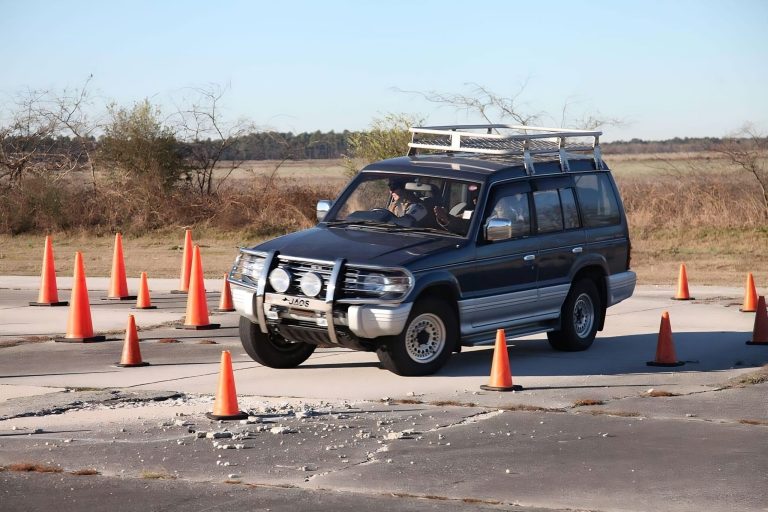
Another example of tactical driving is the “J-Turn” maneuver. The J-Turn is a precision driving technique that involves a rapid change in direction, allowing the driver to quickly reverse their vehicle’s course and accelerate in the opposite direction without coming to a complete stop.

This maneuver is often used in situations where a quick escape or evasion is necessary, such as in law enforcement or security operations.

The J-Turn typically involves the following steps:

Acceleration: The driver accelerates in the forward direction to gain speed.

Braking: The driver abruptly applies the brakes to shift the weight of the vehicle forward.

Steering: While maintaining braking pressure, the driver sharply turns the steering wheel in the opposite direction of travel, causing the vehicle’s rear end to swing around.

Release Brakes: Once the vehicle has completed a 180-degree turn and is facing the opposite direction, the driver releases the brakes and accelerates to continue in the new direction.

The J-Turn requires precise timing, control, and coordination to execute safely and effectively. It’s a valuable skill for evading pursuers or navigating through tight spaces in high-pressure situations, making it an important component of tactical driving training for professionals who may encounter hostile or dangerous environments.

Driving on flats

driving on flats

Navigating the roads with one or more flat tires is undeniably one of the most daunting situations a driver can encounter. Your car’s tires serve as the sole point of contact with the road surface, providing the essential traction required for safe and effective maneuvering.

Interestingly, the dynamics of driving with flat tires can be somewhat counterintuitive. When faced with a flat front tire, the steering becomes notably heavy and unresponsive, causing the vehicle to veer decidedly toward the side with the deflated tire. While this experience is far from enjoyable, it does possess an element of predictability.

Conversely, dealing with a flat rear tire presents a markedly different challenge. In this scenario, the vehicle exhibits a proclivity to sway unpredictably – veering one way when you apply the accelerator and swinging in the opposite direction when you release the pedal.

Steering inputs also induce unanticipated swings in the car’s trajectory. The resulting motions are characterized by their lack of predictability and heightened difficulty in control when compared to the challenges posed by a front flat tire.

Navigating the treacherous terrain of flat tires demands not only a practical understanding but also a keen sense of adaptability and responsiveness. It’s a testament to the intricate dance between driver and vehicle, where the mastery of these challenges lies in an ability to maintain composure and control even when confronted with the unexpected.

Beyond the Wheel: A Comprehensive Skillset

bousaside3

Beyond the realm of tactical driving maneuvers, a holistic training program should encompass a broader skill set that equips individuals for the challenges of high-stakes situations. This includes not only the mastery of vehicles but also knowledge of firearms usage and critical insights into self-preservation when faced with hostile fire.

To demonstrate the art of survival behind the wheel, training often involves using cars as targets, subjecting them to thousands of rounds of ammunition to illustrate where one should seek refuge. A common misconception is that individuals tend to gravitate towards the rear wheel of a car in the face of danger, which, incidentally, is perilously close to the gas tank or the driver’s door.

In contrast, it’s vital to understand that crouching by the front wheel offers a more strategic position. This placement forces bullets to traverse the vehicle’s engine before reaching the individual, significantly enhancing protection. Car doors provide minimal shielding, and the trunk area offers even less, compounded by the presence of flammable gasoline in that region.

What might come as a surprise is that motorcycle training is just as rigorous and demanding as that for cars. Furthermore, in many parts of the world, scooters have emerged as the primary mode of transportation, highlighting the significance of mastering these smaller vehicles in tactical driving training.

Moreover, the art of blending in is a crucial facet of this training. Those who excel in these skills are often indistinguishable from ordinary drivers on the road. They seamlessly integrate into their surroundings, adopting a wholly distinct mindset.

For individuals newly introduced to this world, adapting to this mental attitude can be a formidable challenge, often requiring a period of adjustment and transformation in how they perceive the world around them.

It’s an entire world within itself, redefining the way individuals interact with and view their environment, ultimately preparing them for the unforeseen challenges that may arise.

Suggested resources for prepper and survivalists:

The #1 food of Americans during the Great Depression

What to do when the power grid goes down

The latest innovation in solar pannels – 3D technology

Find Out What’s the Closest Nuclear Bunker to Your Home

How to make a cheap bee hive from a barrel (Honey Cow)

0

People keep bees in many different kinds of hives, but we will focus on a cheap and simple design, called the Honey Cow.

MATERIALS:
55 gallon plastic barrel, preferably food grade (makes two hives)
22 feet of 1”x2” nominal lumber
46 feet of 1½”x1” lumber
2 X 8 foot of 2”x4” nominal lumber
A 3 feet by 4 feet piece of tin
20 – 1½” wood screws
10 – 2” wood screws
8 – ½ “ screws
Bungee Cord or tie wire
45 feet thin moulding OR natural fiber string and beeswax

TOOLS
circular or jig saw
drill
tin snips
tape measure and marker

The Barrel
Cut the barrel in half lengthwise, making sure that there is a bung hole in each half.

Clean it well. Choose a food-grade container to avoid potentially dangerous chemicals.

Lay the barrel down like a canoe, so that it would catch water. This is the position it will be in from now on.

On one end of the barrel (which used to be the top when it was whole) there is a rim of plastic that protrudes. Cut this away.

Rub the interior with beeswax. This will remove any foreign smell that remains and make it more attractive to a hive. A drop or two of lemongrass oil is good as well.

The Frame

Measure the length and width of your barrel and cut the 1”x2” lumber to make a frame. For example, if your barrel is 36” by 24”, cut 2 lengths of 25” and 2 lengths of 37” (the extra inch allows you to screw one piece into the next).

Glue and screw the frame together.

Screw the barrel inside the frame.

Cut the 2″X4″ boards into 40″ pieces.* These boards are now the legs.

Screw the legs into each side of the barrel. Make sure you screw the frame to the leg and put several screws from the barrel into the leg for a good, sturdy fix.

The Top Bars

Cut 23 X 24” lengths out of the 1 ½”x1” lumber.

These are the bars to which the bees will attach their honeycomb. However, you need to provide a guide so that they make straight combs.

Screw a thin piece of moulding, 20” in length, centered on each top bar, with at least an inch on the ends of the top bar. This moulding will face down, into the barrel, when the bar sits on the frame. Rub some bee’s wax on the molding.

The Roof

Using the 1”x2” lumber, make a frame that fits around the barrel frame, with a ¼” gap on all sides.

If you cut 2 lengths of 25” and 2 lengths of 37” for the barrel frame, cut 2 lengths of 27 ½” and 2 lengths of 39 ½” for the roof frame.

Take the piece of tin and screw it to the frame, leaving equal space on all sides. *

Bend the extra bits of tin down and screw to the sides of the frame.

Using the tin snips, cut any extra bits hanging below the frame.

Put the roof on top of the barrel frame.

Tie the roof down to the hive to prevent it from blowing off.

Ready for the Bees

You are now ready for the bees. You can buy a “package”, a queen and bees, however the most satisfying way to get into bee keeping is to capture a swarm.

More information: Vela Creations – Beekeeping
More photos: Top bar Beehive – a set on Flickr


Vector control – what are they spraying?

0

The Lighthouse, so named because it’s where I tinker with liquid fueled lamps and lanterns, is close enough to the city that the vector control truck drives through the neighborhood occasionally and sprays for mosquitoes.

The stuff they use is so effective that I’ve been able to sit outside with bare feet and have not seen a single mosquito.

My lamps usually attract flying insects. Not the last three days. I’m enjoying the respite from the bites, but I’m wondering what kind of nasty stuff they’re spraying. First day I still heard crickets, but tonight I hear none. :(

I think I need to call and ask what they’re spraying and and how often they do it.


Has this site aleady been posted

0

has reviews and such… I have no clue as to how reliable the stuff is???

anyone wanna comment?

Home

SOOTCH REVIEW | FN America Reflex Micro-Compact Pistol